RCM Technology Trends Reshaping Healthcare Finance
Specialty infusion billing demands tools built for high-cost drug claims.

Ambulatory infusion is growing from $50.98 billion in 2025 to a projected $93.41 billion by 2031, and the billing systems underneath that growth are the wrong tool for the job. General-purpose revenue cycle software gets built for claim patterns that look nothing like infusion. That mismatch is structural, baked into how the tools got designed, and unlikely to smooth out with a software update. Independent specialty providers, the operators with the thinnest cushion, are growing even faster than the market itself. What follows is why that gap exists, and what actually closes it.
Start with buy-and-bill, because it explains everything downstream. A practice buys the drug before a single dollar of reimbursement shows up, and that upfront exposure shapes everything that follows. Drug costs consume an outsized share of revenue in oncology and infusion, a burden no other specialty comes close to touching. A denied claim on a high-cost biologic leaves the practice holding a drug it already paid for, with nothing to offset the cost. Stack the coding rules on top of that: J-codes, modifier logic, the CPT 96415 time trigger that only fires once infusion time crosses 30 minutes past the first hour, site-of-care designations, 340B eligibility, Medicare Part B drug rules, step therapy laws. Generalist billing teams weren't trained for this, and generalist software wasn't built for it either. No amount of configuration fixes that after the fact.
How denial rates reached their current level and what's driving further escalation
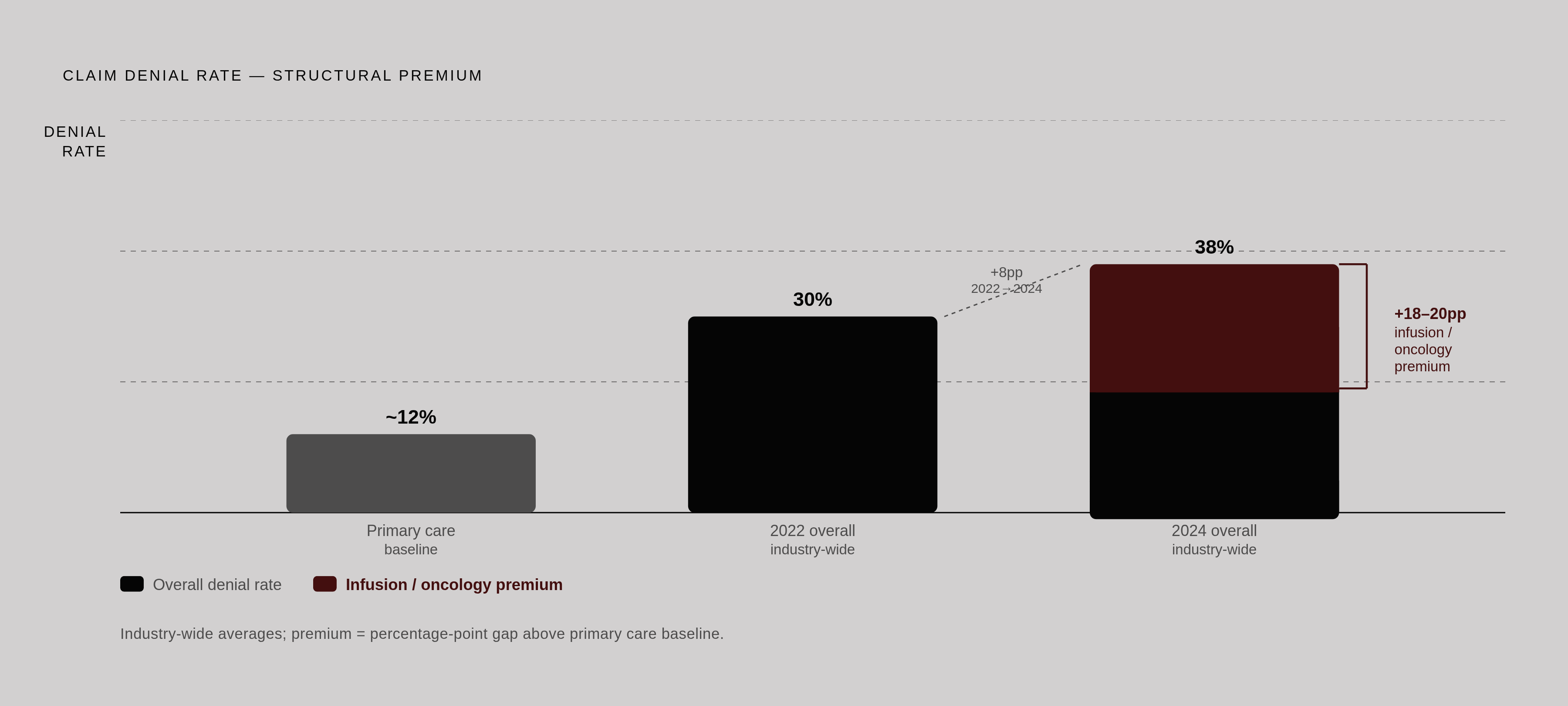
Claim denials climbed from 30% in 2022 to 38% in 2024, according to Experian Health's 2025 State of Claims Report. Infusion and oncology run 18% to 20% higher than primary care on denials, and that gap is worth sitting with for a second: it's a structural premium payers apply to high-cost therapies, and it shows up on every claim batch, every month, without exception.
Payer behavior has gotten sharper, not just more frequent. Payers used to deny broadly; now they target specific service lines, diagnostic codes, site-of-care mismatches, documentation gaps that used to slide through unflagged. High-dollar infusion claims get routed to manual review far more often now, which means a practice has to produce evidence that goes beyond whatever happens to sit in the EMR. Meanwhile, payers are also pushing infusion therapies out of hospital outpatient departments altogether, rewriting site-of-care rules in the middle of existing relationships.
Prior authorization denials have grown more than 20% over the past two years and now make up 20% to 25% of all denials industry-wide. Payers get sharper every year, and any tool sitting on the provider side has to keep pace or fall behind. A workflow that worked fine in 2020 doesn't help when the workflow itself has become the weak point.
The financial consequence of a denial in infusion is categorically different from most specialties
Reworking a denied claim costs somewhere between $25 and $118 depending on complexity, and that's before anyone counts the drug sitting in a fridge that the practice already paid for. Every denial pushes the claim into the 60-plus day AR bucket: status checks, document gathering, corrected claims, appeals. Appeals miss deadlines, partial denials quietly turn into accepted short pays, and small balances drift toward write-off because nobody's watching closely enough to catch the drift before it's permanent.
Here's the part that compounds, and it's worth slowing down on. In buy-and-bill, a denied biologic is an unreimbursed cash outlay on a drug already sitting inside a patient, and there's no getting it back. That single fact changes the math on everything upstream: practices where this complexity isn't actively managed can see collections fall materially short of expected revenue.
In primary care, a denied claim is a paperwork problem. Infusion turns that same denial into a cash-flow emergency tied directly to cost of goods sold, and that difference should decide how a practice picks its RCM technology. Speed and accuracy of denial resolution matter more here than almost anywhere else in medicine, because a slow or generic tool leaves real drug cost sitting on the books, unresolved, month after month.
Prior authorization as the revenue cycle's most consequential upstream variable
Nearly every specialty infusion drug needs prior authorization before the first treatment: drug, dose, frequency, duration, all specified in advance and renewed at payer-defined intervals, often at payer-defined intervals. In a February 2026 national survey of pediatric GI clinicians, 66% of 100 respondents rated prior authorization and payer friction a major or severe pain point, one of the highest-ranked burdens clinicians named.
Recurring authorization behaves differently from one-time auth, and the distinction matters more than it first appears. It has to get retriggered every time a physician changes the regimen. A payer-mandated switch from infliximab to a biosimilar triggers a brand-new prior authorization even when nothing about the clinical picture has changed, and that single recurring vulnerability shows up constantly in infusion RCM. Tying authorization status to scheduling matters: administer before approval comes through, and the claim typically goes unpaid, full stop.
Federal rules governing payer response times for prior auth requests on Part B drugs remain limited, leaving timelines largely at the payer's discretion. That leaves timelines entirely at the payer's discretion. High-performing practices treat authorization as an intake function: resolve questions before treatment starts, validate therapy changes before a claim ever gets submitted. Unified PA management means one system for submission, tracking, renewal reminders, and one-click renewals across every payer and every medical benefit drug, with visibility into turnaround times and denial rates across the whole practice.
Most general-purpose RCM tools treat authorization like a checkbox: get the number, log it, move on. They aren't built for the renewal cadence infusion demands, the biosimilar triggers, or the payer-specific documentation that shifts from one plan to the next.
What AI-assisted authorization and predictive denial tools can actually do — and where they fall short without specialty context
Payers already run AI to speed up adjudication and cut human review out of the loop, and the gap between payer-side sophistication and provider-side tooling keeps widening because of it. On the provider side, a well-built AI-assisted prior auth tool can predict approval odds by payer, pre-fill clinical documentation, and flag an incomplete submission before it goes out the door. That's real, usable value.
Predictive denial analytics promise something similar: catching modifier errors, site-of-care mismatches, and documentation gaps before submission instead of after. But sit with what "predictive" actually requires here. Denial patterns in infusion are payer-specific and root-cause-specific; lump them into one generic bucket and the signal disappears. A tool that flags "prior auth missing" as a category tells a billing team nothing it can act on. A tool that names the payer, the drug class, and the exact documentation gap driving the pattern gives them something to fix.
This is where most vendors overpromise. Generic AI tools underdeliver exactly where infusion needs precision most. J-code logic, unit-of-service math, and time-based add-ons like the 96415 add-on code threshold — which requires infusion time to extend at least 30 minutes past the first hour before it counts as a billable unit — need rules built for this specialty, not a claim scrubber designed for general medical billing. Biosimilar substitutions, step therapy requirements, and 340B eligibility aren't edge cases here; they're routine Tuesday-morning events, and most rule engines were never built with them in mind.
Automation only performs as well as the specialty logic underneath it. A rules engine trained on general claims data optimizes for general claim patterns; it has no way of knowing what an infusion claim actually looks like. Even sharp pattern detection still needs a person: an experienced infusion billing specialist has to decide whether to recode, appeal, escalate to the payer, or flag a policy shift that happened quietly in the background. That judgment call isn't something a rules engine makes alone, and treating it like a solved problem is exactly where practices get burned.
Automated remittance reconciliation and the underpayment problem hiding in infusion AR
Remittance reconciliation in infusion carries more moving parts than routine payment posting. Payer contracts vary by drug, by site of care, by J-code, and by fee schedule, whether that's a Medicare fee schedule rate or a negotiated commercial rate. That variance creates plenty of places for money to quietly go missing.
Underpayments hide easily here. A payer pays a partial amount, posts an adjustment code, and closes the claim. Without someone reviewing at the line level, that variance reads as a normal contractual adjustment, nothing worth a second look. Infusion remits often carry multiple drugs, multiple time units, and multiple modifiers on a single claim, and every one of those lines is its own place for an underpayment to hide.
Line-level reconciliation has to check actual payment against what the contract says should have been paid, by drug, by payer, or underpayments never get disputed. They just become permanent write-offs, not because the money was unrecoverable, but because nobody surfaced the variance in the first place. Real remittance technology matches expected reimbursement per J-code and contract tier against actual payment, line by line, and flags anything above a set threshold for review. Practices running general payment-posting workflows accept short pays at scale, and the losses stay invisible in aggregate AR reports even while they add up to something material.
Ruby's approach centers on line-level reconciliation matched against infusion contracts and drug-level reimbursement expectations, with operators reviewing flagged variances directly instead of posting remits in bulk and hoping nothing slipped through.
AR aging in infusion and why standard prioritization logic misses high-dollar risk
Standard AR logic sorts by oldest bucket first, or by highest-volume payer first. Neither approach accounts for how infusion claims actually distribute by value. A single denied biologic sitting in the 31-to-60-day bucket can outweigh dozens of primary care claims sitting in the 90-plus bucket, dollar for dollar, without anyone noticing until the appeal window has already closed.
Real AR management in infusion needs dollar-weighted aging: which claims carry the biggest drug-cost exposure, which payers run the tightest appeal windows, which denials have real odds on appeal and which don't. Appeal deadlines are the sharpest edge in this whole picture. Infusion appeals often run on strict filing windows, and a claim that misses its window because it sat too long in a generic queue becomes a permanent write-off at full drug cost, with no discount to soften the loss.
AR dashboards built for infusion surface payer, drug, denial reason, and days-to-deadline in one view, so a team can prioritize by financial risk instead of by claim age alone. Practice managers shouldn't be triaging the queue by hand, and if they are, the RCM operation underneath is already broken. The real test for any platform is simple: does it show what's at risk and why, or does it hand over a generic aging report and leave the prioritization to the billing team anyway?
Where the RCM technology stack for infusion needs to start — and why scheduling is the answer
Most recoverable problems get seeded long before a claim ever reaches the payer. Auth lapsed, the drug got switched without a new auth, documentation's incomplete, time units got miscounted, patient eligibility never got re-verified, and by the time the claim actually hits the payer, the damage is done.
That's why the link between scheduling and billing matters so much in infusion. Authorization status needs confirming before a treatment slot even gets assigned, working as a real gate nobody slips past rather than a backstop check after the fact. Eligibility needs re-verifying at every infusion cycle, not just at intake, so a coverage change gets caught before the drug is purchased and administered. Regimen changes flagged right at the scheduling step trigger re-auth workflows before a claim is even built, instead of after it's denied.
Technology that ties scheduling data directly to authorization status and eligibility closes a gap most general-purpose tools leave wide open. In practice: a recurring infusion patient scheduled for week 12 of a six-month authorization gets a renewal alert at week 8, not a denial at week 13. RCM technology for infusion earns its keep at every upstream touchpoint where a future denial can still get stopped, well before the claim stage. Scheduling belongs first on this list because everything downstream depends on getting it right.
How to evaluate RCM technology against infusion-specific requirements rather than general feature lists
General-purpose RCM platforms all check the same boxes: prior auth, denial management, remittance posting, AR aging. The boxes look identical on a feature list. What determines whether infusion billing actually works, or quietly fails, is the depth behind each box, and most vendors won't volunteer that difference.
A handful of questions cut through the marketing fast. Does the platform manage recurring auth renewal cycles, biosimilar substitution triggers, and payer-specific documentation, or does it just log an auth number and call the job done? Does the denial analytics engine surface patterns by payer, drug class, and root cause, or does it report one aggregate denial rate that buries the signal a billing team actually needs? Does remittance reconciliation match payment at the J-code and line level against contract-specific expectations, or does it post EOBs in bulk and move on? Does AR prioritization weight by drug-cost exposure and appeal deadline, or just sort by claim age? Does authorization status feed into scheduling upstream, or does it live only inside the billing module, cut off from the front desk?
Technology alone doesn't settle a payer dispute, navigate a step therapy exception, or catch a quiet policy change that just shifted a biosimilar's preferred status overnight. Experienced infusion billing specialists make those calls, and the platform's job is to support the judgment. Purpose-built infusion RCM platforms, including Ruby, which runs the end-to-end billing workflow specifically for infusion centers and buy-and-bill specialty practices, build these requirements in as defaults from day one rather than bolt them on as configurations later. Ruby pairs its software with hands-on operators for exactly the judgment calls a rules engine can't make: benefits verification, prior authorization, denial management, and payment reconciliation, all built around infusion's specific payer and drug dynamics.
The question worth asking any vendor is whether its authorization module got built for infusion from day one, or adapted for it after the fact. Independent infusion providers keep growing faster than hospital-owned centers, and the gap between running the right infrastructure and improvising with a general tool doesn't hold steady. Every claim cycle either narrows that gap or widens it.