Local Coverage Determination Impact on Infusion Claim Approvals
Outdated LCD versions cause preventable infusion claim denials.
Local Coverage Determinations decide, line by line, whether an infusion claim gets paid or bounced back to the biller. Each regional coverage contractor writes its own version for its own patch of the country, so the same drug, given for the same diagnosis, clears in one state and denies in the next. Most practices treat LCDs like a fixed rulebook, something you file away after reading once. That's the wrong instinct. LCDs get revised on a rolling basis, and the practices that stop denials before they start are the ones tracking those revisions jurisdiction by jurisdiction, not the ones who read the policy once and moved on.
An LCD is a coverage decision made by a regional contractor about whether a specific service, procedure, or piece of equipment gets covered in that contractor's territory. That's different from a National Coverage Determination, which comes from CMS directly and applies everywhere. LCDs only bind the jurisdiction of the MAC that wrote them.
There are 12 MAC jurisdictions total, each covering a cluster of states. Cross a jurisdiction line, and the coverage rules for the exact same infusion service change under you. Building an LCD takes time, too. A MAC spots a coverage gap, or gets a request from a manufacturer or provider, reviews the clinical evidence, opens a public comment period, then finalizes the policy. That cycle runs six to twelve months, per Magnolia Market Access reporting from January 2025.
"Finalized" doesn't mean frozen. MACs revise LCDs as new evidence comes in, as new drugs get approved, as billing policy needs updating. Providers are working against a moving target, not a fixed document, and that's exactly why so many denials trace back to someone billing off a version of the policy that no longer exists.
Commercial payers watch this process closely, too. LCDs are Medicare instruments on paper, but plenty of commercial payers use LCD criteria as a starting point for their own medical necessity standards. So a change at the MAC level doesn't just ripple through Medicare Part B billing. It can end up reshaping private payer policy in the same region a few months later.
None of this means coverage is unconditional once an LCD exists. Eligible patient populations get limited. Site-of-care rules apply. Some conditions are covered, others explicitly aren't, and off-label use is usually excluded outright. An LCD saying yes to a drug is the start of the conversation, not the end of it.
How an LCD controls whether an infusion claim pays or denies
Every LCD runs on three levers, and all three have to line up on the claim at the same time: covered HCPCS codes, allowable ICD-10 diagnosis codes, and the medical necessity criteria tying the two together. Miss any one, and the claim fails, full stop.
If the diagnosis code on the claim isn't on the LCD's approved ICD-10 list, the claim denies. It doesn't matter what the clinician intended, or how clearly the treatment made sense in context. The diagnosis code drives the medical necessity determination on paper. The physician's judgment in the room doesn't count for much once the claim hits the system.
HCPCS coverage works the same way. The LCD spells out exactly which procedure and drug codes get reimbursed, and that includes the supplies and the infusion pump itself, not just the drug. If a code isn't on that list, there's no reimbursement path under that LCD. Not a reduced payment. Nothing.
Medical necessity criteria act as gates the patient has to pass one at a time. The LCD lists specific clinical requirements, and the beneficiary has to satisfy every one before the claim goes through. Fail on one criterion out of five, and the whole claim denies, same as failing all five.
Site of care stacks another layer on top. Some LCDs restrict coverage to specific settings, inpatient, home, outpatient clinic, and the same drug for the same diagnosis can be covered in one setting and excluded in another under that identical LCD.
Part B drug coverage runs on strict LCD adherence, tied to NCDs and national coverage policy. There's no negotiating room here the way there might be in a commercial contract. So an infusion claim functions as more than just a billing record. It's a compliance attestation, one that says the patient, the drug, the diagnosis, the site, and the coding all lined up with what the LCD required, all at once, at the time of service.
L33794, the LCD that governs external infusion pump billing under Part B
LCD L33794, titled External Infusion Pumps, is the DME MAC policy governing coverage for external infusion pumps under Part B, including the HCPCS codes for the pumps themselves, the supplies, and the drugs run through them.
Four DME MACs administer it: CGS Administrators runs J-B and J-C, Noridian Healthcare Solutions runs J-A and J-D. The text reads the same nationally, but each covered item still carries its own policy-specific requirements that have to be met individually, on top of just having the right code.
A revision effective January 25, 2026 changed several things providers need to reflect in billing right away, and this is where the actual risk sits for anyone still coding off the old version.
The criteria structure went from four separate requirements down to three, under a new framework requiring criterion 1 plus either criterion 2 or criterion 3. The applicable ICD-10 codes now point to the Group 4 list in the related Policy Article. Anyone still coding off the old four-criteria structure is billing against a superseded document, and that claim denies regardless of how appropriate the treatment was.
Billing rules were added for foslevodopa/foscarbidopa injection, delivered as continuous subcutaneous infusion, with separate rules for dates of service between October 17, 2024 and June 30, 2025, and a different set for dates of service on or after July 1, 2025. HCPCS code J7356 got added to Group 4 as part of that update.
The VYAFUSER pump got its own billing information added in this revision, and blinatumomab, sold as Blincyto by Amgen under J9039, saw a real expansion. Criterion J went from two coverage criteria to three, and now covers adult and pediatric beneficiaries as young as one month old. The alternative infusion protocols expanded from two options to four, adding a 3-day and a 4-day protocol. Additional policy activity related to blinatumomab coverage is ongoing under the LCD framework. The DME Information Form section was pulled from the Policy Article, tied to changes in timely filing rules.
Noridian put out a joint DME MAC publication on December 11, 2025 summarizing the changes ahead of the effective date. Any practice that missed that notice was billing against outdated criteria starting January 25, no grace period involved.
NHIA submitted comments to the DME MAC medical directors on the proposed updates to L33794, which means the policy is still being shaped by industry pushback, and more changes are likely coming. Separately, the Joe Fiandra Access to Home Infusion Act, reintroduced August 19, 2025, mirrors a 2020 proposed CMS rule aimed at reworking the DMEPOS external infusion pump benefit. If it passes, it changes the statutory ground L33794 currently stands on.
Documentation failures are the source of most infusion LCD denials
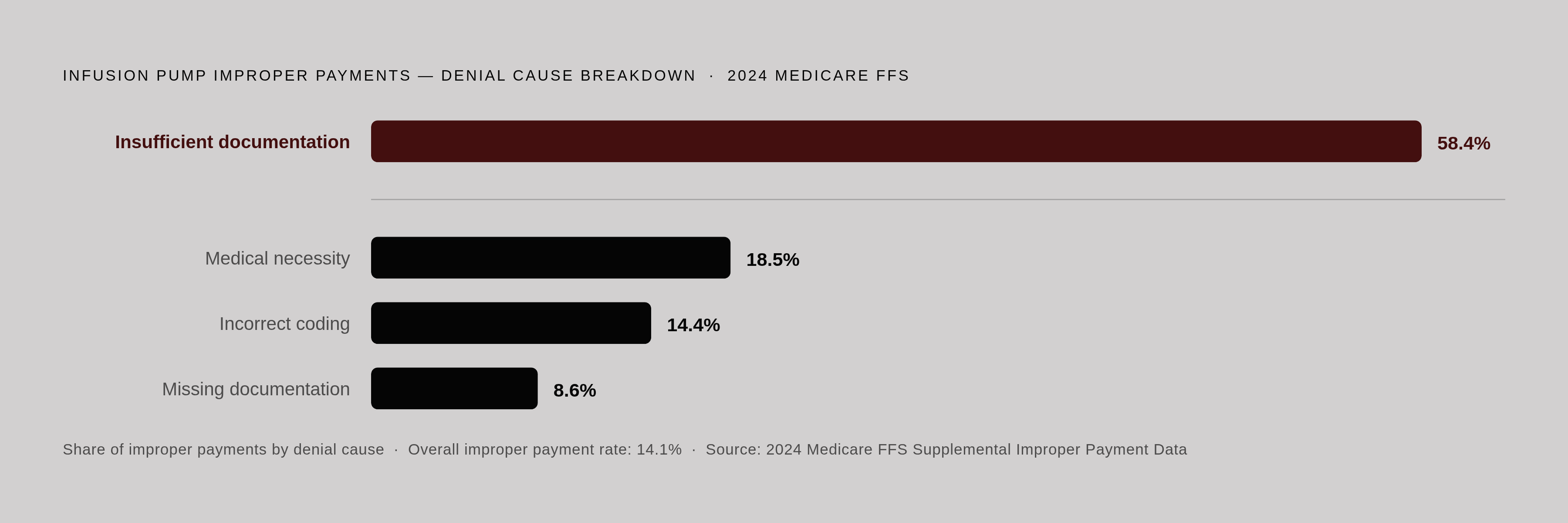
The 2024 Medicare Fee-for-Service Supplemental Improper Payment Data put the improper payment rate for infusion pumps and related drugs at 14.1%. Insufficient documentation was the single largest driver, ahead of medical necessity disputes, incorrect coding, and missing documentation combined.
Get the meaning of "insufficient documentation" right, because it's not what most people assume. It doesn't mean the patient failed to qualify for the treatment. It means the clinical record doesn't explicitly show the patient met each LCD criterion at the time of service. The patient may have absolutely qualified, but if the chart doesn't prove it in writing, the claim denies anyway. Qualification and documentation are two different things, and only one of them gets checked at adjudication.
Palmetto GBA's billing article A53778, covering infusion, injection, and hydration services, lays out exactly where this breaks down. The medication administration record and nursing documentation have to align with the billing record across the key clinical events of the encounter. IV infusions get billed according to the CPT or HCPCS description of what actually happened, and time-based codes need documentation that tracks actual time, not an estimate reconstructed after the fact.
For infusions running past one hour, additional units billed must be supported by corresponding documentation in the clinical record. Items that are part of the base procedure cannot also be billed as separate line items on the same claim. And hydration therapy is subject to sequencing rules relative to infusion or injection therapy, and the clinical documentation needs to support how services are ordered on the claim.
LCD compliance is a clinical documentation problem before it's ever a billing problem. Billing staff can only submit what the chart actually backs up, and no amount of coding skill fixes a chart that never wrote down the time the infusion started.
J-code and HCPCS unit accuracy as the second major LCD compliance pressure point
J-codes, the HCPCS Level II codes for injectable drugs, biologics, and infused medications billed under the buy-and-bill model, tell the payer what got administered and at what dose. Get the J-code wrong, and the payer has no way to determine whether the claim is even reimbursable.
Unit calculation is where the real risk sits, and most unit errors aren't fraud, they're arithmetic. J-codes are defined against a specific dosage denominator, say per 10 mg, and the units billed have to equal the total dose given divided by that denominator. Bill one unit on a multi-unit dose, and it's an underpayment. Over-report units, and it's an overpayment plus an audit flag. CMS statistics put more than 14% of outpatient denials involving J-codes down to exactly this kind of billing unit error, the single most common mechanical mistake in the category.
The financial exposure gets worse with high-cost biologics. Infliximab, billed under J1745, and other monoclonal antibody therapies for autoimmune conditions carry high per-unit drug costs, so a unit error on one claim can run into real money, and that makes these claims attractive audit targets for payers and for OIG.
Chemotherapy infusion claims need a J-code paired with the right administration CPT code, CPT 96413 for the first hour, 96415 for each additional hour. Submit the J-code alone, without the paired administration code, and expect partial payment or outright rejection. Separately, Vial waste documentation carries its own compliance requirements, and failing to follow the applicable modifier rules creates both underpayment risk and a compliance gap at the same time.
Not every biologic even has a permanent J-code. Biosimilars sometimes bill under Q-codes instead, and unclassified biologics may need interim codes. Misclassifying a drug here isn't a small variance, it produces a claim that can't adjudicate correctly, period. And because Medicare Part B drug reimbursement follows a defined methodology tied to national pricing benchmarks, billing off a stale fee schedule creates systematic under- or overpayment risk across an entire billing cycle, not just one claim.
How MAC jurisdiction shapes the denial risk profile for the same drug across different states
A service covered under one MAC's LCD might not be covered under another's. With 12 jurisdictions nationwide, that's up to 12 different coverage environments for the exact same drug or service.
That variance isn't random. Each MAC reads clinical evidence differently, tracks different regional utilization patterns, and draws on its own historical claims data when it writes or revises an LCD. For an infusion practice running multiple sites, that becomes a structural compliance requirement: the LCD in force at each physical site governs billing at that site. Applying the headquarters LCD, or the LCD from the highest-volume location, across every site is a reliable way to generate misaligned claims. It's also a mistake practices keep making, because copying one policy across every site feels efficient, right up until the first denial comes back from a jurisdiction that never used those criteria.
Commercial payers make the geographic variance worse, not better. Because private plans often lean on LCD language as a baseline, a MAC with stricter medical necessity criteria in its jurisdiction tends to produce stricter commercial standards in that same geography, too. Site-of-care restrictions stack on top of that. Commercial site-of-care programs keep expanding, pushing more infusions toward ambulatory and home settings, and a practice that isn't tracking those programs closely can end up billing for a site the payer no longer covers for that drug.
For any infusion group operating across multiple MAC jurisdictions, the right answer is a jurisdiction-specific LCD matrix, not one national reference sheet. That matrix needs updating every time a MAC publishes a revision, not on some annual review cycle.
Prior authorization intersects with LCD criteria and must be managed before the infusion cycle begins
LCD medical necessity criteria and prior authorization documentation are, functionally, the same checklist shown to two different audiences: once to the payer for authorization, again on the claim for adjudication. Any inconsistency between those two versions is a denial waiting to happen.
For recurring infusion therapies, biologics for autoimmune conditions, cancer infusions run on dosing cycles, PA renewal has to track the dosing schedule and the documented clinical response. A lapsed authorization mid-cycle leaves the practice holding the full acquisition cost of the drug with no way to get reimbursed. The most common cause of PA delay is incomplete or inconsistent documentation: missing clinical notes, unclear diagnosis coding, no evidence of step therapy. That's the same set of failures driving LCD denials, just showing up earlier in the process, before the drug is even administered.
CMS regulatory changes taking effect in 2026 reshape this landscape considerably. CMS-0057-F, effective January 1, 2026, requires Medicare Advantage plans, state Medicaid agencies, managed care plans, CHIP, and ACA marketplace plans to meet new standards, though they're excluded from the rule's 72-hour expedited and seven-day standard PA response timeframes. Every denial under this rule has to come with a specific, stated reason, not a boilerplate code.
The CY2026 final MA rule requires MA and Part D plans to honor medical necessity decisions made during the PA process itself, closing loopholes in MA appeals by clearly defining which organizational determinations are eligible for appeal. A separate 2026 transparency requirement covers AI-assisted denials specifically: payers using AI to deny claims have to give a specific reason for each one and publish aggregate approval data, aimed at stopping algorithmic denial at scale with no clinical grounding behind it.
The WISeR Model, also effective January 1, 2026, is a CMS prior authorization pilot running in six states, New Jersey, Ohio, Oklahoma, Texas, Arizona, and Washington, covering 17 services flagged as vulnerable to fraud, waste, and abuse. Traditional Medicare's PA landscape isn't static anymore, and infusion providers in those six states need to treat that pilot as active, not theoretical.
NHIA raised a specific concern in comments submitted to CMS in June 2026: home infusion doesn't fit cleanly into interoperability and PA processes built around the medical and pharmacy benefit split. That's an unresolved structural problem, not a minor administrative wrinkle.
Only a minority of health plans were using full electronic prior authorization systems as of 2024, per a 2025 study, which means most PA interactions for infusion still run through manual touchpoints, fax machines, phone calls, PDF forms, exactly where documentation errors slip through. Start PA management before the treatment cycle begins, not after. By the time a claim gets submitted, the authorization window has already opened or already closed, and there's no fixing that at the billing desk.
Denial rate trajectory and the financial cost of getting LCD alignment wrong
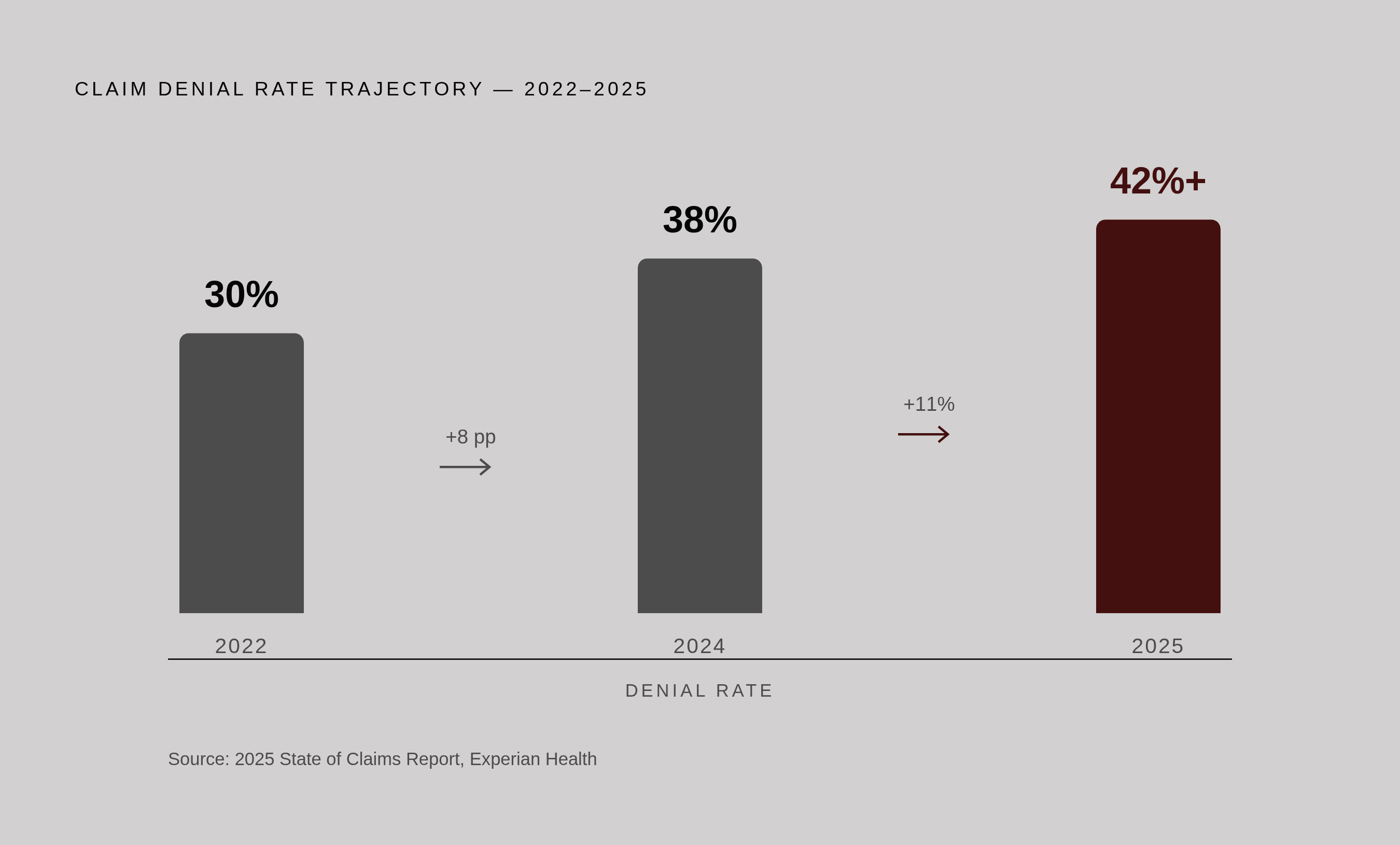
Claim denials climbed from 30% in 2022 to 38% in 2024, with a further increase of more than 11% in 2025, per the 2025 State of Claims Report from Experian Health. That trend line isn't flattening out, and infusion claims, with their layered LCD, coding, and PA requirements, sit right in the middle of it.
A national initial denial rate in the double digits means practices are absorbing real financial exposure every billing cycle, not just the occasional bad claim. Every lever covered here, the ICD-10 match, the HCPCS code list, the medical necessity gate, the unit calculation, the site-of-care rule, the PA renewal timing, has to hold at once for a claim to clear. Miss one, and the drug cost, often the single largest line item in an infusion practice's budget, sits unreimbursed.
Treating LCD alignment as a one-time fix, rather than an ongoing part of running a billing operation, is the error underneath most of the denial rates above. This takes ongoing operational discipline: one that tracks MAC revisions, quarterly ASP updates, and shifting PA rules at the same pace those things actually change, not once a year when someone finally gets around to it. Ruby RCM, a revenue cycle management platform built specifically for infusion centers and buy-and-bill practices that pairs billing software with hands-on operators to manage claims, denials, prior authorizations, and AR, is one example of infrastructure designed to keep that discipline running continuously.
Sources
- NHIA News | Centers for Medicare and Medicaid Services | Home Infusion
- LCD and Policy Article Revisions Summary for December 11, 2025 - JD DME - Noridian
- Article - Billing and Coding: Infusion, Injection and Hydration Services (A53778)
- Understanding National & Local Coverage Determinations | Magnolia Market Access
- LCD - External Infusion Pumps (L33794)
- vigilantbillingms.us
- What Is Local Coverage Determination (LCD) In Medical Billing?
- Revenue Cycle Management in Healthcare | MBC