J3490 Unclassified Drug Billing and Reimbursement Risks

The core problem with J3490 is architectural, and once you see it, every downstream complication makes sense. A product-specific J-code carries embedded context: the payer already knows the drug, has a coverage determination on file, and has a reimbursement rate ready to apply. When a J3490 claim lands in a payer's system, none of that exists. The payer is starting from scratch, claim by claim, working through submitted documentation to figure out what drug was given, whether it's covered, and what it should cost. It's a manual adjudication request dressed up as a billing transaction, and the payer didn't ask for the extra work.
That creates three compounding vulnerabilities, and they aren't independent of each other. The documentation burden falls entirely on the provider, with no pre-established payer framework to fill the gaps. Reimbursement becomes unpredictable, because the same drug, the same payer, and identical clinical circumstances can produce different payment outcomes depending on what documentation was submitted and how. And medical necessity review gets triggered more readily, because the payer has no prior approval structure to anchor its evaluation. One weakness amplifies the others.
The HHS Office of Inspector General has documented unclassified drug overpayments driven by documentation failures and code misuse exceeding $2 billion per year. That figure reflects what happens when J3490 is used at scale and documentation requirements go unmet routinely. In infusion specifically, the risk profile is sharper, because drug cost, not the administration fee, is where the revenue lives. A J3490 denial on a high-cost biologic isn't a billing inconvenience. It's a direct operating loss.
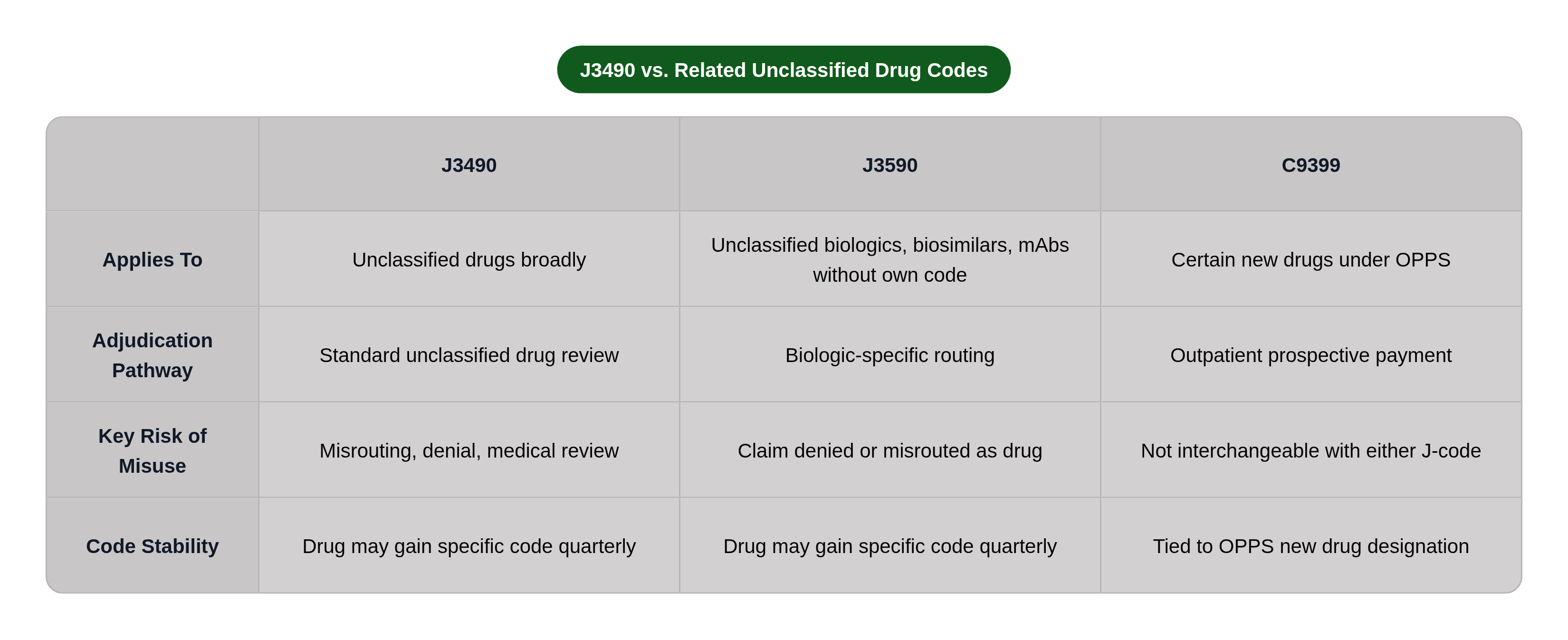
Code selection is also a discrete exposure that exists before any documentation question even enters the picture. J3490 covers unclassified drugs broadly. J3590 is the correct code for unclassified biologics: biosimilars, monoclonal antibodies without their own J-code. Using one when the other applies is a billing error, and it matters because payers route them through entirely different adjudication pathways. C9399 applies to certain new drugs under the Outpatient Prospective Payment System and is not interchangeable with either. And J3490 should never appear on a claim when a product-specific J-code already exists. HCPCS updates quarterly. A drug that legitimately required J3490 six months ago has its own code now, and continued use of a miscellaneous category when a specific code is available draws medical review attention and invites denials.
The documentation requirements that J3490 imposes on every claim
The minimum required on the claim form is non-negotiable: drug name in both brand and generic form, the 11-digit NDC, exact dosage administered (not "one dose," but "50mg"), route of administration, and date and time of administration. Drug name, strength, and dosage belong in block 19 on the CMS-1500 or in the 2400.SV101-7 field in the ANSI 837 electronic file. This is structured data, not optional narrative. Omitting it or placing it in the wrong field creates a documentation gap that reads, to the payer's system, as an incomplete claim.
Supporting documentation goes beyond the claim form and can't be treated as secondary. A copy of the wholesale purchase invoice is required, and it must show acquisition cost, date of purchase, supplier name, NDC, quantity, and price paid. Without it, many commercial payers have no basis for establishing pricing at all. A written medical necessity justification is also required, one that specifically explains why this drug was chosen and why clinically appropriate alternatives were insufficient for this particular patient. Generic language falls short consistently.
JW and JZ modifier compliance became mandatory as of January 1, 2024, with enforcement extending into Medicare Advantage plans through 2026 per CMS guidance. The mechanics are straightforward but unforgiving: if a portion of a single-dose vial was discarded, the administered amount is billed under J3490 and the discarded amount under J3490-JW. If the entire vial was administered with nothing discarded, the JZ modifier must still appear. Claims submitted without one of those modifiers on single-dose vial J-code claims face rejection or recoupment.
NDC precision matters beyond simply including the number. Many payers require the NDC paired with a quantity and unit of measure that match the package configuration exactly. A unit-of-measure mismatch on the NDC line can trigger rejection even when every other element of the claim is correct. And unlike a product-specific J-code denial, where a single discrete correction resolves the problem, J3490 denials frequently involve multiple documentation gaps simultaneously. The rework is multiplicative, not linear, and that distinction matters enormously when you're managing claim volume.
How payers actually adjudicate J3490 claims and where their processes diverge
Medicare contractors determine J3490 reimbursement on a claim-by-claim basis because there is no fixed fee schedule rate. The Medicare ASP methodology applies to drugs furnished incident to a physician's services, including IV infusion. Compounded drugs are priced by the local Medicare Administrative Contractor instead. MACs apply both Local Coverage Determinations and National Coverage Determinations to evaluate medical necessity, which means FDA approval does not guarantee Medicare coverage for a J3490-billed drug.
Commercial payers operate differently, and the invoice becomes central in a way that catches billing teams off guard the first time. The dominant reimbursement methodology among commercial payers for J3490 claims is invoice-based pricing: the provider submits the actual acquisition invoice, and the payer pays invoice cost plus a markup. The invoice is not supporting documentation here. It is the direct pricing input. Without it, the payer cannot calculate payment, and there is no fallback.
BCBS plans use the submitted NDC to cross-reference their own drug databases before setting payment. Incomplete or malformed NDC data almost always results in denial or a request for additional information. UHC introduced an AI adjudication upgrade in 2025 that added auto-denial logic for NPI mismatches, date-of-service range mismatches, and place-of-service mismatches. Claims that would previously have received human review now deny without it. This directly affects J3490 claims because authorization-to-claim matching is already less standardized for unclassified drugs than for product-specific codes, and there is no longer a human reviewer to catch a mismatch before the denial generates.
State Medicaid programs add yet another dimension. J3490 is used within prior authorization and drug program frameworks for specific approved drugs, but coverage and reimbursement amounts differ substantially by state. The same claim, submitted identically to two different Medicaid programs, will adjudicate completely differently, for reasons that are not visible from the claim itself. J3490 billing requires payer-specific knowledge, not just code-level knowledge, and that's a harder operational requirement than most teams anticipate.
Prior authorization complications specific to J3490-billed drugs
The drugs that end up billed under J3490 are, almost without exception, the ones that trigger the most complicated prior authorization requirements. Newly approved agents, biologics awaiting their own J-code, off-label treatments: the same characteristics that force use of J3490 also make PA more likely, more detailed, and more time-consuming to obtain.
For medical benefit drugs administered in an office, hospital outpatient department, or ASC, prior authorization is commonly required and criteria are updated periodically. A PA that was valid last quarter does not necessarily cover the current treatment cycle. For recurring infusion therapies, authorization lapsing mid-series is a predictable failure mode, not an edge case. Treating it as an edge case is how practices end up absorbing drug costs they can't recover.
One failure mode that receives less attention than it deserves involves biosimilar substitution. A PA authorization tied to a drug name does not automatically transfer when the NDC on the claim reflects a biosimilar substituted at the pharmacy. The authorized drug name and the billed NDC must match; when they don't, the claim denies even if the treatment is clinically equivalent. Practices that miss this keep encountering the same denial on the same payer without understanding why, and that pattern is recognizable to anyone who has worked denials on specialty infusion at volume.
Step therapy is another systematic denial mechanism. High-cost biologics and specialty infusions frequently require documented proof that the patient tried lower-cost alternatives first. When the J3490-billed drug is a second-line agent, the PA submission must include that step therapy history. Its absence is a denial trigger regardless of how well the medical necessity documentation is otherwise constructed. According to a 2023 American Medical Association survey, prior authorization requests were not responded to within one business day 93% of the time, with delays extending treatment for many patients. For a buy-and-bill practice, that means drug cost is already on the books before authorization is confirmed.
Commercial payer criteria are also not static. BCBS plans in Texas, Illinois, Florida, and North Carolina have applied updated AIM Specialty Health criteria with more stringent conservative treatment duration requirements. Practices that previously received authorization without difficulty are encountering denials without any change in their clinical approach. CMS's 2024 Interoperability and Prior Authorization Final Rule (CMS-0057-F) established uniform PA decision timeframes for impacted federal programs: 72 hours for expedited requests, 7 calendar days for standard. Commercial payer timelines remain variable. Real-time eligibility verification before every infusion appointment is not optional for J3490-billed drugs. Coverage for specialty drugs changes frequently enough that a verification gap of even 30 days can expose a practice to full write-offs on drug cost already administered.
How J3490 denial patterns differ from standard J-code denials and what that means for recovery
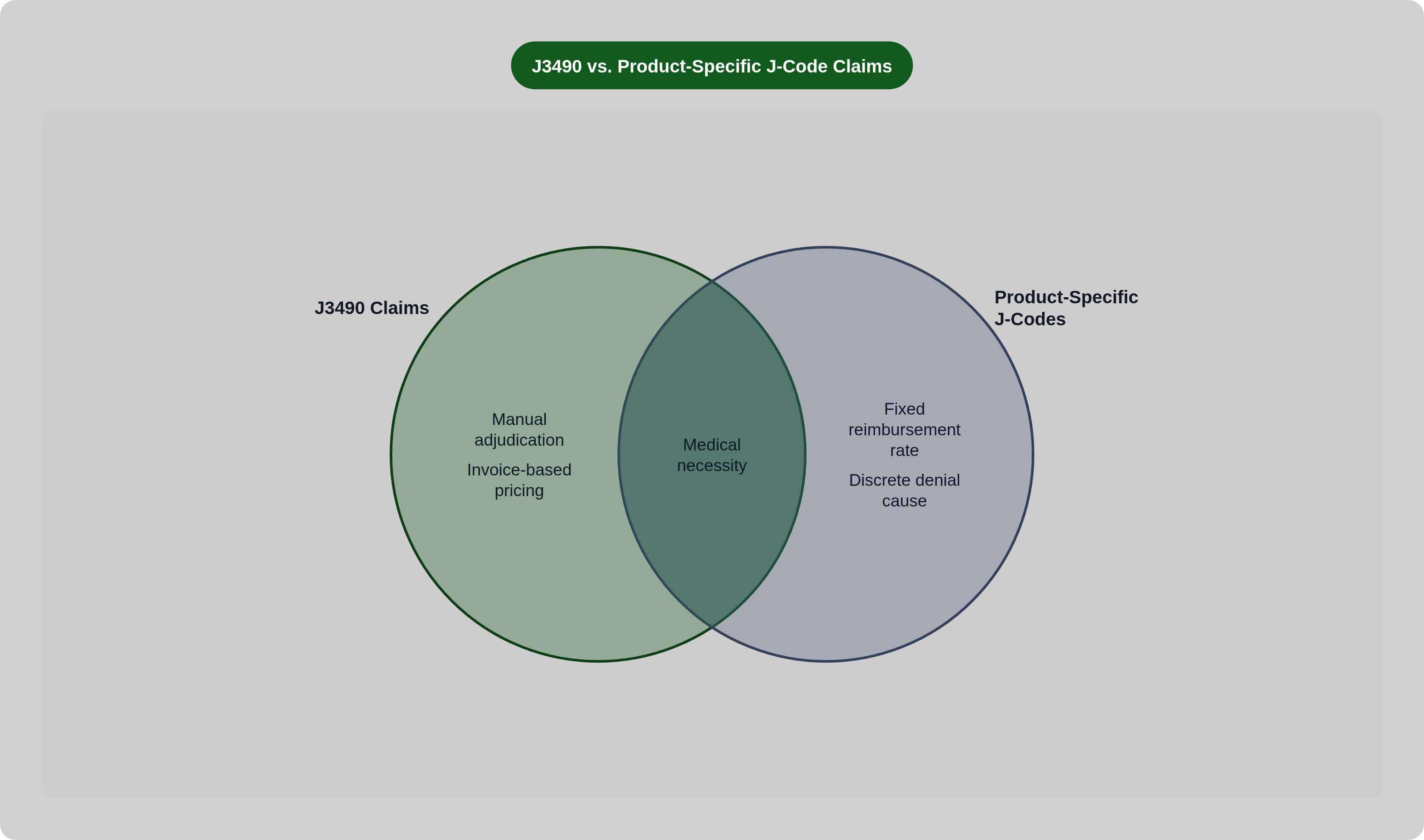
A standard J-code denial is usually legible. The payer knows the drug, and the denial points to something discrete: the unit count is wrong, the authorization expired, eligibility lapsed. Fix the thing, resubmit. A J3490 denial is structurally different. The payer is denying because it cannot identify the drug at all, or because its internal review found the submitted documentation insufficient in ways that the Claim Adjustment Reason Code and Remittance Advice Remark Code combination doesn't fully describe. The root cause is less immediately apparent, the rework is more substantial, and the clock on timely filing runs throughout all of it.
The specific root causes that drive J3490 denials are a missing or malformed NDC that prevents the payer from cross-referencing the drug; a missing invoice that blocks pricing under invoice-based methodology; absent or insufficient medical necessity documentation; a missing JW or JZ modifier on a single-dose vial claim; and the use of J3490 where J3590 was the correct code, causing the claim to be misrouted in the payer's system. A denial that combines two or three of those simultaneously requires more than one fix before resubmission, and each fix draws from a different part of the organization. That coordination overhead is real, and it compounds quickly at volume.
Denial volume is rising across the sector. MDaudit's 2025 Healthcare Billing Compliance Trend Report shows average denied outpatient claim amounts rising 14% from 2024, with denials tied to medical necessity documentation and requests for additional information rising 70%, averaging $450 per denial. Per MGMA data, rework cost per denied claim ranges from $25 to $181 depending on claim type. J3490 denials that require invoice retrieval, medical necessity narrative reconstruction, and payer-specific resubmission formatting reliably sit at the high end of that range.
For high-cost biologics or oncology agents billed under J3490, a denial is not a back-office inconvenience. The drug cost is already recorded as an expense. A denial that becomes a write-off is a direct operating loss with no recovery path. Recovery rates on J3490 denials are structurally lower than on product-specific J-code denials, because the appeal requires reassembling documentation that should have accompanied the original claim. Prevention is cheaper than recovery, and at a certain point, recovery isn't available.
The operational practices that reduce J3490 risk before a claim is submitted
The most effective risk reduction for J3490 happens before the claim is built. Everything downstream, including denial management, appeals, and write-off mitigation, is more expensive than getting the submission right the first time.
Code selection verification has to be a standing workflow step, not a periodic check. Before J3490 is used, someone in the billing process must confirm that no product-specific J-code has been assigned to the drug. HCPCS updates multiple times per year. Using J3490 when a specific code exists is a billing error, and the downstream consequences compound.
NDC capture must happen at the point of dispensing, not at billing. The 11-digit NDC, the quantity, and the unit of measure need to travel with the drug administration record from the moment the drug is pulled. Reconstructing that information from memory or pharmacy records at claim submission produces exactly the kind of NDC formatting problems that trigger denials at BCBS and other data-matching payers.
Invoice documentation must be acquired and attached at the time of drug procurement. Invoice-based pricing payers will not pay without it, and retrieving invoices retroactively under claim deadline pressure is operationally costly and often incomplete.
JW and JZ modifier assignment must be built into the charge capture step, not the billing review step. By the time a coder reviews the claim, the administered versus discarded split needs to be documented in the administration record already.
Prior authorization for J3490-billed drugs must be initiated before the treatment cycle begins. For drugs without a product-specific J-code, payer review timelines are longer and less predictable. PA submissions for recurring treatments should include the specific NDC, not just the drug name, to avoid biosimilar substitution mismatches at adjudication. Quarterly PA update requirements for medical benefit drugs need to be tracked on a standing calendar; an authorization valid at the start of a treatment series can lapse by mid-series without any triggering event to alert the billing team.
Payer-specific documentation checklists are necessary infrastructure, not optional refinement. Because BCBS, UHC, Medicare, and state Medicaid adjudicate J3490 through different processes with different documentation standards, a single-template submission approach will fail consistently. The checklist for each major payer must reflect that payer's specific requirements: NDC formatting expectations, invoice submission protocols, medical necessity documentation standards.
Denial pattern tracking must be organized by root cause, not by code. Grouping all J3490 denials together without separating NDC failures from medical necessity failures from modifier omissions obscures the signal entirely. An NDC formatting problem points to a dispensing and charge capture failure. A missing invoice points to a procurement documentation failure. A modifier omission points to a charge capture design failure. Without that granularity, the same denials recur indefinitely, and the team keeps solving the symptom instead of the process.