Infusion CPT Code Reference for Billing Teams
Learn which infusion code takes billing priority and why payers deny routine dual-coding errors.

There is one initial service code per encounter. Per Noridian's Medicare guidance, if more than one initial code appears on the same claim, the second is denied unless the record documents separate IV access sites and independent medical necessity for each. That is a narrow exception, not a routine workaround, and practices that treat it as routine will eventually find out the hard way.
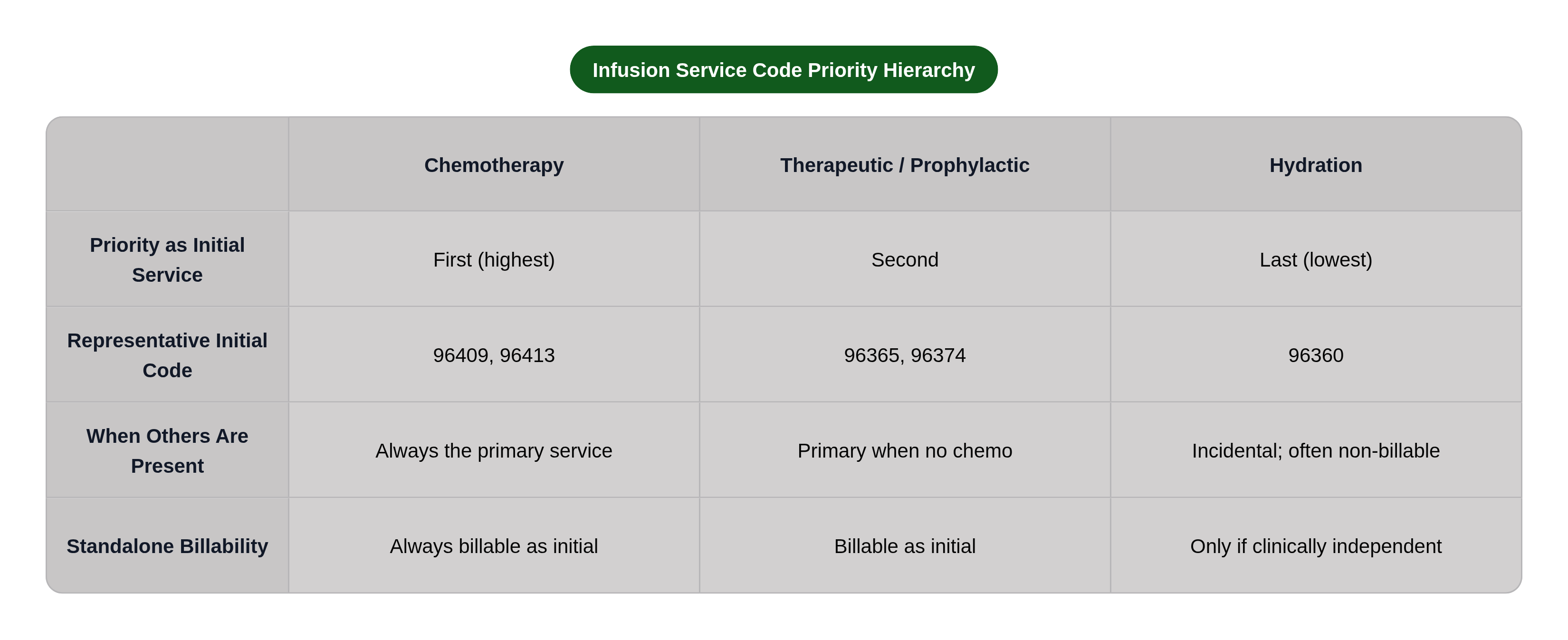
The initial codes in this family are 96360, 96365, 96374, 96409, and 96413. Each describes a "first" service, but only one can claim that slot, and the priority order is fixed. Chemotherapy takes precedence as the primary service when it is present. Therapeutic or prophylactic infusions come second. Hydration is last, and when it appears alongside a therapeutic or chemotherapy infusion, it is considered incidental and frequently cannot be billed at all.
Here is what that looks like in practice: a patient comes in for a biologic infusion and receives a hydration bag during the same visit. The biologic is the initial service, full stop. Hydration does not get coded as initial, and in most cases cannot be billed separately because it is supporting the primary infusion rather than serving a distinct clinical purpose.
The billing error that generates the most denials in this context is coding the first drug hung chronologically as "initial" rather than applying the priority hierarchy. The nurse hangs the hydration bag at 9:00 a.m. and the biologic at 9:15 a.m. A billing team working from the chronological record codes 96360 first. That is the wrong relationship, even if 96360 is technically the correct code for that service in isolation. The payer's edit does not care about clock sequence; it cares about service hierarchy.
One addition for practices billing Medicare: CMS updated its guidance effective January 2, 2025, in IOM Publication 100-04, Chapter 12, Section 30.5. Medicare now weighs multiple clinical factors when determining whether the intensity level for a complex drug administration service is met, not just the drug name. Clinical documentation supporting complexity will carry more weight on audits and appeals going forward.
How Sequential and Concurrent Codes Work After the Initial Service Is Established
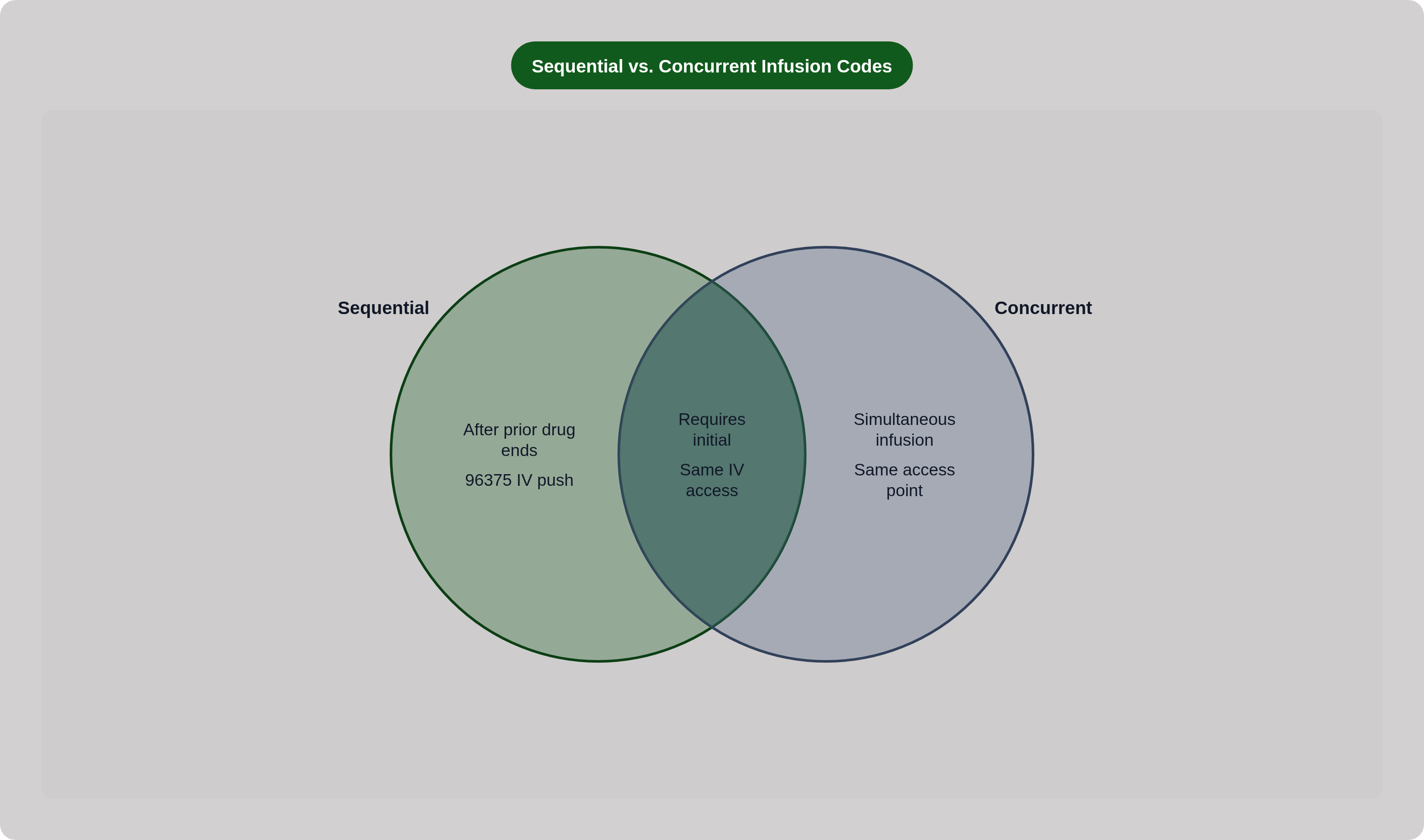
Once the initial code is established, everything else on the claim is either sequential or concurrent, and the distinction between those two categories is one of the most persistently misapplied concepts in infusion billing.
Sequential means a new substance or drug administered after the prior drug finishes, through the same IV access. 96367 covers sequential infusion of a new drug, each additional hour. 96375 covers a sequential IV push of a new drug. Both require that a primary initial service code is already on the claim. They do not stand alone.
Concurrent, coded under 96368, means a different drug running simultaneously with another infusion through the same access point. 96368 is reported once per encounter regardless of how many concurrent infusions are running. Billing it more than once is an audit trigger, and payers are watching.
Two questions need clear answers on every encounter. Did this drug start after the prior drug finished, or were they running at the same time? Is this a genuinely new drug or substance, or a continuation of the same one? A sequential code applied to a continued infusion of the same drug will be treated as a duplicate and denied.
The "new substance or drug" requirement catches pre-medications frequently. Antihistamines and steroids administered before a biologic sometimes qualify as sequential services, sometimes do not. The answer depends on the payer's specific policy and whether the pre-medication has an independent therapeutic purpose documented in the record. A payer-level policy check is the only defensible approach.
Add-on hour codes, 96366 for therapeutic and 96367 for sequential, each require a full additional hour of actual infusion time supported by the clinical record. The units come from documented start and stop times, which is exactly what the next section addresses.
Hydration Coding: The Narrow Circumstances Where It Is Separately Billable
Hydration billing is narrower than most billing teams treat it. 96360 covers hydration initial, 31 minutes to one hour. 96361 covers each additional hour. The 31-minute minimum is absolute; infusions shorter than that threshold do not qualify for 96360 regardless of what the order says.
Hydration is separately billable only when it is medically necessary and clinically independent. Not when it functions as a vehicle for drug delivery. Not when it is routine maintenance during a therapeutic infusion. The phrase "to keep the line open" will not survive an audit. Payers read chart notes, and that language signals incidental use, not independent medical necessity. Claims have been denied on that language specifically, and the appeal goes nowhere without better underlying documentation.
The documentation requirement is specific. The record needs a diagnosis that supports hydration, a physician order, and a clinical narrative establishing why hydration was medically necessary separate from any other service administered that day. A dehydration diagnosis with a corresponding order satisfies this. A vague note that hydration was provided during the infusion visit does not.
When hydration is billed alongside a therapeutic infusion, payers will scrutinize whether the two services were truly independent or whether hydration was incidental to the primary service. The distinction must be explicit in the documentation, not implied.
Before coding 96360: confirm the duration exceeds 31 minutes, confirm there is a documented clinical reason that stands on its own, and confirm it is not incidental to a concurrent therapeutic infusion. If any of those three conditions are not met, the code does not belong on the claim.
Time-Based Add-On Billing and Why Start and Stop Times Are the Foundation of Every Infusion Claim
Infusion coding is time-based at its core. Every add-on hour code is a time statement, and the claim's credibility rests entirely on whether the record can prove how long each service ran.
The most common documentation failure is also the most preventable: missing or inconsistent start and stop times. A record that says "infusion completed at 11:45 a.m." with no start time does not support the units on the claim. A payer reviewing that encounter has no defensible basis to approve additional-hour add-ons, and they will not. They will downcode or deny, and they will be correct to do so.
A compliant infusion record captures, for each service: the start time and stop time, the drug name, dose, and route, the clinical reason for the therapy, and who administered and supervised the infusion. These are the minimum required to support time-based codes on appeal or audit.
Rounding conventions vary by payer, and billing teams need to know which rule applies to each contract. Some payers apply a "greater than half" rule for add-on hours, meaning more than 30 additional minutes qualifies for the next unit. Others require a full additional hour. Applying the wrong rounding rule creates either underpayment or overcoding, and both cause problems downstream.
Time gaps in the record create openings for bundling even when care was genuinely delivered. The fix is not a billing-team correction after the fact; it is a standardized nursing documentation template completed at the point of care, one where start and stop times are required fields, not optional. When that structure is in place, the downstream billing problem largely disappears.
J-Code Pairing: Matching the Drug Claim to the Administration Code Without Creating Unit Conflicts
J-codes and CPT codes measure different things. CPT codes track time and access point. J-codes track the specific drug and the volume administered. They belong on the same claim, but they answer different questions, and conflating what they measure creates errors that are both common and costly.
J-codes must match the drug's unit descriptor exactly. Infliximab, billed under J1745, is reported per 10 mg. If a patient received 500 mg, the claim requires 50 units. The CPT administration code for that same encounter is determined by how long the infusion ran, not by how many milligrams were administered. These are independent calculations that should never be used to modify each other.
Two mispairing errors recur with enough frequency to name directly. The first is a route mismatch: pairing an intravenous J-code with a subcutaneous injection CPT code, or the reverse. Payer edits flag route inconsistencies and deny the claim. The second is unit redundancy: multiplying CPT administration units based on drug milligrams, as if the two codes share a unit basis. They do not. CPT units are time-based. J-code units are volume-based. Treating them as interchangeable produces an overcoded claim that will not hold up.
Drug wastage from single-dose vials requires its own handling. When a vial is partially used and the remainder is discarded, the wasted portion must be documented and billed with the JW modifier. Not applying JW when wastage occurred leaves legitimate reimbursement unclaimed. Applying JW without documentation creates audit exposure.
For 340B-acquired drugs billed to Medicare, Modifier JG is required. Billing a 340B drug without JG, or applying JG to a drug that was not 340B-acquired, creates reimbursement errors and audit risk simultaneously. Payers are conducting retrospective 340B audits with increasing frequency, and the modifier record is what they check first.
The financial stakes on J-code errors are not abstract. In buy-and-bill arrangements, the practice purchased the drug before the appointment. If the J-code claim is denied because of a unit mismatch or a missing modifier, the practice absorbs the acquisition cost. On biologic infusions, that exposure ranges from thousands to tens of thousands of dollars per encounter.
NCCI Edits and Modifier -59: When Bundling Logic Overrides Correct Code Selection
NCCI edits encode the payer's position that certain code combinations represent a single service, not two. When two codes are bundled by edit, billing both without an appropriate modifier results in denial of the second code, and this happens even when each individual code is technically correct for the service it describes.
Infusion claims fail less often from selecting the wrong code and more often from a right-code, wrong-relationship error. The NCCI edit catches the relationship problem. Individual code accuracy is irrelevant to that outcome.
Modifier -59 is the tool to override a bundling edit when the services were genuinely separate: different session, different site, or a distinct procedure not ordinarily performed together. Modifier -59 is frequently applied reflexively, as a way to force payment on a bundled code without underlying documentation that supports the distinction. Payers track that pattern. High frequencies of -59 across a billing entity's claims are an audit flag, and the modifier does not hold up on appeal if the record does not independently establish the separation.
Modifier -25 operates at the evaluation and management level, not directly on infusion codes, but it matters when a significant and separately identifiable E&M service occurs on the same day as an infusion. That E&M must be documented as distinct from the infusion encounter itself. A note that documents only the infusion and the medication administered does not support a separate E&M; a note that captures a clinical decision or assessment independent of infusion management does.
The principle is this: modifier use should follow the clinical record, not precede it. If the documentation does not establish why the services were distinct, the modifier does not create that distinction.
The Denial Patterns That Emerge When CPT Logic Is Applied Inconsistently
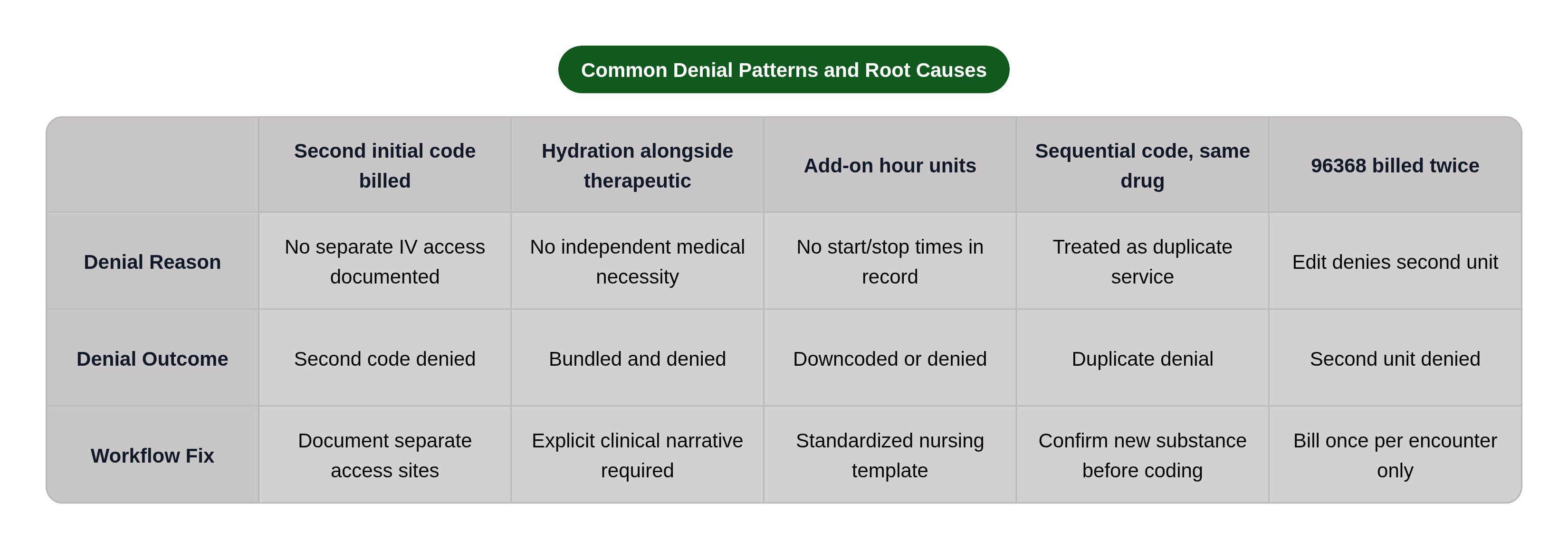
Infusion denials are not random. They cluster around a small number of root causes that repeat across encounters because the underlying coding logic is being applied inconsistently at the workflow level, not because the rules are unclear.
The patterns that appear most often: a second initial code billed without documentation of separate IV access, denied per the hierarchy rule. Hydration coded alongside a therapeutic infusion without documented independent medical necessity, bundled and denied. Add-on hour units not supported by documented start and stop times, downcoded or denied. A sequential code applied to the same substance rather than a new drug, treated as a duplicate and denied. 96368 billed more than once per encounter, with the second unit denied on edit.
These patterns are not identical across payers. A commercial insurer applies different edit logic than Medicare on the same code pair, and the threshold that triggers a denial at one payer does not trigger it at another. That variability is a reason to track denials at a granular level rather than accepting payer-by-payer inconsistency as unavoidable noise.
Effective denial analysis requires tracking by CARC code, payer, and therapy type. Grouping all infusion denials into a single category obscures which specific coding rule is generating the volume. When denials are disaggregated, the pattern becomes visible, and the fix becomes specific rather than generic.
The recoverable portion of these denials is substantial, because in most cases the service was delivered and the clinical documentation exists. The issue is a correctable coding error or a documentation gap, not a missing service. Recovering those claims requires identifying the exact rule that was violated. Resubmitting without diagnosing the root cause produces the same denial on the second pass.
Standardized documentation templates and a pre-billing coding review checklist address most of these patterns before the claim goes out.
Where Coding Errors Originate in the Workflow and How to Close Those Gaps
Most infusion coding errors are not created in the billing department. They are seeded earlier: at nursing documentation, at scheduling when the visit type is entered incorrectly, or at order entry when the drug and route do not align. By the time a claim hits the billing queue, the error is already embedded in the record the coder is working from.
Three workflow points are where the logic covered in this article must be enforced, not just understood.
At the point of care, nursing staff need a documentation template that treats start and stop times, drug, dose, route, and clinical purpose as required fields, not optional notes. What gets captured there is what makes time-based coding defensible on appeal. If it is not in the nursing record, it does not exist for billing purposes.
At pre-billing review, a coding checklist should apply the hierarchy rule, distinguish concurrent from sequential services, confirm J-code unit accuracy, and verify modifier requirements before submission. For practices running buy-and-bill, this review step carries the highest financial stakes on the encounter. A J-code or CPT mismatch on a biologic claim puts drug acquisition cost at risk, not just the administration fee.
At denial analysis, the loop closes by surfacing recurring CPT logic errors as patterns rather than individual claim problems. When a denial root cause appears once, it is a mistake. When it appears across a cohort of claims, it is a workflow failure, and it requires a workflow fix, not a claim-by-claim correction.
General-purpose RCM platforms are not architected for the hierarchy rules, modifier logic, and J-code pairing requirements specific to infusion. Teams working in those environments absorb the gap manually, and that is exactly where inconsistency enters the process. Infusion-specialized RCM platforms, such as Ruby RCM, a revenue cycle management platform built specifically for infusion centers and buy-and-bill practices that handles prior authorization, claims, denial management, and AR as a unified operation, are built around these workflows from the ground up, with coding logic, prior authorization tracking, and denial pattern analysis embedded in the operation rather than applied case by case.