CPT 96374 IV Push Reimbursement Rules and Payer Edits
The CMS hierarchy, not the clock, determines which IV push code bills first at a single encounter.

The CMS initial-service hierarchy runs in descending priority: chemotherapy infusion, then chemotherapy push, then non-chemotherapy infusion, then non-chemotherapy push, then hydration. That ordering governs which code claims the "initial" slot at a given encounter, and it does so regardless of the sequence in which drugs were physically administered. I've seen this confuse even experienced billing teams, because the intuitive assumption is that "initial" means "first in the chair." It doesn't. Think of it like a game of musical chairs where the music stops and the hierarchy — not the clock — decides who sits down first.
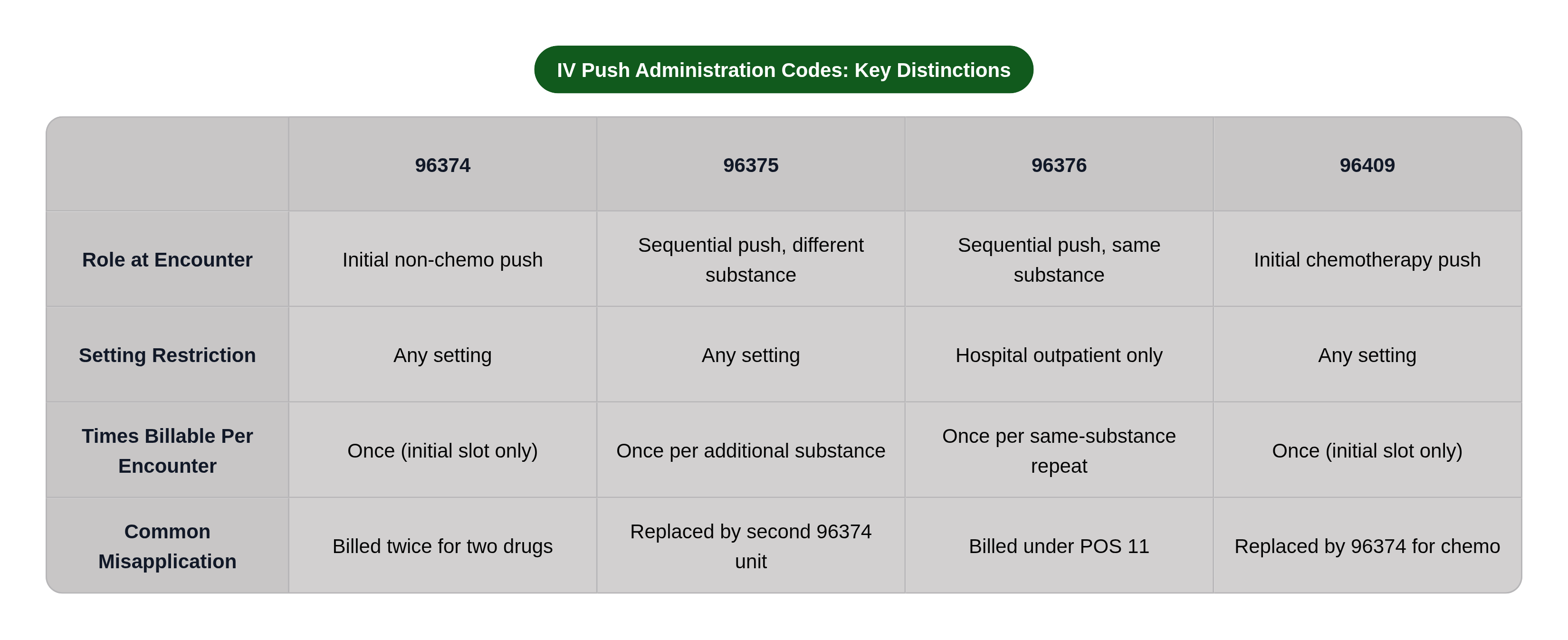
The practical consequence: if an infusion is performed at the same encounter as an IV push, the infusion takes the initial slot even if the push happened first. 96374 is the initial non-chemo push code, and it can only appear once per encounter in that role. Any additional substances pushed sequentially after that go on 96375, the sequential add-on code for a different substance. 96376 handles a sequential push of the same substance, but it is restricted to hospital outpatient settings. Billing 96376 with Place of Service 11 generates a denial every time, without exception. That rule is unambiguous, yet the error persists, because the logic that a same-substance repeat push is coded differently by site is genuinely counterintuitive.
A common misapplication: two 96374 units on a single claim for two different drugs given in sequence during one encounter. Payer edits catch this as a duplicate or bundling error. The second drug belongs on 96375.
96374 is also not the correct code for a chemotherapy push. That service belongs to 96409. Conflating the two generates both a denial and a compliance exposure, because the clinical distinction between chemotherapy administration and other therapeutic injections carries regulatory weight beyond billing.
In multi-drug infusion appointments, common in autoimmune and biologic therapy settings, a single encounter can involve an infusion, one or more pushes, and a hydration line. Each drug's coding slot must be correctly assigned before the claim is constructed. The hierarchy is a pre-claim decision, not a post-billing audit concept. Making it after the fact is where practices hemorrhage revenue they've already earned.
Medicare Reimbursement Rates and How Site of Service Changes the Payment Equation
96374 carries modest per-unit reimbursement under the Medicare Physician Fee Schedule, falling in the low-to-mid thirty dollar range, reflecting roughly 1.13 to 1.30 total RVUs depending on the applicable fee schedule quarter. Check the current figure against the CMS MPFS Look-Up Tool; rates adjust each January, and when you're projecting denial recovery at volume, the specific number matters more than it looks like it should.
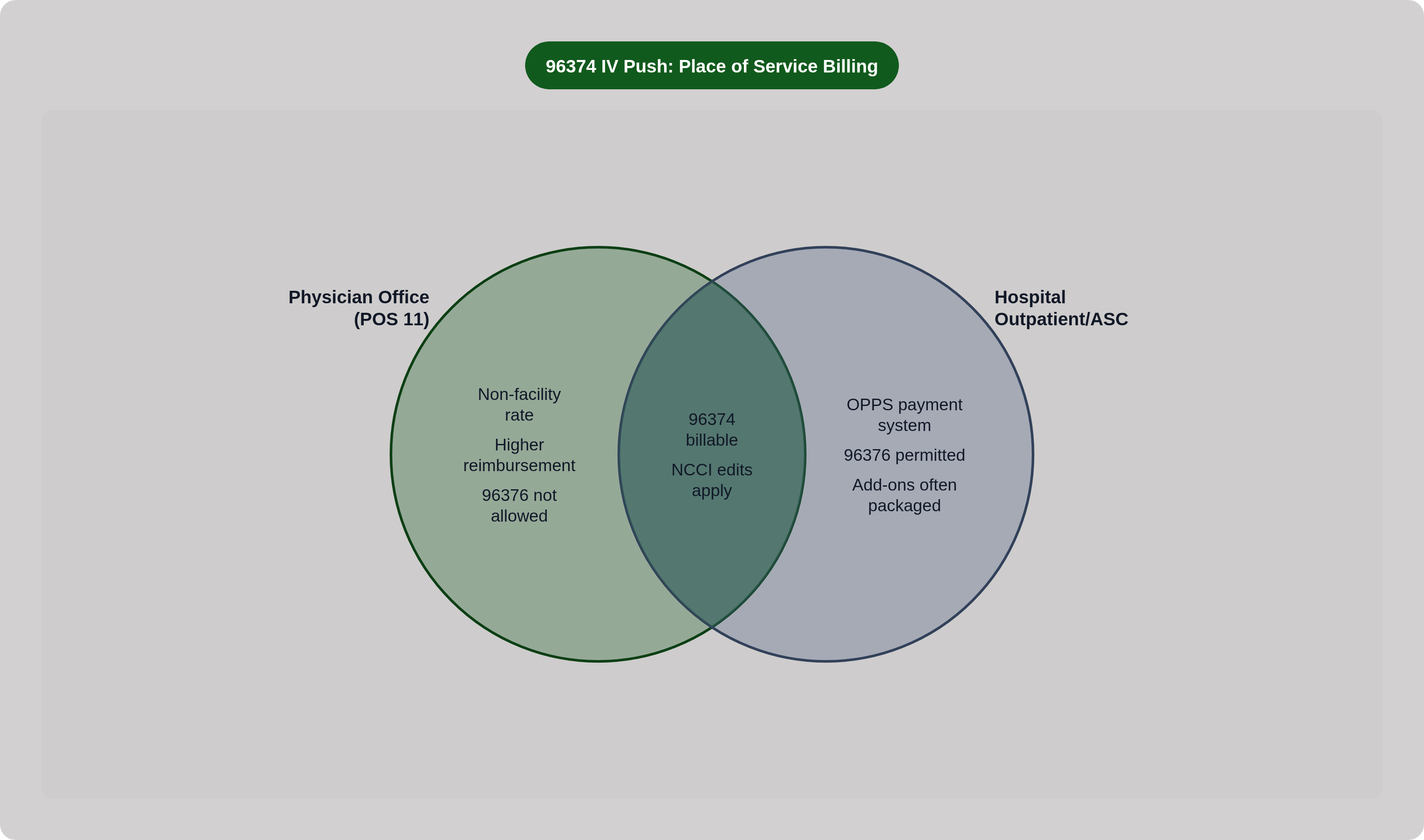
Two distinct payment contexts govern how this code is processed. When billed from a physician office under Place of Service 11, reimbursement follows the Physician Fee Schedule at the non-facility rate, generally the higher of the two contexts because the practice absorbs overhead. When billed in a hospital outpatient or ASC setting, payment flows through the Outpatient Prospective Payment System, and the facility practice expense component is not passed to the physician. Add-on drug administration codes are frequently packaged under OPPS and do not generate a separate line payment at all. That distinction changes the entire financial calculus of where infusion services are delivered.
The CY2026 OPPS and ASC Final Rule extended site-neutral payment policy to physician-administered drug services, meaning identical services now reimburse differently depending on the billing entity and the setting. CMS also finalized a 2.5 percent efficiency adjustment for procedural specialties under the 2026 Physician Fee Schedule, further compressing per-unit margins. Neither of these is a surprise to practices that track policy, but I'll tell you, they hit differently when you're looking at remittance reports in January.
Commercial payer rates vary considerably. Some align to Medicare; others negotiate above or below based on contract terms. Medicaid rates differ by state and program. The financial stakes around 96374 are not dramatic on any single claim. They compound when the code is denied or downcoded at volume, which is exactly where the attention belongs.
NCCI Edits That Bundle 96374 and When Modifiers Legitimately Override Them
96374 is subject to National Correct Coding Initiative Procedure-to-Procedure edits that define which codes bundle into it and cannot be separately reported without a modifier. A recurring scenario: the intramuscular or subcutaneous injection code 96372 bundles into 96374 when performed in the same encounter. Without a modifier, only the higher-ranked service pays. Practices often don't catch this until they're staring at a remittance showing half the expected reimbursement.
Modifier 59 is the primary unbundling tool, and its four granular X-modifiers (XE, XS, XP, XU) exist to communicate the specific reason services are distinct: a different encounter, a different site, a different practitioner, or an unusual circumstance. Apply these only when clinical documentation supports the distinct service. Modifier 59 without a chart to back it is an audit invitation, not a billing solution — and experienced auditors know exactly what an unsupported 59 looks like. It's like showing up to a potluck with an empty dish and claiming you brought dessert.
When an Evaluation and Management service is billed on the same date as 96374, modifier 25 goes on the E/M code, not on 96374. That modifier signals that the E/M was a significant, separately identifiable service from the injection. Without it, the E/M bundles and denies. This failure is especially prevalent in urgent care and office-based infusion settings where a physician evaluates a patient and an injection follows in the same visit. The clinical events are distinct. The billing has to say so explicitly, or the payer treats them as one.
Same-day, separate-encounter situations do arise. A patient receives a morning push, leaves, and returns later that day for a second push. In that scenario, 96374 is reported twice with modifier 59 on the second line, but the clinical documentation must reflect two genuinely distinct encounters, not just two administration events. That difference in documentation framing is the entire basis for the appeal if it's ever challenged.
The denial reason code generated by a bundled claim filed without the correct modifier is CARC 97. Recognizing it on a remittance advice is the trigger for chart review and appeal, not for write-off. Whether an appeal is viable depends on the NCCI edit indicator attached to the edit. When the indicator is 1, the bundling denial is recoverable if the chart supports a distinct service. When the indicator is 0, no modifier can override it, and the services are permanently bundled regardless of the clinical scenario. Knowing which indicator applies before you appeal saves significant time that most billing teams don't have to waste.
Documentation Requirements That Determine Whether a 96374 Claim Survives Audit
Per CMS billing guidance, the medication administration record and nursing notes must reflect three baseline elements: time of initiation, time of completion, and the specific substance administered. Those three are non-negotiable. Everything else builds from them.
The full documentation picture requires more. The drug name and dosage must be recorded. The route must be explicitly documented as IV push, not generically as "IV" and not as "drip," because the route designation is the clinical basis for the code selection. The clinical purpose, whether therapeutic, prophylactic, or diagnostic, must be identifiable in the record. When multiple substances are administered at the same encounter, the documentation must distinguish initial from subsequent pushes. And the record must support medical necessity for the IV route over a less intensive option.
The 15-minute threshold lives in the chart, not in the code. If the medication administration record shows a longer administration time, auditors will apply infusion logic regardless of what was billed. That is a straightforward application of what the chart says, not a matter of interpretation. I've reviewed charts where the nursing note essentially made the billing team's code selection indefensible before the claim was ever filed.
Missing stop time is the single most common documentation failure in 96374 claims. Its absence forces conservative coding and collapses potential infusion billing to push-level, even when the clinical intent was something else entirely. That is a revenue loss driven by a nursing workflow gap, not by any clinical or coding ambiguity. One small omission, outsized consequences.
Retrospective time entries are consistently flagged in injection and infusion billing audits. Payers treat them as a red flag, because they raise legitimate questions about whether the documented times reflect what actually occurred. Real-time charting is preferable and an audit-risk management standard that belongs in the nursing orientation materials, not just in the billing team's complaint log.
The Denial Patterns That Concentrate Around 96374 and Why Most Are Preventable
Three structural root causes account for the majority of 96374 denials. Confusing IV push with IV infusion around the 15-minute threshold, which is almost always a documentation failure rather than a clinical one. Billing more than one initial service at the same encounter without a documented separate encounter or distinct IV site. Filing on the wrong claim type for the place of service, with 96376 billed under POS 11 being the most predictable example.
The missing J-code pattern is pervasive. 96374 without a drug supply code on the same claim is an incomplete filing, and many payers will deny both lines rather than just the missing one. Chemotherapy push miscoded as 96374 instead of 96409 generates a denial and a compliance exposure simultaneously. E/M bundling without modifier 25 is a high-frequency failure in any setting where a physician encounter and an injection occur on the same visit.
Payer behavior is not uniform, and that non-uniformity creates its own denial exposure for practices that assume consistency. Major commercial payers like Aetna and UnitedHealthcare largely align to CMS hierarchy rules, but they diverge at the medical necessity layer, specifically whether the drug is covered for the indicated diagnosis, not at the administration code layer. Commercial payers also impose units-per-encounter caps and E/M bundling policies that can differ from Medicare's. Medicare Advantage plans do not separately reimburse injection administration to the physician when an E/M is billed in a facility setting, a rule that applies differently under traditional Medicare. State Medicaid programs add additional complexity; Wisconsin ForwardHealth, as one example, mandates the U4 modifier for certain therapeutic substances. The assumption that all payers behave like Medicare is a revenue leak hiding in plain sight.
OIG work plans have consistently included injection and infusion codes as audit targets. Practices billing 96374 at volume are operating under heightened scrutiny, which makes a structured denial-prevention protocol a compliance requirement, not an optional efficiency project.
The appeal success rate for 96374 denials, when the NCCI edit indicator is 1 and the chart documents a distinct service, runs in the range of 40 to 60 percent. That number has a pointed implication: a substantial portion of these denials should never have been filed in the first place. The recovery rate is a measure of preventable error, and most billing teams are too underwater to see it that way.
What a Denial-Prevention Protocol for 96374 Actually Requires at the Practice Level
Denial prevention for 96374 begins before the claim is built. By the time the claim reaches the billing team, most of the errors that will generate a denial are already embedded in the record. The fix is upstream, and that's the part practices are slowest to accept.
Nursing staff need to understand the three MAR non-negotiables as a clinical documentation standard, not as a billing requirement. Initiation time, completion time, and specific substance are the foundation of a defensible claim. When clinical staff understand that documentation accuracy protects the care they delivered, compliance improves in ways that coder education alone cannot achieve. That framing shift matters. Real-time charting versus retrospective entry is an audit-risk distinction that has to be addressed at the protocol level and reinforced through practice management, not just mentioned in a staff meeting once a year.
Code selection must happen after encounter data is complete. The hierarchy determination requires visibility into all services performed at the encounter. Building a claim during registration or scheduling, before the clinical picture is fully documented, introduces errors at the structural level. I've seen this exact workflow at practices that couldn't figure out why their denial rate wouldn't move, and changing when the coding decision was made fixed more than half the problem.
Payer-specific edit awareness cannot be generic. The edit behavior applicable to traditional Medicare does not apply uniformly to Medicare Advantage, and commercial payer policies require plan-level lookup. Assuming consistency across payers is an active source of preventable denials, not a neutral risk.
Denial tracking must be segmented by root cause and by payer. Grouping all 96374 denials into a single category obscures whether the underlying problem is documentation, hierarchy, modifier application, or medical necessity. Each root cause requires a different intervention. Undifferentiated tracking produces undifferentiated responses, which accomplish nothing and give leadership the false impression that someone is managing the problem.
The recoverable-denial opportunity deserves specific attention. A CARC 97 denial on a 96374 claim, where the edit indicator is 1, is a chart review and appeal candidate, not a write-off candidate. Practices that routinely write off these denials without appeal are forgoing revenue that the clinical record, in many cases, already supports. The 40 to 60 percent appeal success rate signals precisely how much of that revenue is sitting on the table.
Revenue cycle control for 96374 is, at its core, a clinical operations problem. The billing team executes on what the chart says. Their ability to defend the claim is bounded entirely by what the nursing staff documented and when. That is where the protocol belongs, and that is the last place most practices think to look.