HCPCS Code Structure and Infusion Drug Billing

The Healthcare Common Procedure Coding System has two levels. Level I is CPT: the familiar five-digit numeric codes describing physician procedures and services. Level II is the alphanumeric system, one letter followed by four digits, covering supplies, equipment, and drugs that CPT doesn't touch. Infusion drugs live in Level II, and once you see how the categories divide, the logic takes about sixty seconds to internalize.
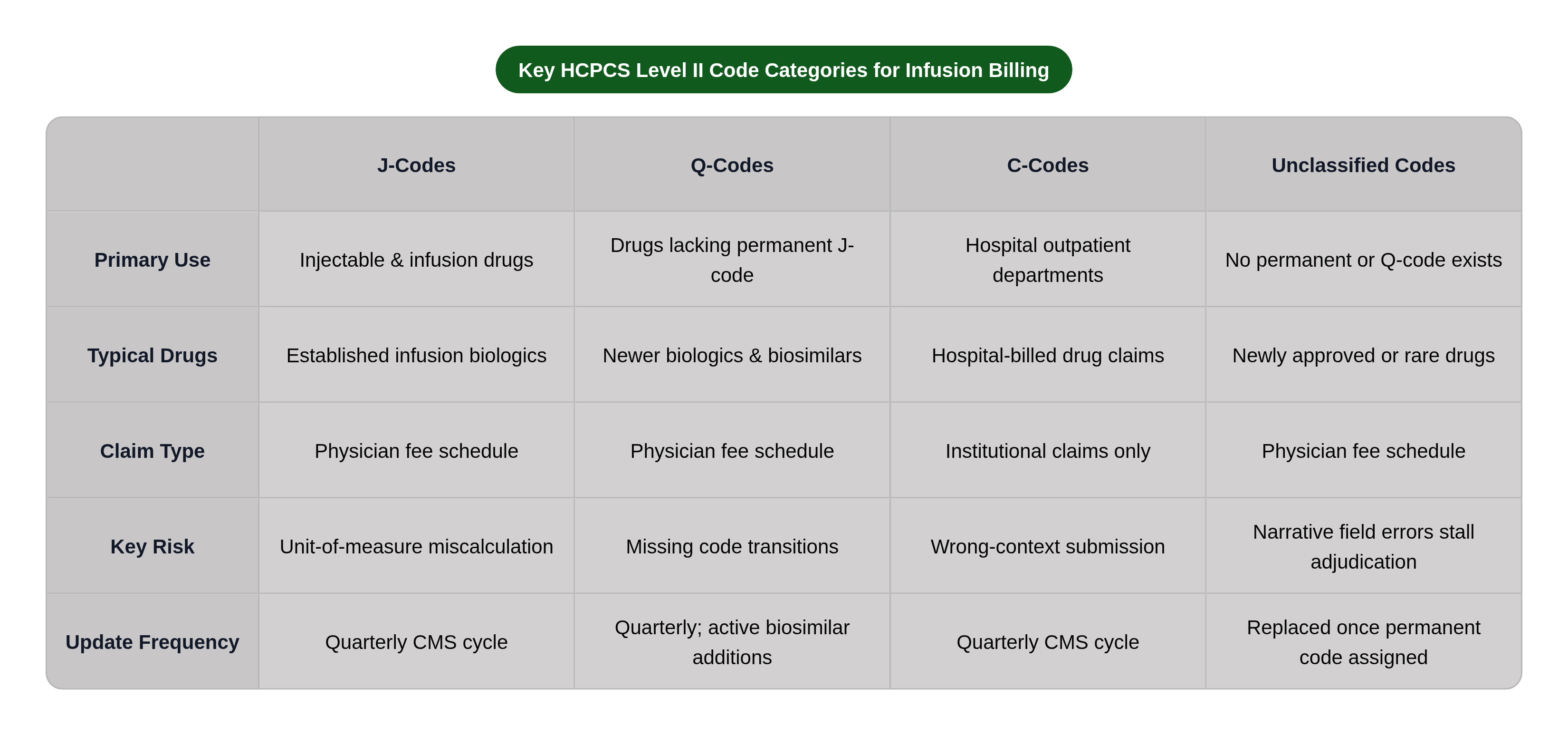
The opening letter is not decorative. It designates the category of service or product. For infusion billing, three categories are operationally relevant. J-codes are the primary category for injectable and infusion drugs administered in clinical settings. Q-codes are supplemental, used for drugs and services that lack permanent J-code categories, often newer biologics and biosimilars still awaiting permanent assignment. C-codes are hospital outpatient department codes, filed on institutional claims. Independent infusion centers billing under physician fee schedule rules generally do not use C-codes; submitting one in the wrong context causes rejection or mispricing, and it happens more than it should, usually because someone assumed the codes were interchangeable.
CMS maintains Level II on a quarterly update cycle. Codes are added, revised, and deleted. A code valid in Q1 can be replaced or split by Q3. Practices without a live update process carry stale codes forward and generate automatic rejections that get misdiagnosed as payer problems. That misdiagnosis is expensive because it sends staff chasing the wrong root cause while the actual problem sits untouched in the code table.
One distinction anchors everything that follows: HCPCS Level II codes describe the drug product. CPT codes describe the administration service. Both must appear on an infusion claim, payers process them as a pair, and a failure in either one contaminates the other.
What J-codes encode: drug identity, route, and unit of measure in a single code
A J-code does more than name the drug. The descriptor embedded in the code defines what one billable unit actually represents: per milligram, per ten milligrams, per vial, per fifty milligrams. That unit basis varies by drug and must be read directly from the descriptor, not inferred from the drug name or guessed from the code number.
This is where the most consequential silent errors occur. If a code's descriptor reads "per 4 mg" and 8 mg was administered, billing one unit produces a 50% underpayment. The claim processes. The payment posts. Nothing in the remittance flags the error because the code itself is valid. The underpayment becomes a permanent write-off, and nobody calls it a coding error because, technically, the claim paid.
Route matters too. J-codes apply exclusively to non-oral administration: IV infusion, intravenous push, intramuscular injection, subcutaneous injection, and certain inhalation drugs. Oral medications dispensed through pharmacy do not use J-codes. When a drug receives a new FDA approval, a permanent J-code typically follows within three to six months. Until then, providers use an unclassified code, which introduces its own complications.
In a buy-and-bill model, the stakes of getting this right are not abstract. Providers acquire the drug upfront before any reimbursement is guaranteed. Annual drug costs per infusion patient, depending on the therapy, can reach six figures. A unit-of-measure error at that scale is not a clerical inconvenience; it is a cash-flow event that repeats on every claim until someone actually finds it.
Q-codes, C-codes, and unclassified codes — when the standard J-code doesn't exist
When a permanent J-code doesn't exist for a drug, billing doesn't stop; it shifts. Q-codes are the most common alternative. CMS assigns them to drugs and services that lack permanent categories, often newer biologics and biosimilars still awaiting a permanent home. The unit-of-measure logic is identical to J-codes: the descriptor defines the billable unit, and the same precision requirements apply. A billing team that treats Q-codes as a loosely defined workaround will generate the same underpayment patterns as one misreading J-code descriptors, just under a different code series.
Biosimilar coding has made the Q-code space particularly active. As biosimilar approvals have accelerated, Q-codes have become the standard transitional vehicle. A biosimilar billing under a Q-code today may have a permanent J-code next quarter, and the practice that fails to track the transition will keep filing Q-codes for a drug that already has a permanent assignment. Some payers will penalize that lag directly.
When no permanent code or Q-code exists at all, providers use unclassified codes: J3490 for unclassified drugs, J3590 for unclassified biologics. These are functional but operationally expensive. They require the drug name, strength, and dose in the claim's narrative field, and without that narrative, adjudication stalls. Most payers route unclassified codes to manual review, extending the payment cycle and elevating denial risk. Once a permanent code is assigned, continued use of an unclassified code signals a coding lag that some payers address through downcoding or outright denial.
Tracking the quarterly HCPCS release for drugs on your formulary is not optional housekeeping. It is the operational difference between billing what the payer expects and building a paper trail of preventable denials.
The modifier layer: how JA, JB, JW, and JZ change what a code means to a payer
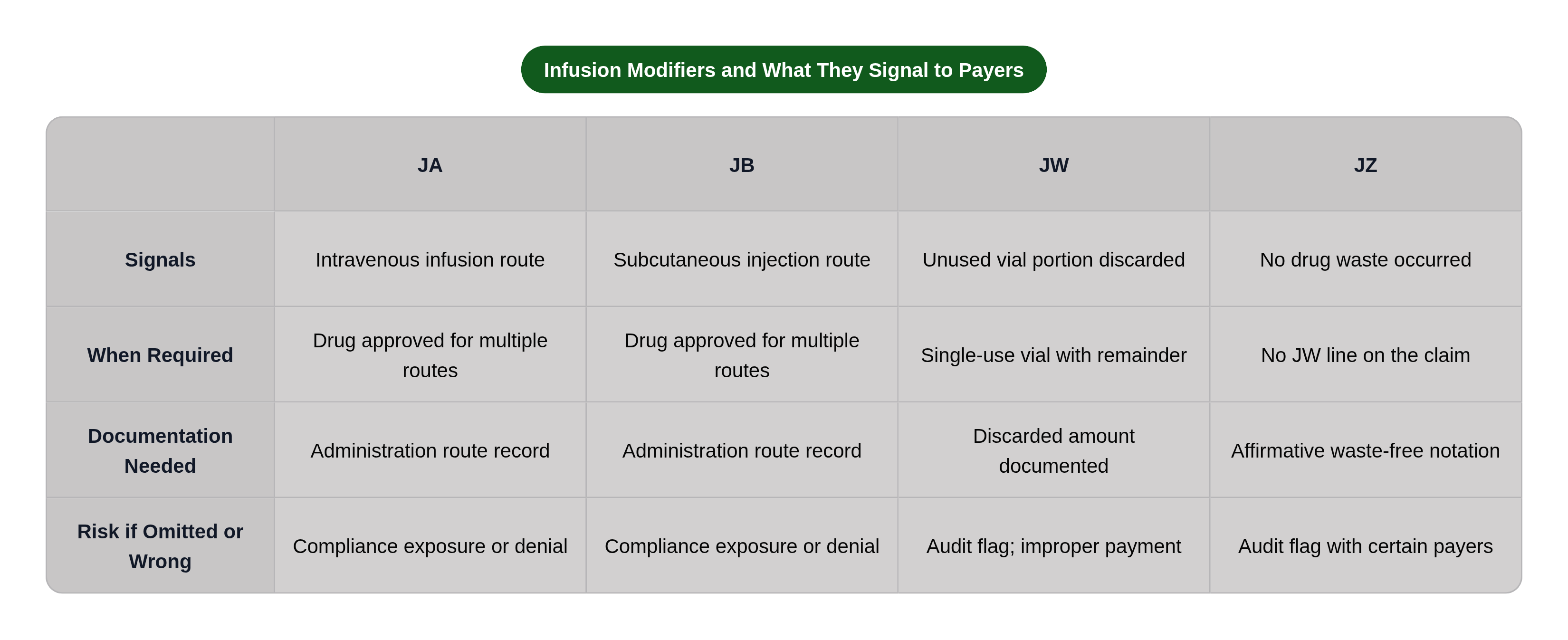
Modifiers attach to the base drug code and convey information the code itself cannot carry. Without the correct modifier, a claim can be technically valid and functionally wrong to the payer simultaneously. Pre-submission scrubbing rarely catches this, which is part of what makes it so persistently costly.
Route modifiers serve the first function. JA designates intravenous infusion; JB designates subcutaneous injection. Many payers require these modifiers to confirm the administration route, particularly for drugs approved for multiple delivery methods where reimbursement differs by route. Applying JA when the drug was administered subcutaneously creates compliance exposure. Omitting the modifier entirely when it's required often results in denial, and the denial reason frequently obscures the actual root cause.
Wastage modifiers carry their own compliance weight, and CMS has made the expectations explicit. JW is used to bill for the unused portion of a single-use vial that could not be used for another patient; it requires documentation of the discarded amount. JZ, introduced by CMS in 2023, is the affirmative counterpart: it signals that no drug was wasted and no JW line is forthcoming. Its absence on a claim without a JW line now creates an audit flag with certain payers. The 2024 Medicare Fee-for-Service Supplemental Improper Payment Data identified improper payments for infusion pumps and related drugs at $89.5 million, with insufficient wastage documentation cited as a contributing factor.
The broader principle is that CMS uses modifier policy to create affirmative documentation requirements. Silence on a claim line is no longer a neutral position. The JW/JZ pair is the clearest current expression of that, but the logic extends to route modifiers and will continue extending as CMS refines its audit methodology.
NDC requirements and why payers want more than the J-code alone
A National Drug Code is an 11-digit identifier that specifies the manufacturer, the product, and the package size. It identifies the exact vial that was administered, not just the drug class. Many payers require three distinct elements on a drug claim: the J-code, the CPT administration code, and the NDC. Each answers a different question, and missing any one of them makes the other two insufficient.
Payers require NDC on buy-and-bill claims for concrete reasons. It validates that the billed product matches a real package configuration, which catches unit miscalculations where the billed unit count doesn't align with any commercially available vial size. It enables cross-referencing of acquisition cost and application of rebate offsets where applicable. It creates an auditable trail: the claim asserts that a specific vial from a specific manufacturer was administered, which is a defensible position. A J-code and unit count alone is not.
Format matters here. The NDC must be submitted in the correct 5-4-2 digit grouping with the appropriate unit-of-measure qualifier. A formatting error causes claim rejection even when the underlying NDC is accurate. In the biosimilar context, the NDC becomes the only claim element that distinguishes which manufacturer's product was actually administered when multiple biosimilars share the same J-code or Q-code. That distinction matters for payer audits and for rebate accounting, and it is not recoverable from the J-code alone.
Build NDC validation and unit-of-measure qualification into the claim workflow. The error rate on manual NDC entry is high enough that it functions as a recurring denial source for practices that haven't automated it.
How CPT administration codes pair with J-codes and where hierarchy errors occur
The J-code identifies the drug. The CPT code identifies what was done to administer it. Payers process them as a pair, and an error in either element can invalidate the claim line regardless of how accurate the other one is.
The foundational infusion administration codes are 96365 for the initial intravenous infusion up to one hour, 96366 for each additional hour of IV infusion of the same drug, 96367 for an additional sequential infusion of a new drug or substance, and 96372 for a therapeutic, prophylactic, or diagnostic injection administered intramuscularly or subcutaneously. Chemotherapy infusions operate under a separate hierarchy beginning with 96413, governed by different rules, and mixing chemotherapy codes with non-chemotherapy codes on the same claim without careful attention to sequencing creates problems that are entirely avoidable.
The hierarchy rules governing multi-drug infusion sessions are where errors concentrate, and the patterns are almost always predictable. When multiple drugs are infused in a single session, only one qualifies as the "initial" infusion, which carries the highest reimbursement. Subsequent drugs are sequential. The two most common hierarchy errors are billing two initial codes in the same session and failing to recognize that a subsequent drug qualifies as a new sequential infusion rather than an additional hour of the same one. Both generate miscoding, either over or under, each with its own downstream consequences.
Documentation grounds everything. The 2024 Medicare Fee-for-Service data attributed 72.5% of improper payments for infusion pumps and related drugs to insufficient documentation. Start and stop times, drug sequence, and route must be recorded with enough specificity to support the administration code selected. When the documentation doesn't support the code, the code is wrong, regardless of clinical intent.
How coding errors at the line level seed prior auth mismatches and claim denials
Prior authorization is requested against a specific drug code. If the code on the authorization request doesn't match the code on the claim, the payer has no obligation to honor the authorization. The clinical appropriateness of the service is irrelevant once there's a code-level mismatch; payer adjudication systems don't deliberate on intent.
The most common mismatch scenarios follow recognizable patterns. A permanent J-code is assigned to a drug after the authorization was obtained using an unclassified code; the claim submits with the permanent code, but the authorization references the unclassified one, and the system fails to reconcile the match. A biosimilar substitution changes the NDC and sometimes the Q-code; the authorization covers the reference product, not the biosimilar. A unit miscalculation on the authorization request means the approved units don't align with the correct units on the claim, and the payer treats the overage as unauthorized.
Across all of these scenarios, the underlying thread is a code-level discrepancy between what was authorized and what was billed. The drug was right. The patient was right. The service was medically appropriate. None of that matters if the code strings don't match.
Virtually all Medicare Advantage plans require prior authorization for physician-administered drugs under the medical benefit. The volume of authorization-to-claim code matching that an infusion center must manage is substantial, and denial patterns that appear payer-specific or drug-specific often share a common root at the code level. Diagnosing that root requires line-level claim review. Aggregated denial category counts will not get you there.
The only intervention that actually prevents these problems is code accuracy at the point of order entry and authorization request, before the drug is administered. Everything after that is remediation, and remediation is expensive.
What line-level remittance reconciliation reveals that summary-level reporting cannot
A claim can pay and still be wrong. Payers routinely reimburse at a rate that doesn't match the contracted allowable, and the discrepancy is only visible at the line level. Summary-level reporting, the kind that tracks total collections or denial rates by payer, will never surface this. The claim sits in the paid bucket. The loss is invisible.
Unit errors generate underpayments that post as paid claims. The remittance shows a payment. The account receivable ages out. The write-off happens without anyone categorizing it as a coding error because the claim processed without rejection. For high-cost biologics, a unit-of-measure error doesn't produce a small variance; it produces a material underpayment on every claim carrying the error. If that error is systemic, embedded in how a code is mapped in the billing system rather than a one-time entry mistake, it compounds across every patient on that drug for every billing period.
Line-level reconciliation means matching the payment received on each drug line to the expected allowable, calculated from the administered dose, the code's unit basis, the contracted rate, and any applicable modifier adjustments. That exercise surfaces unit errors, route modifier mismatches, and contracted rate variances that summary reporting buries. It also identifies claims that paid correctly on first submission, which is genuinely useful because it tells you what accurate coding looks like in practice.
Here is what actually happens when this breaks down. Someone pulls a line-level reconciliation on a single high-cost biologic, maybe because a new biller asked a question nobody had thought to ask, or because an audit flagged something peripheral. What they find is 18 months of systematic underpayment on a unit descriptor that was misconfigured in the billing system from the start, probably since implementation. The money is gone. The write-offs were categorized as adjustments. Nobody flagged it as a coding problem because the claims paid, and in the summary reports, paid claims are closed claims. The billing team wasn't negligent; they were looking at the wrong level of detail. The problem wasn't hidden. It was right there in the remittance data, line by line, the entire time.