White Bagging vs Brown Bagging in Infusion Therapy
Payers shift drug costs to pharmacies to capture rebates and pricing leverage.

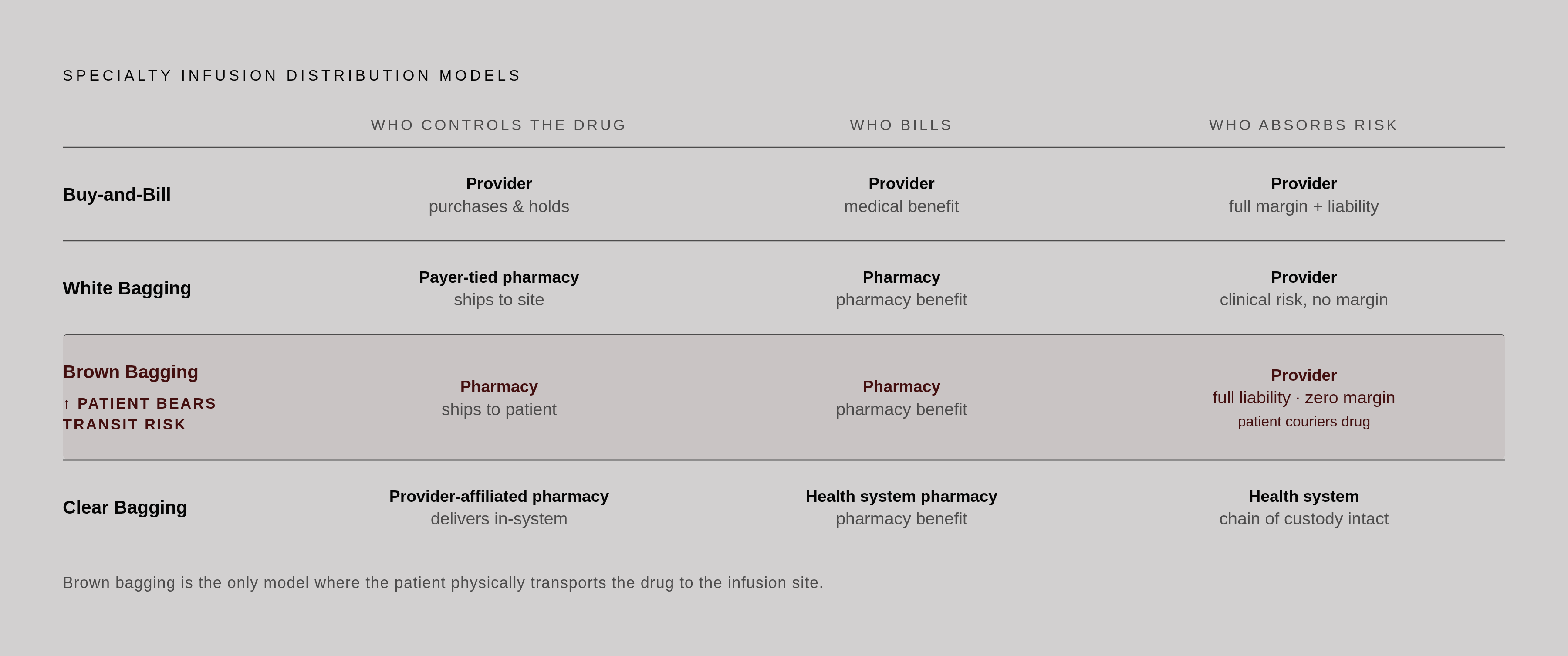
Four distribution models govern how specialty infusion drugs move from manufacturer to patient today, and each one answers the same three questions differently: who controls the drug, who bills for it, and who absorbs the damage when something goes wrong.
Buy-and-bill is the traditional model. The infusion center buys the drug, stores it, administers it, and bills the payer for both the drug and the service of giving it. The provider runs the whole supply chain, start to finish.
White bagging moves that control to the payer's side. A specialty pharmacy tied to the payer dispenses the drug and ships it straight to the infusion center or physician's office. The provider never buys the drug and can't bill for it. Payment for the drug runs through the pharmacy benefit instead of the medical benefit, which is the whole point of the arrangement from the payer's side.
Brown bagging pushes the handoff one step further; the specialty pharmacy ships the drug to the patient directly, and the patient carries it to the infusion center for administration. The patient becomes the courier, with all the risk that implies.
Clear bagging, sometimes called gold bagging, offers a different answer. A specialty pharmacy affiliated with or contracted by the provider, not the payer, prepares the drug and delivers it to the site of care. Chain of custody never leaves the health system. For that reason, clear bagging gets described as the gold standard among the alternatives to buy-and-bill: it keeps clinical flexibility intact while still shifting some control away from the provider's own four walls.
The distinction that matters most across all four models comes down to who holds the drug and who answers for it. White and brown bagging hand it to a pharmacy the payer picked, which sets up everything that follows: who gets paid, who takes the loss, and who bears the clinical risk when the treatment plan changes at the last minute.
Why payers push bagging
Payers mandate white and brown bagging mainly to move drug spending off the medical benefit, where a hospital's markup is hard to touch, and onto the pharmacy benefit, where rebates, formulary rules, and negotiated pharmacy pricing give the payer far more leverage.
The pressure behind this is structural. Specialty drugs are used by a small share of patients but account for roughly half of total drug spending. Any payer trying to control costs has to go after that segment, because nothing else moves the number as much.
ICER's 2023 white paper names markup elimination as the explicit goal behind bagging policies, not a side effect of them.
Specialty pharmacies tied to payers can negotiate lower prices with manufacturers and wholesalers than an individual infusion center ever could, and they capture manufacturer rebates that never touch the medical benefit. That's pure margin recapture, moved from the provider's side of the ledger to the payer's.
Vertical integration makes the incentive sharper. UnitedHealth Group and Elevance Health have both bought their way into the home and alternate-site infusion business, which keeps drug dispensing revenue inside their own corporate structure rather than paying it out to an independent provider.
The lever that makes all of this enforceable is the drug formulary. When a payer removes a drug from its medical benefit list, white bagging through its chosen pharmacy becomes the only covered path for getting that drug to the patient. Providers can't opt out of that without risking non-payment, which is what turns a pricing preference into a mandate.
Losing Control of the Drug
When a payer mandates white or brown bagging, the infusion center doesn't just lose a slice of margin. It loses a meaningful part of the financial logic that makes running an infusion practice sustainable.
Under buy-and-bill, the provider buys the drug and bills it at a markup. For high-cost biologics, that margin is operating revenue the practice depends on, not a bonus sitting on top of the business.
In oncology, rheumatology, gastroenterology, and infusion-focused practices generally, drug reimbursement can run ten times higher or more than professional fees for the same visit. Taking that drug component away forces the practice's entire revenue structure to be rebuilt around a much smaller number, not just a few points of margin.
Under white or brown bagging, the infusion center can still bill for administering the drug, but that administration fee was never designed to stand alone.
Brown bagging is worse on this front because it adds liability with no offsetting revenue. The provider administers a drug it didn't dispense, can't verify was stored properly, and can't bill for. All of the risk sits with the provider, none of the margin does.
Even the waste rules cut against the infusion center. But someone still has to receive the shipment, check it, store it correctly, keep it separate from other patients' medications, and dispose of it if it goes unused, and that someone is the infusion center's own staff and pharmacy resources, uncompensated. Most practices are living with this shift already, not finding ways around it.
Buy-and-bill arrangements, where the infusion center keeps control of the drug supply and bills for both drug and administration, run on a fundamentally different revenue cycle than white or brown bagging. That cycle depends on tracking drug acquisition, confirming benefits coverage before the drug is ever dispensed, managing prior authorizations tied to specific inventory, and reconciling payment against the drug cost itself. Revenue cycle platforms built specifically for infusion billing, Ruby RCM among them, are designed around that end-to-end sequence, including the benefits verification and prior authorization work that has to happen before the drug enters the building.
The clinical risks that compound the financial ones
The same rigidity that drains revenue from infusion centers under white and brown bagging also puts patients at clinical risk, and the two problems can't really be separated from each other.
Many infusion drugs are dosed by weight or by a patient's current condition, which can change day to day. Under a white bagging mandate, the drug ships before the patient is even seen, and there's no way to adjust the dose at the time of administration without throwing out the vial and waiting on a new shipment. The AMA and ASCO have formally opposed mandatory white and brown bagging on that basis specifically.
Oncology shows the problem most clearly. If that CT scan or lab result shifts the plan, the drug already on hand can't be redirected to another patient. It gets discarded, and the patient waits for a new one. When a denial follows that kind of disruption, the median delay before treatment resumes runs 50 days.
Brown bagging layers on its own distinct danger. Patients are made responsible for receiving, storing, and transporting drugs that often need precise cold-chain handling. The brief treats this as a patient safety issue standing on its own, separate from the financial disruption bagging causes.
Patients with fewer financial and social resources carry more of this risk than others. They have a harder time managing drug transport on their own, less access to home infusion as a fallback, and more exposure to delay when a treatment plan shifts unexpectedly. That equity gap is a large part of why provider organizations have pushed for legislation rather than trying to negotiate better contract language payer by payer.
Where the legislative pushback stands
State legislatures have built real protections against mandatory bagging, but those protections are scattered unevenly across the country, and without federal action, whether an infusion center is exposed to a white bagging mandate depends almost entirely on its zip code.
As of July 2025, 12 states have banned mandatory white and brown bagging outright, and roughly a dozen more have legislation under active debate.
New Jersey's law, taking effect January 1, 2026, sets up guidelines and exception processes for step therapy protocols across its state-regulated health plans, Medicaid, SHBP, and SEHBP, covering all conditions and letting providers authorize the originally prescribed drug if the step therapy drug isn't working. Connecticut has gone further still, banning step therapy outright for multiple sclerosis and rheumatoid arthritis and capping it at a short fixed period for everything else.
Texas took a different angle in 2025, passing a law barring utilization review agents from using automated decision systems to make adverse determinations on their own, in whole or in part. A physician or licensed provider now has to make that medical necessity call. That matters for infusion centers because payer-side AI is increasingly involved in managing specialty drug authorization, and the Texas law changes how appeals have to be built in that state.
Every one of these laws draws the same line. The AMA and ASCO oppose mandatory white bagging but don't object to voluntary arrangements inside integrated health systems, and that mandatory-versus-voluntary distinction is the fault line running through every piece of legislation passed so far.
Federal PBM reform bills introduced in recent legislative sessions have gone after spread pricing and formulary transparency, but none have addressed distribution channel mandates directly. Providers operating in states without protective laws remain fully exposed to whatever bagging policy their payers choose to write. State bans also stop at mandates. They don't touch voluntary payer moves like CVS/Aetna's August 2025 drug list changes, which shifted buy-and-bill margin toward CVS specialty pharmacies without technically forcing anyone's hand. State legislatures have enacted real protections, but they cover a narrower problem than the one infusion centers actually face.
Bagging, Site-of-Care, and Payer Vertical Integration
White bagging is one visible piece of a much larger shift in who controls specialty drug distribution, and that shift is reshaping the infusion business from several directions at once.
That same vertical integration can produce the opposite of growth in some corners of the market. A vertically integrated strategy built to capture margin ended up creating access gaps in the markets it walked away from.
Independent providers are moving into those gaps. Option Care Health, the largest independent home and alternate-site infusion provider in the country, acquired Intramed Plus in early 2025 to build out an advanced practitioner model across its ambulatory infusion suites, a consolidation move that positions it to absorb site-of-care volume payers are steering away from hospital outpatient departments. The broader ambulatory infusion market is expanding for the same reason: payers favor lower-cost outpatient and home-based settings, and private equity-backed infusion centers are growing in markets that health systems used to serve on their own.
For an independent infusion center, the competitive landscape now runs on decisions made by payers, PBMs, and vertically integrated insurers that hold both the policy lever and the distribution asset needed to enforce white bagging without any legislature's involvement. Understanding bagging as part of that structural shift, rather than as a one-off payer policy, changes how an infusion center has to think about building its revenue cycle operations, because the entities setting the rules aren't going to stop setting them.
What these models mean for infusion revenue cycle operations
Whichever bagging model a practice operates under, chosen or imposed by a payer, determines which revenue cycle workflows matter most, which risks can actually be managed, and what an RCM operation needs to be built to catch.
When white or brown bagging takes drug acquisition away from the provider, the billing work left behind doesn't get simpler. It gets more complicated. Without careful prior authorization tracking and line-level remit reconciliation tied to the actual administration event, underpayments and denials on those administration fees build up fast, turning what looks like a simple service charge into a genuine revenue cycle problem that generic platforms often fail to catch.
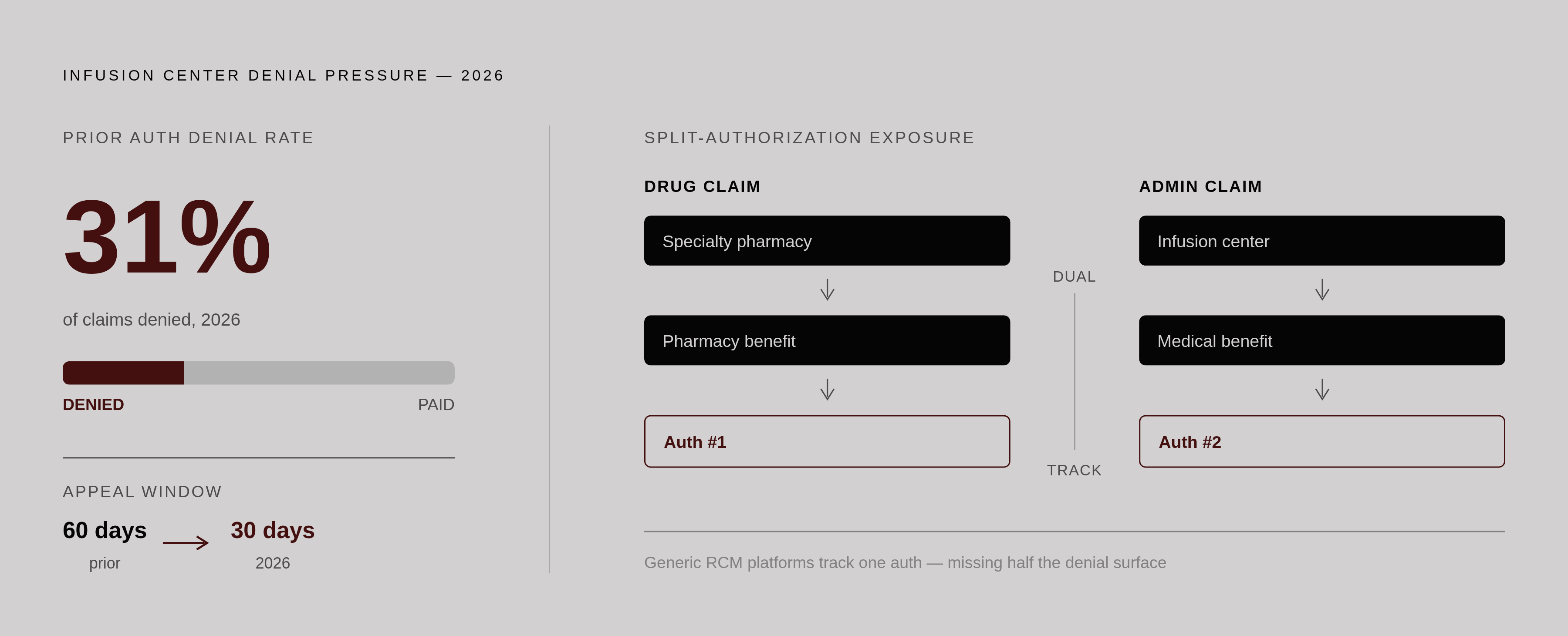
Prior authorization is a clear example of where that complexity hides. Under white bagging, the drug's authorization runs through the specialty pharmacy, but the administration still needs its own separate authorization from the medical benefit. That creates a split authorization workflow, one claim governed by two different approval processes, that most general-purpose RCM tools were never built to track side by side.
Denial management has to follow the same split. A denial on the white-bagged drug claim belongs to the specialty pharmacy. A denial on the administration, whether for lack of medical necessity, missing supervision documentation, or an expired authorization, belongs entirely to the infusion center. Prior authorization denials have climbed to around 31% in 2026, and major payers have been compressing their standard appeal timelines at the same time, so the window to catch and fix these denials keeps shrinking.
Authorization renewals add another failure point that's entirely preventable, if it's tracked. If the renewal isn't filed before that window closes, later sessions in the same treatment course get delivered with no valid authorization on file at all, a loss that's predictable well in advance but still slips through in practices relying on a general-purpose system that isn't watching for it.
Payer authorization rules also shift throughout the year without any direct notice to the infusion center. A drug or billing code that didn't need authorization last month can require it this month, with no announcement beyond a formulary update buried in a payer bulletin. Tracking those payer-specific changes has to be a standing part of daily operations, not something handled during an occasional audit months later.
The bagging model determines the shape of the risk. Buy-and-bill risk sits in drug cost and inventory. White and brown bagging risk sits in split authorizations, administration-only claims, and renewal timing. The revenue cycle has to be built around the model actually in use rather than the one the practice wishes it still had.
Sources
- White Bagging, Brown Bagging, and the Pharmacist Caught in the Middle
- Mandatory White Bagging and Brown Bagging Policies ...
- White Bagging, Brown Bagging, and Site of Service Policies:
- January 2026 Frequently Asked Questions
- From Chair Time to Denial: Prior Authorization Errors Collapse Infusion Billing - rcmworkshop