Medicare Coverage Guidelines for Home Infusion Therapy
Medicare's narrow Part B benefit leaves most home infusion providers unable to bill profitably.
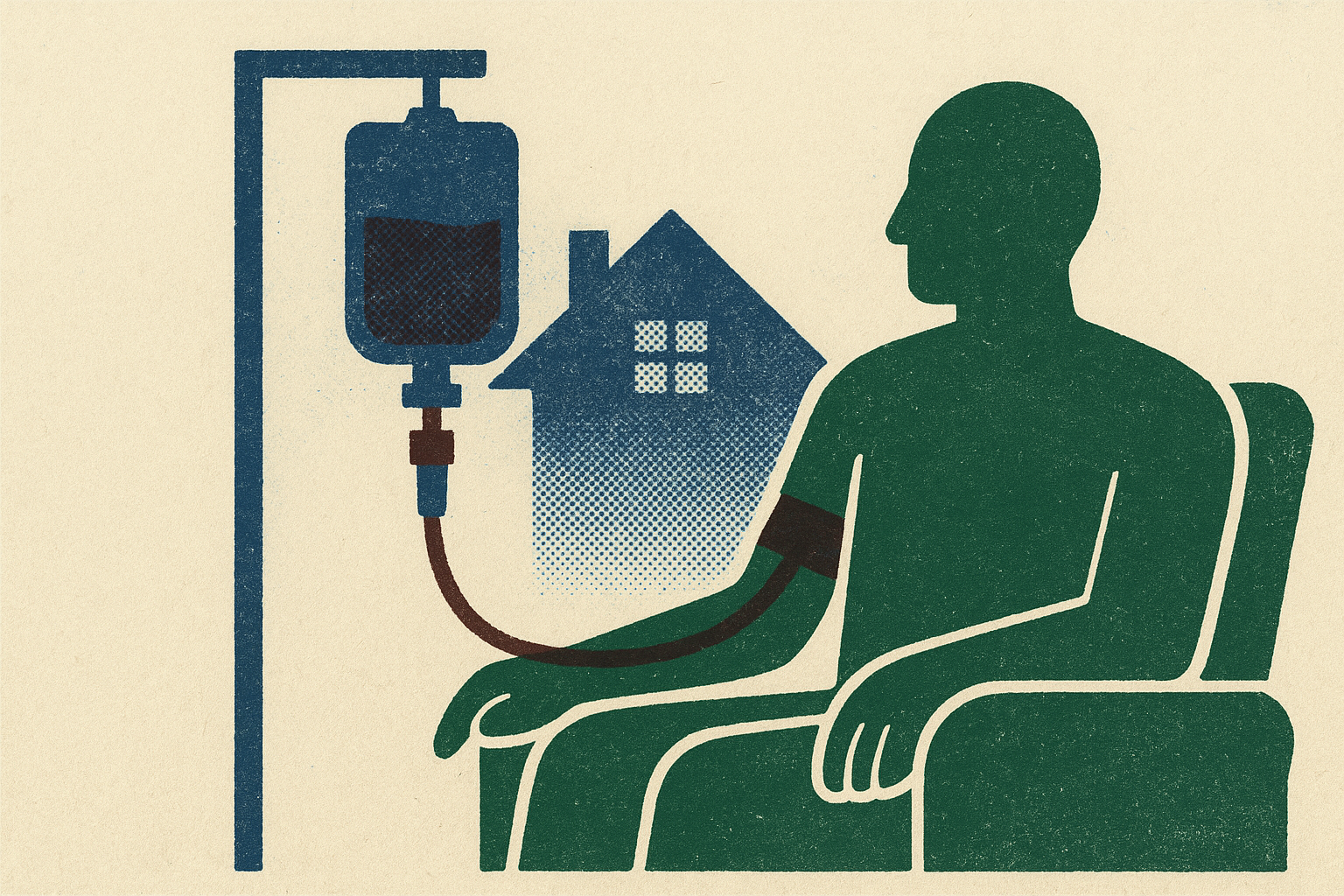
Medicare's home infusion benefit went live on January 1, 2021, five years after Congress created it in the 21st Century Cures Act. That gap tells you something: this was not a simple add-on to existing coverage. It's a narrow, specific payment structure, and if you don't understand exactly what it covers, you'll either leave money on the table or bill claims that get denied before anyone even looks at the clinical file.
The demographics explain why this matters so much. Home infusion skews old, and per NHIA data, 74.3% of home infusion patients are 50 or older, with roughly 3.2 million people getting home infusion therapy in the U.S. every year. That makes Medicare and Medicare Advantage the dominant payers in this space, not a side consideration. More than 550 drugs are already in use across home infusion settings, and 137 new infused drugs have come to market since 2016. That's the pipeline that made a dedicated benefit necessary in the first place. But purpose-built doesn't mean broad. It means narrow and specific, and the boundary of what's covered is the first thing any practice needs to nail down before it bills a single claim.
How the Part B and Part D split actually works for home infusion drugs
Here's the rule that decides everything: if a patient can't self-administer the drug, it falls under Part B, not Part D. IV infusion drugs almost always fail the self-administration test, so they land in Part B by default.
Part B covers three things. It covers the equipment, classified as durable medical equipment (pumps, IV poles, tubing, catheters), and it covers the professional services needed to safely run the drug at home: nursing visits, training for caregivers, monitoring the patient. And it covers certain drugs and biologicals given IV or under the skin through a DME pump.
Part D shows up only at the edges. It might cover a home infusion drug that Part B doesn't touch, when that's medically necessary, but that's the exception, not the backbone of the system. NHIA keeps a Home Infusion Drug List, built from provider reports, that flags drugs likely covered under Part B when a pharmacy dispenses them and they're given at home. Treat that list as a working reference, not gospel, since CMS hasn't published a definitive coverage list, so NHIA's version is the best proxy the industry has, and it's still just a proxy.
Get the Part B versus Part D call wrong, and you don't get a denial after clinical review. You get a denial before anyone even reads the chart, because the claim went down the wrong structural path from the start. And 2025 made this decision harder, not easier, because Part D now has a capped out-of-pocket maximum, which makes it look more appealing to beneficiaries in some cases. That's a real complication for practices trying to route drugs correctly and for patients trying to figure out which benefit actually saves them money.
What the payment model actually pays for (and the unit it pays by)
Medicare doesn't pay per drug unit dispensed, and it doesn't pay per visit. It pays per payment category, per infusion drug administration calendar day. That's the unit, and getting comfortable with it matters, because it drives everything else about how this benefit behaves financially.
Medicare covers 80% of whichever is lower: the actual charge or the fee schedule amount, and the beneficiary owes the other 20%. In 2025, the Part B premium starts at $185 a month, and the annual deductible is $257. After the patient hits that deductible, Medicare pays its 80% and the patient covers the rest.
CMS publishes fee schedules adjusted by locality. The CY 2025 rates came out in January 2025, and CY 2026 rates are already published too. The American Relief Act, 2025 extended the work GPCI floor through April 1, 2025, which matters if you're modeling reimbursement in lower-cost geographic areas.
None of this pays out, though, unless the biller is a qualified home infusion therapy supplier, enrolled in Medicare under the rules in § 424.68. That enrollment isn't paperwork you get around to eventually; it's a precondition. So is 24/7 availability for professional care and remote monitoring (that's a compliance requirement tied directly to billing eligibility, not just a nice-to-have service standard), and the patient has to be under an active plan of care, overseen by a physician, nurse practitioner, or physician assistant. Skip any one of these, and the claim isn't just weak. It's ineligible.
The coverage gaps that explain why so few providers actually bill this benefit
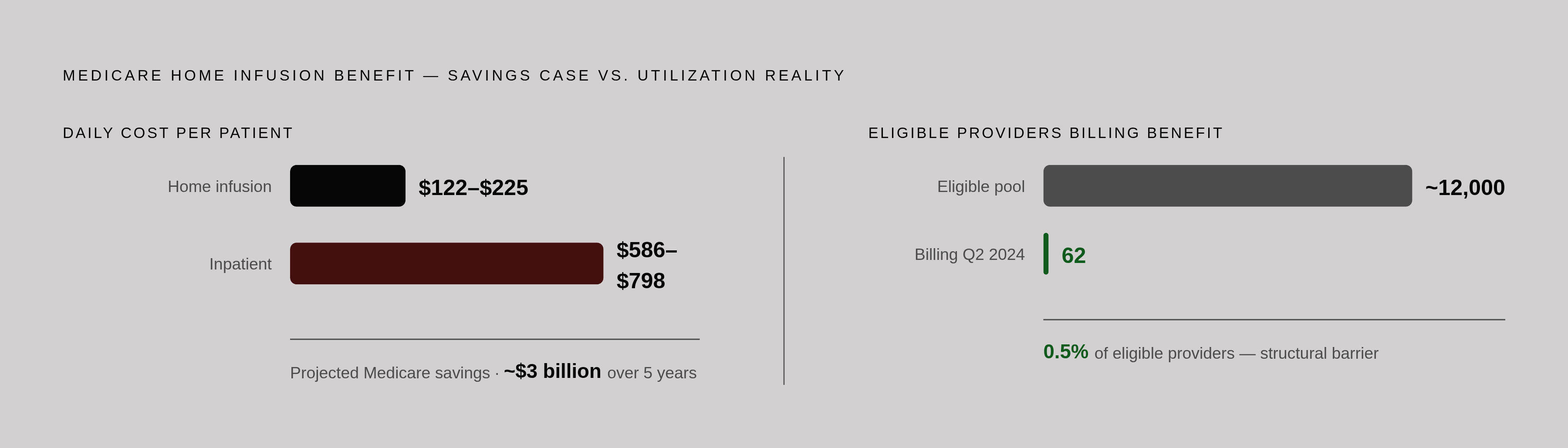
In Q2 2024, only 62 providers billed for home infusion therapy services under this benefit. Compare that to the landscape: nearly 1,000 home infusion pharmacies and about 11,000 home health agencies capable of delivering this care. Sixty-two providers, out of a pool that size — that's not slow adoption. That's a structural wall.
Here's the wall: current law says a skilled professional has to be physically in the home for a billable professional service to happen. Most infusion therapy doesn't work that way day to day. A pump might run for a week, but a nurse visits once, maybe twice. On every day without a physical visit, there's no professional service payment available, even though the provider is still monitoring the patient, still on call, still managing the therapy. A provider can support a patient through an entire course of treatment and only get paid for the handful of days someone walked through the door.
Not every home infusion drug even makes it onto the Part B covered list, either. Providers can meet every enrollment requirement, every documentation standard, and still not generate a billable HIT event if the drug itself isn't on the list.
The frustrating part is the math actually favors this care setting. Home infusion runs $122 to $225 a day, while inpatient care for the same kind of therapy runs $586 to $798 a day. Shifting volume to the home was projected to save Medicare almost $3 billion over five years. NHIA's position, and it's hard to argue with, is that a benefit providers can't afford to bill doesn't expand access, no matter how good it looks on paper.
The 2025 legislative push to fix the benefit's payment structure
The Preserving Patient Access to Home Infusion Act, H.R. 2172 in the House and S. 1058 in the Senate, came back in 2025 aimed squarely at this problem. It would require CMS to pay for professional services on every day the drug is administered, not just the days with a physical nursing visit, and it would drop the physical-presence requirement altogether as a condition for billing. It would also set the payment rate for non-nursing days at 50% of the nursing-day rate, which gives providers an actual economic reason to keep monitoring patients remotely instead of losing money on it.
The Part D changes complicate the argument for passing this bill, oddly enough. With the new out-of-pocket cap now in place, Part D looks more attractive to some patients than it used to. NHIA has pushed back on the idea that this solves anything: expanding a Part B benefit that providers still can't afford to deliver doesn't fix patient access, cap or no cap.
Watch the physical-presence requirement closely. If it goes away, the billing model for home infusion professional services changes in a fundamental way, and practices need to understand what that new compliance picture looks like before it lands, not after. Nothing here is guaranteed to pass, but it's a live legislative fight, and it has direct consequences for how a practice should plan its Medicare home infusion service line over the next few years.
How Medicare Advantage overlays complicate what traditional Medicare covers
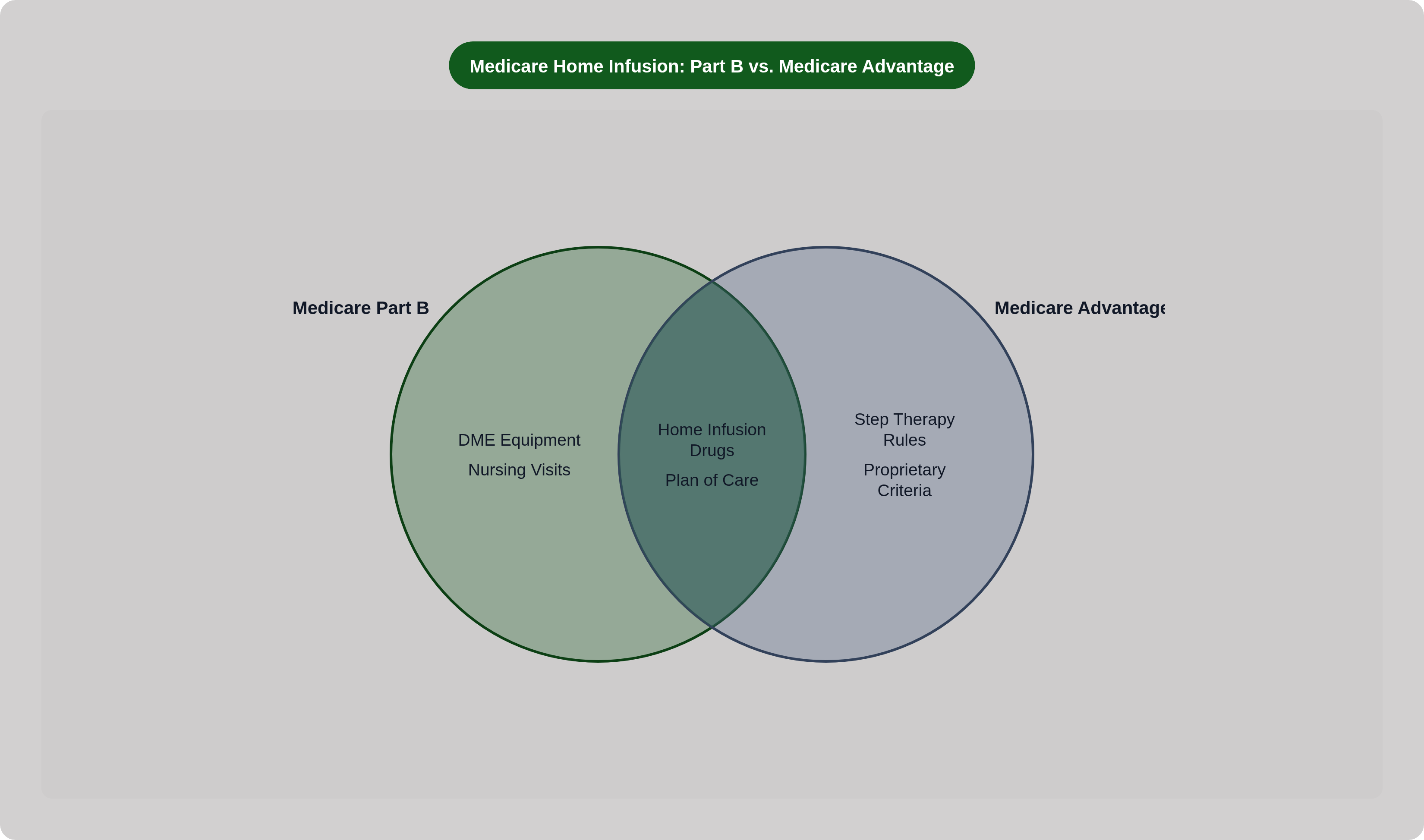
Most Medicare-age home infusion patients aren't in traditional Medicare. They're in Medicare Advantage, and everything described above is the floor; MA plans build their own requirements on top of it, and that's where a lot of practices get tripped up.
The prior authorization numbers from 2024, via KFF, are worth sitting with. MA insurers made 52.8 million prior authorization determinations that year, and of those, 4.1 million were denied in full or in part, with that denial rate climbing steadily over recent years. Worse, 73% of all denials were full denials, not partial approvals where you at least get something.
Injectable medications, the category that covers home infusion biologics, see denial rates well above the overall MA average. Step therapy requirements drive most of that. And a lot of these denials aren't simple "no authorization on file" situations; they're mismatches: the site of care doesn't match what the plan authorized, the drug formulation is off, or the dose administered doesn't line up with what was approved on paper.
Part of the problem is the tools. MA plans lean on clinical criteria systems like InterQual, MCG, or their own proprietary algorithms, and those systems don't always map cleanly to how a treating physician actually documents care. A note that fully supports medical necessity by any normal clinical standard might be missing the exact structured fields the plan's review engine is looking for.
CMS stepped in on this in February 2024, clarifying that MA organizations can't rely only on AI or algorithmic tools to make coverage decisions; a human being has to be part of the review. Whether plans are actually following that in practice is still being fought out in court. Separately, CMS-0057-F, finalized in January 2024, requires faster PA turnaround (7 days for standard requests, 72 hours for urgent ones), specific denial reason codes, electronic prior auth through an API, and public reporting on approval and denial rates. These provisions are rolling out on a phased timeline, so don't assume they're all in effect yet.
What the coverage framework means operationally for infusion practices billing Medicare
Revenue cycle control for Medicare home infusion doesn't start when you submit the claim. It starts at scheduling. Supplier enrollment status, plan of care documentation, drug coverage eligibility: all of that needs to be locked down before the patient's first visit, not chased down afterward.
The Part B versus Part D call isn't a billing detail you sort out later. It's a clinical and administrative decision that has to happen per drug, per patient, before you dispense anything, and getting it wrong on the front end means no amount of clean documentation fixes it on the back end.
Because of the physical-presence rule, nursing visit scheduling is now a revenue function, not just a care coordination task. Every day without a qualifying visit is, under current law, a day with no billable professional service. That's not how most people think about staffing a nursing team, but it's how Medicare currently pays for one.
Then there's the MA layer sitting on top of all of it. A drug can be fully covered under the Part B home infusion benefit and still get blocked by an MA plan's step therapy rule, formulary restriction, or internal clinical criteria. Denial management here needs real precision. Authorization mismatches, documentation gaps against a specific plan's criteria, and site-of-care disputes are three different problems, and they need three different resolution paths, not one generic appeals queue that treats every denial the same way.
And the legislative uncertainty around the physical-presence requirement isn't background noise. It's a planning variable. Any practice building or growing a Medicare home infusion line should be modeling revenue under both scenarios: today's rules, and a possible future where non-nursing days finally get paid. This is exactly why infusion-focused revenue cycle operations, such as Ruby RCM, a revenue cycle management platform built specifically for infusion centers that handles benefits verification, prior authorizations, claims, denials, and AR, exist as a category separate from general medical billing software. The part-split logic, the per-day billing unit, the supplier enrollment rules, the MA overlay: none of that is a minor variation on standard billing. It's a different system, and it needs workflow logic built for infusion from the ground up, not bolted on afterward.