Best Infusion Denial Management Approaches for High-Volume Payer Contracts
Practices that track denials by payer catch patterns most miss.
Claim denials in healthcare climbed from 30% in 2022 to 38% in 2024, and hit 41% in 2025. That slope points one direction: up. But the aggregate number hides the real story, which is that denial rates vary wildly by payer, by specialty, and by how well a practice reads its own contracts. Two providers can sit inside the same reimbursement environment, billing the same payers, and one keeps cash flowing while the other watches AR balloon month over month. The gap isn't payer complexity. It's whether the practice built its operations around how each specific payer actually behaves, or whether it's running one generic denial workflow and hoping it covers everyone. The generic denial workflow won't cover everyone.
High-volume payer contracts throw off denial patterns that repeat, and repeat predictably. Reading those patterns correctly lets a practice build protocols that catch problems before a claim ever goes out. Missing them means a practice spends its time appealing denials it should have caught three weeks earlier.
Structural differences between Medicare Advantage and traditional Medicare denial economics
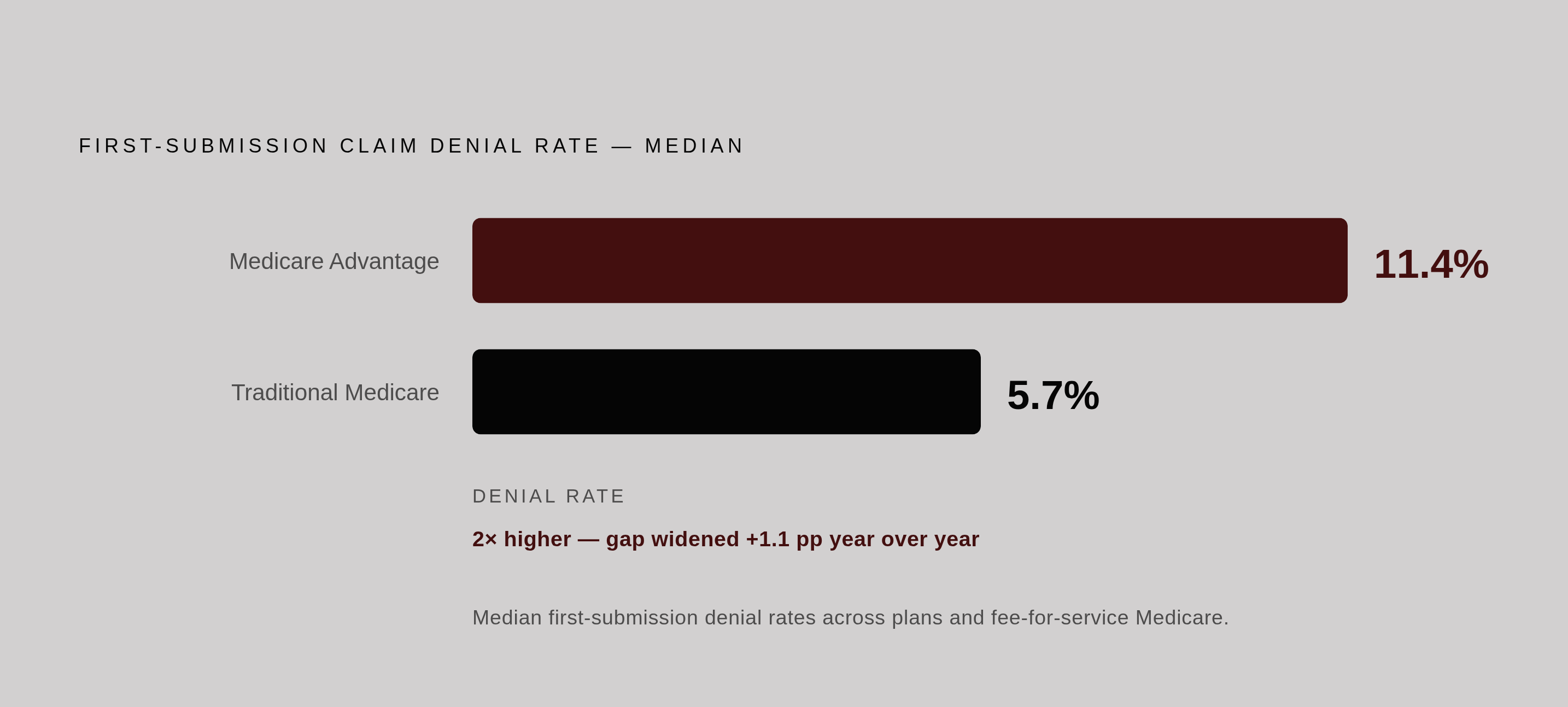
Medicare Advantage claims get denied at a median rate of 11.4% on first submission. Traditional Medicare is 5.7% over that same window. That's a two-to-one gap, caused by Medicare Advantage's more aggressive denial practices, and it is visible across nearly every specialty, not just a handful of outliers.
The gap isn't holding steady. The gap widened by roughly 1.1 percentage points year over year against the prior baseline. That's how MA plans are built to run: tighter authorization gates, more aggressive medical necessity review, and a business model that profits from friction at the claim level, not a blip that corrects itself. That's how MA plans are built to run: tighter authorization gates, more aggressive medical necessity review, and a business model that profits from friction at the claim level.
MA enrollment has grown to cover a substantial share of eligible Medicare beneficiaries. At that scale, MA denial economics stop being a side issue for any infusion practice treating a meaningful Medicare-age population. They become the main event.
A practice still billing MA claims with traditional Medicare assumptions baked into its workflow is miscalibrated before it submits a single claim. Authorization burden runs differently. Documentation depth runs differently. Appeal odds run differently. Carrying old assumptions into an MA claim doesn't just slow things down. It manufactures denials that never needed to happen, and that's the mistake most practices are still making without knowing it.
What drives the gap between infusion and oncology in the MA denial hierarchy
Oncology, which covers most infusion therapy, posted a 12.7% MA denial rate in 2026. That's above the 11.4% cross-specialty median, and more than double the traditional Medicare rate.
Two things drive that number: J-code drug claims, and the step-therapy edits written into infusion regimens.
Break the denial reasons down by code and two stand out. CARC 197, missing authorization or pre-certification, accounts for roughly 38% of all MA denials in the dataset, concentrated hard in infusion therapy, advanced imaging, surgical scheduling, and physical therapy. CARC 50, services the payer decided weren't medically necessary, makes up around 9% of MA denials, concentrated in high-cost infusions.
That second one stings worse than it should. In plenty of these cases, the chart already has the documentation to support medical necessity. It just never made it onto the claim. The information existed. It didn't travel, and that gap between what's true clinically and what's on the form is where the money gets lost.
Why payer-specific denial patterns are predictable and unread by most practices
Every denied claim has a backstory. Incomplete documentation, an authorization that expired mid-cycle, a site-of-care restriction nobody caught at intake, a treatment plan change that never got reflected in the payer's authorization file. None of that is random. It clusters by payer, and it repeats.
A practice that tracks one overall denial rate, say 10%, sees a single number and mistakes it for the whole picture. A practice that breaks denials down by payer, by CARC code, and by where the failure started sees something else: which payer triggers which failure mode, and how often. Most practices never get that far.
Timing explains why. The decision that causes a denial usually happens days or weeks before the claim goes out. An intake coordinator enters an outdated insurance number. An authorization gets approved for four cycles, but the treatment plan changes to six. By the time that denial appears on an aging report, the moment someone could have caught it has already closed.
An MGMA Stat poll of 288 practices found denials and appeals rank as the single biggest revenue cycle leak, cited by 48% of respondents. Front-end issues came in at 23%, billing and collections at 14%, coding at 13%. Look closer at that 23%, though: a lot of what appears downstream as a denial started upstream as a front-end mistake. The survey draws separate boxes for these categories. Operationally, it's often the same failure, caught at two different points in the cycle.
Prior authorization failures as the dominant payer-specific denial pattern in infusion
Prior authorization doesn't just slow down billing. It affects patient care directly: 91% of infusion providers report negative care impacts tied to the authorization process, and delays stretch treatment waiting periods by an average of 31 days.
Prior authorization denials climbed to around 31% in 2026, and that number moves independently of the overall denial rate. Prior authorization denials climbed to around 31% in 2026, and that number moves independently of the overall denial rate, which is the tell. Payers are tightening authorization requirements. Providers making more coding mistakes doesn't explain a jump like that.
Every payer runs its own authorization lifecycle, and none of them line up. Approval windows differ. Renewal intervals differ, often landing somewhere between three and six months. Requirements around drug, dose, and frequency specificity differ. What triggers a reauthorization differs from one contract to the next. No universal PA calendar exists that a practice can build once and apply everywhere.
Two failure patterns recur, and each needs its own fix. Expired prior authorization happens when the practice got the authorization, but it lapsed before or during the treatment cycle. Authorization and procedure code mismatch happens when the authorization is active, but the codes on file don't match what actually gets billed. Same root cause upstream, in both cases, but a different point of failure and a different fix downstream.
The buy-and-bill financial exposure that makes payer-specific denial prevention non-optional
Buy-and-bill puts real money on the line before a claim ever gets submitted. The practice buys the drug at acquisition cost, administers it, then bills the payer afterward for both the drug (the J-code) and the administration (the CPT code). Deny that claim, and the drug cost is already spent. No reimbursement comes back for it.
For high-cost biologics, one denial can leave tens or even hundreds of thousands of dollars sitting in limbo. That kind of delay pushes some practices into an ugly rhythm: using the payment that finally clears for one patient to cover the drug cost already spent on another. That's survival math, not a revenue cycle, and no practice should be running on it.
White-bagging adds another wrinkle. Some payers require a specialty pharmacy to supply the drug rather than allowing the practice to purchase and bill it directly, which changes how the claim is structured and what the practice can bill. Keeping payer-specific drug sourcing requirements straight and billing accordingly takes real operational discipline. Get it wrong, and the financial hit lands immediately.
None of this happens by accident, either. White-bagging reflects a deliberate payer strategy, not an administrative quirk, and infusion practices need to plan around it as one.
Building contract-specific denial protocols: what to map for each high-volume payer
Treat every high-volume payer contract like its own operating environment. Each one has a denial signature, and finding it starts with pulling historical denial data by payer, then sorting it by CARC code and by where the denial originated: intake, authorization, coding, or documentation.
From there, three areas need mapping in detail.
Authorization mapping covers which drugs require PA under that specific contract, how long the approval window lasts and how often it needs renewal, what triggers a reauthorization (a regimen change, a weight-based dose adjustment, a change in prescribing physician, a lab value crossing some threshold), the payer's step-therapy rules and biosimilar substitution requirements, and whether peer-to-peer review is available along with the payer's appeal timelines.
Medical necessity documentation mapping covers diagnosis-specific language that matches the payer's own coverage policy, evidence that prior therapies were tried and failed where step-therapy applies, lab values required before each cycle or reauthorization, and clinical notes on symptom change tied directly to the frequency and dosage being billed.
White-bag versus buy-and-bill tracking rounds it out: document, payer by payer and drug by drug, which billing model applies. Errors here don't look like contract problems on the surface. They look like plain coding mistakes, systematic J-code denials that repeat because nobody flagged which model that payer requires.
Upstream revenue cycle disciplines that prevent the denials contract protocols can't catch alone
Contract-specific protocols catch a lot. They don't catch everything, because some denials start further upstream than any authorization map can reach. In that same MGMA poll, 26% of respondents traced at least one in ten denials back to intake errors: wrong policy numbers, outdated insurance cards, eligibility that never got rechecked. Even a practice with airtight authorization management still bleeds revenue if intake is sloppy.
Benefits verification needs to catch site-of-care restrictions, white-bagging requirements, and carve-out plan structures before the treatment date, not after. A site-of-care restriction discovered after the infusion already happened is a denial with no path to recovery. That claim is gone, full stop.
Authorization tracking needs its own disciplines: structured expiration-date tracking across every open authorization, sorted by payer, automated reminders timed to each payer's specific renewal lead time rather than one blanket reminder schedule, a clear protocol for flagging treatment plan changes that trigger a new authorization requirement, and authorization-to-procedure-code matching done before the claim goes out, not after it bounces back denied.
A unified prior authorization system, one that pulls submission, tracking, and management into a single interface across all payers and surfaces metrics like average payer turnaround time and denial rate by payer, cuts both the denial rate and the referral turnaround time. Manual, portal-by-portal tracking can't hold up the discipline that payer-specific protocols demand. There are too many payers, too many renewal calendars, too many moving pieces for a spreadsheet and a login list to keep straight, and pretending otherwise is how the backlog builds.
Purpose-built infusion RCM infrastructure versus general-purpose billing workflows
General-purpose revenue cycle platforms weren't built with the authorization-renewal lifecycle, J-code drug-margin tracking, or payer-specific step-therapy documentation of infusion in mind. Their workflows get calibrated for simpler, more standardized billing, the kind found in a typical outpatient clinic where drug acquisition cost and reauthorization timing aren't life-or-death for cash flow.
Infusion runs on a different set of pressures entirely: six-figure drugs purchased before reimbursement, authorizations that expire mid-treatment, payer-by-payer rules on white-bagging, and documentation that has to match each payer's own medical necessity language. A billing system built for general use treats all of that as an edge case. In infusion, it's the daily workload. General-purpose tools keep losing ground here because of that workload.
Purpose-built infusion RCM infrastructure treats benefits verification, authorization tracking, and payer-specific denial protocols as one connected system, not three separate tasks split across three different tools, platforms like Ruby RCM, a revenue cycle management tool built specifically for infusion centers that tracks denials by payer and root cause rather than collapsing them into a single aggregate rate, are designed around exactly that kind of granularity. That's the dividing line, and it comes down to one question: was the infrastructure built around how infusion billing actually behaves, payer by payer, authorization by authorization, drug by drug?