White Bagging Pharmacy Impact on Infusion Billing
Infusion centers lose drug revenue but keep the administrative costs under white bagging.
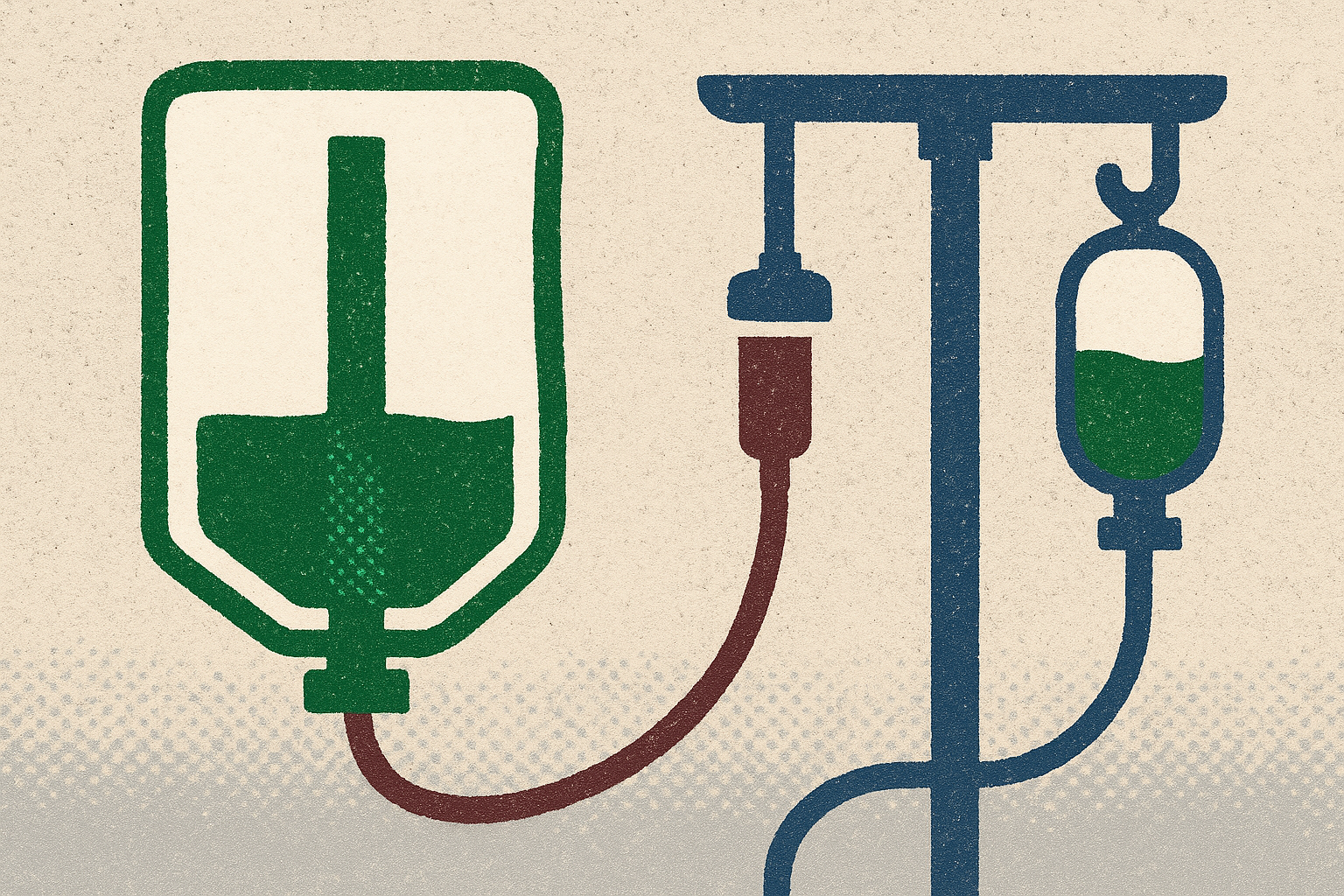
White bagging changes what an infusion center actually gets paid for, full stop. The drug revenue disappears from the claim entirely, and the billing team is left running a fractured process split across two benefits, two payers, and two authorization tracks for the same patient on the same day. This piece walks through exactly where that split breaks the old billing workflow, and what a biller has to rebuild in its place.
How white bagging removes drug revenue from the infusion center's income statement
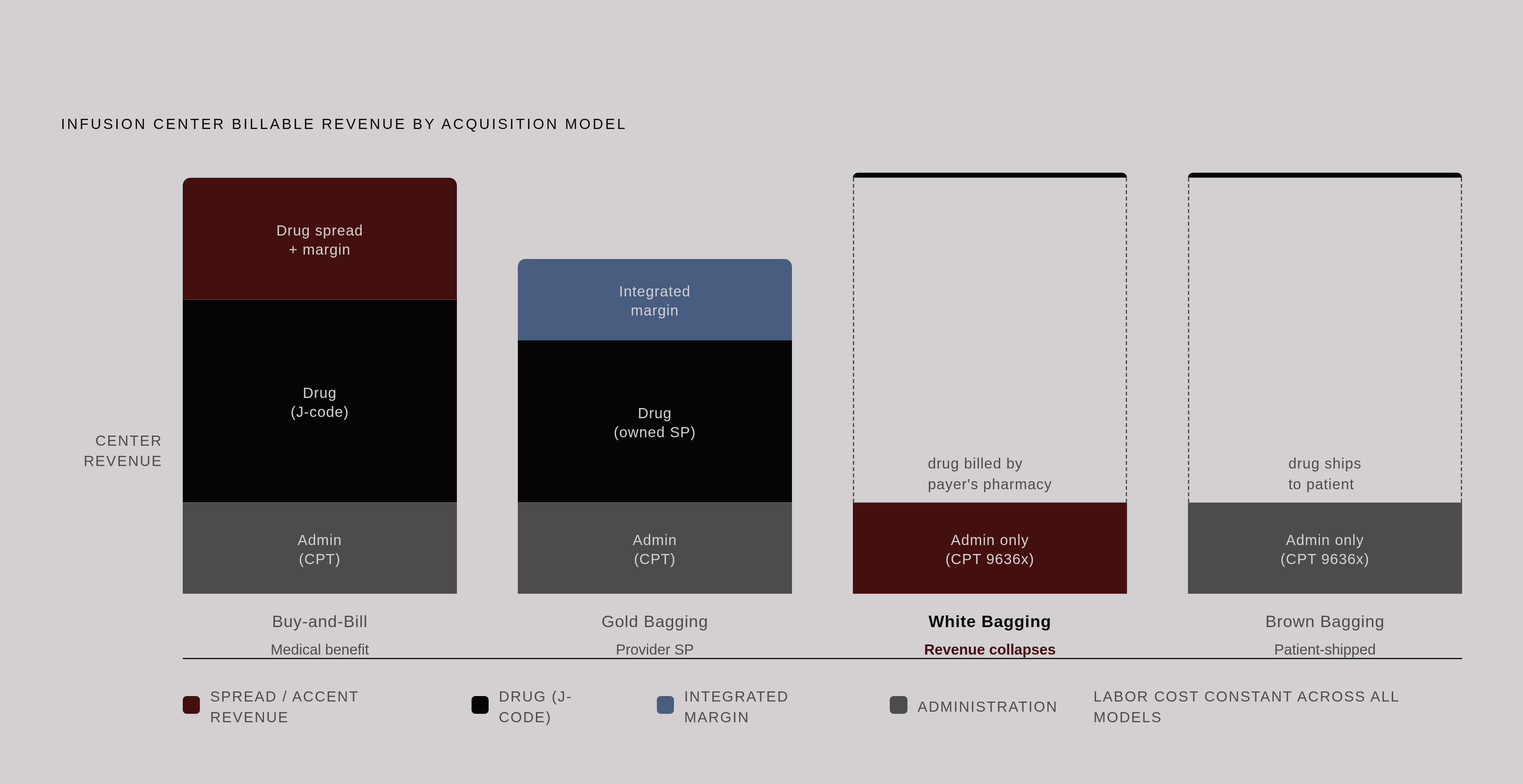
Four drug acquisition models run through infusion today, and they are not interchangeable, no matter how often people talk about them like they are. Buy-and-bill is the traditional path: the provider buys the drug, gives it, and bills a J-code under the medical benefit, collecting reimbursement under the medical benefit at Medicare rates and often more under commercial contracts. White bagging hands the fill to a payer-designated specialty pharmacy, which ships the drug straight to the provider's site; the pharmacy bills the payer under the pharmacy benefit, and the provider bills only for administration. Brown bagging ships the drug to the patient instead, who then carries it in to the appointment, which raises its own handling and liability questions but lands on the center's revenue the same way white bagging does. Gold bagging is the outlier: a health system or provider-owned specialty pharmacy controls the whole chain, from prescribing through administering, so the integrated margin stays in-house.
Practices often describe white bagging as a reimbursement cut. A closer look at the numbers shows something more severe: it removes the funding mechanism buy-and-bill was built on. Under buy-and-bill, the spread between what the drug costs to acquire and what the payer pays back is the engine funding a lot of the practice's overhead. Take that away, and the center is left billing administration codes in the 9636x to 9637x range, maybe a hydration code, nursing time, chair time. A buy-and-bill infusion visit can run anywhere from $5,000 to $50,000 in charges depending on the drug. Under white bagging, the center's cut of that same visit shrinks down to a sliver.
The labor doesn't shrink with it. Specialty infusions still require significant additional labor per patient — hours of coordination, administration, and monitoring — whether or not the center bills for the drug itself. And the waste exposure just moves rather than disappears: when a patient-specific dose ships for a scheduled visit and the dose changes, or the visit gets cancelled, that vial usually gets thrown out. The payer eats the cost of the drug, but the center still eats the scheduling mess and the coordination headache. For a practice built around buy-and-bill margin, a white bagging mandate isn't a line-item adjustment. It's a question of whether administration-only revenue covers the actual cost of treating the patient, and for a lot of centers, it doesn't.
Where the billing workflow fractures when the drug benefit splits from the medical benefit
Buy-and-bill keeps everything under one roof: one payer, one authorization, one claim, one remittance, all under the medical benefit. White bagging splits that into two lanes that don't talk to each other well, and pretending they do is how claims fall through the cracks. The specialty pharmacy handles the pharmacy benefit claim for the drug. The infusion center handles the medical benefit claim for administration. Different payers in effect, different benefit structures, different authorization rules, different timelines for when the money actually shows up.
That split creates real fracture points. Benefits verification now has to confirm both sides: the medical benefit for administration, and separately, whether the pharmacy benefit even mandates white bagging and which pharmacy is designated to fill it. Prior auth has to go to the right benefit; an approval under medical doesn't cover pharmacy, and it doesn't run the other way either. Someone at the center now has to coordinate drug ordering, dosing, and shipment timing directly with the specialty pharmacy, a job that simply didn't exist under buy-and-bill. Scheduling can't lock in until the shipment is confirmed, and mismatched timing, the drug shows up too early or too late, is a known headache in this model. On the claims side, the center only submits for administration; if the drug claim gets denied on the pharmacy side, that doesn't trigger a denial on the medical side, but it can mean the center gives a drug whose payment status nobody's confirmed yet.
One of the most avoidable denials shows up when a center bills for a drug under buy-and-bill, not realizing the payer's policy actually requires white bagging through its designated pharmacy. That gap traces back to a policy compliance failure that starts at intake, and when these denials keep showing up, it means the front end isn't catching payer policy before the drug gets ordered. By the time the denial letter arrives, the drug's already been bought and given to the patient, and there's no walking that back.
Benefits verification under white bagging requires a different checklist than standard infusion intake
Standard infusion verification checks eligibility, coverage tier, deductible status, and prior auth requirements under the medical benefit. That checklist doesn't go far enough here, and running it as-is is how centers get blindsided.
Under white bagging, verification needs to confirm several more things before scheduling moves forward:
- Whether this specific drug, for this specific indication, triggers the payer's white bagging policy at all (it's drug-specific and plan-specific, never a blanket rule)
- Which specialty pharmacy the payer has designated (use the wrong one and the drug simply isn't covered)
- The pharmacy benefit's own formulary tier, step therapy rules, and cost-sharing structure, since patients often pay more out of pocket under the pharmacy benefit than they would under medical for the same drug
- Whether a site-of-care restriction is stacked on top of the white bagging mandate, and whether the administration benefit is even active, since white bagging does not automatically mean administration fees get paid
Documenting the designated pharmacy's contact info, ordering process, and typical lead time also becomes part of the scheduling workflow going forward, not something someone chases down after the fact.
A meaningful share of claim denials trace straight back to intake mistakes: wrong policy numbers, stale insurance cards, eligibility that never got rechecked. Under white bagging, the intake checklist is longer, and a mistake costs more, because it can knock the entire drug delivery chain off track before treatment even happens. Revenue cycle control starts at scheduling, not at the claim form; under this model, that's truer than ever, since the scheduling decision is what sets off the whole procurement process downstream.
Prior authorization under white bagging: two auth tracks, different owners, same patient
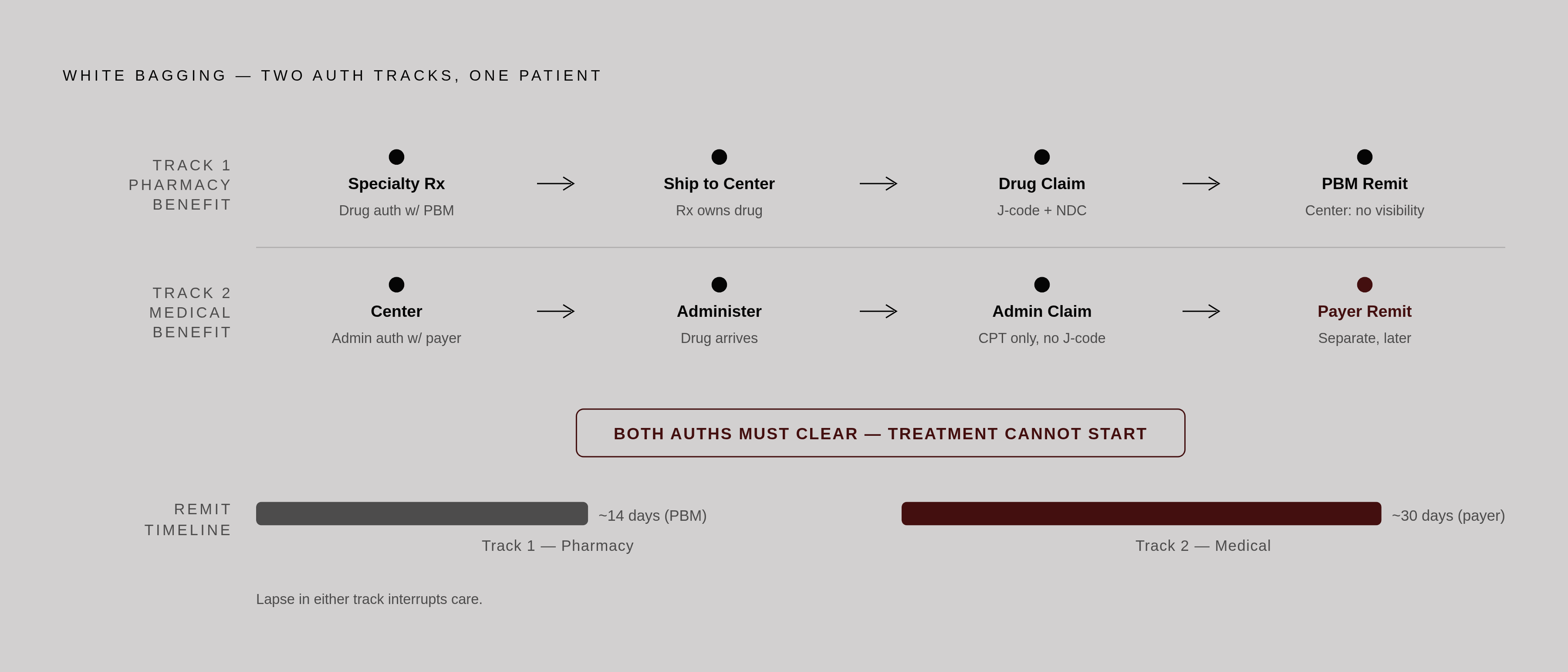
Buy-and-bill puts the center in charge of one authorization covering both the drug and the administration. White bagging splits that ownership, and the center that assumes it still controls both is setting itself up for a surprise. The specialty pharmacy usually handles the pharmacy benefit auth for the drug itself, often with limited visibility for the center into how that process is going. Meanwhile, the center still has to confirm a separate medical benefit auth covers the administration service, with its own documentation requirements. Sometimes these two auths get reviewed by entirely different departments inside the same payer, pharmacy benefit management on one side, medical benefit review on the other, each running its own clinical criteria and its own clock.
Recurring infusions complicate this further. Most specialty infusion drugs need reauthorization every few months tied to dosing cycles or clinical response, and under white bagging, both tracks need to renew on the same schedule. A lapse in either one can interrupt care or leave the administration fee unprotected. Step therapy requirements can differ between the two tracks too; the pharmacy benefit may run its own step protocol independent of whatever the medical benefit already required.
Even though the specialty pharmacy owns the drug authorization, the center still needs to track its status closely. If the drug ships without a valid pharmacy auth behind it, the patient may end up on the hook for the cost, and the center often faces pressure to absorb it or reschedule the visit. A large majority of providers report that prior auth already hurts patient care generally; under white bagging, that burden effectively doubles, since two separate tracks both need to clear before treatment can start. The centers that keep patients on schedule are the ones that start both authorization tracks well ahead of the infusion date instead of waiting on the specialty pharmacy to confirm first.
Coding and claims submission when administration is all the center can bill
Under white bagging, the claim covers administration CPT codes only. No J-code, no drug units, no NDC line anywhere on it. The administration hierarchy still applies in full, and it still generates denials even with no drug revenue at stake: primary infusion, concurrent infusion, sequential infusion, and push services all need to be sequenced and coded right, and NCCI edits fire on administration codes exactly as they would on a full drug-plus-administration claim. Miscoding one of these encounters can cost anywhere from $500 to $3,000 or more in lost reimbursement, and at real infusion center volumes, that adds up fast.
The claim still needs to name which drug was actually given, even though the center isn't billing for it, because payers use that line to cross-reference the pharmacy benefit claim and confirm the drug was really administered. Time-based administration units matter more than ever, since duration drives the fee directly; underdocumented time means underpaid units, full stop. Place of service still affects reimbursement rates and coverage eligibility, and modifiers for bilateral, repeat, or same-day services still apply.
Centers used to building the charge outward from the J-code, where the drug drives the whole encounter, now have to build it outward from administration instead. That's a real workflow shift, not just a mental one; the muscle memory doesn't transfer on its own. And because the drug claim runs through the pharmacy benefit while administration runs through medical, remittance timing for the two won't match. Anyone coordinating benefits with a secondary payer needs to track both timelines separately, not assume they land together.
Denial patterns specific to administration-only claims and how to anticipate them
A handful of denial types show up again and again in this model, and most of them are preventable if the right check happens early enough.
The drug acquisition denial comes from billing a drug under buy-and-bill when the payer's policy actually requires white bagging. It gets coded as a coverage denial, but it traces back to a policy compliance failure, and it means the front end didn't catch the requirement before the drug got ordered. The administration-not-separately-payable denial shows up when a payer bundles administration payment into what it pays the specialty pharmacy, leaving the center with nothing separately payable, something that needs to surface during benefits verification, not after the claim's already gone out. The medical necessity denial on administration can hit even with a clean pharmacy auth for the drug, since the medical benefit may demand its own documentation for the administration site, and step therapy noncompliance on the medical side can trigger this even when the pharmacy side looks fine. And the coordination failure denial happens when the payer cross-references the pharmacy claim, finds no matching dispensing record because the drug never shipped or the pharmacy claim itself got denied, and knocks out the center's administration claim as unsubstantiated.
Payers increasingly run AI and predictive models to flag unusual claim patterns, and a center that just shifted from J-code billing to administration-only claims for a drug it used to bill differently can look anomalous to that system, even when everything's coded right. Denial rates climbed from 30% in 2022 to 38% in 2024, according to the Experian Health 2025 State of Claims Report,, and administration claims, lower dollar as they are, get just as much scrutiny as anything else. Worth remembering: available data shows that 57% of Medicare Advantage denials get overturned on appeal. For administration-only denials backed by clean documentation, appealing every single time, not just when it's convenient, is worth the effort.
The accounts receivable and cash flow consequences of losing drug revenue
Buy-and-bill AR gets anchored by big-dollar drug claims; one denied biologic can leave tens of thousands of dollars sitting unresolved for months. White bagging moves that exposure off the center's books and onto the specialty pharmacy's. That's a real trade: the center loses the upside of drug margin, but it also loses the downside of a drug-denial cash crunch. The AR profile becomes lower-dollar and lower-variance at the same time, which sounds safer and in some ways is, but it isn't free.
The dollar thresholds that trigger escalation and manual follow-up need to be recalibrated, since administration-only claims simply carry less weight per claim than the old drug-plus-administration claims did. Cash flow gets less predictable too: a delayed drug shipment — a real operational risk in this model — means a rescheduled appointment, which means an administration claim that never gets billed in the period it was expected. And because each claim is worth less, the center needs more volume or tighter denial control just to hit the revenue it used to pull in from fewer, bigger claims.
Underpayment risk hasn't gone anywhere either. Payers can shortchange administration codes the same way they've always shortchanged drug codes, and without line-level remittance review, those small shortfalls quietly turn into permanent write-offs, smaller per claim, but potentially more frequent. Practices watching AR only at the total balance level are going to miss this shift entirely. They need to see the claim-type mix, buy-and-bill versus white bagging encounters, to actually understand what their AR represents and where to point follow-up effort.
What the legislative and regulatory environment means for white bagging
White bagging didn't spread by accident, and treating it as some temporary payer quirk misses the point entirely. Commercial payers and PBMs pushed toward it because routing drug cost through the pharmacy benefit gives them formulary control, rebate leverage, and cost containment tools they don't have under the medical benefit. Analysis from the Drug Channels Institute found that two-thirds of commercial health plans reported getting rebates in 2023 tied to provider-administered injectable and infused drugs billed under the medical benefit, which explains a lot about why payers keep expanding these policies instead of pulling back.
The growth curve backs that up. In 2022, 27% of oncology therapy products given in physician offices under commercial insurance were already subject to white bagging. What started with a short list, Remicade and IVIG among the earliest targets, has grown into a long and still-expanding restricted list. Several states have pushed back with legislation restricting or banning white bagging mandates, arguing patient safety and continuity of care are at stake when a provider can't control drug sourcing. That state-by-state patchwork means a center operating across multiple states can face a completely different acquisition model for the same drug depending on which side of a border the patient sits on.
For billing teams, the regulatory picture carries real operational weight. It's the reason the checklist keeps changing, and it's the reason a policy that applied to a given payer and drug combination last year might not apply the same way next year. Treating white bagging as a fixed set of rules, instead of a shifting one tied to state law and payer contract renewal, is exactly how a center falls behind on the intake checks that catch this stuff before the drug ever gets ordered. Ruby RCM, a revenue cycle management platform built specifically for infusion centers that handles benefits verification, prior auth, claims, and AR across both buy-and-bill and administration-only encounters, is one tool designed around exactly this kind of claim-type complexity.