Infusion Clinic Credentialing and Payer Enrollment Workflows
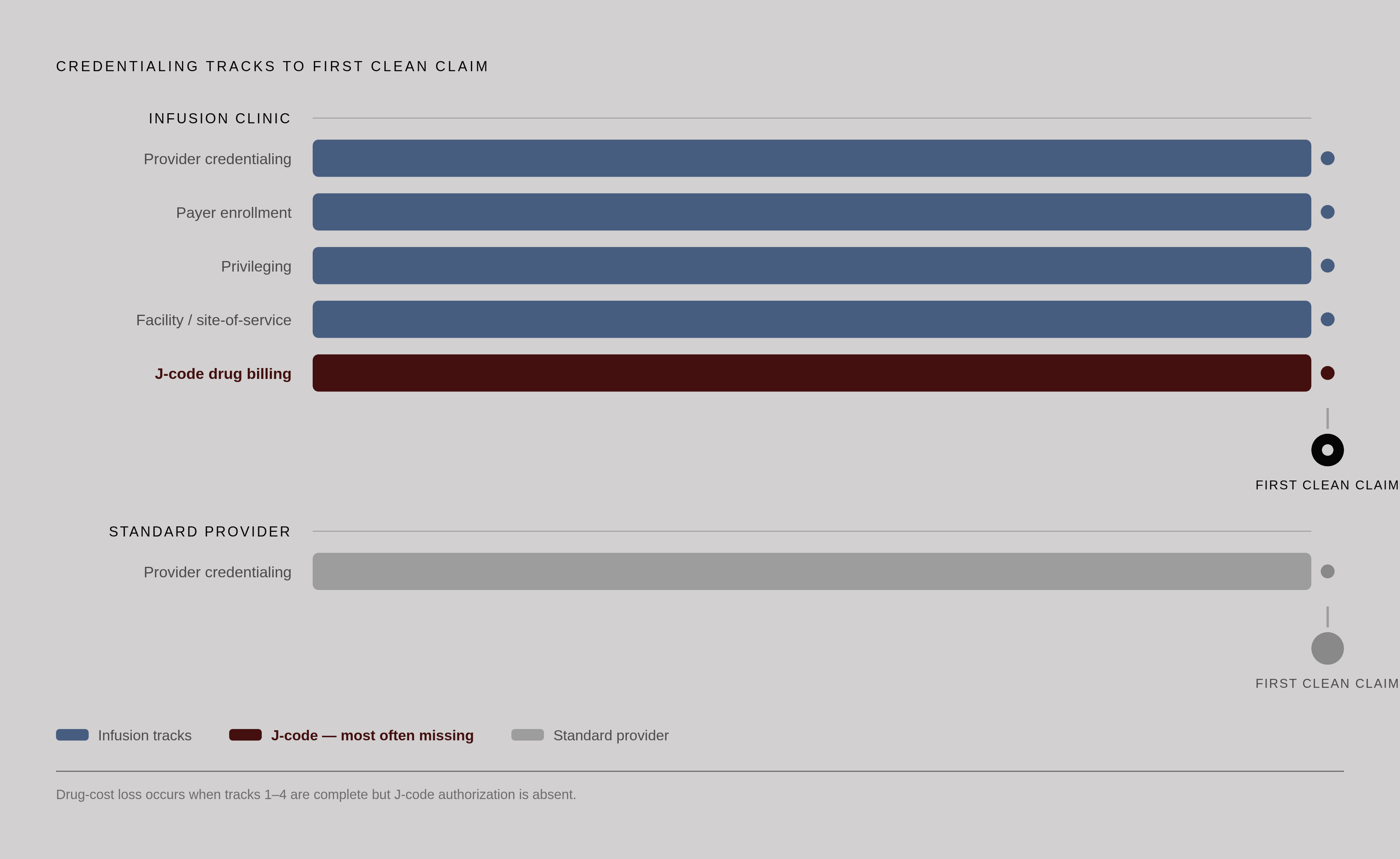
Infusion clinics must coordinate five credentialing tracks simultaneously before billing one dose.
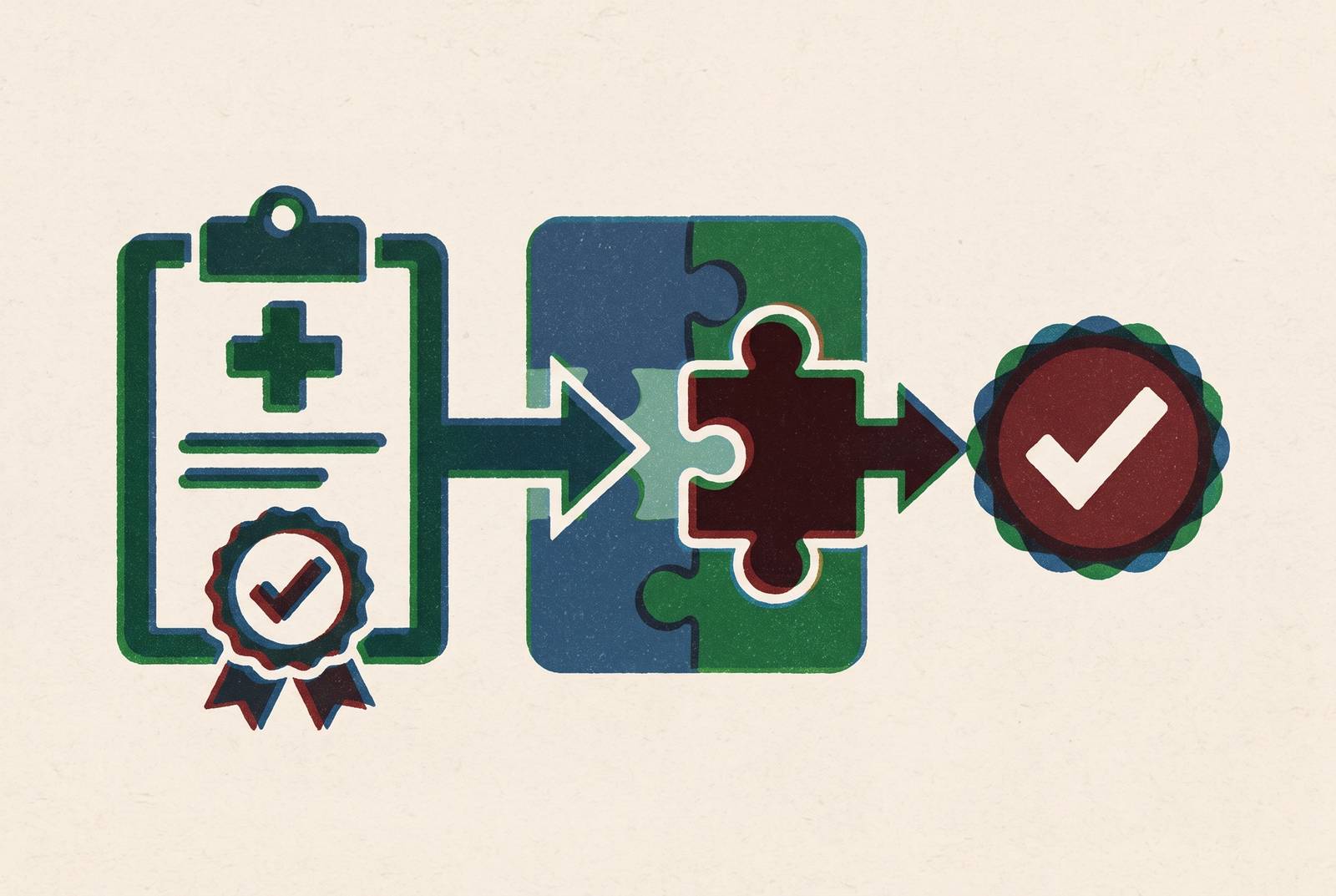
A patient gets a biologic infusion. The drug costs thousands of dollars per dose, and the clinic bought it before the needle ever went in. If the provider who administered that dose wasn't fully enrolled with that patient's payer on that exact date, the claim for the drug gets denied, and there's no appeal that brings the money back.
The underlying rule is the same across every specialty: a provider who sees patients before credentialing is complete can't legally collect reimbursement from most payers for those visits. The drug cost is sunk. The claim window closes. The practice absorbs the loss in full, permanently.
This is what separates infusion credentialing from a routine back-office task. It's a cash-flow event with a hard deadline, tied directly to inventory the practice has already purchased and already given to a patient. Treating it like a form to file eventually means the clinic is gambling with drug margin on every uncredentialed date of service.
Infusion credentialing's structural complexity versus standard provider enrollment
Most provider enrollment workflows assume a single track: verify the provider's qualifications, get them contracted with payers, done. Infusion clinics run four or five tracks at once, and all of them have to land before a clean claim can go out the door.
Three of those tracks apply to any specialty, but infusion makes all three mandatory before the first claim: credentialing, which verifies the provider's qualifications; payer enrollment, which secures the actual contract and billing rights; and privileging, which authorizes the facility to perform specific procedures. Missing any one of the three keeps the claim from going out clean, regardless of how complete the other two are.
Infusion adds a fourth track that most specialties never touch: the infusion suite or facility itself has to be enrolled and tied to the correct NPI for that specific site of service. Miss one disclosure about who owns the suite or how it bills, and the effective date can slip by months, not days.
The office-based infusion center model piles complexity on top of complexity. Rheumatology practices face a related version of the same problem: many of their providers are dual-certified in a base specialty like internal medicine and a subspecialty like rheumatology, and their enrollment has to satisfy both sets of requirements at the same time, often mirroring the same rigor applied to internal medicine enrollment while adding rheumatology-specific hurdles on top.
None of this is exotic. It's just five moving pieces instead of one, and every one of them has to be in place before a dose gets billed.
The 2026 credentialing regulatory environment for infusion practices
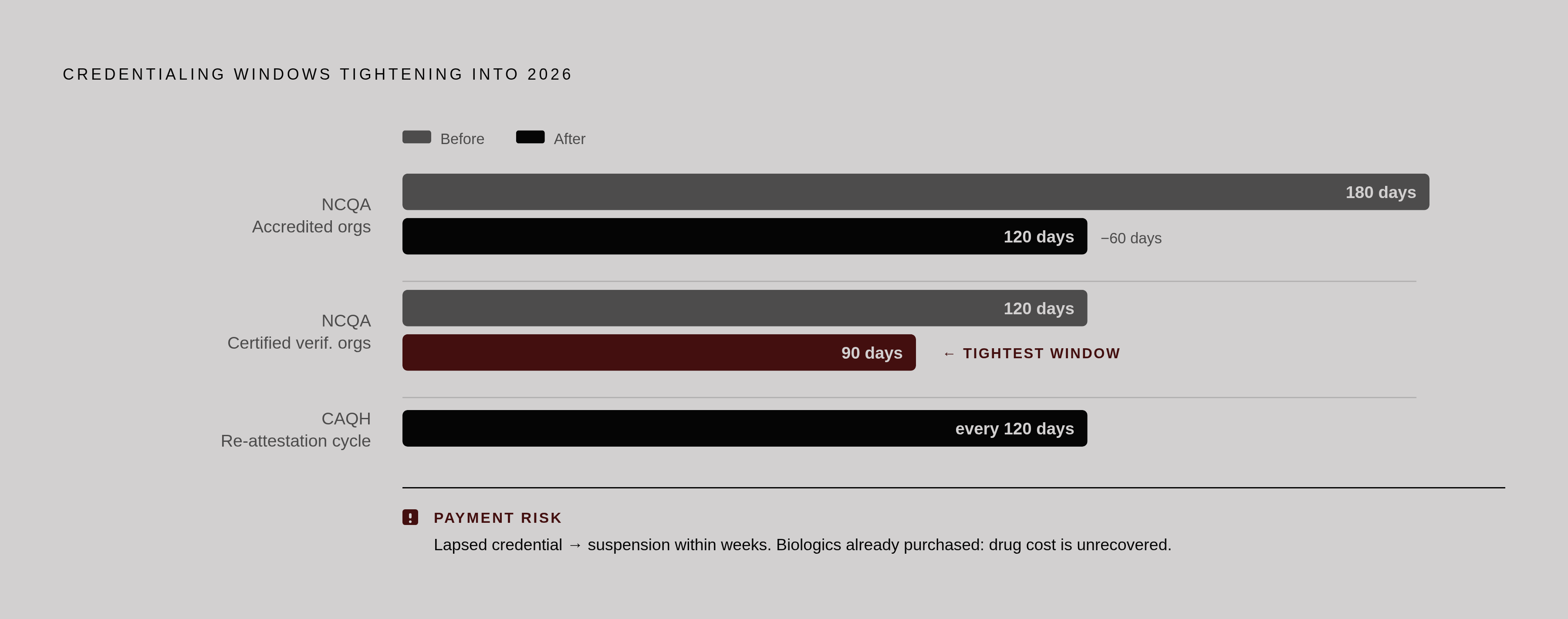
The rules infusion practices build their workflows around tightened considerably heading into 2026, and the margin for error that used to exist has mostly disappeared.
NCQA cut its credentialing window from 180 days to 120 days for accredited organizations, and from 120 days to 90 days for certified verification organizations. Speed now cuts in both directions.
CAQH re-attestation now has to happen every 120 days. For an infusion practice running several enrolled providers, one missed attestation can freeze the whole enrollment portfolio, not just one provider's file.
The monthly cadence matters operationally, in line with guidance OIG has given for years: a lapsed credential can now trigger payment suspension within a few weeks.
Payers have followed NCQA's lead on this point. Continuous monitoring of licenses, sanctions, and exclusions, checked at least every 30 days, is now the baseline expectation. That means a license or sanction issue that pops up at any point after enrollment, not just at renewal time, can trigger a payment suspension mid-cycle. For a practice with biologics already purchased and scheduled for administration, that kind of mid-cycle suspension lands directly on drug cost the practice can't get back.
The end-to-end credentialing and enrollment workflow for an infusion clinic, by stage
A complete infusion credentialing process runs through five stages in sequence. None of them can be skipped or compressed by starting late, and each one sets up the next.
Stage 1: Provider data preparation and CAQH profile completion. For infusion providers, the CAQH profile has to list the infusion site of service as its own distinct practice location, not just the supervising physician's main office address. If that detail is wrong, payer records won't line up with claims billed under the infusion suite's NPI. Data accuracy at this stage decides whether primary source verification moves smoothly or stalls out: name spelling, certification dates, fellowship records, DEA registration, and malpractice coverage all have to match exactly across every document, because any mismatch triggers an immediate Return to Provider status and resets the clock.
Stage 2: Facility and site-of-service enrollment. The infusion suite needs its own enrollment as a distinct billing entity, with its own NPI separate from the supervising physician's individual NPI, and that facility NPI has to be linked inside each payer's system before infusion claims will adjudicate correctly. An in-house infusion suite has to be disclosed and tied to the right NPI in PECOS, and skipping even one disclosure about ownership or site-specific billing can push the effective date back by months. For buy-and-bill practices, the CMS-855B organization enrollment form has to reflect the infusion site specifically, and the J-code billing relationship, the authorization to purchase and separately bill for a drug, needs to be established at this stage rather than tacked on after the provider's own credentialing wraps up.
Stage 3: Payer-specific application submission and timeline management. Enrollment timelines in 2026 vary widely by payer type: Medicare, Medicaid, and commercial carriers each run their own track, with different paperwork and different review committees behind each one. Nearly 30% of provider groups wait more than 8 days for committee approval, and 17% wait more than 31 days. In infusion, every one of those days is a day the practice can't bill for a biologic it may already be administering. A 90-day lead time is the minimum safe window for rheumatology and infusion enrollment, and given how long current payer timelines run, Medicaid applications and multi-payer submissions often call for starting even earlier than that.
Each payer assigns an effective date, and that date marks the earliest date of service the payer will actually pay for, so it needs confirming before any patient is scheduled for a billable infusion under that provider or facility. For infusion specifically, the effective date has to be validated separately for the facility NPI and for J-code billing authorization, because a provider's effective date doesn't automatically turn on the drug billing relationship behind it.
Stage 5: Ongoing maintenance and re-attestation. Credentialing doesn't end at approval. License expirations, sanctions checks, and CAQH attestation cycles all need continuous tracking as a standing operational task, not an annual audit item. If a provider's credentials lapse for even 24 hours, the automated systems major payers run will flag the account, and that flag can trigger an immediate suspension of payments.
Fragmented credentialing systems and billing voids in infusion practices
Most infusion practices that get caught by a credentialing-driven billing gap didn't skip a step. Credentialing, enrollment, and billing run as separate workflows with no shared view across them, so a gap that opens in one track stays invisible to the other two until a denial appears on a claim. Forty-three percent of provider groups use two separate systems to credential a single provider, and 32% rely on three or more, and each extra system is another point where status information gets lost or delayed on its way from one team to the next. Visibility suffers along with it: only 57% of provider groups report full visibility into privileging, and only 62% say they understand how a file actually moves through committee review, which leaves staff chasing updates reactively instead of catching delays before they cost anything.
Infusion failures follow a predictable pattern. Individual enrollment finishes on schedule, but the J-code drug billing authorization behind it never gets established, so the administration code pays while the drug code denies, and the practice eats the drug cost with nothing to show for it. One provider misses a CAQH attestation while every other provider in the practice stays current, and that single provider's payer enrollments quietly stall while the schedule keeps booking infusions under their name, with the denials only surfacing weeks later across every claim tied to that provider. An effective date reaches the credentialing team but never makes it to billing, so claims go out for dates of service that predate the effective date and come back as non-rebillable denials on exactly the high-dollar biologic claims a practice can least afford to lose.
Prior authorization linkage to enrollment as a second billing void credentialing alone does not prevent
Finishing payer enrollment opens the billing relationship, but it doesn't secure the authorization approvals that biologic infusions need before each treatment cycle starts. For therapies a patient receives repeatedly, an expired authorization creates the same billing void a credentialing gap does, and it lands on the same high-dollar claims.
Most infusion medications require prior authorization along with an initial approval request, and that authorization has to be managed as a recurring obligation for every patient, every treatment cycle, on an ongoing basis. Enrollment doesn't carry that authorization forward automatically, so a lapsed authorization on a long-established patient produces the exact same denial a brand-new patient without prior auth would get.
The authorization workflow needs to connect to the enrollment infrastructure from day one. Payer-specific rules, step therapy thresholds, biosimilar preferences, dose limits, how long an approval period lasts, all of that belongs in a living requirements library captured during enrollment, not something staff discover case by case after a claim gets denied. The exposure point in a buy-and-bill model is stark: if authorization gets denied after the biologic has already gone into the patient, the practice absorbs the full drug cost even though enrollment itself was perfectly complete. The missing or expired authorization causes a financial loss that looks identical to a straight credentialing gap. Submitting authorization requests early, at the point of scheduling, gives the practice time to resolve any payer pushback before the infusion date arrives, while the drug is still on hand.
The J-code billing and buy-and-bill exposure that enrollment gaps directly produce
A credentialing or enrollment gap in infusion doesn't just delay a payment. It produces a loss that can't be recovered, covering both the claim revenue the practice never collects and the drug cost it already spent, because J-code billing is counted in drug units that can't be returned or credited once a patient has received the dose.
Biologics like adalimumab, rituximab, and infliximab represent a serious upfront cash outlay for any infusion practice. If the claim comes back denied because of an enrollment gap, that cost never gets recovered.
J-code billing errors often compound enrollment problems. Even when enrollment is fully complete, wrong unit counts, NDC mismatches, or outdated HCPCS codes generate denials that look like simple billing mistakes on the surface but actually trace back to enrollment data that doesn't match, a wrong NPI tied to the claim, or a site-of-service code that doesn't align with what's on file. Practices that haven't updated their billing systems to reflect that switch carry compliance exposure on every 340B drug claim they submit, and that exposure only grows if the underlying enrollment data has gaps of its own.
A credentialing-aware infusion revenue cycle operation in practice
Practices that close these billing voids put credentialing status, authorization tracking, and billing activation into one shared operational view instead of adding more credentialing staff, so no patient ever gets scheduled for a biologic infusion before every prerequisite is already confirmed.
That kind of operation has three defining features. Credentialing timelines get tracked as revenue cycle milestones rather than HR milestones, so the billing team already knows every provider's enrollment status with every payer before that provider ever sees a first patient. Facility NPI enrollment, J-code drug billing authorization, and provider credentialing all run as one linked workflow, so a gap in any single track becomes visible immediately across all three. And authorization work starts at the moment of scheduling, well before the treatment cycle begins, rather than waiting until claim submission, so step therapy requirements and authorization expirations get resolved before any drug cost is committed.
Continuous monitoring takes the place of the old annual credentialing audit. License expiration tracking, CAQH attestation reminders, and monthly OIG and SAM sanctions screening run as automated triggers built into the workflow itself, not as calendar reminders that depend on one person remembering to check, and that walk out the door the day that person leaves. Payer-specific knowledge, step therapy thresholds, biosimilar preferences, authorization period lengths, site-of-care redirection rules, gets built into a standing requirements library that updates as payer rules change, rather than living in one enrollment specialist's head where it disappears the moment that specialist moves on.
The clearest sign that an infusion revenue cycle operation is working this way: the people running the practice can see which providers are enrolled with which payers, which authorizations are active, and which claims carry risk, all without having to manage those workflows by hand themselves. The moment practice staff find themselves doing credentialing busywork instead of seeing clean status and outcomes, the operation underneath them has already broken down.