340B Program Eligibility and Infusion Provider Participation
Discount drug purchasing requires meeting strict eligibility rules and tracking patients carefully.
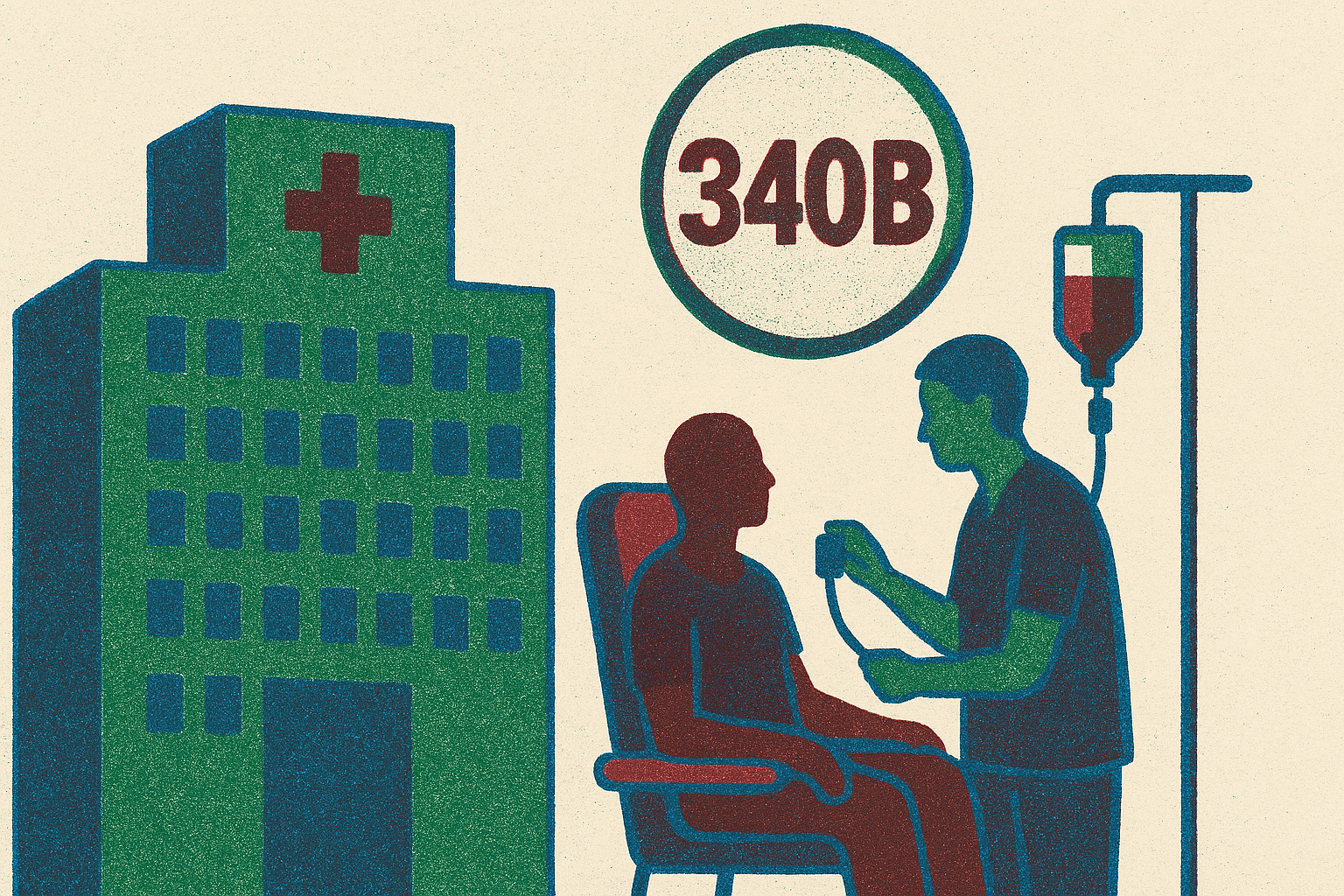
340B lets certain providers buy outpatient drugs at a discount off the manufacturer's price. For infusion specifically, that discount can be the difference between running a program at a loss and running one that actually funds patient care. Congress built the program in 1992 so safety-net providers could stretch federal dollars further, and it's grown into the second-largest federally sponsored drug program in the country, behind only Medicare Part D. Annual purchases now run into the tens of billions.
The math behind it is simple enough on paper. A manufacturer's ceiling price under 340B equals the average manufacturer price minus the unit rebate amount, and for a lot of infusion drugs, that lands well below wholesale acquisition cost. Infusion drugs are some of the priciest things billed in outpatient care, and since reimbursement usually tracks ASP or a negotiated rate, the gap between what a covered entity pays and what it collects is where the whole program's value sits. Providers chase that gap because it cuts drug costs, stretches access for patients who'd otherwise go without, and can turn an infusion service from a cost center into something that actually pencils out.
340B is a purchasing program, not a billing code or a modifier you drop onto a claim. What happens after the drug gets bought, how it's billed, tracked, documented, lives in a totally separate compliance layer. And that layer trips up more infusion providers than the purchasing rules ever will.
Which entity types are actually eligible, and the wall independent infusion centers run into
Eligibility splits into two tracks: hospitals and non-hospital grantees.
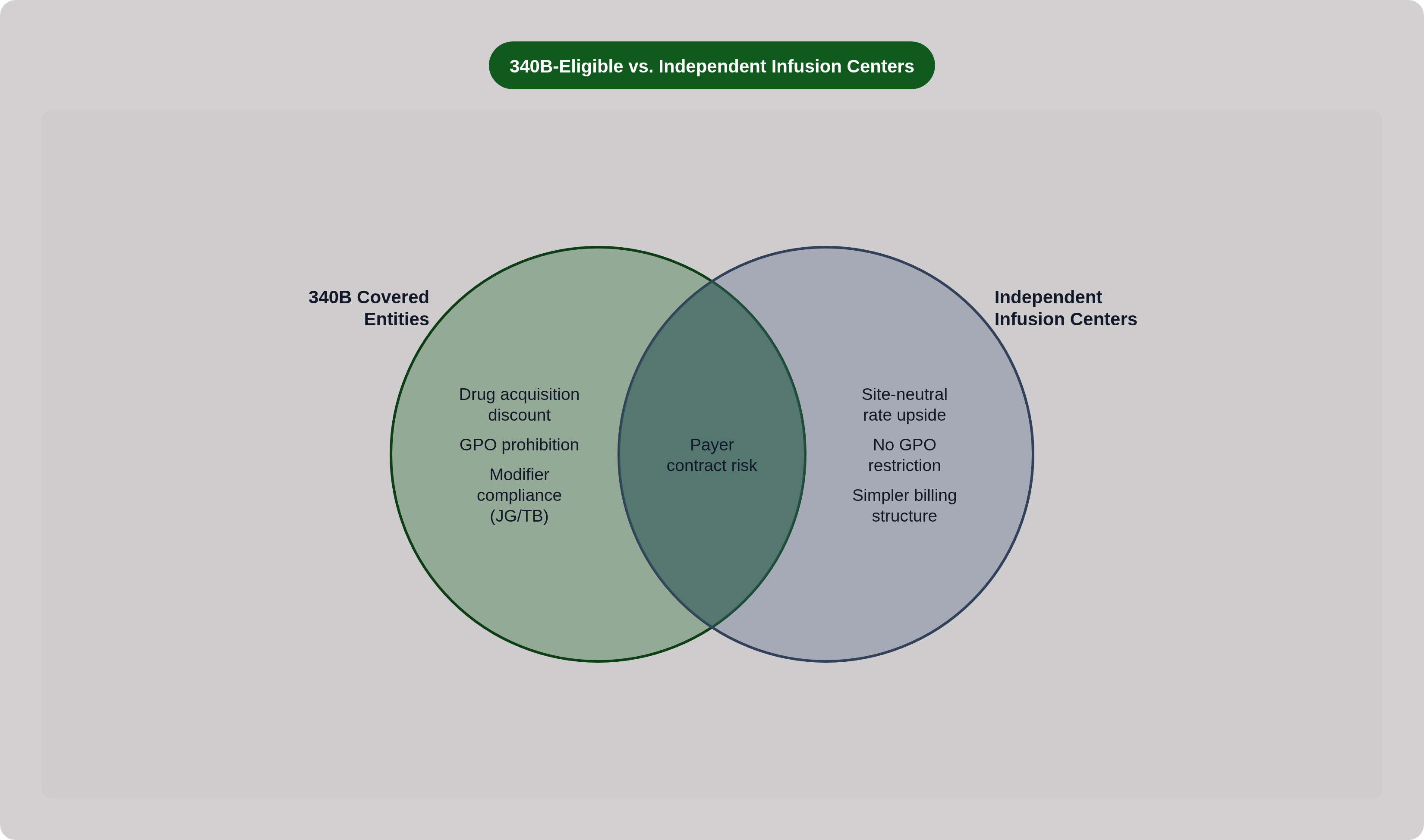
On the hospital side you've got disproportionate share hospitals, children's hospitals, free-standing cancer hospitals, and three rural designations, critical access hospitals, rural referral centers, and sole community hospitals. DSHs, children's hospitals, and free-standing cancer hospitals can't buy covered outpatient drugs through group purchasing arrangements; that's the GPO prohibition. The rural three are exempt, which matters quite a bit for smaller facilities trying to keep supply costs down.
On the grantee side, the categories relevant to infusion-adjacent care include Federally Qualified Health Centers and FQHC look-alikes, Ryan White CARE Act clinics, hemophilia treatment centers, and a handful of other federally funded grant types. None of this hinges on patient volume or payer mix. It comes down to holding an active, qualifying federal grant, period.
A standard independent ambulatory infusion center, or a physician-office infusion suite with no hospital or grantee tie, doesn't qualify as a covered entity under current law. There's no application path that gets a freestanding infusion business into 340B on its own merits, yet the search for one is a common and costly detour.
Three routes can still bring a non-hospital infusion operation into the program. One: operate as or within an FQHC or FQHC look-alike. Two: qualify as a registered child site of an eligible hospital, which means showing up on that hospital's most recent Medicare cost report. Three: set up a contractual or referral arrangement with a covered entity, though that comes with narrower participation and its own strings.
The child-site path needs a caveat that is easy to overlook. Being listed on a cost report gets you eligibility, not cover. You carry the same audit exposure as any other 340B location. So for an independent infusion group looking at this seriously, the real question isn't whether you can apply, it's what structural relationship (hospital affiliation, grant status, contractual tie) would even make you eligible in the first place. That's a legal and operational conversation, and it needs to happen well before anyone calls a wholesaler about 340B pricing.
How the patient definition rule works, and why it's a landmine in infusion settings
HRSA doesn't define "patient" as anyone who walks through the door and gets treated. Three things have to be true at once: there's a documented, ongoing relationship between the person and the covered entity (not a one-off visit), the care comes from a provider employed by or under contract or referral with the covered entity, and the care falls within the scope of services the entity's grant or federal designation actually covers.
This is where infusion gets messy. Picture a patient referred in purely for an infusion, with no other tie to the covered entity beyond that single service. That patient may not meet the patient definition at all, which means the 340B-priced drug given to them could count as diversion, whether or not anyone meant to break a rule. HRSA doesn't require intent. Using a 340B drug on a patient who doesn't meet the criteria is the violation.
Then there's the duplicate discount prohibition sitting on top of it. A 340B drug given to a Medicaid patient can't also trigger a Medicaid rebate to the manufacturer, so somebody has to track which patients are Medicaid-enrolled and bill those specific drugs correctly every single time. That's not a task you finish once and file away. It runs every day, forever, for as long as the program's active.
A pure referral-and-administer infusion model just doesn't fit 340B, unless the covered entity's structure genuinely wraps around that care. Well-intentioned arrangements frequently fall apart right at this point, usually because the patient definition wasn't examined closely until an audit forced the issue.
Registration mechanics, recertification, and what kills your eligibility
HRSA only opens registration during the first two weeks of each quarter: January 1 to 15, April 1 to 15, July 1 to 15, October 1 to 15. Miss it and you wait for the next window, no exceptions.
Once approved, an entity shows up in the 340B OPAIS database and can start buying at discounted prices on the first day of the following quarter. So a missed registration window doesn't cost you a few days. It costs you a full quarter of savings, sitting there unclaimed.
Recertification happens annually and it's mandatory; every covered entity has to affirm through HRSA's online system that it still meets the eligibility bar. But that's not the only trigger. If a child site drops off the cost report, a hospital's DSH percentage slips below the line, or a grantee loses its funding, the entity has to notify the Office of Pharmacy Affairs and stop buying at 340B prices right away. Not at the next recertification cycle. Immediately.
Quarterly registration windows plus a self-reporting duty that never lets up means a covered entity can lose eligibility through nothing more than administrative inattention, no bad actor required. And any claims tied to drugs purchased after eligibility lapsed but before the entity actually stopped buying at 340B rates sit there as both a compliance liability and a repayment risk, waiting for an audit to find them.
Where billing meets 340B status: modifiers, claim-level tracking, and payer audits
CMS requires the JG modifier on Medicare Part B claims for drugs bought through 340B. Skip it when it's needed, or put it on a drug that wasn't actually 340B-purchased, and you're looking at payer audit exposure plus a cut reimbursement rate.
Then there's the TB modifier, mandatory since January 1, 2025, for every covered entity, hospital-based or not. The Inflation Reduction Act created it so CMS can track discounts and calculate manufacturer rebates when drug price hikes outpace inflation. It's not a phase-in. It applies now, across the board.
Both modifiers share the same catch: a covered entity has to prove, claim by claim, that the drug billed really was purchased through 340B and that the patient really was 340B-eligible. Without that traceability behind each claim, the modifier is just a label an auditor knocks down in about five minutes.
Commercial payers have caught on. Retrospective 340B audits are getting routine, and plenty of payers now pay a reduced rate specifically for 340B-acquired drugs, sometimes written right into the contract language. Know which of your contracts carry that clause before you bill, not after a payment shows up light.
Manufacturer restrictions add yet another layer. By early 2024, over three dozen manufacturers had limited contract pharmacy arrangements, some requiring prescription data to route through third-party verifiers. That's real workflow overhead sitting on top of an already complicated process, and it's only grown since.
The Medicaid duplicate discount rule doesn't disappear just because your attention's on commercial claims either. Pharmacy and billing systems need to talk to each other reliably, flagging 340B drugs going to Medicaid patients so the state doesn't collect a rebate on top of a discount already given. A practice that tracks purchases carefully but never carries that tracking through to the claim itself is exposed on two fronts at once, compliance and reimbursement.
How the 2026 site-neutral payment cuts change the 340B math for hospital-based infusion
CMS's CY2026 OPPS Final Rule changes the math for hospital-based infusion in a big way. Starting January 1, 2026, drug administration services at off-campus hospital outpatient departments get paid at the Physician Fee Schedule rate instead of the OPPS rate.
The size of the cut is hard to overstate. Off-campus provider-based departments that keep their excepted status will get roughly 40% of what they used to collect under OPPS, across 61 HCPCS codes tied to infusion and injection services. CMS estimates this trims OPPS spending by $290 million in 2026 alone: $220 million from Medicare, $70 million from patient coinsurance.
None of this came from nowhere. MedPAC had already found that the identical chemotherapy infusion service got reimbursed 186% higher in a hospital outpatient department than in a physician's office, with infusions in HOPDs running 42% more expensive for payers and no measurable difference in outcomes to show for it. The 2026 rule is CMS acting on that finding, plainly and directly.
For a hospital-based infusion program leaning on 340B for margin, the drug discount hasn't moved. But the reimbursement on the administration side, the part that used to make the whole arrangement worth the compliance overhead, just got squeezed hard at off-campus sites. The spread that made hospital-based 340B infusion attractive for so long is narrower now, and it's narrower on purpose.
Here's what's strange: independent ambulatory infusion centers, the ones locked out of 340B entirely, are suddenly better positioned on the reimbursement side. The site-neutral cuts don't touch them, and they can still negotiate rates closer to what hospitals used to collect under old OPPS pricing. The program that shut them out of drug discounts never touched their reimbursement upside.
There's more coming, too. The Same Care, Lower Cost Act, introduced in May 2025, would push site-neutral equalization across additional APC codes starting in 2027. If it passes, the pressure on hospital-based infusion only builds from here. Any hospital-based covered entity running 340B infusion needs to run the numbers now: does the acquisition savings still beat the compliance load and the GPO prohibition once administration-side reimbursement is squeezed this tight? I don't think that question has a clean answer yet, and every finance team in this space should be working through it rather than waiting for one.
The payer behavior layer that makes 340B infusion billing harder
Commercial payers aren't sitting still on any of this. Site-of-care programs have become common: prior authorization rules that push patients toward cheaper settings, lower cost-sharing at preferred sites, and sometimes flat denials for hospital-based infusion when a payer decides another site would do just as well.
For a 340B hospital infusion program, that's a double bind. The payer is cutting reimbursement for the setting at the exact moment it's scrutinizing whether the drug billed even qualified as 340B to begin with.
A few patterns tend to trigger denials that tangle specifically with 340B status. Prior authorizations issued for one site, only to have the infusion happen at a 340B-registered child site with a different address, cause mismatches that flag review almost automatically. Drug-to-diagnosis inconsistencies turn up during retrospective 340B audits more than people expect. Gaps in eligibility or coverage checks can quietly undermine whether the patient met the 340B definition at the point of service in the first place. Modifier mistakes, a missing JG, a wrongly applied TB, aren't just a Medicare problem anymore either; commercial payer audits catch these too, and they're catching them more often.
Infusion billing teams working under 340B need claim-level clarity on three things simultaneously: which drugs were 340B-purchased, which patients met eligibility, and which payer contracts carry 340B-specific rate terms. That's a heavier documentation load than standard infusion billing carries, and volume doesn't make it lighter. If anything, it gets heavier as volume climbs.
If denials keep clustering around 340B-billed claims at one particular payer, that's rarely random. It usually points to a modifier problem or an eligibility-tracking gap, and finding it takes root-cause digging at the payer and therapy level. Watching an aggregate denial rate tick up on a dashboard won't get you there.
What running 340B, or walking away from it, does to an infusion practice's revenue cycle
340B isn't a switch you flip to boost margin. It's a program with real, structural compliance duties, and those duties reshape how billing, pharmacy, and clinical documentation work together day to day, whether anyone likes it or not.
A functioning 340B infusion program needs a handful of things locked in. Drug-level tracking from purchase through administration, often called split billing, keeps 340B inventory separate from everything else. Patient eligibility gets determined and documented at every encounter, not just once at enrollment. Claim-level modifier management, JG and TB both, needs audit-ready backup behind every claim that goes out the door. Payer contracts get reviewed ahead of time so nobody's blindsided by a 340B-specific rate clause after the fact, and Medicaid duplicate discount controls need pharmacy and billing talking to each other in real time, not on a weekly reconciliation call that catches problems a week too late.
Annual recertification and the constant mid-year watch, cost report status, grant funding, HRSA notices, all of it needs someone whose actual job is tracking this. Let it slip for even a quarter and you can invalidate months of purchases made in good faith.
For most independent infusion centers, the ones shut out of 340B entirely, none of this applies. That doesn't make the finances simpler, though. Without a 340B spread, margin comes down entirely to ASP-based reimbursement and whatever rates you can negotiate directly with payers. Different program, different pressure points, same underlying truth: know exactly where your margin comes from, because nobody hands it to you by accident. Platforms like Ruby RCM, a revenue cycle management tool built specifically for infusion centers that handles claims, denials, prior authorizations, and AR, exist precisely because that margin tracking has to happen at the claim level, not the summary level.