Medicare Reimbursement Rates for Infusion Drugs Under Part B

The ASP calculation runs on a six-month delay, and most practices treat that fact as background noise until it costs them something.
Here is how it works: CMS collects manufacturer-reported sales data, processes it, and publishes reimbursement rates that reflect market conditions from roughly two quarters ago. The July 2026 Payment Limit File, for instance, was finalized June 17, 2026. That is a narrow window between publication and implementation.
The lag creates a specific kind of pain. A practice purchases drug at today's acquisition cost and gets reimbursed at a rate built from what the market looked like six months prior. When a manufacturer raises list price after the measurement period closes, the practice absorbs the margin compression until the next quarterly update catches up. When biosimilar competition drives a reference biologic's price down, the eventual benefit arrives only after the lag resolves.
Practices that are not actively tracking the quarterly rate file against actual drug acquisition costs are operating on assumptions with an expiration date they missed. A rate drop does not announce itself. It shows up as a persistent, low-grade shortfall in remittances, and by the time anyone notices, multiple quarters of underperformance have quietly stacked. I have seen practices go a full year without catching it, convinced their billing was clean because the denial queue was empty. The claims paid; they just paid wrong.
Quarterly ASP rate updates have to feed into charge capture and fee schedule maintenance as a standing, scheduled workflow, not something that gets triggered by a billing discrepancy someone stumbled across at the end of the quarter.
Where J-Code Accuracy Becomes the Hinge Point of the Entire Claim
Each drug administered under Part B must map to the correct HCPCS J-code. The payment limit is code-specific. A wrong code produces wrong payment, or no payment.
Unit billing is where errors concentrate most predictably. J-codes are billed in defined increments: milligrams, milliliters, units, depending on the drug. Miscalculating the number of units billed against actual dosing generates either underpayment, which stays invisible until someone reconciles remittances against the correct rate, or an overpayment that becomes an audit target.
Drug waste documentation adds another layer of complexity that catches practices off guard. Single-dose vials frequently contain more drug than the administered dose requires. The JW modifier documents discarded drug from a single-dose vial. The JZ modifier documents that there was no discarded drug. These are not interchangeable, and payers have intensified audits on waste documentation. The wrong modifier creates both a denial risk and a compliance exposure simultaneously.
On multi-drug encounters, NCCI edits are a standing hazard. An oncology infusion visit may involve multiple CPT codes, multiple J-codes, hydration, injections, and supportive care all on the same claim. Each element is an independent denial point. Incorrect classification of primary, concurrent, or sequential administration generates edit-based denials, which is part of why CMS has flagged oncology as a high-risk specialty. The billing patterns are genuinely complex, and the drug portfolio is genuinely expensive.
J-code accuracy is not a coding department concern in isolation. It is the mechanism by which the ASP-based payment the practice already earned by purchasing and administering the drug either gets collected or gets permanently lost.
How Buy-and-Bill Financial Exposure Is Magnified Under ASP+6%
Buy-and-bill creates a financial structure that most non-infusion specialties never encounter. The practice purchases the drug upfront, administers it, and then becomes a creditor waiting on reimbursement. At tens of thousands of dollars per biologic infusion encounter, that is a significant receivable sitting on the balance sheet between administration and payment clearance.
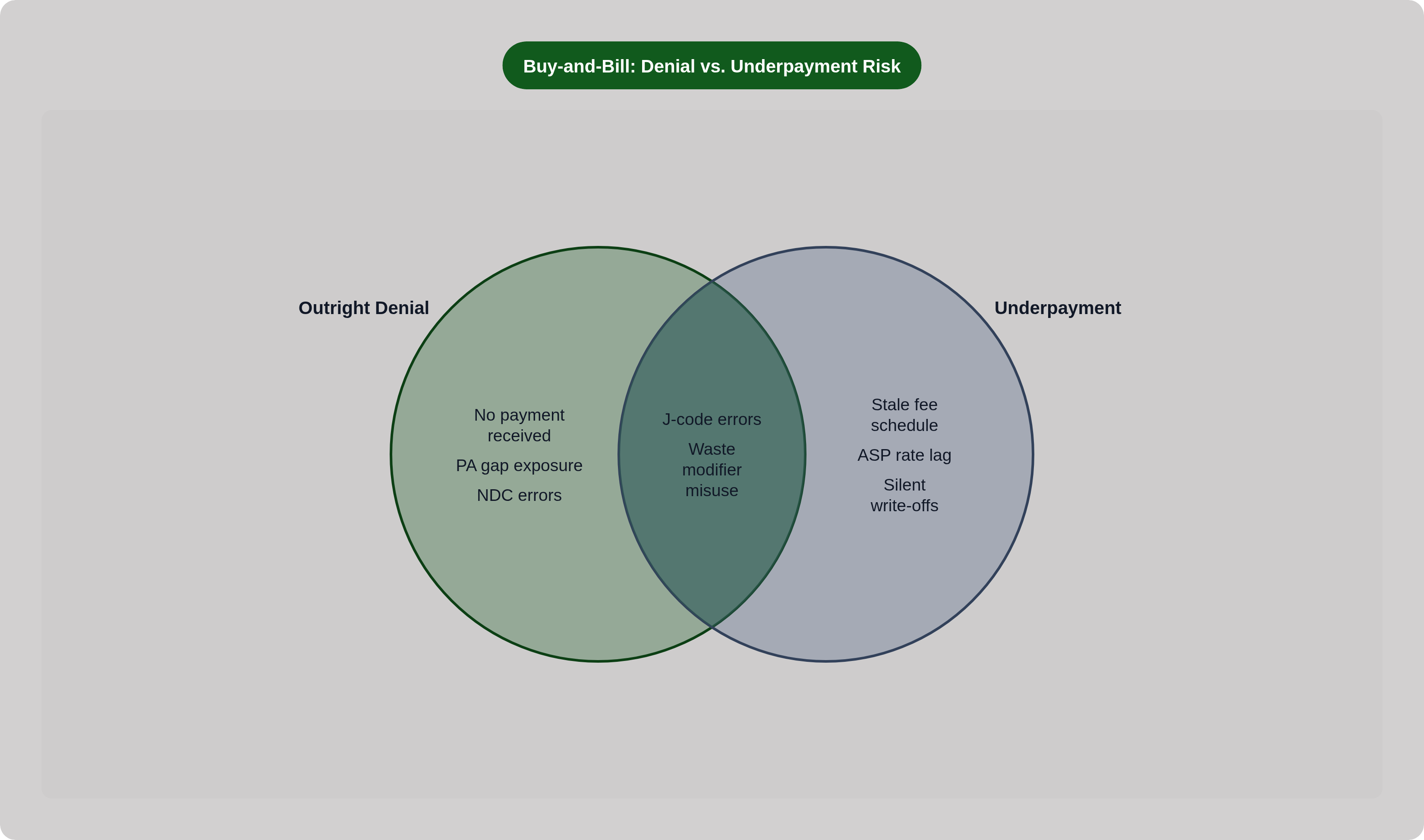
The 4.3% effective margin post-sequestration leaves almost no cushion. That is not enough room to absorb billing errors, underpayments, or stale-rate discrepancies the way a higher-margin product line might allow. Buy-and-bill fails in two distinct ways, and one of them is much harder to see than the other. Outright denial is visible: no payment arrives, and the practice is holding full acquisition cost with nothing to offset it. Underpayment is insidious: payment arrives, clears the receivable off the aging report, and the shortfall between what was paid and what the correct ASP-based rate should have produced becomes a permanent write-off unless someone is reconciling at the drug-line level.
Quarterly ASP rate shifts compound underpayment risk in a specific way. A payer that has not updated its fee schedule to the current quarter's ASP limits is processing claims at a stale rate. The underpayment is invisible until someone goes looking for it deliberately.
Prior Authorization as the Upstream Gate on Buy-and-Bill Revenue
For infusion biologics, prior authorization is the financial prerequisite for buy-and-bill recovery. Administer without approval in place and the practice absorbs the full drug cost with no path to reimbursement. That scenario is not rare; it is a recurring event in practices where PA management is reactive rather than structured and scheduled.
The PA lifecycle for recurring infusion therapy is not a one-time event. Authorization must be in place before the infusion date, must specify drug, dose, frequency, and duration, must be renewed at payer-defined intervals that often run every three to six months, and must be re-triggered whenever the regimen changes. Every one of those touchpoints is a potential gap. Physicians average 43 authorization requests per week, consuming roughly 12 staff hours, per AMA survey data. Practice PA staffing spend jumped 43% between 2019 and 2024, per MGMA analysis. Approval timelines range from one day to a month depending on payer and plan, with no reliable way to predict which requests will move quickly and which will stall.
The downstream effect on clinical practice is not theoretical. A 2022 SamaCare survey found that 91% of providers said consistent PA delays or denials would influence their prescribing if an equally effective alternative existed. PA friction starts as an administrative burden; it eventually reaches the treatment decision itself.
CMS's 2024 Interoperability and Prior Authorization Final Rule requires Medicare Advantage, Medicaid, and ACA exchange plans to respond to urgent requests within 72 hours and routine requests within seven calendar days. As of 2022, only about 28% of medical PA transactions moved through electronic pathways. The rule exists. The infrastructure to support it does not yet match the mandate.
A PA management gap on a high-dollar biologic is not a delayed payment. It is the difference between a collectible claim and an unrecoverable drug cost.
Medicare Advantage Denial Patterns That Break the ASP+6% Assumption
Medicare Advantage plans are required to cover Part B drugs. They manage utilization through prior authorization, step therapy, and site-of-care redirects, all of which intercept or reduce payment on claims that would sail through traditional fee-for-service without issue. The gap between what ASP+6% promises and what MA plans actually pay is real, measurable, and payer-specific in ways that matter operationally.
KFF 2024 data shows MA insurers issued nearly 53 million PA determinations, with a blended denial rate of 6.4%. That average conceals enormous variation. Elevance Health denied 4.2% of requests. UnitedHealthcare denied 12.8%. Within UnitedHealthcare, denial rates on post-acute care climbed from 10% in 2020 to 22.7% by 2022, and on high-acuity categories including specialty injectables, denial rates in the 35% to 56% range align closely with what providers have reported in practice.
AI-driven claim processing has accelerated denial volume in ways that have drawn congressional scrutiny. CMS clarified in February 2024 that MA organizations cannot rely solely on AI or algorithmic tools to make coverage decisions; a human reviewer must be in the loop. Whether plans are actually complying with that requirement remains under active congressional inquiry and class action litigation.
Infusion-specific denial triggers beyond PA include NDC errors, J-code unit miscalculation, 340B modifier disputes, documentation gaps, and site-of-care redirects. A large majority of denials are eventually overturned due to administrative errors. That figure means the large majority of infusion denials are preventable at the front end, not inevitable outcomes requiring back-end appeals.
Payer-specific denial patterns are not uniform, and managing denials generically misses the signal. The mix of triggers, appeal pathways, and resolution timelines varies by plan. Practices that track denial patterns by payer, by drug, and by claim type develop the pattern recognition to prevent recurrence. Practices routing everything through a generic appeals workflow accumulate the same losses quarter after quarter without ever understanding the source.
How IRA Drug Price Negotiation Will Restructure Infusion Margins Starting in 2028
The Inflation Reduction Act's Maximum Fair Price mechanism will begin applying to Part B drugs in 2028. This is a legislatively mandated, escalating schedule, not a distant policy possibility.
The scale of exposure is significant. Forty drugs selected for negotiation to date accounted for 36% of total Medicare Part B and Part D drug spending, representing $125 billion out of $350 billion in 2024. The third negotiation cycle covers approximately $27 billion in Medicare spending and includes the first Part B medicines to face IRA-enabled price cuts. From there, the schedule is fixed: 15 additional drugs for 2027, 15 more for 2028 when Part B drugs formally enter, then 20 per year from 2029 onward.
The agents with the highest Medicare volume are the most probable negotiation targets. Those are precisely the drugs generating the most buy-and-bill revenue today. The practices most exposed to IRA restructuring are the ones most concentrated in agents that will be negotiated first.
One near-term development worth tracking: the One Big Beautiful Bill Act, signed July 4, 2025, expanded the orphan drug exclusion, which delays Keytruda and Opdivo from the 2028 negotiation cycle. For oncology infusion programs with significant volume in those specific agents, that is a meaningful reprieve, though not a permanent one.
The IRA also increased biosimilar reimbursement from 6% to 8% for qualifying agents. That differential will grow more consequential as the negotiated price regime compresses margins on reference biologics, creating a direct financial incentive to shift toward biosimilars where clinical appropriateness supports it.
When a drug enters the Maximum Fair Price regime, its ASP calculation resets to reflect the negotiated price. Practices that have modeled buy-and-bill economics on current ASP levels will be working from the wrong baseline when those drugs move. Recalibrating ahead of 2028 is not optional due diligence; it is the minimum.
What Site of Care Determines About Reimbursement Before a Single Claim Is Filed
Site of care is a reimbursement determinant, not a logistical variable.
Freestanding infusion centers and physician offices bill under the physician fee schedule and receive ASP+6%, effectively 4.3% post-sequestration, for Part B drugs. Hospital outpatient departments bill under OPPS and typically receive ASP+4% or less. That differential is structural. Independent settings carry higher drug margins than hospital outpatient departments before a single claim is filed, all else equal.
Home infusion operates under a separate fee schedule entirely. CY 2025 national rates range from $186.16 per day for IV drug administration to $380.58 for the first home visit for chemotherapy. The drug bills separately under Part B. The reimbursement logic is different, the documentation requirements are different, and the governing fee schedule is different. Billing home infusion like an office visit is a reliable way to create both underpayments and compliance exposure simultaneously.
Site-of-care redirects by payers are a denial-adjacent tactic that practices sometimes misclassify as a claims issue. When a payer steers a patient toward a hospital outpatient setting, the practice does not receive a denial on a claim. It simply loses the revenue opportunity before the claim exists. That distinction matters because the remedy is upstream, at the PA and contracting level, not in the appeals queue.
For independent infusion centers, the financial argument for site differentiation is built into the rate differential. That advantage holds only if the billing infrastructure correctly captures the setting, applies the right fee schedule rules, and prevents payers from reassigning care to a lower-margin site without clinical justification.
The Revenue Cycle Functions That Have to Work Together to Protect ASP-Based Payment
Each of the sections above isolated a specific failure mode. The operational reality is that they interact, and the interaction is where practices lose the most money. A PA gap sets up a denial. A J-code error turns an otherwise clean claim into an underpayment. A stale fee schedule turns that underpayment into a permanent write-off because no one in remittance review noticed the delta. The failure modes compound quietly while the denial queue looks clean and the aging report looks acceptable.
Quarterly rate maintenance is the connective tissue between every other function described here. It means pulling the CMS Payment Limit File the week it publishes, updating the fee schedule in the practice management system before claims go out, and flagging any drug line where the new rate diverges materially from acquisition cost. That flag is an operational alert. It signals that buy-and-bill margin on that agent has changed and that claim integrity on that J-code deserves tightened scrutiny going forward.
PA tracking has to operate by drug, by payer, and by renewal date, with lead times built in for each payer's processing window. The practice that knows its MA plan requires 14 business days for routine requests does not administer on day 13. The practice that skips tracking that variable finds out the hard way, and the finding usually involves an unrecoverable drug cost.
Denial analytics have to be payer-specific and drug-specific. An overall denial rate of 8% tells you almost nothing actionable. A denial rate of 31% on one J-code from one MA plan, concentrated in claims where the NDC was drawn from a 340B-designated purchase, tells you exactly where the process broke and what to fix.
Remittance reconciliation at the drug-line level is not optional at the revenue concentrations that characterize infusion billing. If the practice is not comparing the paid amount against the current quarter's ASP payment limit on every J-code line, it is not detecting underpayments.
None of these functions operates effectively in isolation. The PA team, the coders, the billing staff, and whoever owns fee schedule maintenance have to share information on a rhythm that matches the quarterly CMS publication cycle. That rhythm is the operational floor for managing ASP-based reimbursement without compounding risks that are already baked into the structure of the system.