Injection and Infusion Coding Examples for Common Scenarios
Every injection and infusion encounter is governed by three designations: initial, sequential, and concurrent. They determine which codes fire and, because reimbursement flows from those codes, how much the practice actually collects.
The initial infusion code covers the first substance administered or, when multiple drugs are involved, the substance that sits highest in the service-type hierarchy. That hierarchy, from highest to lowest, runs chemotherapy administration, then therapeutic and prophylactic infusions, then hydration. Clock order does not determine which drug is "initial." Hierarchy does. A coder who anchors the claim to whichever bag was hung first will misprice the encounter every time a lower-priority drug goes up before a higher-priority one.
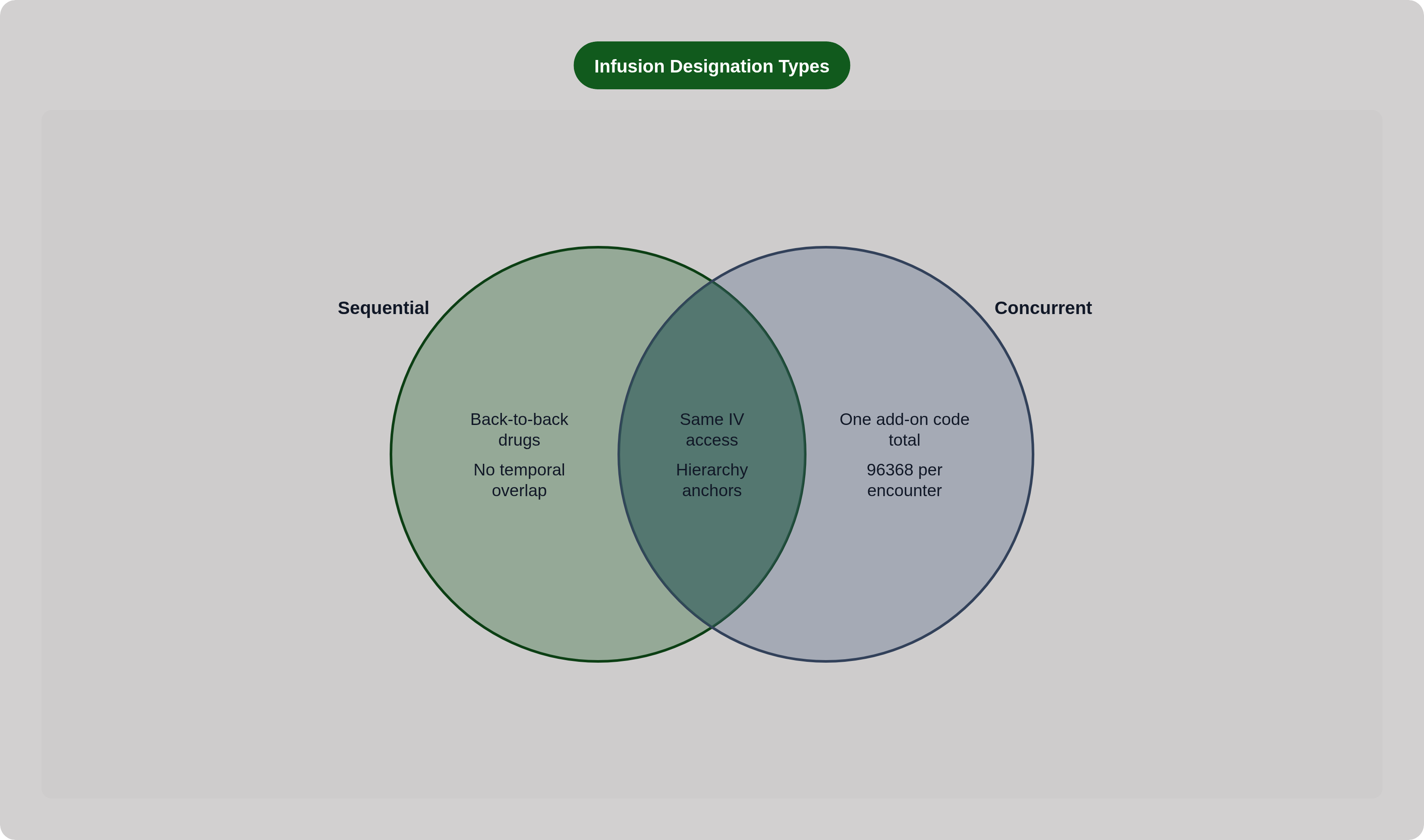
Sequential designation applies when a second substance begins after the prior infusion has completely ended: same IV access, no temporal overlap, drugs running back to back. If the second substance is the same drug as the first, the additional-hour add-on applies. If it is a different drug, the sequential new-drug code applies. These are not interchangeable; using the wrong one misstates the clinical facts to the payer in ways that create both denial exposure and audit risk.
Concurrent designation applies when a second drug runs simultaneously through the same access point while the primary infusion is still active. One concurrent add-on code covers the overlap regardless of how many additional drugs are piggybacked onto the primary line. Three drugs running concurrently produces one concurrent code, not three.
The most persistent misread: a nurse hangs Drug B while Drug A is still infusing, and the coder bills sequential because the drugs are different substances administered at different moments. The clinical reality is concurrent. That error inverts both the designation and the payment, and it repeats invisibly across every similar encounter until someone audits the records and traces it back to a fundamental misunderstanding of what "concurrent" actually requires.
Single-Drug Infusion Scenarios: Applying 96365 and Its Add-On Correctly
Start simple. A patient receives a single therapeutic infusion, iron sucrose, for 90 minutes. The correct claim is 96365 for the initial hour and 96366 for the remaining time. The threshold for adding 96366 is a fraction exceeding 30 minutes beyond the first hour, so a 61-minute infusion does not earn the add-on. A 90-minute infusion does. This 30-minute threshold is one of the more routine documentation gaps I see: the nursing record shows a start time but a vague or missing stop time, and the coder cannot confidently support the add-on without it.
Change one variable. Same drug, same patient, but the documented infusion time is 12 minutes. That administration falls below the 16-minute minimum CMS guidance requires before billing 96365. The correct code is 96374, an IV push. Submitting 96365 is an error, and it creates both a denial risk and a compliance exposure that cannot be resolved after the fact by arguing clinical intent.
The drug itself, iron sucrose in this case, bills separately on its own claim line using the applicable J-code. The unit calculation follows the per-unit dose in the HCPCS descriptor, not the vial size. Iron sucrose under J1756 is billed at one unit per milligram administered, so a 100 mg dose is 100 units. Billing by vial rather than by administered dose is persistent and auditable given how clearly the descriptor reads.
As of January 1, 2024, every single-dose vial J-code claim under Medicare requires either the JW modifier for documented wastage or the JZ modifier indicating no wastage. Omitting both triggers rejection or recoupment audit, and Medicare Advantage plans are increasingly aligned with this requirement. Practices that treat it as a detail to clean up later are accumulating exposure they do not fully see yet.
Multi-Drug Infusion Encounters and Why Billing 96413 Twice Is the Most Common Oncology Coding Error
The single most prevalent billing error in oncology infusion is straightforward once you see it: a practice administers two chemotherapy agents sequentially and submits 96413 for both. Payers pay one initial code per encounter. The second 96413 denies, and the practice absorbs the administration revenue on Drug B across every multi-drug encounter until someone audits the records and traces the pattern.
The correct claim for a two-drug sequential chemotherapy encounter is 96413 for the initial drug and 96417 for the sequential new drug, one unit of 96417 per new substance, not per hour of that substance. If Drug B runs for two hours, that produces one unit of 96417 plus an additional-hour add-on if the duration qualifies.
When Drug B is added concurrently, before Drug A finishes, the code shifts to 96368. That code fires once per encounter regardless of how many drugs overlap with the primary infusion. A third concurrent drug does not generate a second 96368.
Hydration running alongside a therapeutic or chemotherapy infusion sits at the bottom of the hierarchy and does not anchor the claim. Billing hydration as the primary service when a higher-priority infusion is present inverts the hierarchy and misprices everything downstream from that anchor.
The financial stakes are real. In infusion-heavy specialties operating under buy-and-bill, a denied administration claim leaves the practice absorbing the acquisition cost of the drug. For high-cost biologics, that exposure can reach tens of thousands of dollars per encounter. Administration coding errors in these practices are financial, not clerical, and they compound.
IV Push Scenarios and the Documentation Line That Separates a Push from an Infusion
The boundary between an IV push and an IV infusion is duration, not the drug being administered. Under CMS guidance, administration under the 16-minute threshold is a push. The code is 96374, not 96365.
Consider this scenario: a patient receives an antiemetic by IV push before a chemotherapy infusion begins. The push stands on its own claim line as 96374. The chemotherapy infusion remains the primary service by hierarchy, not because it ran second on the clock. The sequencing in the nursing record tells the coder what happened; the hierarchy tells the coder how to code it.
When a second push drug follows the first, 96375 applies for each additional sequential IV push of a new substance. When the same drug is pushed again, 96376 covers the repeat dose, but that code is restricted to facility billing. Applying 96376 in a non-facility setting may process silently or deny outright, and the silent ones accumulate undetected.
The documentation failure I see most often in this context: a drug is set up as a piggyback and administered without a stop time in the nursing record. The coder infers a 30-minute infusion and bills 96365. If the actual administration was under 16 minutes, the code is wrong. A claim without a documented stop time cannot be defended on audit.
The compliance risk runs in both directions. Overcoding a push as an infusion is an audit target. Undercoding an infusion as a push leaves revenue on the table. Both trace back to the same origin: an incomplete record.
Intramuscular and Subcutaneous Injection Scenarios Under 96372
Code 96372 covers therapeutic, prophylactic, and diagnostic injections delivered intramuscularly or subcutaneously. It is not an IV code and does not interact with the 96365 to 96368 infusion hierarchy. Applying it to an IV administration is both a coding error and a compliance flag.
Consider a practice administering a biologic subcutaneously in the infusion center, a self-injectable that the patient's plan requires be given on-site. The administration code is 96372. The drug bills separately on its own J-code line, with units calculated from the administered dose and the per-unit descriptor in HCPCS, not from vial size.
When a patient receives an IM injection and a separate IV infusion in the same visit, 96372 and the applicable infusion code bill as separate services. The injection does not subordinate to the infusion hierarchy. Both generate their own J-code lines with correct unit calculations, and the two services coexist on the claim without one absorbing the other.
Vaccines are coded from a separate section of CPT entirely. Applying 96372 to a vaccine administration is a misapplication that does not withstand even routine payer review.
Same-Day Encounters with Multiple Service Types: How the Hierarchy Resolves Conflicts
The clearest way to see the hierarchy at work is a genuine multi-service encounter. A patient arrives for a 90-minute biologic infusion, receives an antiemetic by IV push before the infusion starts, and gets a B12 injection intramuscularly at the end of the visit.
The biologic infusion anchors the claim: 96365 for the initial hour, 96366 for the qualifying additional time. The antiemetic push, despite occurring before the infusion chronologically, does not become the "initial" service; hierarchy overrides clock order. It bills as 96374 on its own line. The B12 injection bills as 96372, entirely separate from the infusion hierarchy. Each drug generates its own J-code line with correct units and the applicable JW or JZ modifier for single-dose vials.
Now alter one variable: the antiemetic infuses concurrently with the biologic rather than preceding it as a push. That single change shifts the antiemetic from 96374 to 96368. Same drug, same visit, different code, because the nursing documentation shows overlap rather than separation. The documentation controls the code, not the intent behind the administration.
Payer-specific editing adds another layer. Some payers bundle the push or concurrent add-on when billed alongside a primary infusion on the same claim. This is payer behavior, not a coding error. Knowing which payers apply this edit, and appealing with supporting documentation when they do, is a core competency in infusion billing.
Where Coding Errors Originate and What the Infusion Record Must Capture to Prevent Them
Every scenario above shares the same failure mode: the code is wrong because the record did not capture what happened with sufficient specificity to support the correct code. The problem is almost never the coder. It is the record the coder received.
Four documentation elements determine coding accuracy in infusion encounters. Start and stop time for each drug: without these, push versus infusion cannot be established, sequential versus concurrent cannot be established, and add-on hour eligibility cannot be established. Drug name, dose administered, and route: these drive J-code selection and unit calculation, and an ambiguous entry in any of the three introduces error that compounds on every similar encounter going forward. Vial size and amount wasted: required for JW and JZ modifier compliance, and unrecoverable after the encounter closes if not captured in real time. Order of administration and any overlaps: the factual basis for sequential versus concurrent designation and, by extension, for the entire coding structure of a multi-drug encounter.
The 16-minute push-versus-infusion threshold is the most documentation-sensitive rule in this entire code set. A missing stop time on a short infusion cannot be reconstructed from memory or clinical inference, and no legitimate back-end correction retrieves that revenue.
Multi-drug encounters multiply the documentation surface proportionally. Each drug needs its own time stamp, its own dose entry, and its own route notation. One consolidated nursing note for a four-drug infusion encounter is a billing liability that will eventually surface in an audit.
The infusion record is not an input to the claim. It is the claim. By the time a coder receives a record with missing times, ambiguous overlaps, or unspecified routes, the correctable problems have already been seeded. Training nursing staff to understand why the documentation matters, not just what to document, is how practices prevent the errors these scenarios illustrate. Compliance is built at the chair, long before the claim is ever submitted.