CMS Documentation Requirements for Infusion Claims

The physician order is the legal foundation for every line on an infusion claim. Without it, nothing else in the record matters. Not the nursing notes, not the MAR, not the authorization. I've seen practices with meticulous clinical documentation lose claims entirely because the order was vague, unsigned, or failed to connect the drug to a diagnosis.
Per 42 CFR 486.520, the plan of care must specify the type of infusion therapy, the drug and dosage, and the duration of treatment. Vague standing orders don't satisfy this requirement. "Infusion therapy as needed" is not a plan of care, and it will not survive scrutiny regardless of how thorough everything else in the chart looks.
The diagnosis connection must be visible on the face of the order. Medical necessity is not implied by the presence of a diagnosis code somewhere in the chart. The order must explicitly link the administered drug to the patient's diagnosis so that any reviewer, whether a payer's automated system or a RAC auditor requesting records two years from now, can trace the clinical rationale without having to interpret anything.
Signature and dating requirements are concrete and non-negotiable. The ordering physician must sign and date the plan of care before a claim is submitted. Any change to the plan requires a new signed and dated order, not an amendment, not a verbal update confirmed by staff, not a co-signature on a modified document. Electronic signatures are accepted under Medicare rules, but the system generating them must include protections against modification and must meet administrative safeguard requirements. If a scribe or AI-assisted documentation tool creates the entry, the ordering physician must personally authenticate it. The technology does not substitute for physician signature.
For home infusion suppliers, structural requirements extend further. The claim must include line-item G-codes for each drug administration calendar day, with professional service time reported in 15-minute increments. The order must support each of those reported units, individually.
What this means operationally is that order intake and physician signature workflows are revenue cycle functions, not just clinical ones. An incomplete or unsigned order at the time of scheduling creates billing exposure that cannot be corrected after the claim is filed.
How Nursing Timestamps Determine What Time-Based Codes Can Be Billed
Infusion billing is arithmetic before it is anything else. The initial service code, additional-hour add-on codes, and sequential drug codes are all computed from precise start and stop timestamps for each substance administered. Nurses writing those times into a chart are, whether they know it or not, writing the claim.
CPT rules require that a substance infuse for more than 15 minutes to qualify as an infusion rather than an IV push. The nursing note must affirmatively support that threshold. If the record shows a drug was administered but not how long it ran, the billing assumption a payer's auditor will apply is IV push, which reimburses at a lower rate. The benefit of the doubt belongs to the payer, not the practice.
Only one initial code is billable per encounter. A second initial code requires two separate IV sites that are medically reasonable and necessary, documented as such, and billed with modifier 59. If a patient returns for a separate, distinct encounter on the same calendar day, a second initial code can be supported, but only with modifier 59 and documentation establishing the visits as clinically separate and independently medically necessary. Both conditions must be met.
Hierarchy rules govern how multiple drugs in a single encounter are coded: infusion is primary, IV push is secondary, hydration is last. The nursing record must show the sequence clearly enough to apply that hierarchy without guesswork.
The most pervasive documentation failure in this space is absent or imprecise per-drug start and stop times. When drugs are administered sequentially, the record must show the stop time of the first drug and the start time of the next. Without that transition notation, payers assume concurrent administration, and sequential billing becomes indefensible. Line flush documentation carries the same weight; payers will deny sequential billing when flush records don't establish whether substances were compatible or sequentially distinct.
A nursing note template that captures drug name, route, access site, start time, stop time, and any interruptions is the direct input to the billing calculation, constructed once, at the point of care, with no opportunity for retrospective correction that a payer is obligated to accept.
Drug Administration Records and What They Must Show to Support J-Code Billing
J-codes identify specific drugs by NDC or HCPCS code and bill for the drug itself, not just its administration. In a buy-and-bill environment, the acquisition cost is already spent. A documentation gap here makes the drug cost unrecoverable.
The administration record must match the claim exactly. Drug name, NDC, units administered, and route must be consistent across the nursing note, the medication administration record, and the claim line. Discrepancies between what was ordered, what was documented as administered, and what was billed are a primary audit trigger. Payer systems are increasingly automated in detecting these inconsistencies, and they operate without any instinct toward charitable interpretation.
IVIG illustrates what layered, drug-specific documentation requirements look like when CMS is serious about them. Accurate weight in kilograms must be recorded before each infusion; dosage is calculated per kilogram, so a missing or outdated weight undermines both the clinical and the billing record simultaneously. Physician orders must be no more than 30 days old at the date of service and must specify dose, frequency, and route. After the first infusion, subsequent orders must be accompanied by documentation of the patient's response to prior infusions. Supporting physician rationale must be current within the last 12 months. Evidence of prior failed conventional therapies, or documentation that conventional therapy is contraindicated, must be present in the chart. According to 2024 Medicare Fee-for-Service Supplemental Improper Payment Data, the improper payment rate for IVIG was 4.6%, projecting $7.6 million in improper payments.
These requirements represent what CMS expects for any high-cost biologic: a traceable clinical rationale, a current order, a documented treatment response pattern. IVIG is the clearest illustration of how granular those expectations actually are.
One documentation gap that persists even in otherwise thorough clinical records is NDC-to-J-code crosswalk accuracy and unit-of-measure translation errors. These are coding failures that occur after documentation is complete, but they are equally audit-exposing. They are correctable, but only if the underlying administration record is precise enough to reference during an appeal. If the source record is vague, there's nothing to appeal from.
Medical Necessity Documentation and How LCDs Define the Evidence Standard Payers Apply
Medical necessity is not self-evident from a diagnosis code. The clinical record must affirmatively demonstrate why this particular patient, on this particular date, required this drug at this dose. A claim that doesn't answer that question in the chart is vulnerable regardless of whether the treatment was clinically appropriate. Appropriateness and supportability are not the same thing.
Medicare National Coverage Determinations establish national coverage criteria. Local Coverage Determinations set contractor-specific criteria that can be more restrictive than the national standard. The applicable LCD for a given drug determines exactly what the medical record must contain, and that standard varies by MAC jurisdiction.
Diagnosis codes in the claim must match diagnosis codes listed in the relevant LCD. A covered drug billed under an unsupported diagnosis code will be denied on medical necessity grounds regardless of clinical appropriateness. The mapping between the clinical record, the diagnosis code on the claim, and the LCD's covered indications must be exact.
Step therapy documentation requires particular attention for biologics. Many require evidence that the patient failed, or could not tolerate, lower-cost alternatives. This evidence must appear in the clinical record, not just in the prior authorization submission. If the PA was approved on step-therapy grounds but the chart doesn't independently document prior therapy failure, an audit can recoup the claim even after it was paid. The PA and the medical record are parallel documents that must be mutually consistent, and auditors will compare them.
When medical necessity is uncertain before a service is delivered, Advance Beneficiary Notice requirements govern financial liability. A GA modifier on the claim line, when a valid ABN has been obtained before service, shifts liability to the patient. A GZ modifier, when no valid ABN was obtained, means the practice absorbs the denial. The ABN must be executed correctly before service. A retroactive ABN provides no protection.
Parenteral nutrition carries particularly high audit risk. The improper payment rate for parenteral nutrition reached 33% in 2024, projecting $81.9 million in improper payments per CMS data. Practices treating it as routine charting are paying for that assumption, sometimes substantially.
How Prior Authorization Documentation Connects to and Diverges From the Medical Record
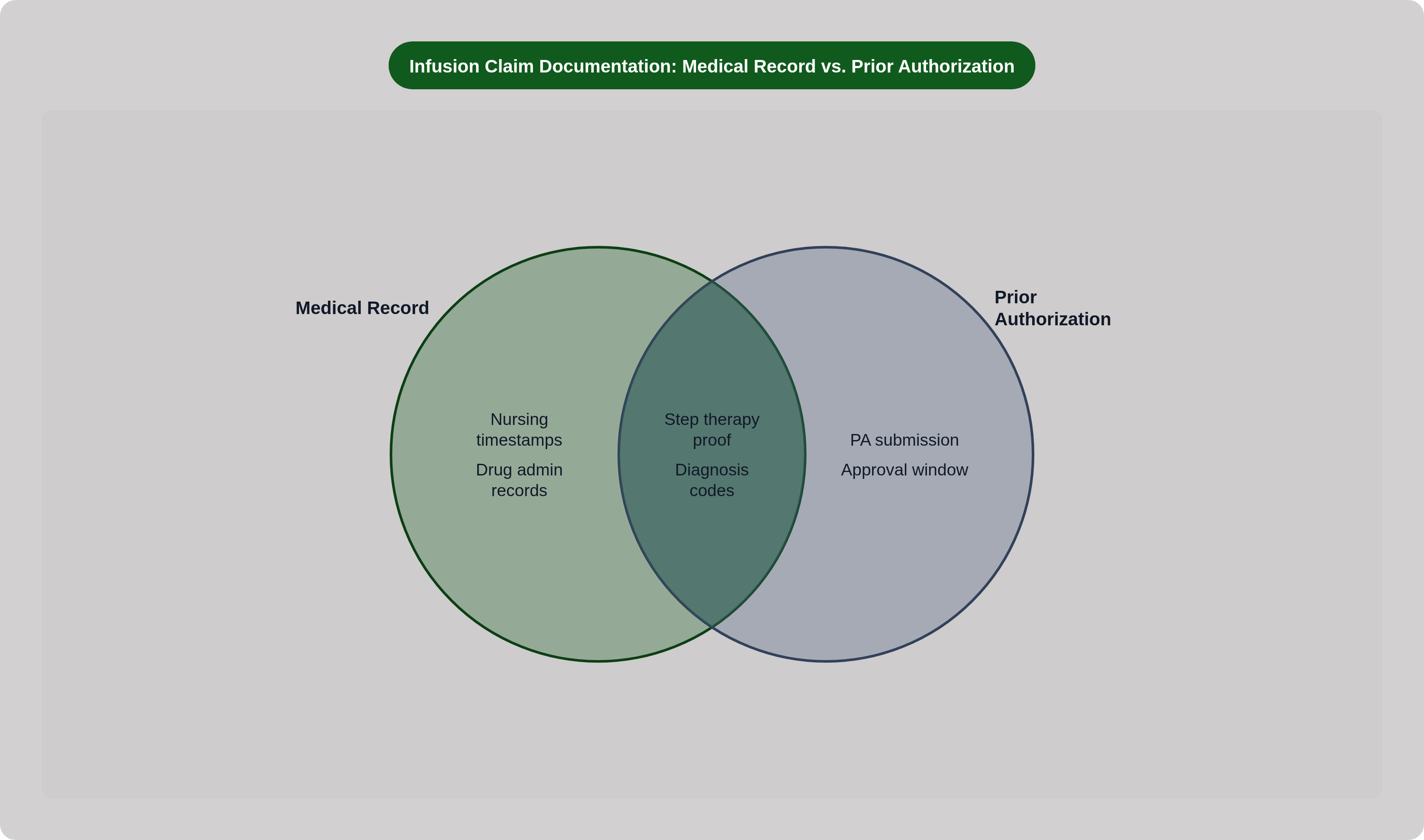
A prior authorization approval is not a substitute for medical record documentation. Payers can recoup a paid claim on audit if the underlying chart doesn't support what the PA submission represented. The PA opens the door; the medical record is what proves you were supposed to be there.
The most common PA failure point is documentation inconsistency: clinical notes, diagnosis codes, or step-therapy evidence in the PA submission that can't be located in, or don't match, the medical record. When those two documents diverge, the audit defaults to the medical record. The PA submission has no authority in a records review. The chart does.
For recurring infusion therapies, the authorization is a lifecycle event, not a one-time clearance. Renewals require updated clinical documentation, including response to prior infusions, current weight, and an active, supported diagnosis. Missing a renewal window because the chart lacked a current response note is a documentation failure before it is a workflow failure.
PA success rates varied from 62% to 94% across the ten largest commercial insurers in 2025. That spread reflects, in part, how consistently practices document to the specific standards each payer applies. The payers with high denial rates are applying their LCD criteria against whatever the practice submitted, and finding the gaps.
White bagging scenarios introduce a specific documentation complication. When a drug is dispensed by a payer-mandated pharmacy rather than purchased by the practice, the administration record still belongs to the clinical team. Drug-level documentation, including lot number, NDC, and preparation records, arrives separately or incompletely from the dispensing pharmacy. The practice is still responsible for the completeness of the administration record, regardless of where the drug originated.
Authorization tracking tied to scheduling is the operational mechanism that prevents administration before approval. The documentation standard that triggers a renewal must be built into clinical workflow. Managing it as a billing team response to an impending denial is managing a problem that was already preventable.
Where Documentation Failures Actually Produce Denials and What the Audit Data Shows
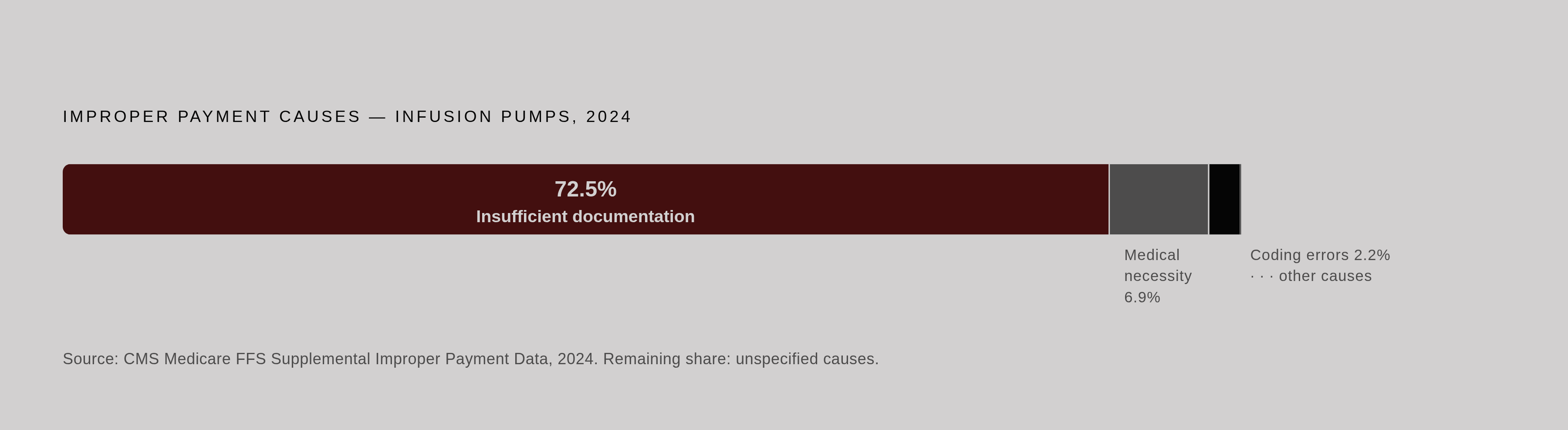
The 2024 CMS Medicare Fee-for-Service Supplemental Improper Payment Data makes the distribution of blame clear. Insufficient documentation caused 72.5% of improper payments in the infusion pump category. Medical necessity errors accounted for 6.9%. Coding errors accounted for 2.2%. The documentation problem is the dominant factor by a margin that should fundamentally recalibrate where practices invest their compliance attention.
The improper payment rate for infusion pumps and related drugs hit 14.1% in 2024, representing $89.5 million in projected improper payments.
Insufficient documentation is not the same as missing documentation. Insufficient documentation includes records that exist but are incomplete, unsigned, outdated, or internally inconsistent. A nursing note that captures start time but not stop time exists; it is also insufficient. Practices often diagnose their documentation problem as a volume problem when it is more frequently a completeness problem, which requires a different remedy.
Denial patterns follow predictable failure types. Missing or unsigned physician orders produce full denials because the claim lacks an authorization basis. Missing start and stop timestamps make time-based code units indefensible, producing partial or full denial. Absent access site documentation or incomplete flush notation renders sequential billing unsupportable and triggers downcoding. Drug administration records that don't match the claim line produce J-code denials or audit recoupment. Medical necessity narratives that are absent or outdated generate LCD-based denials, particularly for biologics and parenteral nutrition.
The denial environment is getting worse. The industry-wide initial denial rate reached 11.8% in 2024, up from 10.2% in 2020, with denials increasingly concentrated in high-value services. AI-driven payer claim review has compressed the timeline between submission and denial and has eliminated the informal grace period that once existed when human reviewers had case backlogs and practical bandwidth constraints. There is no more slack in that system.
The gap between initial denial rate and final write-off rate is instructive: approximately 11.8% initial versus 2.8% final in 2024. Most denied claims are eventually recoverable, but recovery requires that the documentation exist and be retrievable. Initial documentation quality determines whether an appeal is possible, not merely whether it succeeds.
Building Documentation Standards That Hold Up at the Point of Audit, Not Just at Billing
The correct test for documentation quality is not whether a claim was submitted. It is whether that claim can be defended two years from now when a RAC auditor requests the chart.
Nursing note templates should be constructed around billing requirements, with mandatory fields for drug name, NDC, route, access site, start time, stop time, flush notation, and any interruptions. Sequential administration must be explicit in the record, meaning the stop time of drug one and the start time of drug two as separate, distinct entries, not a single encounter note that describes the session in aggregate.
Physician order workflows need a completion checkpoint before scheduling, not before billing. A signed, dated, diagnosis-linked order must exist before the patient arrives. An unsigned order at infusion chair time is a billing risk that cannot be retroactively corrected under Medicare rules.
For recurring biologics, a documentation renewal calendar tied to the authorization cycle is a practical necessity. Response documentation, updated weight, and refreshed orders should be triggered by the authorization renewal date. Managing this from the billing team's denial queue, after the authorization has lapsed, is expensive remediation of a preventable problem.
Internal audit cadence matters more than practices typically acknowledge. Periodic prospective review of a sample of infusion records against billing output, checking that timestamps support units billed, that J-codes match medication administration records, and that medical necessity narratives are current, catches documentation drift before payers identify it. A finding from a prospective internal review is fixable. A finding from a RAC audit is not.
Automation has a role in claim integrity, but it operates downstream of documentation quality. Automated claim scrubbing and predictive validation can reduce avoidable denials meaningfully, but only if the upstream documentation is complete enough for the logic to function. Automation validates documentation; it does not generate it. The practices that sustain their infusion revenue over time are distinguished by clinical teams who understand that nursing timestamps, order signatures, and drug administration records are the billing record, created once, at the point of care, with no meaningful opportunity for reconstruction after the fact.