Buy-and-Bill vs Specialty Pharmacy for Infusion Practices
Knowing which model fits your practice depends on your payer mix and tolerance for inventory risk.
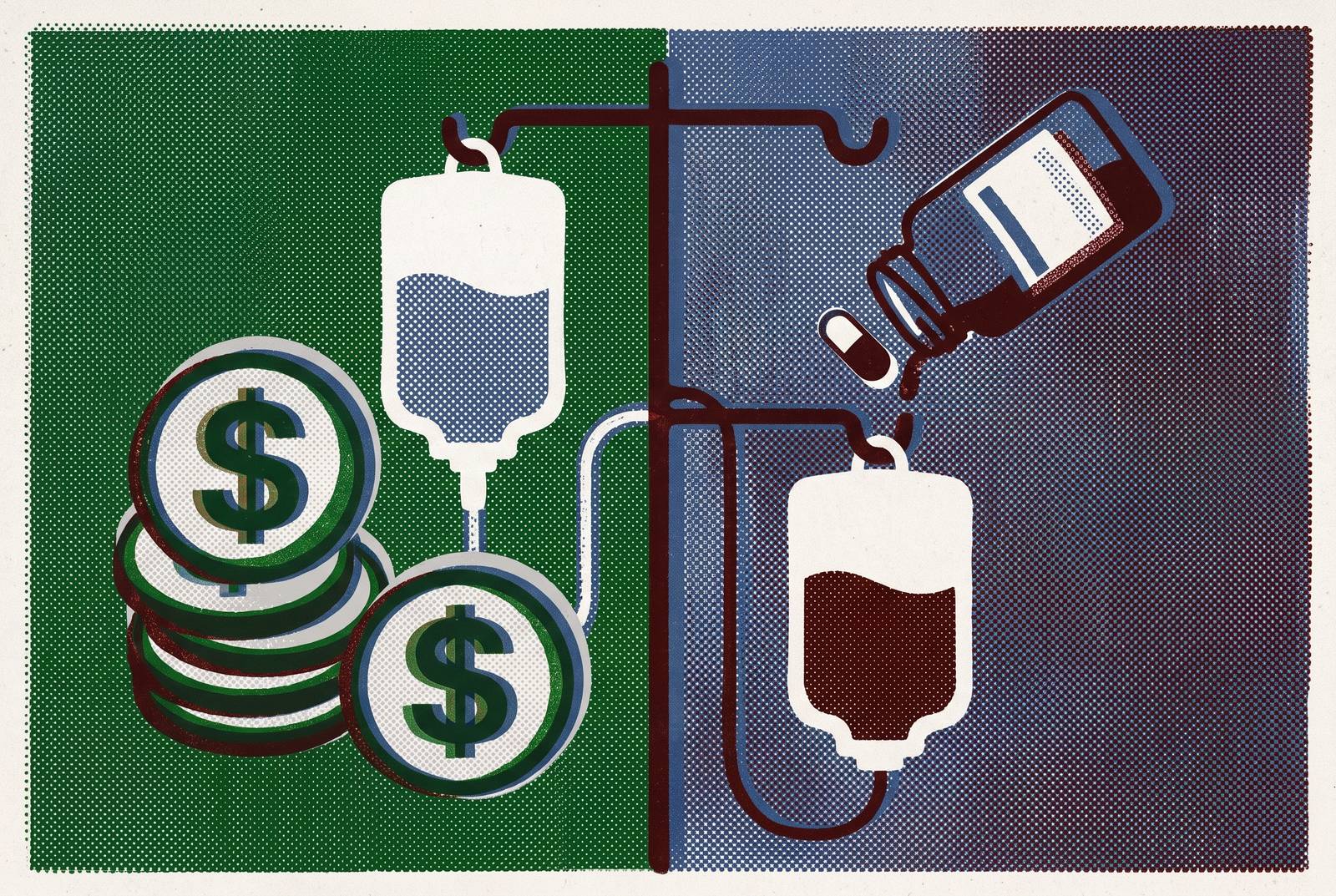
Buy-and-bill and white bagging get treated as if they're two names for the same decision: not using a retail pharmacy. Each describes a different path for cash, a different owner of risk, and a different reimbursement system.
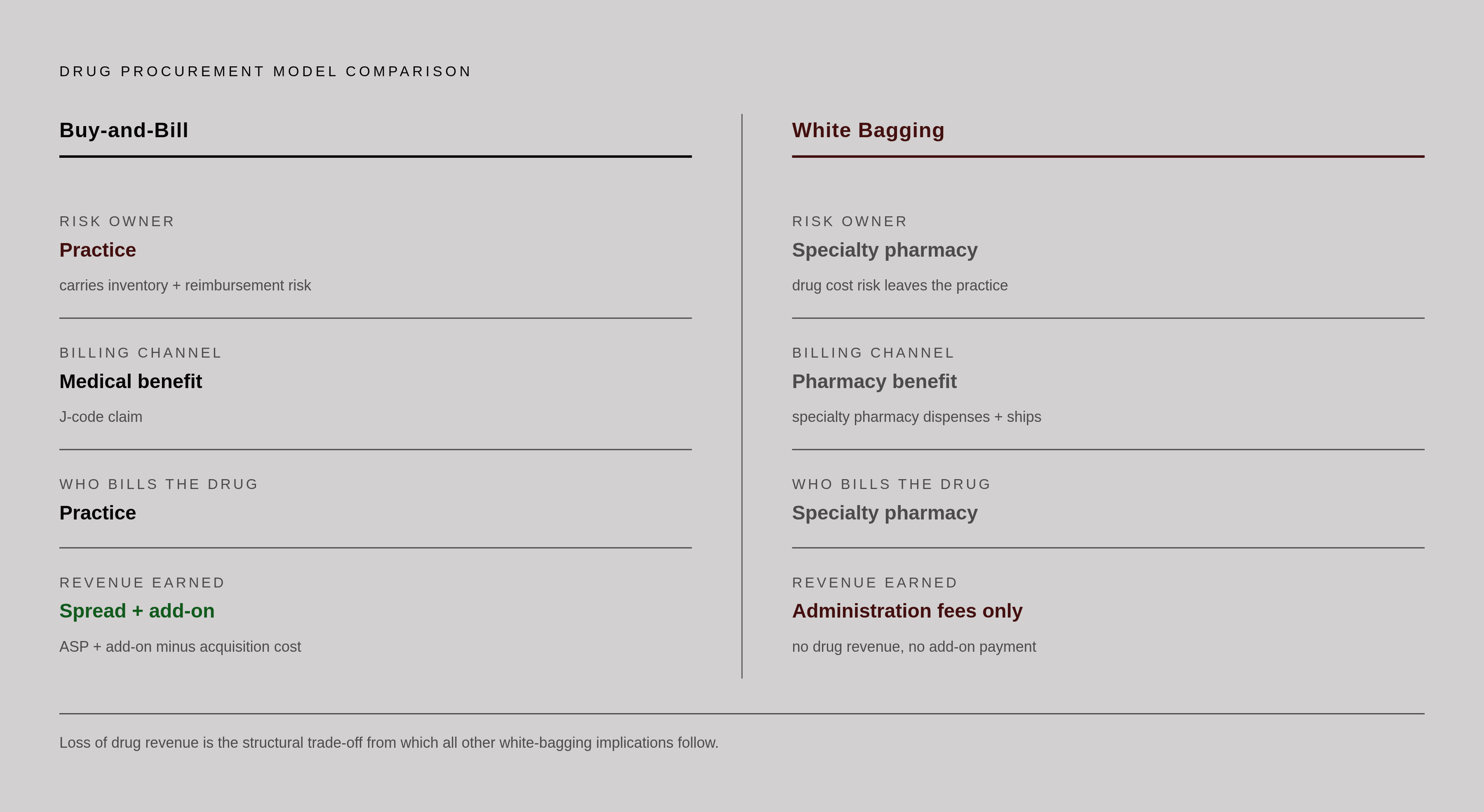
Under buy-and-bill, the practice purchases the drug upfront, administers it in the office, then bills the payer for both the drug (through a J-code) and the administration (through a CPT code) after the fact. Drug cost, inventory, and reimbursement risk sit entirely with the practice until the claim clears. Under white bagging, the payer's chosen specialty pharmacy dispenses the drug and ships it straight to the infusion center. The practice never buys the drug, never bills for it, and never earns a margin on it. Drug cost risk leaves the building, but so does drug revenue.
These two models also travel different reimbursement channels, and the channel matters as much as the model. Buy-and-bill moves through the medical benefit, using J-codes under Medicare Part B or commercial medical plans. Specialty pharmacy drugs typically move through the pharmacy benefit, adjudicated by a PBM. That channel decides the cost-sharing structure, the code set, and who the practice actually negotiates with.
Altus Biologics frames buy-and-bill as a four-step cycle: purchase, documentation at the point of care, clean claim submission, and payer reimbursement. In buy-and-bill, the practice shoulders drug cost, inventory, and reimbursement risk until the claim clears, so execution at each step is what separates a profitable claim from a write-off. The gap between purchase and payment is where buy-and-bill either pays off or quietly fails, and that gap is what the rest of this piece works through.
What the margin opportunity in buy-and-bill depends on
The margin in buy-and-bill isn't a fixed number set the day a practice buys a vial. Knock out any one of those three, and the margin goes with it.
Medicare Part B reimburses at the drug's average sales price (ASP) plus a percentage add-on. The space between what a practice pays for the drug and what it eventually collects is the margin, and that space isn't locked in the moment the drug is purchased, because it moves.
One structural squeeze comes from timing. A practice absorbs the higher cost the day it restocks, then waits months for reimbursement to catch up. That lag ties up working capital for any practice carrying expensive biologic inventory.
Biosimilars cut the other way, at least potentially. Elevate HT notes that Stelara biosimilars now carry discounts of up to 90% below the reference product's price, a gap that could meaningfully improve buy-and-bill margins for GI and rheumatology practices. That upside isn't automatic, though. Formulary placement differs by PBM, so a practice needs to confirm biosimilar coverage with each payer before making the switch.
Government pricing action adds another layer. Practices administering either drug under buy-and-bill need to rework how that negotiated price interacts with their acquisition cost and their ASP-based reimbursement, because the math that worked in 2025 doesn't hold anymore.
Commercial payers often pay a richer add-on than Medicare's standard rate, which sounds like an advantage until the administrative side gets factored in. The richer add-on comes with more moving parts to manage.
Because buy-and-bill margin is a residual, realized only when acquisition cost, contracted reimbursement rate, and billing accuracy all align, any single failure point can erase it. A denied claim, an underpayment buried in a remittance, or a two-quarter ASP lag can turn months of carrying costly inventory into a straight loss. Keeping that margin intact depends on fast cycle time and clean claim execution; the systems handling benefits verification, claim accuracy, and payment posting end up tied directly to a practice's financial results.
White bagging eliminates drug cost risk but not financial risk
Practices pushed into white bagging by payer contracts do shed drug acquisition risk. What replaces it is a set of costs that are harder to measure and almost never reimbursed.
The add-on payment built into buy-and-bill exists partly to cover the overhead of storing and handling complex drugs. Under white bagging, that payment disappears along with the drug revenue it was tied to. The practice still handles the drug, still manages its storage and its timing, but now does so without the payment that used to cover that work.
CareRoute, in material published May 5, 2026, describes white bagging as eliminating the provider's drug margin. The practice earns administration fees and nothing else. The practice never bought the drug, so no spread exists between acquisition cost and reimbursement.
Most practices that run white bagging do so because a payer contract requires it, rather than because the model serves the practice better. That detail matters, because it means the switch usually isn't optional and isn't a judgment call about what works best operationally.
Shipped specialty pharmacy drugs bring their own documented problems: wrong drug delivered, damaged product on arrival, shipping delays that push back treatment, and no ability to adjust dose at the point of care when a patient's condition calls for it.
Payers that require white bagging also typically name which specialty pharmacy the practice has to use.
State law is starting to push back on the mandate itself. Vermont and Louisiana, among other states, have passed protections limiting mandatory white bagging, while states including California are still weighing similar bills. For multi-state groups, though, the patchwork of differing state rules adds its own compliance work, since a policy that applies in one state may not apply next door.
White bagging moves drug acquisition risk onto the payer but hands the practice a set of operational costs and service risks that come with no matching reimbursement, and those costs are harder to track than a denied claim sitting in a queue. Once all of that is counted, the real financial trade-off between the two models looks a lot less clean than the headline savings number suggests.
Payer mix as the primary variable that tips the decision
A practice's payer mix decides whether buy-and-bill makes financial sense long before any question about billing workflow even comes up. The ratio of Medicare to commercial to Medicaid patients, and which specific commercial payers make up that mix, sets the terms of the decision.
Medicare Part B is the most predictable part of that mix. The exception is IRA-negotiated Part B drugs, where reimbursement shifts to the maximum fair price (MFP) plus a defined percentage, and standard ASP publication stops. Even with that exception, the risk in Medicare buy-and-bill is mostly about executing the claim correctly, not about guessing what the contract will pay.
Rates differ contract to contract, add-ons get negotiated individually, and prior authorization rules can differ by plan, by drug, and sometimes even by therapeutic class within the same plan.
Site-neutral pricing is reshaping part of this landscape too. CMS extended site-neutral pricing in 2026 to certain drug administration services, infusions included, delivered in off-campus provider-based hospital outpatient departments. Any practice that competes with, or is affiliated with, a hospital outpatient department needs to build this into its margin math, since it changes what a comparable site of care actually collects for the same service.
Medicaid sits at the other end of the predictability scale. A practice with a high share of Medicaid patients may find that buy-and-bill margin simply isn't enough to cover the carrying cost of stocking expensive biologics.
The practical move is to map every major payer's white-bagging policy, broken down by therapeutic class, before assuming buy-and-bill is even available as an option. In some payer-drug combinations, it isn't available at all, no matter how well the practice runs its billing operation. Payer mix is the first filter. Whether the practice's billing infrastructure can protect the margin that payer mix allows is the second, and that's the question the next section takes on.
Billing infrastructure and whether buy-and-bill margin survives claims processing
Margin in buy-and-bill is decided at claim submission, and the technical demands of J-code billing create several places where a claim can fail, places a generic billing team is often not set up to catch.
Unit-count errors cause some of the most expensive and most common damage.
Waste modifiers add another failure point. JW marks discarded drug, JZ confirms no waste, and both are required on single-dose vial drugs. A billing team still running on older modifier logic is generating denials that didn't need to happen.
New drugs create a separate problem. Payers scrutinize these codes automatically, and billing them well requires heavier documentation than a standard J-code claim. That added workload and denial risk lasts for however long the drug goes without a permanent code.
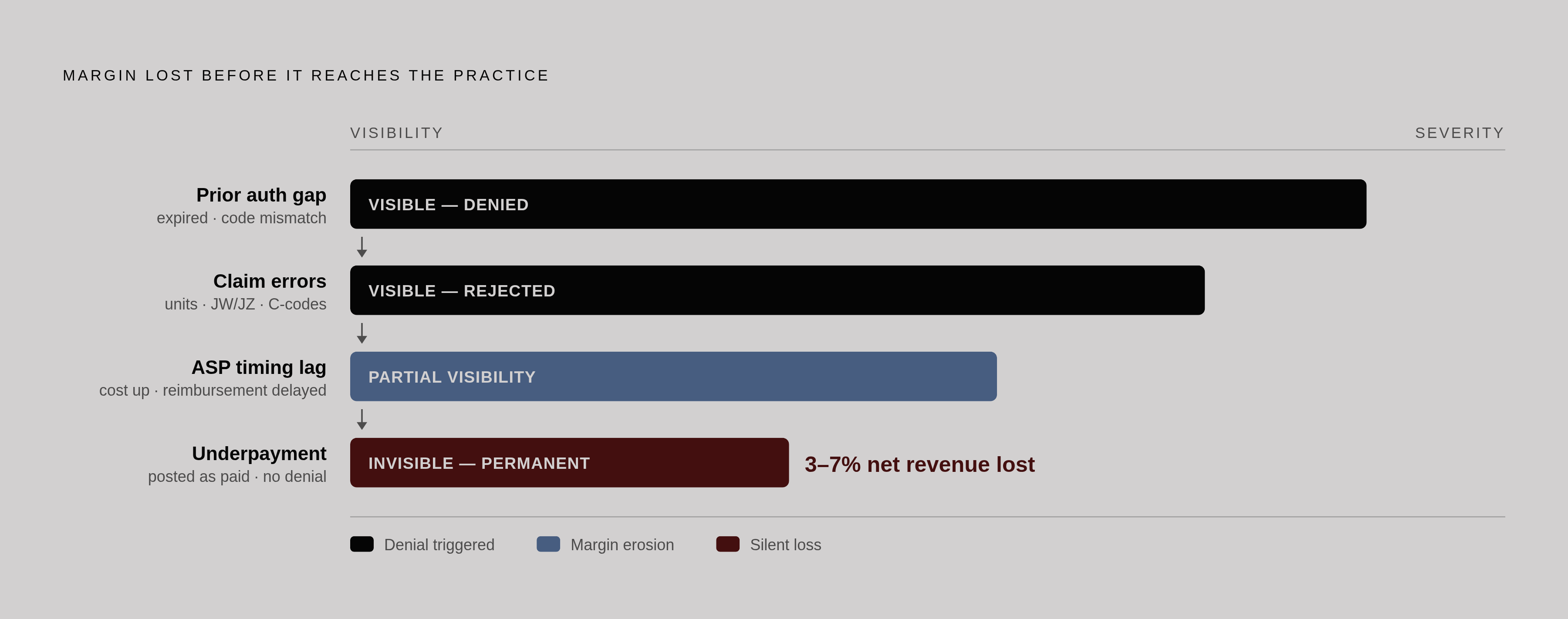
Prior authorization has to match the claim exactly, down to the code. An authorization approved for one J-code or CPT code doesn't cover a different but related code, even when the clinical intent behind both is identical. That mismatch is its own denial category, separate from a lapsed or missing authorization.
Altus Biologics points to avoidable gaps, not the model itself, as the source of most buy-and-bill friction: incorrect units, missing documentation, payer requirements the practice didn't account for, or claims submitted late. None of those are inherent to buy-and-bill. All of them are fixable with the right billing process in place.
That's the case for infusion-specific billing infrastructure over general-purpose revenue cycle tools. J-code complexity, modifier logic, and NDC reporting aren't edge cases in infusion billing, they're the baseline requirement, and platforms built specifically for this work, Ruby RCM included, are designed around that baseline rather than treating it as an exception to handle manually. A practice running buy-and-bill on a billing system built for general medical claims is carrying a risk it often can't see until the denials start piling up.
Prior authorization failures as the largest recoverable revenue risk in buy-and-bill
Prior authorization in buy-and-bill is the gate standing between buying the drug and getting paid back for it, and gaps in that gate are the single most common source of large, avoidable denials on recurring infusion therapy.
Infusion treatment runs in cycles, often over months, and the original authorization usually covers a set number of sessions or a defined window of time. When re-authorization doesn't get submitted before that window closes, every session delivered afterward under the same treatment course goes out without valid authorization. Those claims get denied, even though the treatment itself was never in question clinically.
Payers change prior authorization requirements throughout the year, and they don't always tell providers when they do. A practice relying on an outdated list of requirements is exposed to denials it has no way to predict just by watching its remittance data.
A related but distinct problem is the code mismatch described earlier: an authorization approved for one CPT or J-code doesn't carry over to a slightly different code used at billing, even when the treatment delivered is the same in every clinical respect. This failure mode is distinct from a lapsed authorization, and catching it requires checking codes at the front end of every treatment episode, not just at the start of the authorization period.
Payers are leaning more on algorithmic tools to make prior authorization decisions. States are starting to respond: Texas passed SB 815 in 2025, requiring human clinical review before an adverse determination can be issued. Practices that understand this shifting regulatory ground are in a stronger position to push back on an algorithmically generated denial during appeal.
Appeal windows themselves are shrinking. An infusion center that only reviews denials on a weekly or biweekly schedule is missing windows that a faster-moving operation would still catch, and a denial that was recoverable on day one becomes a permanent write-off by the time someone looks at it.
The fix starts before the treatment cycle does: confirming coverage, checking that the authorized codes match what will actually be billed, and tracking re-authorization deadlines as a scheduled task rather than something handled after a denial already landed. Prior authorization management, treated this way, belongs in the revenue cycle function alongside denial management, not left to whoever happens to be at the front desk that day. Once authorization is under control, the next risk to manage is the one that doesn't announce itself at all: underpayments.
Underpayments as the invisible margin erosion that buy-and-bill practices systematically miss
Denials get noticed because they demand action. Underpayments don't work that way. They post as paid, the claim closes, and the shortfall becomes a permanent write-off unless someone catches the variance at the moment the payment is posted.
Catching it at that moment is the whole game. Remittance-level variance detection means comparing what a payer actually paid against the contracted rate right when the payment posts, not weeks or months later. By the time a practice runs a quarterly audit, many of the windows for disputing those underpayments have already closed.
Coding and modifier mistakes can quietly shrink reimbursement without tripping a denial. The claim clears, nobody flags the shortfall, and the same error repeats on the next claim for that drug.
The scale of this gap tracks directly with process, not volume. Average-performing centers lose 3% to 7% of net revenue to underpayments, based on industry benchmarks. That spread comes down to whether line-level reconciliation is built into payment posting, not how many claims a practice processes in a given month.
A separate contractual underpayment occurs when a commercial payer simply pays below the rate its own contract specifies. Either way, the underpayment only gets caught if someone is looking for it at the point the payment lands, not after the books have already closed on the claim.
Sources
- Demystifying the Buy-and-Bill Model: What Specialty Practices Need to Know in 2026 - Altus Biologics
- Specialty Pharmacy Billing: Medical vs Pharmacy Benefit, Buy-and-Bill, and Hidden Markups (2026)
- Unifying Prior Authorization Data: Unique Challenges and Opportunities for Infusion Centers
- Breaking Down the Practice of Bagging