Payer Mix Optimization Strategies for Infusion Practices
Reimbursement, denials, and contracting all shift by payer—and most practices ignore the difference.

I sit down every year with our payer mix report expecting to feel good about it, and every year I get about halfway through before I remember that mix is only half the story. This piece walks through how reimbursement, authorization, and denial behavior actually differ by payer class, and what that means for the contracting and intake calls that move mix over time. Payer mix is the single biggest lever an infusion practice has over its own financial outcome, yet most practices still treat it like weather.
How different payers actually reimburse buy-and-bill drugs
Medicare Part B pays most J-code drug classes at Average Sales Price plus 6%, adjusted quarterly. That rate is predictable, and predictability counts for something in a business this volatile, but it's thin. The 6% add-on rarely covers true acquisition and handling cost on high-price biologics, and CMS's 2.4% bump to infusion reimbursement in 2025 offers limited relief against that structural constraint. It's a modest increase stacked on a formula that was never generous.
Coverage mechanics matter too, and this is the part people forget. Medicare Part B covers most infusion services in hospital and provider-based settings, but coverage thins out fast for standalone and home infusion sites. Same drug, same patient, two completely different revenue cycles depending on where the needle goes in.
Commercial payers work differently. Rates get negotiated, not calculated, so the same J-code can pay wildly different amounts across plans, sometimes even within one insurer's own book of business. That kind of spread is not unusual, and the variability cuts both ways. Practices heavily dependent on Medicare and Medicaid, or lacking in-network status with the commercial payers that matter regionally, get valued lower in M&A, according to Scope Research, because buyers know where the margin sits. Revenue per encounter and drug mix, whether a practice runs buy-and-bill or leans on specialty pharmacy, are among the biggest levers in how a practice gets priced.
Medicaid sits at the bottom on rate and the top on friction. State-to-state variation in drug coverage and authorization rules makes denial exposure unpredictable for recurring infusion treatment. A JAMA Network Open study found step therapy and utilization management touch 43.4% of covered medications in Medicaid plans, the highest of any payer class studied. The exposure combines lower reimbursement with the heaviest administrative load of the three payer classes, and that combination is why so many practices quietly cap their Medicaid volume without ever saying so out loud.
A denied commercial claim and a denied Medicare claim get filed under the same word, but they carry different recovery timelines and different odds of getting overturned on appeal. Lump them together in an internal denial report and you've hidden more than you've revealed.
How site-of-care policies are reshaping which payers infusion centers can access
Commercial payers have spent the last several years building site-of-care optimization policies that push patients toward ambulatory infusion centers and away from hospital outpatient departments. That sounds like good news for independent AICs, but it only works if the practice is in-network with the payer doing the steering.
Practices without contracts with the key commercial payers in their market get bypassed entirely, even when the payer's own policy would otherwise route the patient their way. The referral flow exists, but access to it doesn't, not until the contract is signed.
Site-of-care restrictions filter which therapies get delivered where, and that filter cuts both directions: favorable for AICs that qualify, exclusionary for the ones that don't. The market underneath all this is moving fast. The U.S. ambulatory infusion center sector is growing at roughly an 8.8% compound annual rate through 2035, driven partly by payers pushing care out of expensive hospital settings into cheaper ambulatory ones. Practices positioned right on contracting catch that wave, while the rest watch it pass.
Accreditation has taken on an added function. NICA's program used to read as a quality badge; now it also functions as a contracting gate, since payers increasingly use it to filter which practices even get considered for network inclusion. That makes accreditation a mix-access lever as well as a certificate for the waiting room wall.
Why the denial environment has become structurally worse for infusion practices specifically
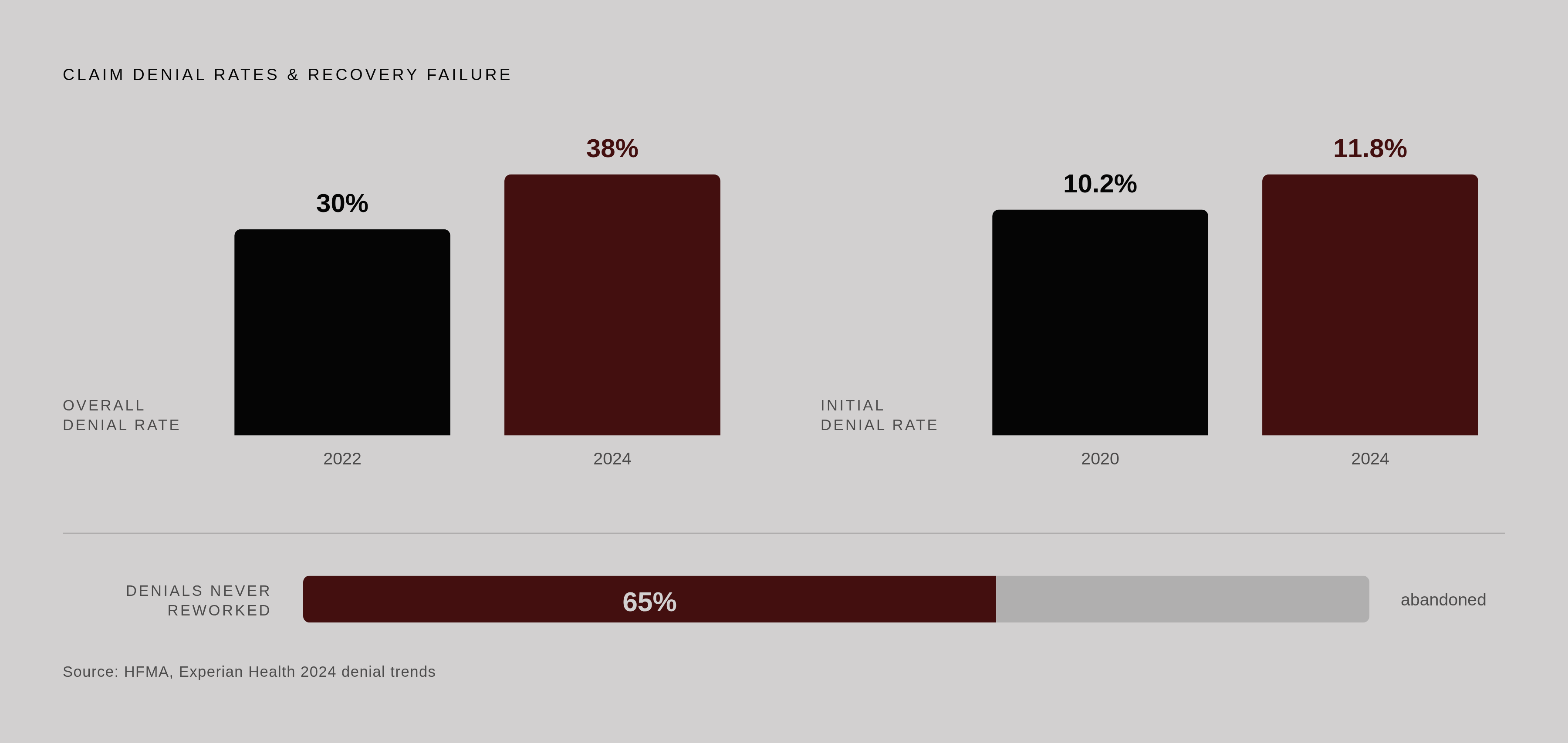
Denials are up across the board, and not by a little. The 2025 State of Claims Report from Experian Health tracks it: overall denial rates climbed from 30% in 2022 to 38% in 2024. Separately, Neolytix reports initial claim denial rates hit 11.8% in 2024, up from 10.2% in 2020. HFMA's 2024 Health System CFO Pain Points report found 82% of CFOs believe payer denials have risen significantly since before the pandemic, and 90% of health systems name denials their top revenue cycle problem.
For infusion, a denial carries a different category of exposure than a delayed payment. A denied buy-and-bill claim leaves the practice holding the drug acquisition cost, and at typical biologic price points, that exposure per encounter can run into the tens of thousands of dollars. Industry-wide, 65% of denied claims never get reworked or resubmitted at all. In general medical billing, that's a lost visit fee, annoying but survivable. In infusion, it's a permanent write-off of a drug the practice already paid for out of pocket.
The payer side is getting more aggressive on top of all this. BillingParadise reports denied inpatient and outpatient claim dollar amounts rose 12% and 14% respectively from 2024 to 2025, and denials tied to medical necessity rose 70% in dollar value, averaging $450 per denial. Payer clinical criteria have continued to tighten, and practices that were getting routine approvals are now seeing denials on the identical clinical picture, even though nothing changed on their end. The rules moved underneath them.
That's really the pattern. Payer policy moves faster than most practices can track it, and nobody sends a memo when the rules change. What cleared in Q1 might get denied in Q2, quietly, with no warning attached.
How prior authorization for recurring infusion treatments creates a distinct workflow problem
Prior authorization for an infusion patient isn't a one-time hurdle to clear and forget. It's a recurring cycle that has to be managed against payer policy update schedules, treatment intervals, and expiration windows, all running at once. Medical benefit drugs given in an office or ambulatory setting often need PA that gets refreshed quarterly, which means an authorization valid in Q1 can get silently invalidated by a Q2 policy change with zero proactive notice from the payer.
This isn't a fringe problem affecting a handful of drugs. A JAMA Network Open study found utilization management (PA, quantity limits, and step therapy combined) affects 39.7% of covered medications in ACA plans. That's close to half the covered drug list operating under some form of gatekeeping. Step therapy compounds it: patients doing well on an established therapy can face interruptions if payer criteria shift mid-cycle, and getting back to approved status may mean documenting failure on a newly preferred drug first, even after years of stability on the one already working.
There's a regulatory gap worth flagging here, because most people don't know about it. Electronic prior authorization mandates have not fully reached physician-administered drugs billed under the medical benefit. The highest-cost infused biologics can sit outside electronic PA requirements entirely, meaning manual PA management stays the standard for exactly the claims where the financial stakes are highest.
There's one real point of leverage, though. A growing number of states have enacted step therapy exception protections that work in the practice's favor by default. Practices managing recurring infusion populations should know exactly which state-level protections apply to them, because those rules can function as an appeal tool that requires no extra fight to invoke.
PA management has to start before the treatment cycle begins, full stop, because by the time a lapse turns into a denial, the revenue is gone and the patient's next infusion is what's actually at risk.
What J-code billing complexity means for mix-driven revenue capture
J-codes bill physician-administered drugs: infusions, injections, immunosuppressants, chemotherapy agents, biologics. Each code ties one specific drug to one specific reimbursement rate, and any error compounds fast across high-cost encounters.
Most of these errors start with data, not intent, which is almost worse in a way. Experian Health's 2024 State of Claims report found 76% of denials industry-wide trace back to missing, incomplete, or inaccurate data. In J-code billing, that shows up as drug identity mismatches, dosing errors, NDC number mismatches. Weight-based dosing, common in oncology and immunology, adds per-encounter variability that has to land precisely on the claim; round the billed units wrong and you've handed the payer an easy denial. Chemotherapy and oncology billing carries a higher risk profile specifically because of custom weight-based dosing stacked with multi-drug regimens.
Underpayment is the quieter cousin of this problem, and it's the one that actually costs more money over time because nobody notices. Payers sometimes apply the wrong ASP rate, use outdated unit pricing, or map a drug to the wrong tier. None of that looks like an error on the remit; it looks like a normal payment. It only surfaces if someone runs line-level reconciliation against what the rate should have been. On high-cost biologics, even a small underpayment per unit adds up to real money across a full patient population, and most general-purpose billing tools aren't built to catch it.
This is where mix and billing accuracy actually meet. Commercial payers typically pay better than Medicare's ASP+6% on the same J-code, but they also run more variable, more opaque adjudication logic behind the scenes. The upside of a commercial-heavy mix only shows up in real revenue if the claims go out clean and someone checks the remits line by line.
How to read your current payer mix as a financial diagnostic
Payer mix analysis has to start with more than patient headcount by payer, because headcount alone tells you almost nothing useful. Revenue per encounter, denial rate, and days to payment, broken out by payer, tell a very different story than volume ever will.
Four things are worth tracking for every payer relationship:
- Reimbursement rate relative to ASP or billed charges, to see which payers pay above or below expected on the drug side
- Authorization approval rate and average time to approval, to see which payers create the most upstream friction for the same therapy categories
- Denial rate and overturn rate, to see which relationships generate rework that eats into the gross revenue gain
- Days in AR and payment pattern, to see which payers are slow and which ones eat a disproportionate share of staff time chasing payment
The more useful question is which payer generates the most revenue net of the administrative cost to collect it, rather than which payer simply pays the most. A payer can pay a decent rate and still be a net drag if it burns enough staff time on PA and denial rework. That's a margin illusion, and it's easy to miss if gross reimbursement is the only number on the dashboard.
Denial patterns need this same granularity. Grouping everything under a label like "authorization denials" across every payer hides the actual signal underneath it. The diagnostic has to work at the payer level and the denial-type level together, or it tells you nothing you can act on. FTI Consulting puts the number of independently owned practices in this market at more than 800, roughly half the total field, and most of them lack the data infrastructure to run this kind of analysis at all. For a lot of practices, the first real optimization step is building the measurement layer that lets them see the mix they already have, ahead of any move to actually shift that mix.
Contracting and intake decisions that shift payer mix over time
Contracting is where mix actually gets built, one negotiated rate at a time. In-network status with whichever commercial payers drive site-of-care steerage in a given market is the single highest-leverage move on the table. Those payers are already sending patients toward ambulatory infusion centers, and the only open question is whether the practice's contract lets it receive them.
Contract terms need to match what the practice actually treats, which sounds obvious until you look at the contracts practices actually sign. A contract that pays well on hydration and antibiotics but has no negotiated rate on high-cost biologics falls short as a biologics contract, no matter how good the rest of it reads on paper. Accreditation strengthens the negotiating position going in, since NICA accreditation signals quality to payers and increasingly functions as a prerequisite just to get a seat at the table. Rate escalation language is worth reviewing in any contract, since a commercial rate that looked strong at signing can erode relative to Medicare's ASP+6% over time.
Intake decisions matter just as much, and they happen earlier than most practices realize. Revenue cycle control starts at scheduling, not at claim submission, and by the time a claim goes out, most of the mix problems that show up later were already seeded when the patient got accepted. Benefits verification at intake should flag authorization requirements, step therapy obligations, and site-of-care restrictions specific to the payer and the intended therapy, before the first appointment ever gets confirmed.
Referral relationships shape mix over time in ways that are easy to overlook entirely. Prescribers who send a high volume of Medicaid patients or out-of-network patients will pull the practice's mix in an unfavorable direction structurally, regardless of how good the clinical relationship is on the ground. Understanding payer composition at the referral-source level lets a practice target outreach toward prescribers whose patients already align with its contracted network. Therapeutic focus plays a role too. Scope Research notes that providers concentrated on high-margin specialty biologics (immunoglobulins, monoclonal antibodies, oncology drugs) tend to post better per-encounter economics than those built around lower-acuity hydration or antibiotic infusions.
Contracting sets the rate, intake decides who walks through the door, and billing accuracy decides whether the revenue that should follow both of those actually shows up in the bank.
How denial management and AR discipline protect the revenue that mix optimization generates
A better payer mix and higher denial risk arrive together, and I think this is the part practices underestimate most. Commercial payers pay more, but they also run more active utilization management than Medicare or Medicaid, so the same shift toward commercial mix that improves revenue potential also raises the stakes on every claim going out the door. Denial management functions as a core part of this equation, determining whether mix optimization actually pays off or just generates a taller stack of paperwork.
Denials need sorting by payer and by root cause, not lumped into one bucket labeled "denied" and handed to whoever has time that week. An authorization denial from a commercial payer with a 72-hour appeal window behaves nothing like a medical necessity denial from Medicaid working through a state-specific appeals process. Treat them the same and some of them never get worked at all, and given that 65% of denials industry-wide never get reworked, that's not a hypothetical; it's the default outcome for any practice that hasn't built the discipline to sort, prioritize, and chase each type on its own clock.
The practices getting real value out of a favorable payer mix treat AR follow-up as a daily discipline tied to payer-specific timelines, not a monthly cleanup task somebody does when there's time. Mix optimization opens the door to more revenue, but denial management and AR discipline are what actually get that revenue through the door and into the account.