Infusion Denial Recovery by Payer Behavior vs Root Cause Why the Grouping Method Changes Your Win Rate
Grouping denials by root cause instead of payer language doubles your appeal win rate.

Denial recovery in infusion billing lives or dies on one decision: how you sort the denials in the first place. Two grouping methods dominate the field, payer behavior and root cause, and they answer different questions. Picking the wrong one, or picking only one, quietly caps the appeal win rate well below where it should sit.
The stakes here aren't small. Infusion and buy-and-bill practices sit inside a market pegged at $55.8 billion in 2026, growing at a 12% compound annual rate toward $138.2 billion by 2034. Because buy-and-bill means the practice pays for the drug, Remicade, Ocrevus, Stelara, oncology biologics, before a payer ever reimburses a dime, a single denied claim can strand tens or hundreds of thousands of dollars in limbo. Payers know this. Oncology alone recorded a 12.7% Medicare Advantage denial rate in 2026, driven largely by J-code claims and step-therapy edits, and high-dollar infusion claims now face denial rates 18 to 20% higher in categories flagged for AI-driven payer audits. These pressures continue to intensify across the infusion space heading into 2026.
What payer-behavior grouping captures and misses
Payer-behavior grouping sorts denials by what the payer actually said: medical necessity not established, no authorization on file, site-of-care restriction, step therapy incomplete, documentation insufficient. It's organized around the payer's language.
That has real value. Grouping by payer behavior shows which payers are running which policies right now, flags policy shifts as they happen, and gives contract negotiators hard evidence when they sit down across the table from a payer's network team. If one plan suddenly starts denying every Remicade claim for step therapy, that pattern becomes visible fast in a payer-behavior view.
A denial reason describes the outcome, not the failure that caused it. "Medical necessity not established" is a conclusion the payer reached. Three infusion claims can all land in that same bucket for three entirely different reasons: incomplete nursing notes, an ICD-10 code that doesn't match the therapy given, or a prior authorization that was approved for the wrong drug concentration. Payer-behavior grouping treats all three the same. The corrective actions are nothing alike, and the label doesn't tell anyone which one applies.
What root-cause grouping captures and misses
Root-cause grouping flips the lens inward. It sorts denials by the workflow failure that actually produced them, including a registration error, a gap in benefits verification, an authorization that lapsed or got mismatched to the wrong drug, a documentation shortfall, a coding mistake, a misused modifier, or a claim filed past deadline.
This method surfaces the decision that seeded the denial, often days or weeks before the claim ever touched a payer's system. By the time a denial shows up on an aging report, the operational mistake behind it usually happened much earlier in the cycle, as ACU-Serve's 2026 analysis shows. The sources that support this framework break root cause into five recurring buckets: missing or inaccurate claim data, registration errors (cited by 32% of providers in the Experian Health 2025 survey), authorization failures (35% in the Experian Health 2025 survey), documentation deficiencies, and coding errors including modifier misuse.
A practical four-tier taxonomy sits on top of this. Tier 1 covers administrative denial grounds and Tier 2 covers clinical necessity denials. Tier 3 is correct-and-resubmit, a coding fix rather than an appeal. Tier 4 is the write-off-versus-rework decision, where a team has to weigh the cost of chasing a claim against what it's worth.
Root-cause grouping's blind spot is the mirror image of payer behavior's. It tells a team what broke internally, but it doesn't say which payers are the ones exploiting that break, or how aggressively. A registration error might slip past one payer's system entirely and get flagged by another every single time. Root cause alone won't show that asymmetry.
How misclassification suppresses win rates, the mechanism
MD Revenue Group's data on this is blunt. After one practice finally categorized its denials by root cause instead of payer language, it found that 61% of written-off claims were actually Tier 3, correct-and-resubmit cases. A coder had been applying the wrong modifier to a specific telehealth CPT code for four months straight.
Under payer-behavior grouping, every one of those denials had been routed as the hardest denial category to win, the one demanding the most intensive appeal effort. Staff were writing appeal letters and building clinical justifications for claims that needed nothing more than a corrected modifier and a resubmission. That's a significant inefficiency: the entire appeals team worked the wrong problem for months while a one-line coding fix sat unaddressed. That's the entire appeals team working the wrong problem for months while a one-line coding fix sat unaddressed.
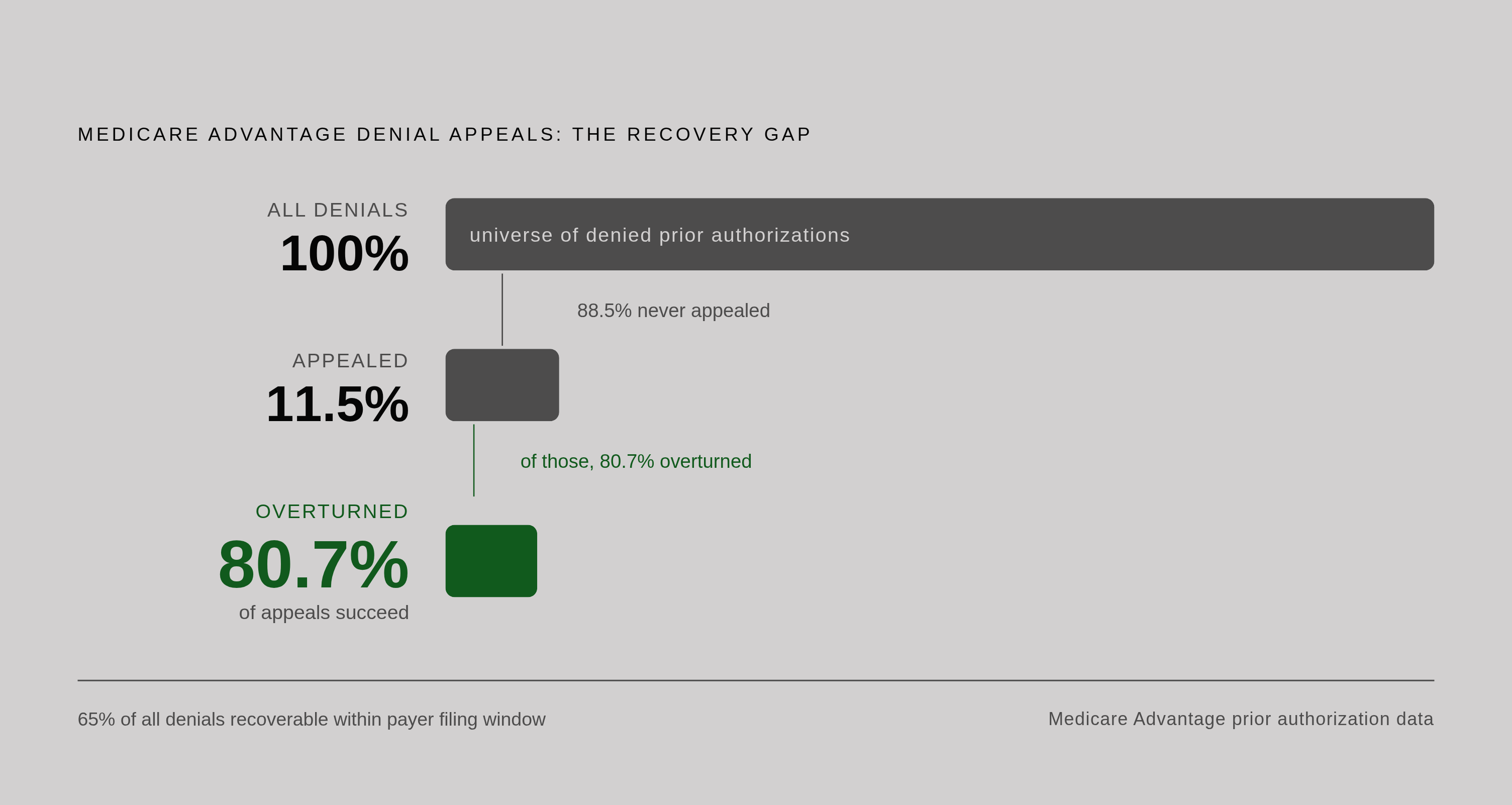
The opportunity cost is also visible at the national level. KFF and CMS data show that only 11.5% of denied Medicare Advantage prior authorization requests ever get appealed, yet 80.7% of the appeals that do get filed are partially or fully overturned. That gap between how rarely denials get appealed and how often appeals succeed points to a huge population of denials that were probably recoverable and never got worked, exactly the category root-cause analysis is built to catch.
Layer timing on top of that: 65% of denials are recoverable, but only inside the payer's filing window. Misclassify a denial as a hard clinical appeal when it's actually a five-minute coding correction, and the clock keeps running while the wrong team works the wrong fix. By the time anyone catches the mistake, the timely-filing window may already be gone.
Why infusion prior authorization complicates root-cause precision
Infusion therapy carries a burden most other specialties don't: 91% of infusion providers report that the authorization process actively hurts patient care. This is exactly the population where getting denial categorization right matters most, because the patients on the other end of these claims are often mid-treatment, not waiting to start.
The volume backs that urgency up. Medicare Advantage insurers fully or partially denied 4.1 million prior authorization requests in 2024, a 7.7% denial rate, up from 6.4% the year before. That's not a rounding error; it's a trend line moving the wrong direction, and it's happening at a scale where manual, case-by-case tracking starts to break down.
Reauthorization is where infusion billing gets uniquely hard to keep clean. Recurring therapies, IVIG for CIDP, Remicade for Crohn's, Ocrevus for MS, don't stop needing authorization once the first approval comes through. Reauthorization intervals vary by payer and by drug, and missing that window on a patient who's already mid-treatment creates retroactive denial risk on infusions that already happened. The drug's already been administered. The cost is already absorbed. The claim is in jeopardy for a paperwork lapse.
The payer-behavior label for a missed reauthorization usually reads "authorization not on file" or "service not authorized." Categorize it that way and the team's instinct is to appeal, to argue the clinical case for a drug that's already working. But the actual root cause is a tracking failure, a missed date on a calendar somewhere, and it will happen again at the next reauthorization interval unless the workflow itself gets fixed. An appeal wins the current claim, maybe. It does nothing for the next one.
What combining both dimensions reveals
Putting payer behavior and root cause side by side brings into focus something neither view shows alone. Payer behavior says which payers are denying which claim types and how hard they're pushing. Root cause says which internal failures are feeding those denials. The intersection of the two says which failures matter most, and with which payers specifically.
Take documentation deficiency as the root cause. On its own, it triggers "medical necessity not established" across every payer a practice bills. Generic response: train staff on documentation, broadly, everywhere. But if the combined data shows one commercial payer denying documentation gaps at three times the rate of the others, the fix isn't generic training, it's targeted correction aimed at that payer's specific therapy mix. Same root cause, completely different action, once the payer layer gets added back in.
Denial patterns are both payer-specific and root-cause-specific at the same time. Sort them into one generic bucket, "denials," and the signal that actually predicts resolution disappears into the noise. The combined view is what turns that noise back into something a team can act on, section by section:
- Which Tier 1 clinical-necessity appeals are genuine payer policy disputes, and which are mislabeled Tier 3 coding fixes hiding in the wrong queue
- Which authorization denials are initial-auth failures, which are reauthorization lapses, and which are auth-to-claim mismatches, since each one belongs to a different owner
- Which documentation denials cluster around a specific drug, a specific diagnosis, or a specific payer, which turns vague "improve documentation" advice into a targeted CDI fix
Structuring an infusion denial queue around both dimensions in practice
None of this works unless root-cause coding becomes a mandatory step, not an optional add-on for whoever has time. Programs that actually sustain this discipline build it in as a gate: no root-cause code assigned, the claim doesn't advance. Full stop.
From there, the queue itself needs real structure. Correct-and-resubmit claims get pulled out and handled separately the moment a denial comes in; they are not appeals, and they shouldn't eat up appeal-staff hours or burn appeal filing deadlines. Authorization denials need their own sub-queue that splits initial-auth failures from reauthorization lapses from auth-to-claim mismatches, with each type routed to whoever can actually fix the upstream process, not just patch the one claim in front of them. Payer-behavior data sits on top of all of it as a priority layer, so the team knows which payers are running the most aggressive adjudication on which therapy types this month. Documentation-deficiency claims go to clinical staff to complete before anything gets appealed, not to billing staff to draft another boilerplate appeal letter that skips the actual gap.
None of this closes the loop unless denial data travels back upstream, into scheduling, benefits verification, and the authorization process itself. Infusion-specific revenue cycle platforms that pair software with operators who actually know infusion billing are built around closing that loop. General-purpose RCM tools, built for a much broader range of billing types, generally aren't tuned to the reauthorization cycles and site-of-care rules that make infusion so particular.
Rules engines can sort a denial into a bucket. They can't tell a team that a payer has shifted its adjudication posture on a specific therapy type, or that patterns emerging in the data signal a broader policy change. Recognizing that pattern needs someone who's worked infusion billing long enough to know what a policy shift looks like before it shows up in the numbers. The categorization framework creates the visibility. Someone still has to read it.
Sources
- Healthcare Denial Trends In 2025: How AI Agents Are Changing The Game
- Why Infusion Providers Thrive with Payer Rules | ACU-Serve
- Healthcare Denial Trends in 2026: What to Know - MBW RCM
- 2026 Medicare Advantage Denial Report: Top Reasons by Specialty | Revenue Synergy
- omnimd.com
- mdrevenuegroup.com
- medicalhealthcaresolutions.com