Medical Necessity Documentation for Infusion Claim Denials
Payers audit documentation against policy, not clinical reality.
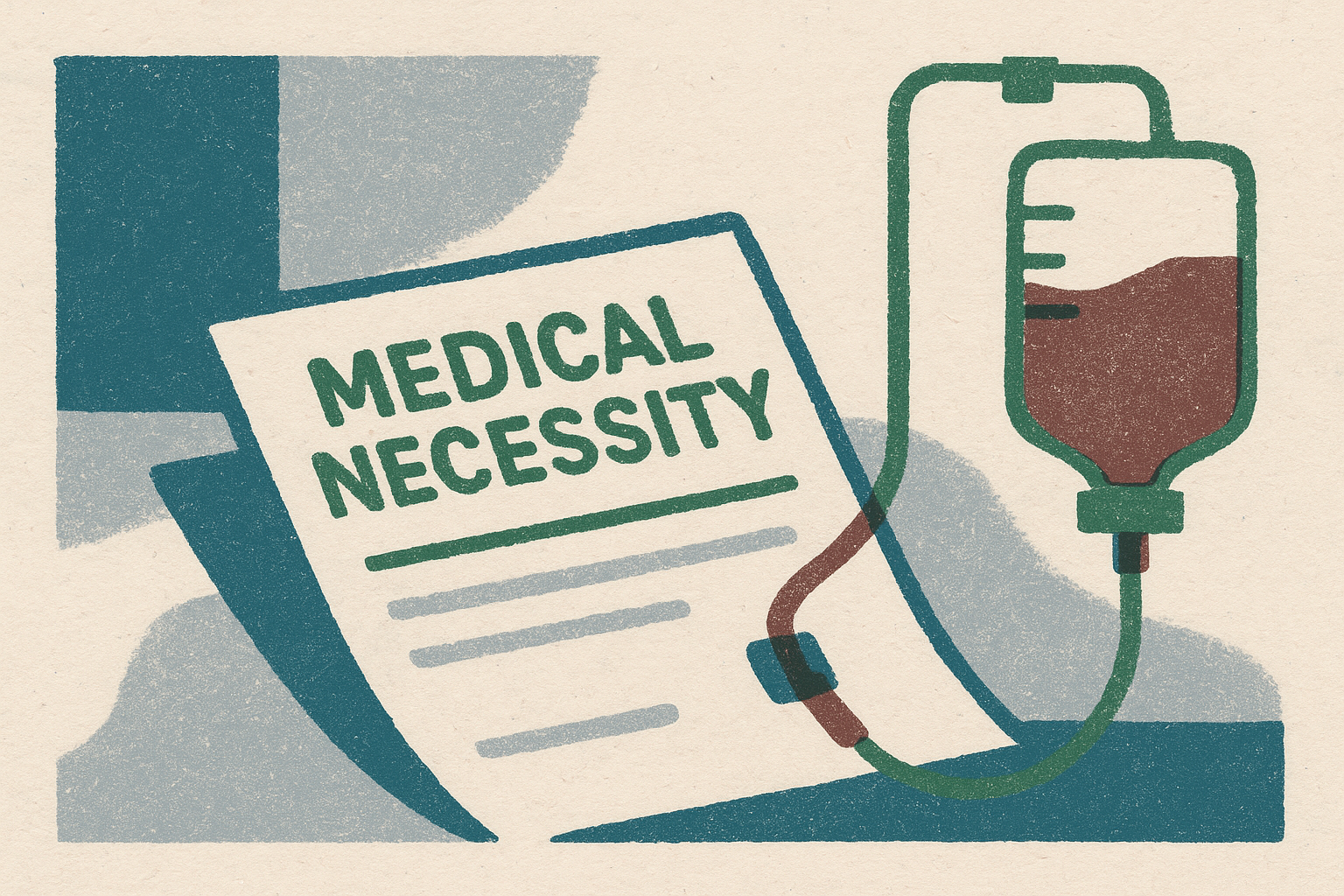
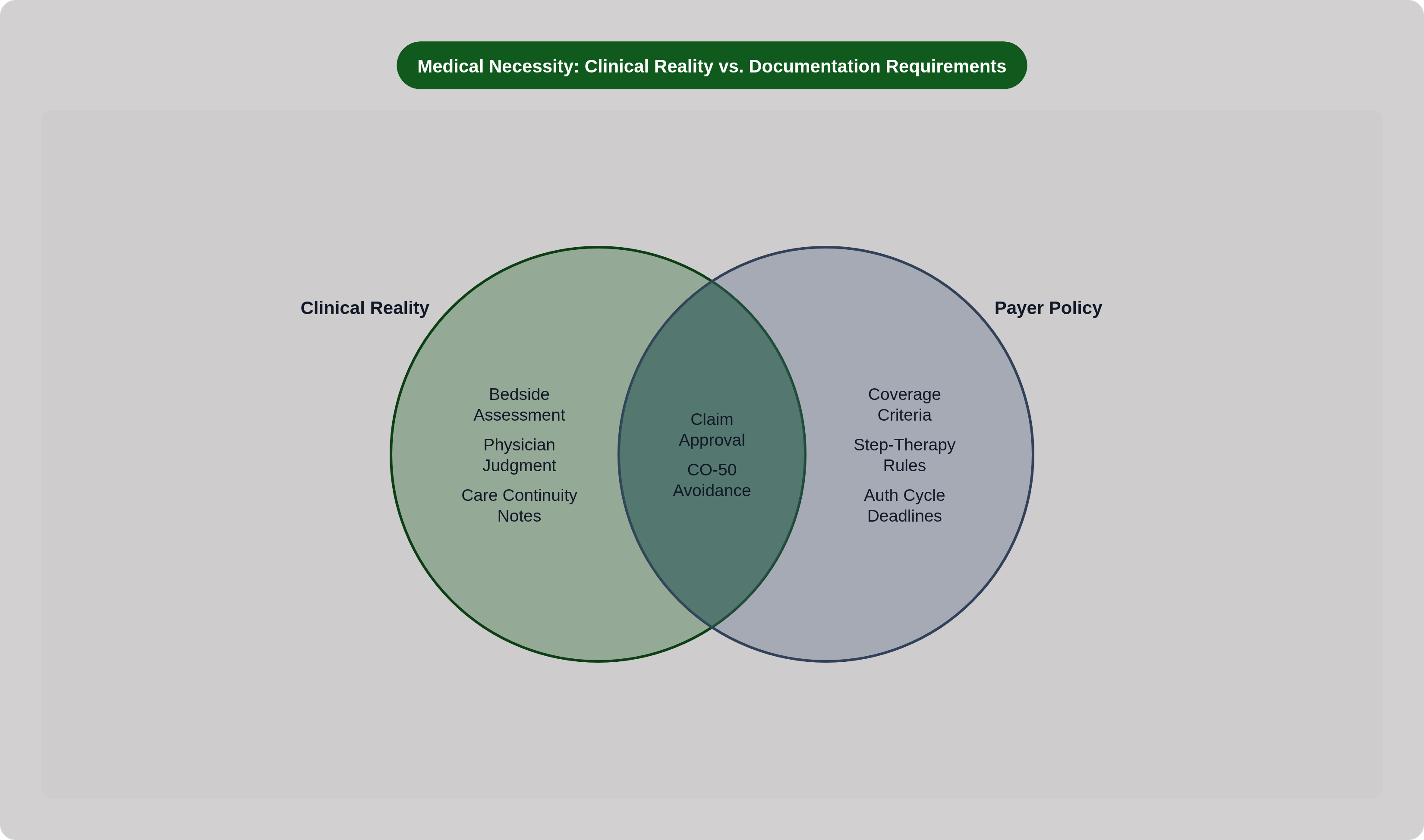
Medical necessity isn't solely a clinical judgment when a payer is making the call. It is also a contractual determination: does this service meet the specific criteria in our coverage policy, as demonstrated by the documentation in the file? Not by the clinical reality in the room. That distinction is where revenue gets lost.
Think of it this way: the payer isn't reading the room — they're reading the file. The clinical story is airtight on its own, but if the documentation doesn't mirror the policy's exact requirements, the claim fails. A payer's coverage decision is less like a physician's diagnosis and more like a contract audit: precise, policy-bound, and indifferent to what actually happened at the bedside.
CO-50 is the denial code Medicare applies when it determines a service doesn't meet medical necessity criteria. It surfaces on claims with correct CPT codes and correct ICD-10 codes. Missing rationale, unmet step-therapy requirements, documentation that doesn't align with the submitted claim details: all of it triggers CO-50. The codes being right doesn't save you if the clinical record doesn't tell the story the policy requires.
Both government and commercial payers maintain hundreds of individual medical policies. Each has unique requirements. Each updates on its own schedule. Locating the correct policy for a specific therapy at a specific payer has to happen before the first infusion, not after the first denial. The phrase "medically necessary" provides zero operational guidance. The operative question is always: necessary according to which policy, and proven how?
The Scale of What Documentation Failures Cost Infusion Operations
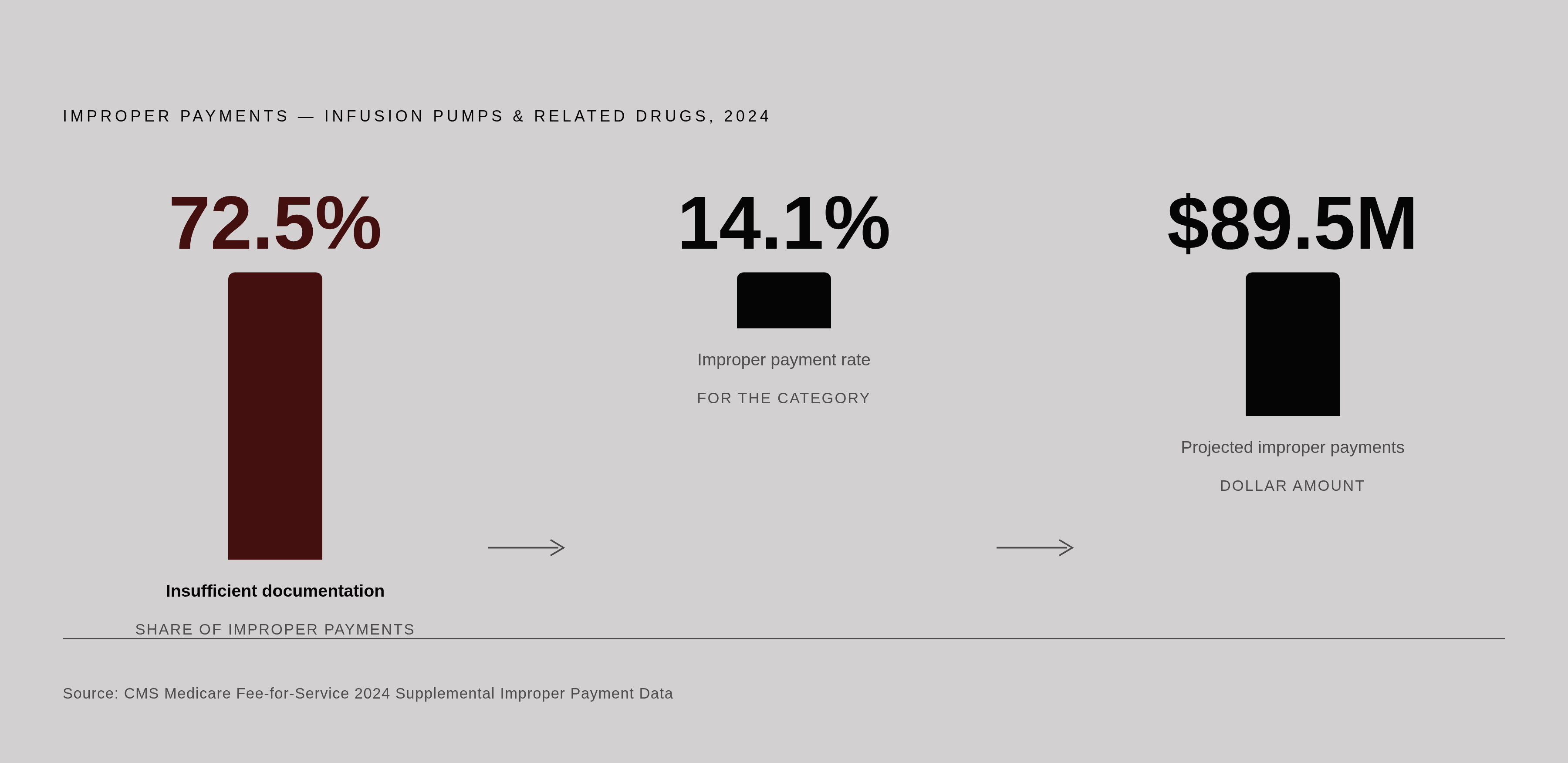
The numbers here are worth sitting with. Insufficient documentation accounted for 72.5% of improper payments for infusion pumps and related drugs during the 2024 Medicare reporting period, making it the single largest driver, per CMS data. The improper payment rate for that category sits at 14.1%, with a projected improper payment amount of $89.5 million. These aren't edge cases. This is the baseline.
The loss grows at every stage it isn't caught. A denial that could have been prevented at submission becomes a rework cost, then an appeal cost, then a write-off. Some write-offs aren't recoverable at any price. And the administrative drag compounds: rework on a single denied claim, before accounting for the working capital impact of a high-dollar biologic sitting unpaid in AR, adds cost that doesn't show up neatly in a denial rate metric.
At infusion drug prices, a denied biologic isn't a billing inconvenience. It's a cash-flow event tied to an asset already administered. The earlier the intervention, the cheaper the fix.
What CMS Actually Requires in a Medical Necessity Documentation Record
The December 2024 CMS MLN Fact Sheet defines the required elements: reason for encounter, relevant history, physical exam findings, prior diagnostic test results, assessment, clinical impression or diagnosis, plan of care, and legible provider identity with date. Those are the floor. Individual therapy policies layer additional requirements on top, and those layers are where most operations stumble.
IVIG is instructive precisely because it has one of the more demanding documentation profiles. Payers require a history and physical with supporting physician rationale, current within the last 12 months. Physician orders must be no more than 30 days old, specifying dose, frequency, and administration route. Progress notes must explicitly document the ongoing necessity for treatment, not just confirm that treatment occurred. Patient weight in kilograms must be recorded before each infusion because dosage is calculated on a mg/kg basis, making weight documentation a billing compliance requirement, not merely a clinical one. A step-therapy trail demonstrating prior failed conventional therapies must exist. Response to prior infusions must be documented. The IVIG improper payment rate sits at 4.6% with a projected improper payment amount of $7.6 million, per the same 2024 CMS data. Even a lower-rate therapy carries meaningful exposure when documentation lapses at volume.
The consistent pattern across therapy types: payers want a longitudinal record, not a snapshot. History, failure of alternatives, current clinical rationale, and response tracking all belong in the file. A record that documents the starting point but doesn't evolve with the patient will eventually deny.
Where the Documentation Record Breaks Down in Practice — and When
The central problem with documentation failures is that they are almost always historical by the time the denial arrives. The gap was created weeks or months earlier, at a point in the workflow that felt administrative rather than consequential. It's a bit like discovering a leak only after the ceiling has already come down — the damage wasn't sudden, it was slow, invisible, and entirely preventable.
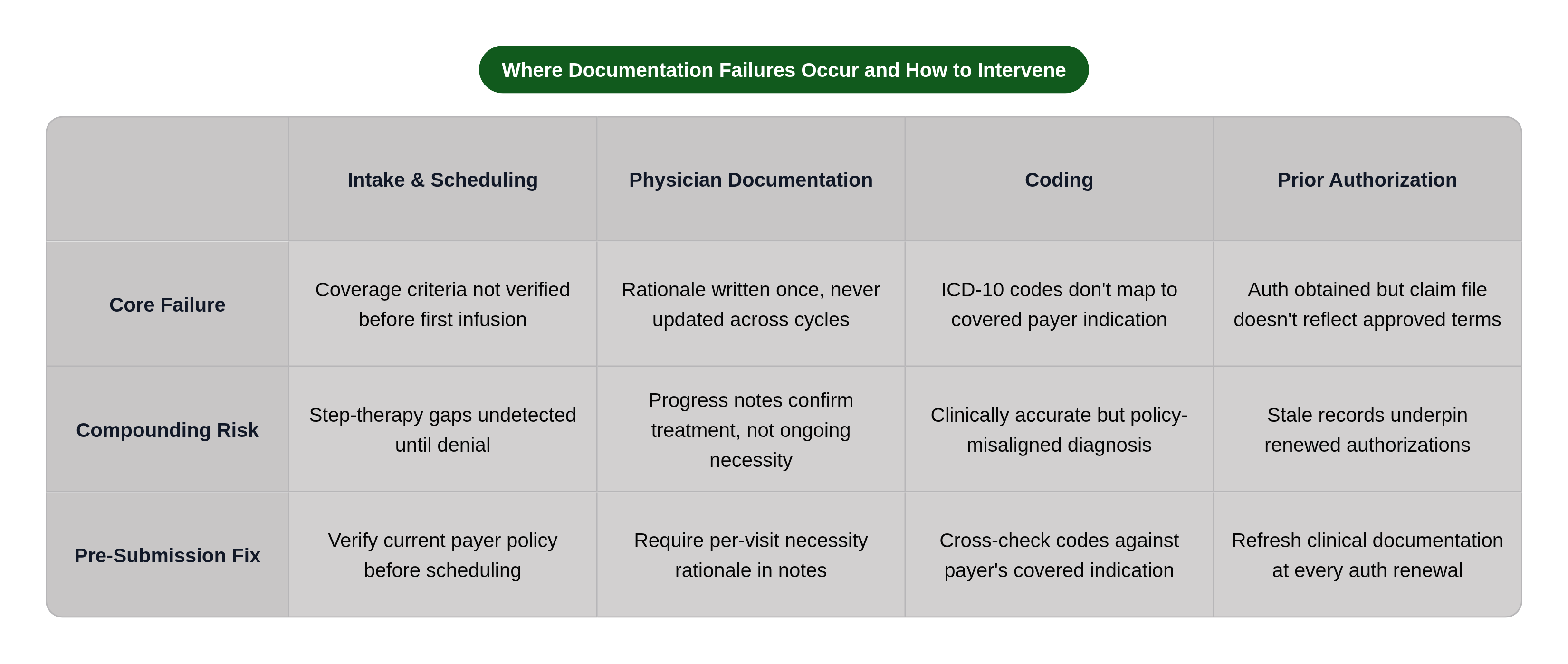
At intake and scheduling, eligibility and coverage criteria aren't verified against the current payer policy before the first infusion, and step-therapy requirements aren't confirmed before treatment begins. At the physician documentation level, progress notes confirm that treatment was given but don't articulate why it remains necessary; rationale is written once at initiation and not updated across recurring cycles. At coding, ICD-10 codes submitted don't map to the covered indication in the payer's policy, a mismatch that can exist even when the clinical picture is entirely accurate. Prior authorization gaps appear when an auth is obtained but the documentation in the claim file doesn't reflect the approved indication, dose, or frequency. For recurring treatments, authorization renews but supporting clinical documentation isn't refreshed, so payers are adjudicating a current claim against stale records.
The revenue cycle problem frequently starts at the front desk. Hydration therapy and prolonged infusions are consistent audit targets: billing hydration as incidental to another infusion, infusion time below the minimum threshold, mismatches between drug units and administration codes. These aren't obscure edge cases. They're recurring patterns that signal process gaps, not one-time errors.
Every failure type above has a pre-submission intervention point. The denial was preventable, but only if the process catches it before the claim goes out.
How Prior Authorization Intersects with Medical Necessity Documentation for Recurring Infusion Treatments
Prior authorization and medical necessity documentation are not parallel tracks. They are the same record viewed at different stages. The auth approval is based on the initial documentation. The claim is adjudicated against both the auth and the documentation in the file. If those two things don't align, the claim denies regardless of what the auth approval letter says.
The administrative burden here is substantial. Per AMA survey data, physicians average 43 authorization requests per week, requiring roughly 12 staff hours, and practice spending on prior-auth staffing jumped 43% between 2019 and 2024. In 2024, Medicare Advantage plans issued nearly 53 million PA determinations. KFF's 2024 analysis puts the blended denial rate around 6.4%, but that average masks wide variation: UnitedHealthcare denied 12.8% of requests while Elevance Health denied 4.2%. Payer matters enormously. Treating all payers as equivalently burdensome is a planning failure.
For recurring infusions, the documentation problem compounds across the authorization cycle. An auth renews on a cycle, but clinical documentation must be refreshed to match it. An auth approval on stale records is a future denial in waiting. Response-to-treatment documentation, required for ongoing coverage of therapies like IVIG, must be collected and filed between visits, not reconstructed at audit.
The CMS Interoperability and Prior Authorization Rule, finalized in January 2024 and taking effect in 2026, will require Medicare Advantage, Medicaid, and ACA plans to respond to routine requests within seven days and urgent requests within 72 hours, and to publish their own approval and denial metrics. That last piece matters: it creates an external benchmark for payer-specific denial patterns, which until now have required internal tracking to surface.
Building the Documentation Record as a Pre-Submission Workflow, Not a Denial Response
Documentation assembly is a revenue cycle function. It begins at scheduling, runs through every clinical encounter, and must be complete before the claim is submitted. Treating it as a response to denial is how operations absorb costs they didn't have to absorb.
The pre-submission workflow covers several non-negotiable categories. Coverage verification means the payer's current medical policy is confirmed against the specific therapy and indication before the first infusion. Clinical record completeness means the H&P is current within 12 months, progress notes are updated each visit with ongoing medical necessity rationale, and response-to-treatment is documented, not assumed. Order currency means physician orders are dated within 30 days for applicable therapies, specifying dose, frequency, and route. Weight documentation means patient weight in kilograms is recorded before each infusion for weight-based dosing drugs, a field that is easy to omit and consistently triggers denial. Auth-to-claim alignment means the approved indication, dose, and frequency are cross-referenced against the claim before submission. ICD-10-to-CPT alignment means diagnosis codes are verified against the covered indication in the payer's current policy, not just confirmed as clinically accurate.
Claims denied for documentation that was never created are far harder to overturn than claims denied for documentation that exists but wasn't attached. The former often become write-offs. The latter can usually be appealed. The operational discipline is completeness before submission, not reconstruction afterward.
How Denial Pattern Analysis Turns Documentation Failures Into Process Fixes
Documentation failures rarely occur randomly. They concentrate by payer policy, therapy type, and site. A denial at one payer for a specific therapy is almost always a signal of a systemic gap, not a one-time miss.
Root causes in mid-market infusion operations tend to cluster around a small number of drivers: prior authorization mismatches, drug-to-diagnosis inconsistencies, eligibility coverage lapses, and secondary claim filing breakdowns. A generic denial rate metric that doesn't disaggregate by those dimensions can't drive a process fix because it doesn't locate the problem.
Payer-specific denial tracking enables a few distinct capabilities. It identifies which payers apply the most restrictive medical necessity criteria for specific therapies, so those requirements can be built into pre-submission workflows before a denial arrives. It distinguishes between denials that reflect a missing documentation step and denials that reflect a payer policy change, which require different responses. And it surfaces when a payer begins applying a new standard before formally communicating it. Early pattern detection is consistently faster than waiting for a policy announcement.
The CMS 2026 requirement for Medicare Advantage plans to publish their own approval and denial metrics will add an external benchmark to this analysis. Discrepancies between internal experience and published figures will be worth investigating; that comparison hasn't been possible until now.
Denial data is only useful if it's granular enough to trace back to root cause. Grouping denials by code alone hides the signal. Root-cause categorization by payer and therapy type is what generates something you can actually act on.
What an Operationally Sound Infusion Documentation Process Looks Like at the Team Level
Documentation quality is not a clinical problem alone. It is shared accountability across clinical staff who create the record, front-end RCM staff who verify coverage and authorization, and billing staff who validate the file before submission. The breakdown happens most often at the handoff between those functions.
Clinical staff document for care continuity. That's what their training optimizes for. Payer-specific coverage criteria are a different lens entirely, and without a structural bridge between those two orientations, documentation gaps are inevitable. The RCM function exists to provide that bridge, but only if it's positioned in the workflow before the claim goes out, not summoned after the denial arrives.
A documentation-complete infusion operation has a few consistent structural features. A payer policy library, maintained and updated per therapy, means staff reference current policy-specific checklists rather than working from memory. A pre-submission review that checks documentation completeness, not just coding accuracy, catches the cases where the codes are clean but the clinical record is insufficient. Auth tracking integrated with documentation tracking ensures that renewal dates trigger documentation refresh workflows, not just authorization resubmission. A denial feedback loop that reports root-cause data back to clinical and front-end teams corrects process gaps at the source rather than absorbing the cost downstream.
Infusion practice operators managing documentation workflows manually, chasing clinical notes after the fact, or reconstructing records at the appeal stage have a structural gap in their RCM operation. Automation can close part of it. But the judgment calls can't be automated away: knowing what a specific payer requires for a specific therapy, recognizing when a documentation set is insufficient before the claim goes out, understanding the difference between a fixable gap and an unrecoverable write-off. Those require people who know infusion billing and are reviewing each case with that knowledge applied.