COB Sequencing Rules in Infusion Billing Workflows
Permanent COB errors at intake create cascading denials weeks after treatment.
The sequencing hierarchy that governs which payer adjudicates first is not ambiguous. Active employee coverage is primary over dependent coverage. When dependent children are covered by both parents' plans, the birthday rule applies, and the parent whose birthday falls earlier in the calendar year holds the primary position. An active employer plan supersedes COBRA or other continuation coverage. When no other rule resolves the order, the longer-held plan is primary. And then there are Medicare Secondary Payer rules, which govern a distinct and consequential set of situations: working-aged patients covered by employer-sponsored insurance, ESRD patients within the coordination period, and disabled individuals under 65 with active group coverage.
Clean rules on paper. In practice, the chronic disease populations driving infusion volume collide with all of them — like a freight train hitting a revolving door.
Patients receiving recurring biologics for rheumatoid arthritis, IBD, or multiple sclerosis are, by definition, in long-duration treatment. Long-duration treatment means coverage events. Job changes. COBRA elections. A spouse adds them to a new plan. Medicare eligibility hits. Open enrollment shifts the benefit design entirely. These are not edge cases; they are just what happens to a person who has been coming in every four to eight weeks for two or three years. The COBRA trap is one I see constantly: the patient continues presenting the same insurance card, the billing team has no automatic signal that the underlying status changed, and the claim goes out with the wrong payer in the primary slot. Nobody catches it until the denial lands.
MSP questionnaire failures are their own category of recurring damage. A lapsed or missing MSP questionnaire creates a situation where Medicare adjudicates as primary when it should be secondary. That is not a correctable overpayment; it is a recoupment scenario with audit exposure attached. The corrective path is substantially harder than getting it right the first time, and the audit risk compounds long after the original claim is resolved.
The birthday rule introduces operational friction specific to infusion because verifying which parent's plan is primary is only the first step. When both parents carry employer-sponsored coverage and the same biologic requires prior authorization, those two plans may have entirely different formulary requirements and PA pathways for that drug. The COB sequencing question and the PA pathway question are bound together, and you have to resolve both before the patient sits down for treatment.
The largest single failure mode across all seven rules is treating COB as a one-time question answered at the front desk during initial intake. It is not. It is a living determination that changes whenever the patient's coverage changes, and in a chronic infusion population, that happens regularly. By the time a CO-22 denial code appears on a remittance, indicating that another payer may be responsible, the sequencing error has already been embedded in a submitted claim, a primary adjudication has already run on faulty premises, and the secondary cannot process until the primary is corrected. The denial is not the problem; it is confirmation that the problem occurred weeks earlier.
The CPT Hierarchy Layer: How Infusion Service Sequencing Compounds Payer-Priority Errors
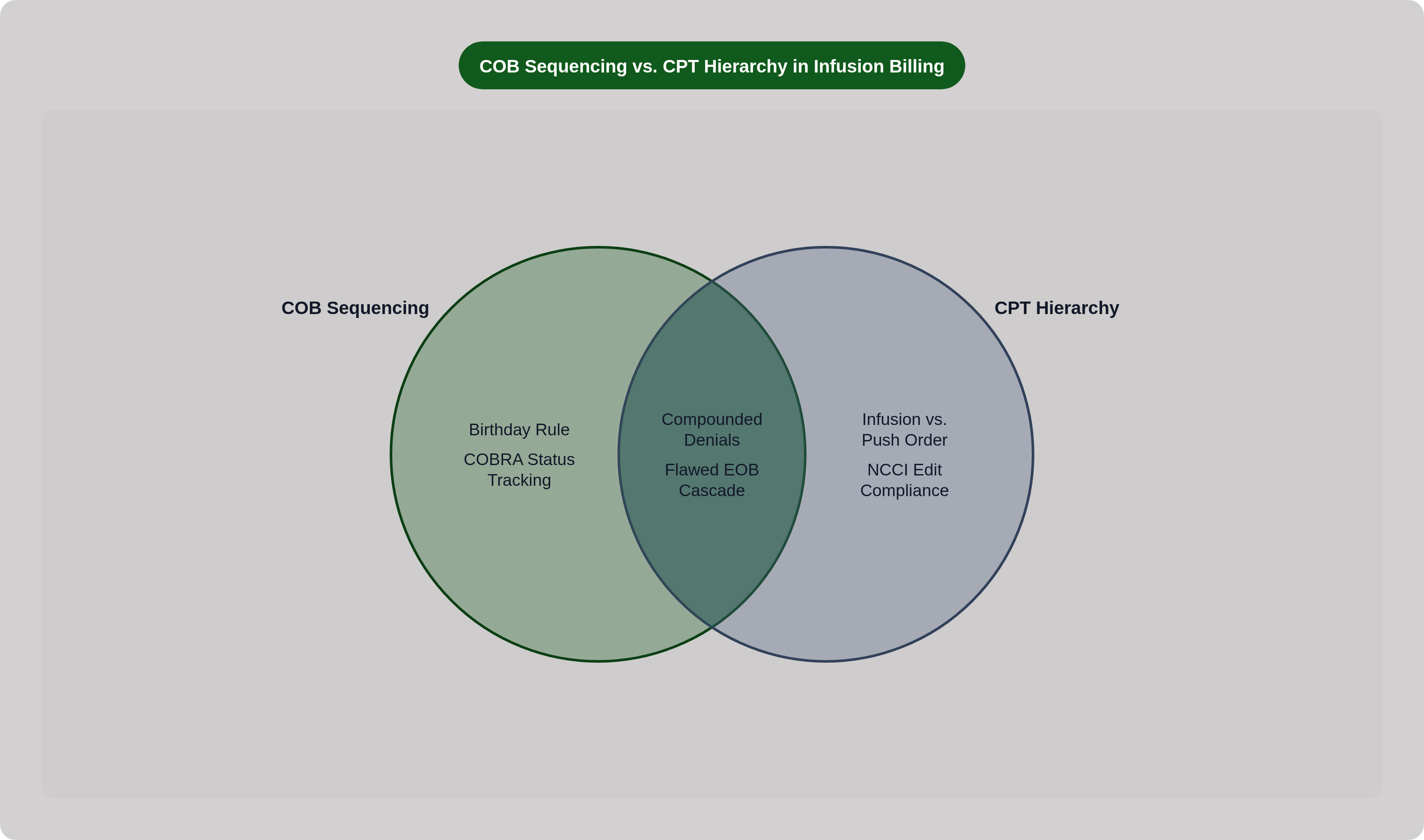
Payer-priority sequencing is only one of two overlapping sequencing systems operating simultaneously in infusion billing. The second is the CPT administration code hierarchy. Errors in either one corrupt the claim independently. When both fail together, the damage compounds.
CMS mandates a specific order for drug administration codes when multiple services occur in a single encounter. Chemotherapy administration codes take precedence over therapeutic infusion codes, which take precedence over hydration. One initial service code per encounter per day, unless two separate IV access sites are clearly documented. That is the rule, and it is not discretionary.
Sequential versus concurrent infusion adds another layer. A sequential infusion, meaning a different drug administered through the same IV site after the first has completed, can be billed separately, but only with documentation that explicitly supports the sequential characterization. Payers audit this distinction aggressively on high-cost biologics, because concurrent bundling reduces reimbursement and the difference in payment can be substantial.
Infusions are hierarchically primary to pushes, which are primary to injections. Reporting a push as the initial service when an infusion also occurred in the same encounter triggers NCCI edits and produces bundling denials. This happens regardless of how cleanly the payer-priority sequencing is otherwise set up.
Here is where infusion billing gets genuinely complicated: when the wrong payer is designated primary, that payer's adjudication logic — its bundling rules, its NCCI edit implementation, its benefit design — applies to the claim first. The EOB it produces is what the secondary requires before it will process. If the primary's adjudication was built on a flawed CPT hierarchy, the secondary inherits that error. It calculates its liability off a number that was already wrong. Think of it as passing a broken ruler to the next person in line and asking them to measure accurately.
A CPT hierarchy error caught by the primary results in a bundling denial requiring correction and resubmission before the secondary can process at all. In a buy-and-bill model, the practice purchased the drug before the first claim was submitted. Every week that claim sits unresolved is a week of drug acquisition cost with no corresponding payment. That is the operational reality that makes CPT hierarchy errors so costly in infusion specifically.
How COB Sequencing Errors Enter the Workflow at Intake, Before a Claim Is Ever Submitted
Most recoverable COB sequencing problems are not created at adjudication. They are seeded at scheduling or eligibility verification, sometimes days before the patient arrives. By the time the claim is submitted, the error is already structural.
Patients are an unreliable source of COB information, and I do not mean that as criticism. Most patients genuinely cannot tell you which of their two plans is primary, whether their coverage runs through their own employer or their spouse's, or whether a recent COBRA election changed their status relative to a secondary plan. They have one or two insurance cards and a general understanding that they have coverage. The legal determination of which plan adjudicates first is not something they have any reason to track.
Infusion referrals introduce a second vulnerability. The prescribing physician's office typically verifies eligibility for an office visit, not for an infusion center encounter. When the referral arrives, it often comes with a coverage snapshot that is accurate for the referring context but structurally incomplete for the infusion billing context. The infusion center inherits that verification without inheriting the caveat that it was performed under different circumstances and for a different setting.
Mid-treatment coverage changes are endemic in chronic infusion populations. A patient whose COB was correctly established at the first infusion may have changed employers, enrolled in a spouse's plan, or quietly elected COBRA by the fourth visit. Unless the billing operation has a mechanism to detect and surface those changes between visits, the incorrect COB determination simply carries forward. Every visit in the authorization period goes out wrong until someone catches it, and by that point, the corrective work involves a chain of submitted claims, not a single one.
The siloed handoff model that still governs many revenue cycle operations makes this worse. When eligibility verification, COB determination, and denial management are owned by separate teams working in sequence, coverage changes that occur between visits fall into the gaps. No single function owns the ongoing accuracy of the COB determination, so no single function catches the drift when it happens.
The recurring intake failure modes are specific: MSP questionnaires not collected at initial intake, or not refreshed before a new treatment cycle begins; the birthday rule not applied when both parents appear in the patient record; COBRA versus active-plan status not re-confirmed after a patient mentions a job change in passing during check-in. Each of these is a discrete failure that, on an infusion schedule, does not produce one correctable claim. It propagates.
What Happens to a Mis-Sequenced Infusion Claim Through Adjudication and Payment Posting
Standard adjudication timelines for primary payers run roughly 15 to 45 days on electronic claims. Secondary processing adds another two to three weeks. A complex dual-eligible claim can take 60 to 90 days from submission to final resolution under normal conditions. A mis-sequenced claim does not compress that timeline; it resets it.
A CO-22 denial from the primary payer means the claim must be corrected and resubmitted, not appealed. Appeal pathways are designed for disputed clinical or coverage determinations. A sequencing correction requires identifying the error, establishing the correct payer order, gathering documentation to support resubmission, and resubmitting to the primary. Only after the corrected primary adjudication produces a valid EOB can the secondary process. The practice absorbs drug acquisition cost through all of it.
If the primary's EOB is missing or malformed, meaning the primary adjudicated but the remittance does not contain the data elements the secondary needs to calculate its liability, the secondary will reject or suspend the claim. The practice must obtain a corrected EOB before any secondary submission is possible. This is a distinct failure mode from the CO-22 scenario, and it is common when claims are corrected manually or when electronic remittance data is incomplete.
Timely filing risk is the most consequential downstream effect. Secondary payers measure their filing windows from the primary's adjudication date, not from the date of service. If a primary correction and resubmission take long enough, the secondary's window may close before the corrected primary EOB is even available. At that point, the sequencing error has been converted into a permanent write-off. The secondary's liability is gone, not because the claim was invalid, but because the filing window closed while the billing team was still correcting the primary.
Payment posting on COB claims is structurally different from single-payer posting. When a coordinated claim eventually pays, the remittance reflects adjustments from two payers operating under different contractual and benefit design logic. A J-code drug claim where the primary underpaid based on incorrect payer logic, and the secondary then calculated its liability off that flawed allowed amount, produces a compounded underpayment that is nearly invisible without line-level review of both remittances. If the posting team treats the combined payment as final without comparing it against the expected allowed amounts under both contracts, that underpayment closes silently. No denial code, no flag, no follow-up. Just lost revenue — like a leak you never find because you stopped looking at the pipe.
Industry-wide denial rates reached 11.8% in 2024, and the share of providers reporting denial rates above 10% climbed from 30% in 2022 to 41% by 2025. COB sequencing errors are a contributing driver of that trend in infusion settings specifically, where claim values are large enough that each individual error carries material revenue consequence.
Payer-Specific COB Behavior Patterns Infusion Billers Encounter in Practice
COB behavior is not uniform across payer types. The same sequencing error produces different outcomes depending on which payer is involved, and anyone who has billed infusion long enough develops a working map of those behavioral differences because they affect how fast errors surface and how hard they are to fix.
Medicare and Medicare Advantage
When Medicare is secondary under MSP rules, it moves relatively quickly on electronic claims. But the MSP framework carries audit authority, and an erroneous Medicare primary payment triggers recoupment, not a standard billing correction. That distinction matters operationally: recoupment means Medicare takes money back from future payments while the dispute resolves. That creates cash flow disruption that a routine denial does not, and it can hit the practice before anyone has had time to fully investigate the original error.
Medicare Advantage is where even experienced billers get tripped up. An MA plan functions as the primary payer using commercial-style adjudication logic, including its own prior authorization requirements and bundling rules. Medicare then coordinates as secondary, but it coordinates against the MA plan's adjudication, not traditional Medicare's payment model. A sequencing error in an MA claim runs through an entirely different adjudication engine than a traditional Medicare error. The corrective path is correspondingly different, and assuming otherwise wastes time.
Commercial Payers and Pre-Payment Review
Commercial payers have increasingly deployed AI and predictive modeling to flag high-risk claim patterns before payment is issued. Infusion claims are disproportionately represented in that scrutiny because of their dollar values, their diagnosis clusters, and the utilization patterns associated with high-cost biologics. A mis-sequenced COB claim that also triggers a pre-payment review flag may be suspended for manual review, extending adjudication well beyond standard timelines.
The specific irony here is worth naming: the claims with the highest financial exposure — oncology, rheumatology, neurology infusion claims — are precisely the ones most likely to be held for manual review. Sequencing errors on those claims are caught more slowly, suspended longer, and resolved later than the practice's cash flow position can absorb comfortably.
Payer-specific bundling behavior also interacts with CPT hierarchy in ways that require advance knowledge. The same infusion service combination may be bundled by one commercial payer and paid separately by another under its contract. Understanding the primary payer's bundling behavior before submission is part of correct COB preparation, not a detail to discover after a denial lands.
Medicaid as Secondary
Medicaid is almost always payer of last resort. Submitting to Medicaid before all other payers have adjudicated is a COB violation that produces automatic denials. Medicaid timely filing windows vary by state and are frequently shorter than commercial payer windows. A COB error that delays primary adjudication can close the Medicaid window entirely, converting what would have been a recoverable sequencing correction into a permanent loss of the Medicaid balance. There is no appeal pathway for a missed Medicaid filing window in most states. It is simply gone.
Revalidating COB Across a Recurring Infusion Treatment Cycle
Infusion differs from episodic care in one respect the revenue cycle must account for structurally: the treatment continues. A patient receiving a biologic every four to eight weeks over a multi-year course has a COB determination that must remain accurate across every visit in that cycle, not just the first one. That sounds obvious. The operational reality is that most revenue cycle workflows are not built with that continuity requirement in mind.
The coverage events that reset COB during treatment are just ordinary life. A job change by the patient or a covered spouse moves an active employer plan into the primary position and displaces whatever was there before. A patient reaching Medicare eligibility at 65, or hitting an ESRD threshold mid-treatment, triggers MSP rules that did not apply when the treatment cycle started. Open enrollment, which happens every year, can shift plan type, carrier, benefit design, and the identity of the primary payer for a dependent. A patient who drops secondary coverage mid-cycle changes the expected payment structure for every remaining claim in the authorization period, often without mentioning it to anyone at the infusion center.
Authorization lifecycle interaction with COB changes is a specific operational challenge that does not get enough attention. Prior authorizations for recurring infusions are typically issued for a defined dosing cycle or tied to clinical response-update windows. When a COB change occurs at renewal time, the reauthorization may need to run through a different primary payer that has different formulary requirements and a different PA pathway for the same drug. Research on prior authorization denial patterns indicates that a substantial majority of PA denials are eventually overturned on administrative grounds rather than clinical ones. When COB sequencing is wrong at the point of PA submission, the authorization itself may be issued by the wrong payer and may need to be reissued, creating a chain of corrections that extends well beyond the billing function and back into the clinical workflow.
The practical requirement is not complicated to state, even if it is demanding to execute: COB must be re-confirmed at each treatment visit and at each authorization renewal. A scheduling workflow that surfaces COB status alongside authorization status, so both are verified before the patient is seated, is the mechanism that prevents a mid-cycle coverage change from quietly propagating across six subsequent visits before anyone notices.
Treating COB revalidation as a step embedded in scheduling rather than a cleanup task handled by billing after a denial is the structural change that prevents propagation. That is a workflow design decision. It has to be made deliberately, because the default structure in most operations leaves it as a billing problem by design.
Building a COB Sequencing Control Into Infusion RCM Operations
The operational gap in most infusion revenue cycle operations is not a knowledge gap. Billing teams generally understand the rules. The gap is structural: eligibility verification, COB determination, and denial management are owned by separate functions working in sequence, and mid-cycle coverage changes fall into the spaces between them. In infusion, that handoff model does not produce occasional errors; it guarantees that certain categories of errors will not be caught until a claim fails.
A functioning COB control in infusion has specific characteristics. Coverage verification at scheduling explicitly confirms COB order, not just eligibility, before each visit. That is a meaningful distinction: confirming that a patient has active coverage is not the same as confirming which payer adjudicates first, and conflating the two is how the intake process produces the sequencing errors described throughout this piece. MSP questionnaire collection runs on a defined cadence tied to treatment cycles, not only to initial intake. Authorization status and COB status appear together in the scheduling workflow so that a COB change requiring a PA correction is identified before treatment is administered, not after.
Denial code tracking must distinguish CO-22 payer-priority sequencing denials from bundling denials driven by CPT hierarchy errors. Grouping both under a generic COB denial category obscures root cause and guarantees that neither gets fixed systematically. A CO-22 denial points to intake and eligibility verification as the corrective target. A bundling denial points to coding and CPT sequencing. Different problems, different owners, different fixes.
Secondary claim timely filing must be tracked from the primary adjudication date, with escalation triggers calibrated to each secondary payer's filing window. Waiting for a denial to discover that a window has closed is not a monitoring strategy; it is an absence of one. The trigger should fire while the window is still open.
None of this requires sophisticated technology. It requires assigned ownership, workflow design that surfaces COB status at the point where it can still be corrected, and denial code reporting that keeps sequencing errors and hierarchy errors in separate buckets so patterns stay visible. The practices that manage COB sequencing well in infusion do not have access to better rules. They have built process discipline around the rules that already exist, and they apply that discipline at every point in the cycle where a sequencing determination can still be verified before it becomes a claim error.