CO 97 Denial Code in Infusion Billing
CO-97 denials stem from three different rule systems, and confusing them costs recoverable revenue.
CO-97 has a precise, formal definition: the benefit for the denied service is already included in the payment adjudicated for another service on the same claim. The CO prefix designates it as a contractual obligation adjustment, which means the provider cannot balance-bill the patient. Miss the appeal window, and the write-off is permanent. No exceptions.
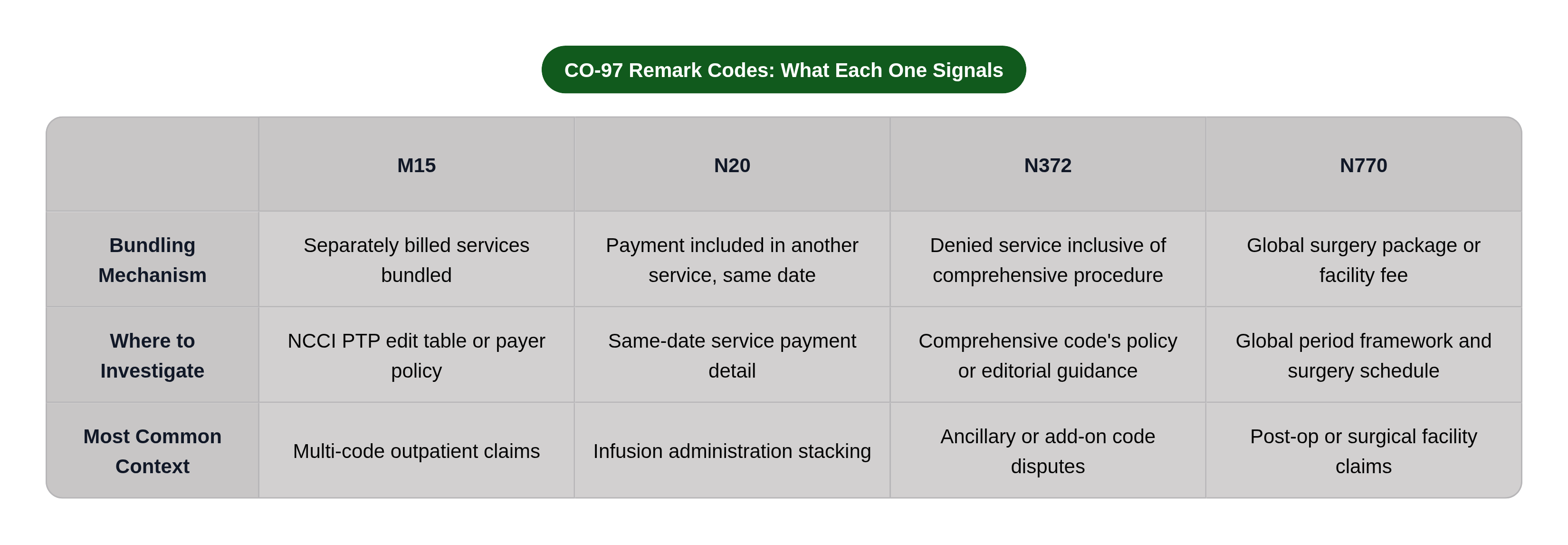
You find CO-97 in the 835 electronic remittance, Loop 2110 CAS segment. The remark codes accompanying it are your first triage signal, and most billers treat them as background noise. That is the first mistake, and it is expensive. M15 tells you separately billed services have been bundled. N20 tells you payment for the denied procedure is included in another service on the same date. N372 tells you the denied service is considered inclusive of a more comprehensive billed procedure. N770 points to a global surgery package or facility fee. Each of those remark codes narrows your investigation before you pull up a single code pair. Read them first, every time.
Here is the mistake that kills recoverable appeals at scale: CO-97 is not CO-236. CO-236 is explicitly tied to NCCI procedure-to-procedure edits. CO-97 reflects a payer's proprietary bundling policy that exists entirely outside NCCI, was written by a team you've never met, and lives on an update schedule you are not notified about. Conflating the two means you investigate the wrong rule system, find nothing, and let the claim die — not because it was unwinnable, but because you were looking in the wrong place.
Three distinct rule systems trigger CO-97. First: the NCCI Procedure-to-Procedure edit table, maintained by CMS, updated quarterly, publicly accessible, governing for Medicare, and adopted with varying uniformity by Medicaid programs. Second: the payer's proprietary reimbursement policy library, where commercial payers maintain bundling logic that extends well beyond NCCI on their own schedules, with no transparency requirement. Third: the global surgical package framework, which bundles related E&M services and minor procedures into the global period of a base surgical code.
The appeal pathway differs for each. The supporting documentation differs. The modifier logic differs. Treating them as one thing is where the revenue disappears.
For NCCI-triggered denials, the single most important triage variable is the modifier indicator attached to the edit pair. Indicator 0 is a hard bundle: no modifier bypasses it, no clinical narrative overrides it. Appealing an indicator 0 denial on clinical grounds is converting staff time into nothing. Indicator 1 means a modifier can bypass the edit when clinical circumstances support a distinct, separately identifiable service. That is where recoverable revenue lives. Indicator 9 means the edit does not apply. Checking the modifier indicator before any other appeal work separates recoverable from non-recoverable in under two minutes.
NCCI edits update quarterly. A code pair that was separately payable last quarter carries a new edit this quarter. Relying on a lookup tool running even one quarter behind will give you wrong answers with complete confidence.
Why infusion billing is structurally more prone to CO-97 than most specialties
A single infusion encounter routinely stacks billing elements that most outpatient specialties never see in combination on the same date: multiple drug administrations, multiple CPT administration codes covering initial infusion, sequential infusions, concurrent infusions, and additional-hour units, high-cost J-codes for the drug itself, an E&M for the supervising provider, and ancillary services like hydration and antiemetics. More code combinations per claim means more PTP edit pairs in play. The exposure is multiplicative, not additive.
The administration hierarchy is where the most preventable errors originate. The initial infusion code applies only to the first substance administered in a given encounter. Each additional drug uses either the sequential infusion code, for a new drug on a different line at a different time, or the concurrent infusion code, for a different drug running simultaneously on a separate line. Billing two separate drugs as two separate initial infusion codes on the same date produces CO-97 reliably and predictably. It is not a payer quirk; it is a misapplication of the hierarchy.
The double-lumen catheter rule adds another layer that catches people off guard. Per the CMS NCCI Policy Manual, when both lumina of a double-lumen catheter are used for different substances, only one initial infusion code may be reported. One vascular access site, regardless of how many lumina are in use.
Infusion services embedded within other procedure types carry their own bundling logic entirely outside the standard infusion framework. Cardiovascular pharmacologic stress testing is the cleanest example: infusion and injection codes, catheter insertion codes, and ECG codes are bundled into the stress test procedure and are not reported separately.
Time documentation is a vulnerability payers exploit systematically, and it is entirely avoidable. If start and stop times are not explicitly documented for each infusion, payers treat the units as unsubstantiated. Without the timestamps, the claim does not survive scrutiny, and the denial is technically correct. This is a documentation training problem, not a coding problem.
The E&M bundling problem and when modifier 25 applies versus modifier 59
E&M services billed on the same date as an infusion are a recurring CO-97 source. The payer denies the E&M as bundled into the administration service, and the instinct is to reach for a modifier to fix it. The correct modifier is 25, not 59. Appending modifier 59 to an E&M code is a miscoding error that delays adjudication or generates a different denial entirely, and it signals to auditors that the practice is applying modifiers without understanding what they do.
Modifier 25 signals a significant, separately identifiable evaluation and management service performed on the same day as a procedure or other service. Modifier 59 signals a distinct procedural service and belongs in procedure-to-procedure bundling situations. They are not interchangeable.
The documentation standard for modifier 25 in infusion is where this becomes practical rather than theoretical. The E&M must reflect a clinical evaluation that goes beyond the work of ordering and supervising the infusion. Disease monitoring, new symptom assessment, medication adjustment decisions: these support a separately identifiable service. A note that documents only that the patient arrived, received the infusion, and tolerated it without issue does not support a separate E&M. In that scenario, the denial is correct, and no modifier fixes it.
Payers routinely request records on same-day E&M and infusion claims. A pattern of modifier 25 without substantive documentation depth is an audit trigger, not just a denial risk. The correction is documentation protocol, established upstream with the clinical team, before the modifier is ever appended. The note must stand on its own as a distinct encounter. The modifier follows the documentation. It does not manufacture it.
JW and JZ modifier compliance and how drug waste reporting intersects with CO-97 risk
J-code claims for single-dose vial drugs carry a specific modifier compliance requirement. Either modifier JW, indicating a portion of the drug was discarded, or modifier JZ, indicating no drug was discarded, must appear on the claim. CMS made this mandatory beginning January 2024. Enforcement has extended into 2026 with increasing scrutiny from Medicare Advantage plans, and the compliance gap in most infusion billing operations is wider than most practices realize, partly because the requirement feels administrative rather than clinical and does not always get the same attention as coding rules.
A J-code denial tied to a missing JW or JZ modifier is a compliance issue, not a bundling issue. It has nothing to do with CO-97. Misreading that denial as a bundling problem wastes investigation time and leaves the actual compliance gap unresolved, still generating future denials. The remark codes tell you which is which.
The J-code for the drug product is not bundled with the administration code under NCCI; they are appropriately billed separately. When a CO-97 denial appears on a J-code in isolation, that is a payer policy issue, not an NCCI edit. The investigation starts at the payer's reimbursement policy portal, not the NCCI table.
How payer-specific bundling policies diverge from NCCI and what that means for commercial claims
Major commercial payers maintain proprietary reimbursement policy libraries that extend well beyond NCCI. They bundle code pairs that NCCI does not bundle, update those policies on their own schedules with no obligation to notify providers, and the effective date of a policy change does not appear in your denial queue until claims start coming back. A billing team relying solely on NCCI lookups for commercial claims is working with incomplete information on every commercial remittance.
The appeal pathway for a CO-97 rooted in a payer's proprietary policy is contractual and policy-based. The appeal must cite the specific payer reimbursement policy by name and number. When the payer's own policy is ambiguous or contradicts CPT editorial guidance, the appeal cites CPT editorial guidelines or CMS coding guidance as external interpretive authority. Citing the NCCI table in a dispute over a commercial payer's proprietary bundling policy signals, plainly, that you do not know what triggered the denial.
UnitedHealthcare and Anthem both maintain payer portals that are the authoritative source for their respective adjudication logic. These are the primary reference for commercial bundling lookups. Third-party lookup tools may or may not reflect current policy, and when they are wrong, the claim pays the price.
Medicare Advantage plans follow Medicare rules as a floor, then apply additional restrictions above that floor. The JW/JZ enforcement trend illustrates how MA plans extend CMS requirements with their own audit programs, often more aggressively than traditional Medicare.
CO-97 denial patterns are payer-specific, and aggregate CO-97 volume counts obscure the actual root causes. The same code pair is separately payable under one payer's policy and bundled under another's. Tracking denials by payer and by code pair surfaces which payers are responsible for which patterns. When one payer is generating a disproportionate share of volume on the same code pair, the appropriate intervention is a formal coverage policy update request, not a claim-by-claim appeal. Most practices never pursue it because they never identify the pattern; they just keep working the same denial every month.
A working triage protocol for CO-97 denials in infusion remittances
Read the remark code first. M15, N20, N372, and N770 each point to a different bundling mechanism. Skipping this step is how people spend forty-five minutes investigating the wrong problem and come up empty.
Once the remark code narrows the probable mechanism, identify the rule system. For Medicare and Medicaid claims, check the NCCI PTP edit table for the specific code pair on the date of service, using the version current to that date. For commercial claims, go directly to the payer's reimbursement policy portal. For surgical global denials, determine whether the denied service falls within the global period of a separately billed procedure.
For NCCI-triggered denials, the modifier indicator is the next and most decisive step. Indicator 0 means close the claim; the bundle is absolute and no appeal pathway exists. Indicator 1 means proceed: document the clinical distinction and determine the appropriate modifier.
Before appending any modifier, confirm the documentation supports it. For modifier 59 and the X-modifiers (XE, XS, XP, XU), documentation must demonstrate a distinct procedure, a different session, a different anatomic site, or a non-overlapping service. For modifier 25, the E&M documentation must reflect a separately identifiable evaluation that goes beyond infusion supervision. The modifier follows the documentation. It does not substitute for it, and auditors know the difference.
From there: correct and resubmit if the denial reflects a billing error, or file a formal appeal with policy citation and supporting clinical documentation if the denial reflects a payer policy the provider legitimately disputes. Either way, work within the payer's timely filing window. That window is not negotiable.
Log every denial at the payer-code-pair level, not as a raw CO-97 count. Patterns that recur for the same payer on the same code pair are a coverage policy or contract problem. Treating them as individual claim corrections, indefinitely, is a losing strategy that scales badly.
Appending modifier 59 to every NCCI edit pair without individualized clinical distinction documentation is not a workaround. It is an audit invitation, and payer and government auditors are actively looking for it.
The revenue cost of writing off CO-97 denials that are clinically and legally recoverable
A substantial share of denied claims across specialties are never reworked or resubmitted. In many operations, CO-97 denials sit in a queue until the appeal window closes and then move to write-off. When that window closes, the loss is permanent. CO-97 is among the most commonly reversed denial codes when worked correctly, with appropriate documentation or modifiers attached. The write-off rate in most practices reflects a workflow failure, not an unwinnable denial landscape.
Infusion billing makes this materially worse. A single denied infusion claim represents a biologic or specialty drug with a drug cost reaching tens of thousands of dollars. Workflow decisions built around primary care volume assumptions do not survive contact with infusion remittances, and the practices that apply them anyway are absorbing losses they could recover.
The rework burden is real and should be acknowledged honestly. Each denied claim consumes staff time to investigate, document, and resubmit, and the administrative cost per denied claim has risen considerably. Prioritizing the highest-value claims first is operationally sensible. But the cumulative write-off from smaller claims, compounded across a year's remittances, is often larger than the high-value individual denials that command attention.
The denial environment is more adversarial now than it was five years ago, and there is no credible signal that it is moving in the other direction. Payers are applying more automated prepayment edits. MA plans are extending their audit programs. Modifier compliance requirements are increasing. CO-97 volume in infusion billing is more likely to grow than contract. Practices without a structured triage protocol are falling further behind with each remittance cycle, and the gap compounds.