Medical Documentation Audit Process for Billing Compliance
Incomplete documentation, not fraud, drives most infusion billing denials on audit.

The dominant failure mode in infusion billing is not fraud, and it is not coding complexity either. It is incomplete documentation that technically exists but does not hold up when someone actually looks at it. The records are there. They just don't survive scrutiny.
Four gaps drive the majority of denials, and none of them are exotic.
Missing or incomplete start and stop times are probably the most preventable failure on this list, and also the most frequent. Time-based coding is not approximate. A one-hour infusion code covers a specific window; the second-hour add-on kicks in after that threshold. Without exact times in the record, the correct code cannot be defended on audit or appeal. "Approximately 11:00 a.m." is not a timestamp anyone will accept when real money is on the line.
Unsupported drug units are a revenue leak that practices often don't find until they run a remittance-level reconciliation, and by then the losses have been accumulating quietly for months. J-code unit calculation depends on the documented administered dose, not the ordered dose. Any discrepancy creates either an underpayment or a denial. The frustrating part is that many of these resolve as underpayments rather than outright rejections, so the practice receives something, doesn't flag the claim, and moves on. That pattern compounds.
Missing or unsigned physician orders collapse claims on medical necessity grounds, and payers don't hesitate on this one. When an order is unsigned, undated, or doesn't match what was actually administered, the claim has no clinical foundation to stand on.
Incomplete drug wastage records are an audit exposure that practices often don't recognize until they're already under review. The JW modifier is required when drug is wasted from a single-use vial. The JZ modifier is required when there is no wastage. Missing either one is not a soft documentation preference; payers treat it as a billing integrity issue, which is a different category of problem entirely.
Beyond those four, there is a structural problem that compounds everything else: EMR and workflow misalignment. During system transitions, J-codes and HCPCS codes go missing at elevated rates because charge capture logic hasn't been updated to reflect how the new system actually works. Hydration billed separately after chemotherapy is bundled under current NCCI edits, for instance. If charge capture logic hasn't been reconciled against that, the practice is generating denials consistently, until someone finally audits the pattern and finds it.
Root causes don't distribute randomly across a claim population. They concentrate by payer, by therapy type, and often by site of service. An audit process that doesn't segment by those variables will surface a general error rate and miss the actionable signal underneath it.
How CPT Code Hierarchy and Time-Based Rules Create the Highest-Frequency Audit Failure Points
The hierarchy rule is the most frequently violated sequencing requirement in infusion billing, and it carries consequences on two fronts at once. Chemotherapy takes priority over therapeutic and diagnostic infusions; infusions take priority over injections and pushes; injections take priority over hydration. When two or more services occur in the same encounter, only the top-level service gets designated as primary. Getting this wrong is both a billing accuracy problem and a regulatory exposure, and payers have gotten considerably better at recognizing it.
Time documentation is what makes or breaks code assignment, and the standard is unforgiving. Codes require exceeding the threshold, not merely reaching it. A claim billed for two hours of infusion time, supported by a note saying the infusion ran from 9:00 a.m. to "approximately" 11:00 a.m., does not survive scrutiny.
J-code unit errors are a common source of infusion underpayment and largely invisible without remittance-level review. Billed units must match the documented administered dose exactly. Rounding, transcription errors, and dose adjustments not captured in the infusion record all create discrepancies that surface as underpayments rather than denials. The practice receives a reduced payment, closes the claim, and never investigates. Across a high-volume biologic therapy line over a full billing cycle, that accumulates into a number worth caring about.
Modifier gaps compound over time in a way that's easy to underestimate. The JW and JZ modifiers are required, not optional, and their absence creates two distinct problems: forfeited reimbursement for waste and audit flags for billing integrity. When sequence or timing-based modifiers for multi-drug infusion encounters are applied incorrectly, claims bundle in ways that reduce payment without triggering an obvious denial.
NCCI edits update continuously, and payers enforce on a lag that creates a genuine window of risk. A practice billing correctly under a prior edit set can begin generating denials without any change in its own workflow. UHC, for instance, added a substantial number of new code pairs to its unbundling detection list in Q3 2025. Practices that don't build a periodic refresh of charge capture logic into their audit cadence are perpetually one edit cycle behind.
Building a Pre-Submission Audit Workflow Around Infusion-Specific Failure Points
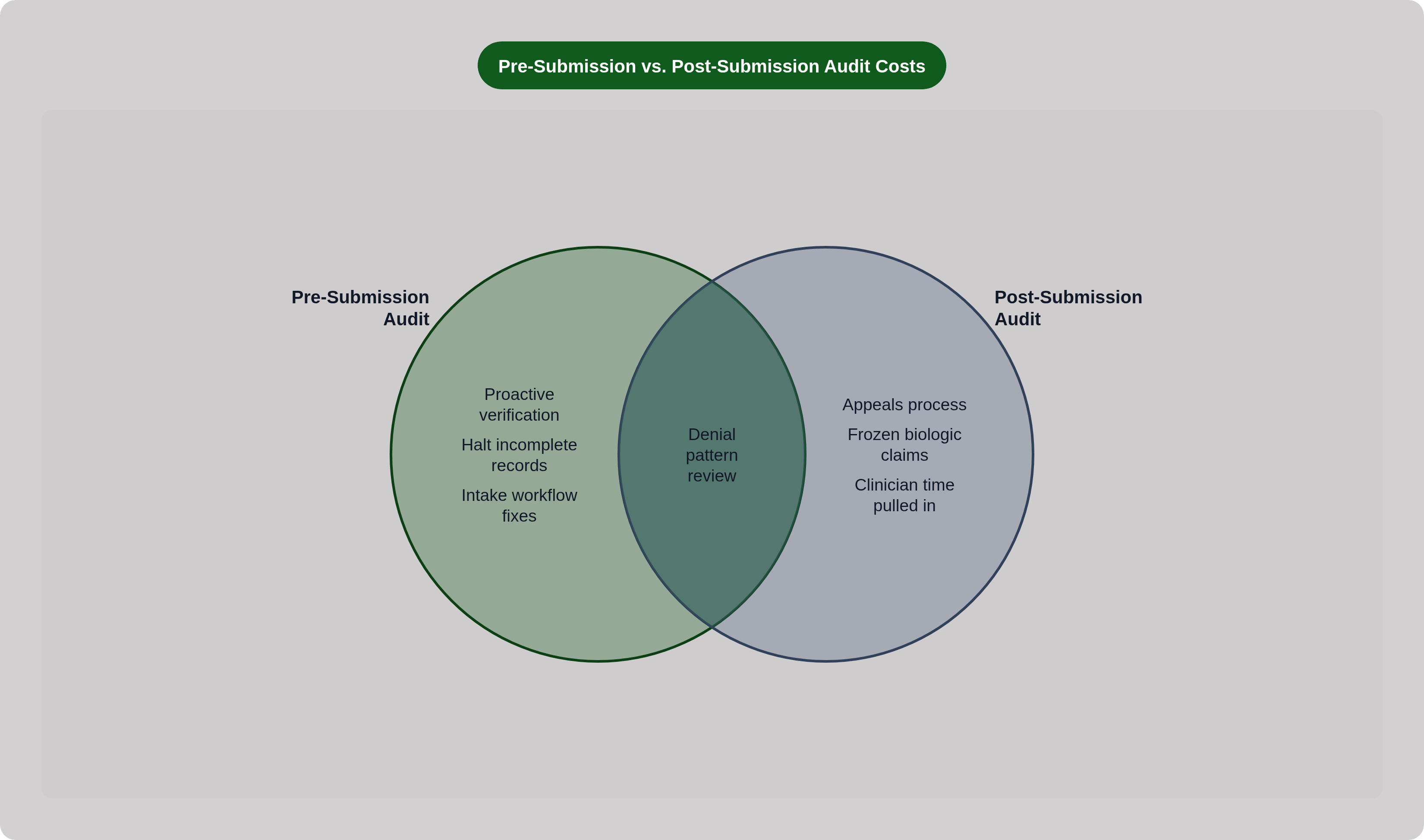
The fundamental shift is from retrospective chart review to prospective claim-level verification. For infusion specifically, the cost of a post-submission catch is disproportionately high: biologic denials freeze large dollar amounts and require clinical documentation to appeal, which pulls clinician time back into a revenue cycle problem that should have been resolved before the claim ever left the building.
Lock down the infusion record before charge capture moves forward. Every infusion day requires a complete flow sheet: drug name, dose administered, start and stop times, administration route, patient tolerance, and clinician identity. Any missing field should halt charge capture, not flag it for retroactive resolution later. The moment a claim moves forward with an incomplete record, the cost of correction escalates and the probability of full recovery drops.
J-code unit calculation should be verified against the documented administered dose at the point of charge capture, not in the billing queue after the claim is already built. Discrepancies between what was ordered and what was administered must be reconciled and documented before billing. Moving this check earlier eliminates a category of error that otherwise produces quiet, persistent underpayments.
Any encounter with concurrent chemotherapy and hydration, or multiple drug infusions, should be flagged for hierarchy review before submission. This cannot be a step that relies entirely on individual biller judgment without a formal check. The rules are specific enough that a structured review catches violations that judgment alone misses, especially in a high-volume environment.
Modifier completeness is a two-minute check per claim that prevents denials that take far longer to appeal. Confirm JW or JZ status for every single-use vial drug. Verify any sequence or timing-based modifiers for multi-drug encounters.
Physician order chain validation must happen before submission, not during appeal. The order must be signed, dated, and match the drug and dose administered. For off-label use or step-therapy situations, the clinical rationale must be explicitly in the chart before the claim goes out. Payers are increasingly skeptical of documentation added at the appeal stage, and some deny appeals on that basis alone.
Audit sampling should not be distributed uniformly across the claim population. High-volume, high-dollar therapy lines warrant higher sampling rates than hydration or routine push administrations. Audit intensity should increase around EMR transitions, new payer contract implementations, and NCCI edit update cycles, because those are the periods when error rates rise without any change in the practice's intent.
How Payer Behavior in 2025 and 2026 Raises the Cost of Documentation Gaps That Used to Slip Through
Payers have expanded the use of automated denial tools in ways that affect infusion practices directly, and the speed of that expansion has outpaced most practices' awareness of it. NLP tools now compare clinical notes against submitted CPT and ICD-10 codes before a human reviewer ever sees the claim. Vague medical necessity language, a missing comorbidity, a note that doesn't substantiate the billed code: these can trigger automatic denials in adjudication systems that were far more forgiving two or three years ago.
KFF analysis of Medicare Advantage data shows MA plan denial rates have risen meaningfully in recent years, and that trend is particularly relevant for infusion practices because MA plans are disproportionately represented in infusion patient populations running high-cost biologic or specialty drug lines. When denial rates rise across your largest payer segment, the margin compression is not abstract.
UHC's 2025 authorization-to-claim matching logic auto-denies NPI mismatches, date-of-service range mismatches, and place-of-service mismatches without human review. For a multi-provider oncology practice, the annual exposure from retroactive prior authorization match denials can be substantial, and none of it has anything to do with clinical documentation quality. These are administrative data precision failures, which means the pre-submission audit workflow has to cover administrative fields alongside clinical documentation.
BCBS plans in multiple states began applying updated AIM Specialty Health criteria in Q2 2025, with more stringent conservative treatment duration requirements. Step-therapy and prior treatment documentation requirements have become more demanding. The practices that document reactively rather than prospectively get caught short on appeal because the documentation that would have supported the claim was never generated in the first place.
Payers are not only denying more frequently; they are denying larger amounts per claim. MDaudit data across a large provider population reflects a significant rise in the average denial amount tied to medical necessity and requests for information from 2024 to 2025, with outpatient coding-related denial amounts rising sharply over the same period. A practice that treats appeals as its primary recovery strategy is absorbing costs at a compounding rate that a pre-submission audit would have intercepted at a fraction of the expense.
Using Audit Findings to Build a Denial Pattern Map by Payer and Root Cause
A generic denial dashboard obscures the signal you actually need. Grouping denials broadly under "documentation" makes it impossible to identify which specific documentation failure is driving which payer's denials, and that distinction is where the actionable information lives. The audit log needs to surface concentrations: by payer, by therapy type, by root cause, and often by site of service.
A payer-segmented audit log does things a consolidated view cannot. It identifies which payers are applying new edit logic before the denial volume makes it obvious in the aggregate. Catching UHC's new bundling pairs through audit findings rather than through a spike in denial reason codes means the practice closes the gap proactively, before it compounds into something that takes a quarter to unwind. It also surfaces documentation patterns that are genuinely payer-specific. A BCBS plan applying AIM criteria requires different pre-authorization documentation than a Medicare plan, and the audit log should reflect that distinction so the pre-submission checklist can be calibrated accordingly, rather than applied as a generic standard across all payers.
One of the highest-leverage applications of this data is connecting audit findings back to scheduling and intake, and it is consistently underutilized. Most recoverable documentation problems are seeded before the infusion date, at scheduling, eligibility verification, and prior authorization. Audit findings that trace back to missing physician orders or prior authorization mismatches should trigger workflow changes at intake, not just corrections in the billing queue. The billing queue correction fixes the claim; the intake workflow change prevents the next fifty.
Audit resources should follow the risk. Therapy lines and payers with elevated denial rates in the audit log warrant more frequent pre-submission review. The goal is to allocate audit capacity where the error concentration actually is, not where it is administratively convenient to look. MGMA data indicates a significant share of providers are now reporting denial rates above 10%. Practices that build a structured feedback loop from audit findings to workflow correction are positioned to close those gaps before they compound into AR aging problems that require a completely different kind of intervention.
What the Audit Process Should Look Like Operationally for an Infusion Practice
The audit function belongs in the revenue cycle operation, not in clinical workflows. Nurses and infusion technicians document the clinical record; the audit step is a billing-side verification against that record. Conflating the two creates compliance risk and disrupts clinical workflow simultaneously. Practice operators should receive outcome reporting from the audit process — denial rates by payer, documentation error rates by therapy type, open pre-submission flags — but they should not be managing the audit queue itself.
Automation handles volume. Experienced operators handle judgment. Rules-based checks — J-code unit calculation against documented dose, modifier presence or absence, hierarchy sequencing — can be automated and applied at the point of charge capture, running on every claim without adding reviewer time. Off-label use documentation sufficiency, step-therapy narrative adequacy, payer-specific medical necessity language: those require a trained reviewer who knows what a particular payer actually wants to see in a chart and can evaluate whether the note in front of them meets that standard. The distinction between those two categories of work should be explicit in how the audit function is staffed, because conflating them produces either underinvestment in automation or overreliance on it.
For a resource-constrained practice, coverage priorities are relatively clear. Biologics and specialty drugs carry the highest dollar exposure per claim and the highest denial rates; they warrant the most rigorous pre-submission review. Chemotherapy infusions require hierarchy and time documentation review on every encounter without exception. IVIG and other high-cost infusions warrant modifier and unit verification at a higher sampling rate than routine administrations. Hydration and standard push administrations can be reviewed on a sampling basis unless the audit log shows an elevated error concentration for a specific payer, in which case that payer gets elevated scrutiny regardless of therapy type.
The operational cadence should not be static. Audit intensity should increase around EMR transitions, new payer contract activations, and NCCI edit update cycles. Those are the windows when error rates rise without any change in the practice's intent, and they are entirely predictable in advance.
Practices that treat documentation audit as a revenue protection mechanism rather than a compliance formality absorb fewer avoidable losses. The ones that break down are not the ones lacking the right tools or the right payer contracts. They are the ones that run the audit process inconsistently and never close the loop between what the audit finds and what intake and billing do differently the next week.