Top Denial Codes in Medical Billing and Root Causes
Understanding who pays the adjustment—not just the code number—determines your next move.

Before you read the numeric denial code, read the two-letter prefix. That prefix is the group code, and it tells you something more immediately actionable than any number that follows it: who bears financial responsibility for the adjustment.
The most consequential group code is CO, Contractual Obligations. A CO denial means the provider has agreed, through its contract with the payer, to absorb the adjustment. The patient cannot be billed for the difference.
PR denotes Patient Responsibility. The adjusted amount shifts to the patient, which triggers a different downstream workflow entirely: balance billing, patient statements, collections. The clinical or billing error may be identical to a CO scenario, but the remediation path diverges sharply.
OA, Other Adjustments, is a catch-all applied when neither CO nor PR fits. It appears less frequently but demands the same scrutiny.
Reading the group code before the numeric code orients the billing team immediately. It answers the first question: who owes this, and what do we do next? In infusion and buy-and-bill billing, CO codes dominate the denial landscape. The practice has already purchased the drug, already administered it, already recorded the acquisition cost. A CO denial means there is no reimbursement path to the patient. The practice is holding the bag on the full cost of goods, often on a drug that cost tens of thousands of dollars. That is not a receivables delay. That is a cash-flow event.
The Denial Codes That Actually Show Up and What Each One Is Telling You
CO-16: Missing or Incomplete Information
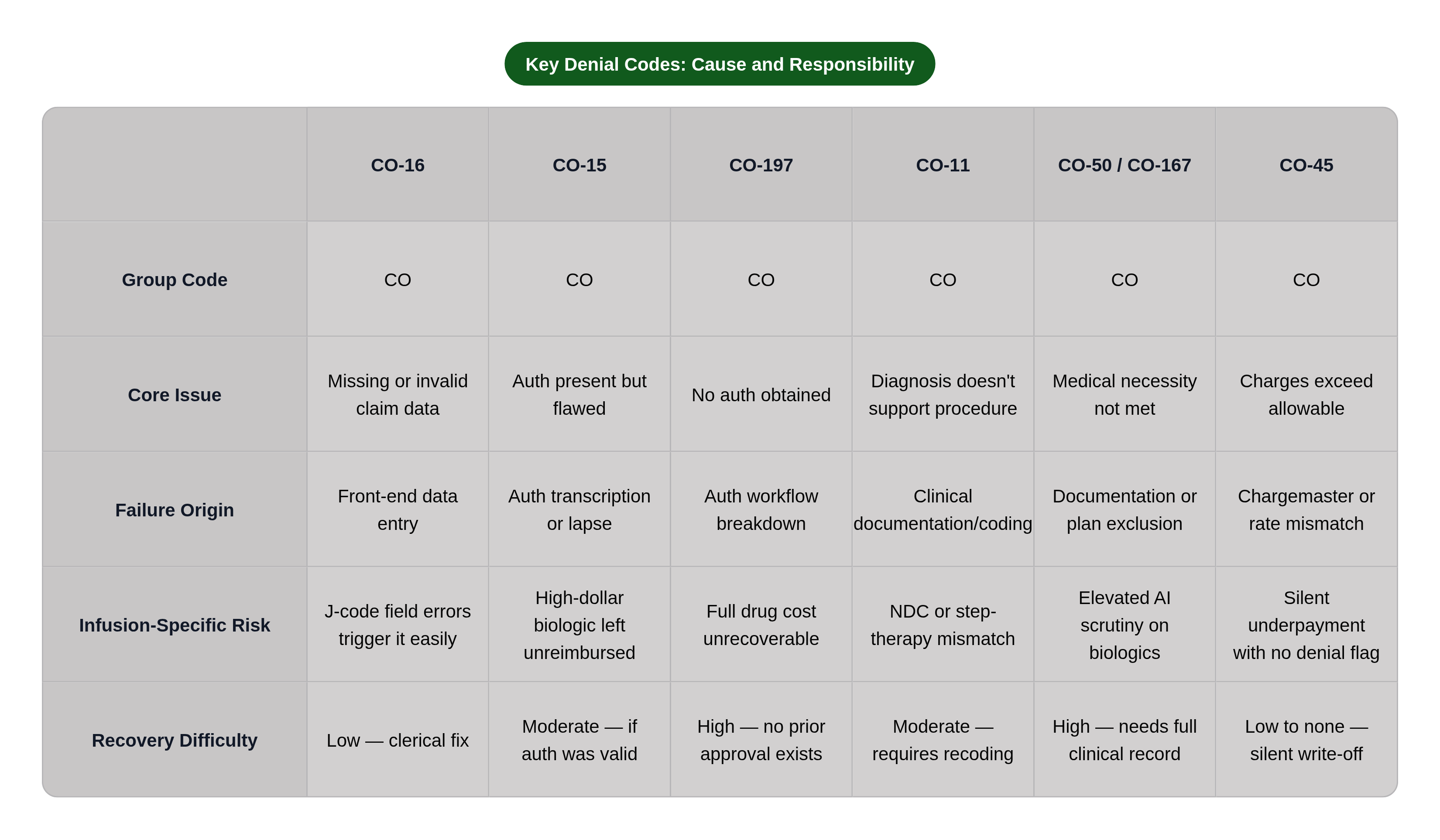
CO-16 is the most common denial code across medical billing, and its ubiquity makes it easy to underestimate. It does not mean the claim was clinically wrong. It means the payer could not process what was submitted because something required was absent or invalid: a missing NPI, an incorrect date of birth, a mismatched place of service, an absent CLIA number, an incorrect modifier. The claim never reached clinical adjudication. It was rejected at the processing layer before anyone, human or algorithm, evaluated whether the service was covered.
The fix lives in claim-level data hygiene, not clinical documentation.
CO-15 and CO-197: Authorization Failures, Two Different Shapes
These two codes get conflated constantly, but they represent distinct failure modes, and treating them the same way is a mistake.
CO-15 means an authorization number is on the claim but something is wrong with it: absent, expired, or not matching what the payer has on record. An authorization was obtained; it was either mis-transcribed, allowed to lapse, or the claim was submitted after the authorization window closed.
CO-197 means no authorization was obtained at all. The service was rendered before the payer approved it. The prior authorization workflow failed in execution, not in transcription.
CO-15 often has a recovery route if the underlying authorization was valid and the error was clerical. CO-197 is considerably harder to overturn. The payer's position is that approval was never granted, and arguing otherwise requires more than a corrected submission.
CO-11: Diagnosis Code Inconsistent with Procedure
CO-11 appears when the ICD-10 code on the claim does not support or justify the procedure billed. Most often, clinical documentation was not translated accurately into codes, or an unspecified diagnosis code was used where the payer required specificity. Payer AI systems are scanning for these mismatches before payment issues now, which means CO-11 denials are arriving faster and in higher volume than they did even a few years ago.
CO-50 and CO-167: Medical Necessity and Non-Covered Diagnosis
CO-50 means the payer determined the service was not medically necessary given the diagnosis and documentation submitted. CO-167 means the diagnosis code does not qualify for coverage under the patient's plan, either because it is explicitly excluded or because it fails the plan's written medical necessity criteria.
Both are increasingly driven by payer-side AI flagging high-risk diagnosis clusters or unspecified codes before human review occurs. The average medical necessity denial reached significant levels in 2025, a 70% increase year-over-year, and denied inpatient claims rose 12% from 2024 to 2025. These are not nuisance denials. Winning them requires appeals with clinical record support, and the documentation depth required to prevail has grown considerably.
CO-18: Duplicate Claim
CO-18 is a resubmission error. The payer has already received and adjudicated a claim for this service and date. The most common cause: a corrected claim submitted without the appropriate corrected-claim modifier, or a system error generating a second transmission. Technically fixable, usually, but it clogs AR queues and the resolution time compounds quickly with volume.
CO-22: Coordination of Benefits Error
CO-22 means the claim was submitted to the wrong payer in sequence, most commonly when a secondary insurer is billed before the primary has adjudicated. The root cause is almost always an eligibility check that failed to surface a second active policy, or a coordination of benefits order that was never confirmed at intake.
CO-45: Charges Exceed Fee Schedule
The submitted charge exceeds the contracted or allowable maximum. The excess is written off. Most commonly, the chargemaster was not updated to reflect current contracted rates, or an out-of-network billed rate was applied to an in-network claim. In isolation, CO-45 looks manageable. In buy-and-bill infusion, the implications run considerably deeper.
CO-97: Service Included in a Previous Payment
CO-97 appears when the payer considers the service already reimbursed, either as part of a bundled payment or because a prior claim captured it. The root cause is almost always a billing team without visibility into payer-specific bundling rules, billing ancillary services separately when the payer treats them as included. Preventing it requires payer-specific knowledge, not just a corrected submission.
Where Denials Actually Come From: Front-End Failures Versus Clinical Documentation Gaps
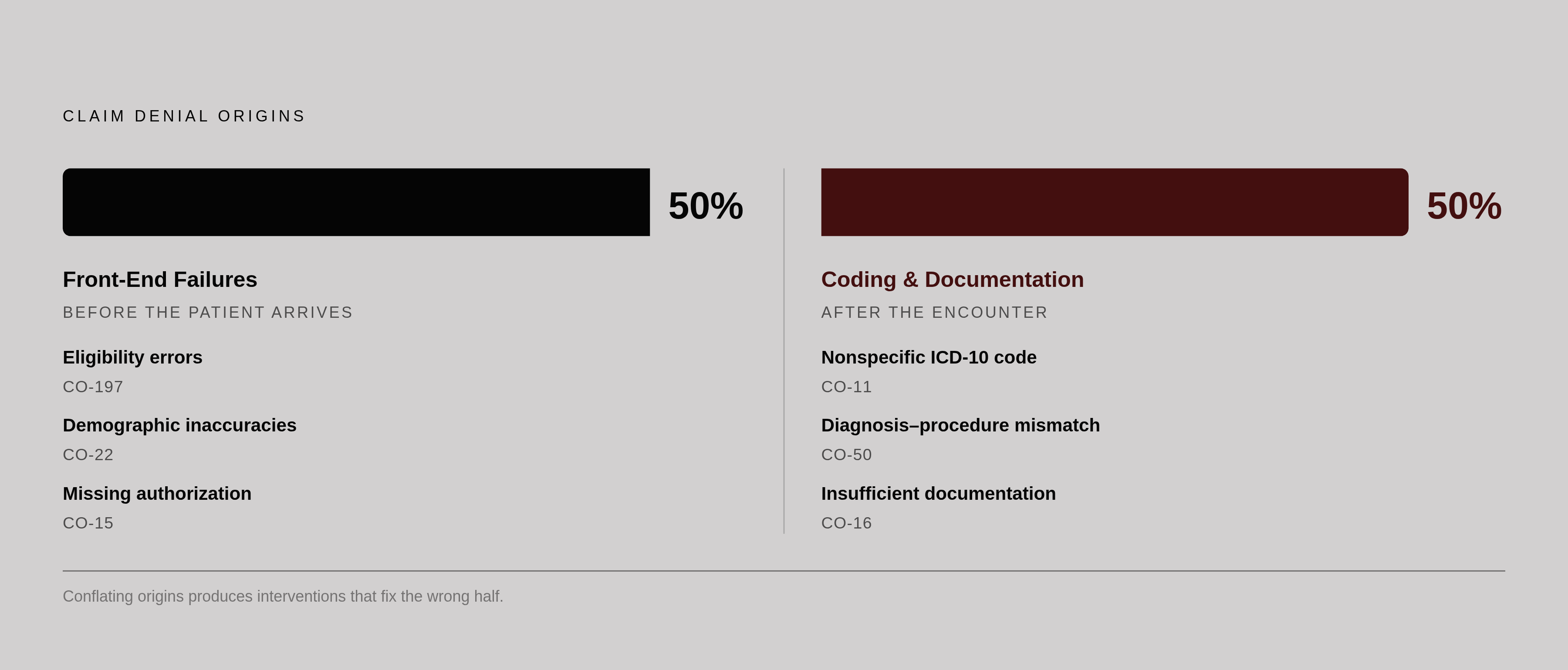
The codes above do not share a single origin. They cluster around two distinct failure modes, and conflating them produces interventions that fix the wrong thing.
Roughly half of all denials trace to front-end failures: eligibility errors, demographic inaccuracies, missing or insufficient authorizations. These errors exist before the patient reaches the chair. By the time a claim is submitted, the problem has already been seeded. The billing department is just the one holding it.
The remaining denials involve improper coding or insufficient documentation, which is a clinical documentation failure more than a billing entry failure. The ICD-10 code was too nonspecific. The diagnosis-to-procedure linkage was not explicit in the clinical record. The documentation did not support the level of service billed. These require an intervention at the encounter level, with coder-clinician alignment that cannot be retrofitted after the fact.
Payer AI has compressed the window between submission and denial. Claims with unspecified codes or unusual diagnosis-procedure combinations are flagged before payment issues. The opportunity to intercept errors before they become denied claims is narrowing, which makes the front-end-versus-documentation distinction more operationally urgent, not less.
Why These Same Root Causes Hit Harder in Infusion and Buy-and-Bill Billing
In most specialties, a denied claim means delayed revenue. In buy-and-bill infusion, it means the practice is carrying the acquisition cost of a drug it has already administered and cannot recover from the patient. That structural difference changes the financial calculus on every code discussed above.
At thousands to tens of thousands of dollars per infusion encounter, a single denied biologic is not a billing variance. It is a cash-flow event.
Authorization Failures at Infusion Scale
Infusion therapies, particularly biologics for autoimmune, oncology, and neurological indications, are almost universally subject to prior authorization. A CO-15 or CO-197 denial on a high-dollar infliximab claim carries the same code as a missed authorization on a low-cost office visit. The code is identical; the financial consequence is not. Payers are expanding reauthorization requirements, and tracking expiration dates across recurring treatment cycles for multiple patients on multiple biologics is an operational burden that general RCM tools are not built to manage.
Diagnosis and Medical Necessity Under Elevated Scrutiny
High-dollar infusion claims face elevated manual review and payer AI scrutiny that adds weeks to payment timelines. Step-therapy denials occur when the prior authorization does not reflect the specific biologic administered. Biosimilar substitution conflicts arise when the NDC on the claim does not match the authorized drug name. Both scenarios produce a CO-11 or CO-50 denial from a documentation mismatch that a general billing workflow is not designed to catch, because a general billing workflow was not designed with drug acquisition cost on the line.
CO-16 Complexity in J-Code Billing
J-code billing requires specific modifiers, NDC numbers, units of administration, and place-of-service codes. Each is an additional field where a CO-16 can be triggered. The more insidious scenario is the underpayment: a misplaced modifier or incorrect CPT on an infusion claim can produce a remittance that simply pays less than it should, with no denial code appearing at all. That shortfall becomes a permanent write-off if remittance lines are not reconciled at the line level.
CO-45 and Silent Underpayments in Buy-and-Bill
Medicare Part B reimburses most J-code drugs at ASP plus 6%. Commercial payers use proprietary fee schedules, fixed percentages of ASP, or AWP-based rates. When the submitted charge exceeds the payer's allowable, the result may be a CO-45, or it may be a silent underpayment processed without a denial code. Without line-level reconciliation against contracted rates, these underpayments become permanent write-offs. There is no flag, no denial queue, no prompt to appeal. The revenue is simply gone.
Documentation failure is the common thread. Inadequate clinical records that fail to connect medical reasoning to diagnosis codes are among the leading denial drivers in infusion, and at drug acquisition cost, every documentation gap is a meaningful financial risk.
How Payer Behavior Patterns Make Infusion Denials a Distinct Category to Manage
Payers are not applying uniform denial logic. They use AI and predictive modeling to flag claims that fit risk profiles they have identified internally, which means an infusion center can face different denial patterns from different payers on the same drug and the same diagnosis, without changing a single thing about how the claim was prepared. That is not a billing error problem. That is a payer behavior problem.
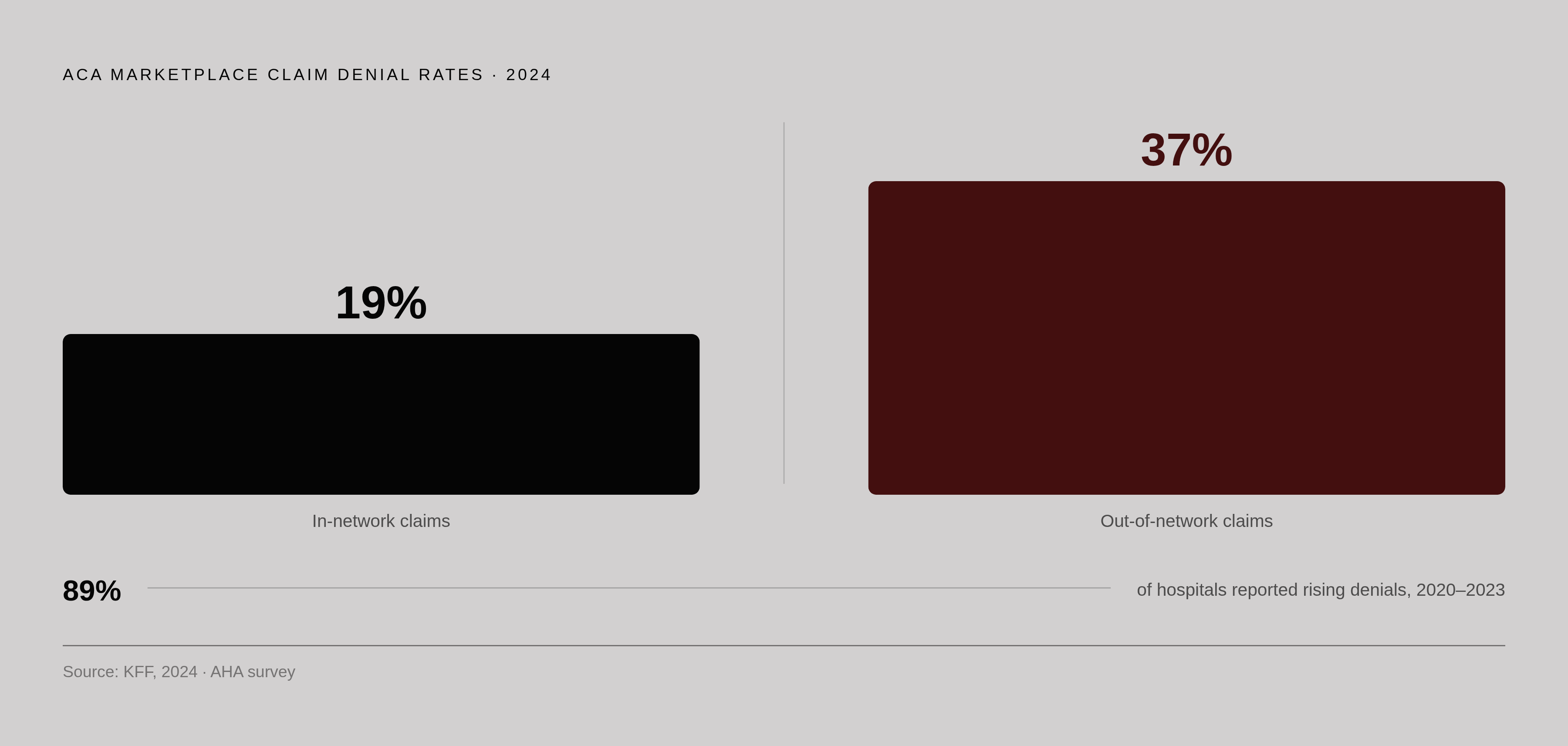
89% of hospitals reported more claim denials between 2020 and 2023. Medicare Advantage, ACA exchange plans, and commercial insurers are all deploying advanced claim-review technology simultaneously. Infusion sits at the intersection of all three payer types at once. KFF data shows ACA marketplace insurers denied 19% of in-network claims and 37% of out-of-network claims in 2024. For infusion centers treating plan members, the denial exposure from plan type alone is significant before a single clinical or coding variable is introduced.
Site-of-care pressure adds another layer. Payers are actively redirecting infusion toward home settings because it costs less, and site-neutral payment changes accelerate that dynamic. For office-based infusion centers, place-of-service coding errors are not merely technical mistakes; they are potential triggers for coverage disputes that carry the full financial weight of the drug cost.
Payer-specific step-therapy requirements for biologics, including adalimumab, infliximab, and tocilizumab, differ across commercial contracts. What satisfies one payer's prior authorization criteria fails another's. Same drug, same patient, same diagnosis: two different prior auth requirements, two different documentation standards, two different denial risks. Per a 2022 survey by SamaCare, 91% of providers said consistent prior authorization delays or denials would affect their likelihood to prescribe a drug if an equally effective alternative existed. Denial pressure shapes clinical decision-making. It is not purely a billing problem.
Grouping denials by generic code without separating them by payer and root cause hides the signal needed to resolve current denials and prevent future ones. The code alone is not the unit of analysis. The code, the payer, and the drug together are.
What Effective Denial Resolution Actually Requires for Infusion-Specific Codes
Authorization Workflows Built to Prevent, Not React
CO-15 and CO-197 resolution requires a proactive authorization workflow. Authorization tracking must begin at scheduling, before the treatment cycle starts, with structured monitoring of expiration dates for recurring infusions. A lapsed authorization on a recurring biologic patient is a preventable denial; most general RCM tools do not flag it until the claim has already gone out the door.
Beyond prevention, tracking payer-level turnaround times and first-time approval rates by therapeutic area converts authorization data into a predictive instrument. When a specific payer consistently delays approvals for a specific biologic beyond its stated turnaround window, that lead time can be built into the scheduling workflow before it becomes a cash problem. That is not an aspirational capability. It is what managing this at scale actually requires.
Medical Necessity Appeals Require Documentation Depth
CO-50 medical necessity denials at the 2025 average cost are worth appealing, but a successful appeal requires clinical records that explicitly connect the diagnosis to the procedure and to the specific biologic administered. A generic chart note is not enough. Step-therapy documentation must be maintained per payer, per drug, and per patient, structured as a payer-legible record of the treatment pathway. Payers reviewing high-dollar infusion claims have a clear financial incentive to deny. The documentation has to be thorough enough to make that position untenable.
CO-16 Prevention Through J-Code Field Discipline
NDC numbers, units of administration, modifiers, and place-of-service codes must be validated before submission, not corrected after the CO-16 arrives. Infusion-specific billing requires a claim validation layer that checks J-code fields against payer-specific requirements at the time of claim preparation.
The field discipline required for infusion claims is not analogous to standard outpatient billing. It requires either specialized tooling or a team with granular payer-contract knowledge sufficient to replicate that specificity manually. For practices operating at any meaningful volume, manual replication is the slower and more error-prone path. Rxpert is built specifically for the buy-and-bill environment, with J-code-level field validation, authorization cycle tracking by drug and payer, and remittance reconciliation integrated into a single workflow rather than assembled from general-purpose tools that were not designed with drug acquisition cost on the line.
The denial codes are the same across specialties. The financial consequences in infusion are not. Managing them requires code-level precision, payer-specific knowledge, and a workflow architecture designed for the specific risk profile of buy-and-bill billing, which is the problem Ruby RCM, a revenue cycle management platform built exclusively for infusion centers and buy-and-bill practices that pairs software with hands-on operators to manage authorizations, claims, denials, and AR, was purpose-built to address. That is not a competitive differentiator. It is the baseline requirement for protecting the revenue that makes infusion viable.