N130 Remark Code and Infusion Remittance Disputes
N130 remark codes need the right CARC to tell you whether to appeal, correct, or write off.

An 835 remittance line with N130 on it does not tell you whether to appeal, correct, or write off the charge. That decision comes from the CARC sitting next to it. N130 is a remark code, and remark codes explain a decision that's already been made elsewhere on the line, they don't make the decision themselves. For infusion billing teams working high-dollar biologic claims, mixing that up costs real money.
The division of work among the three codes on every 835 line
Every adjustment line on an 835 carries three codes, and each one answers a different question.
The group code answers who owes the money. PR means patient responsibility. CO means contractual obligation, which is a write-off the practice eats. OA covers other adjustments, and PI marks payer-initiated reductions. This single letter combination decides whether a balance can even move to the patient, which makes it a compliance question as much as a financial one. PR-204, for instance, governs whether any leftover balance can reach the patient.
The CARC answers why the payment changed. It names the rule or restriction the payer applied: a benefit exclusion, a medical necessity dispute, or a billing technicality.
The RARC, and this is where N130 lives, answers what to do next. Except N130's instruction ("consult plan benefit documents/guidelines for information about restrictions for this service") is deliberately generic. It's a pointer, not a verdict. The actual next step depends entirely on which CARC it's traveling with.
Reading any one of these three codes alone means guessing. For infusion practices specifically, the group code changes the stakes before anyone even reaches the appeal question. A biologic line denied under CO means the clinic absorbs the loss unless the appeal works. The same line under PR means the patient might owe it instead. That's a different conversation with a different urgency, and it starts before anyone reads N130.
Why N130 surfaces so often on infusion and buy-and-bill claims
Infusion therapy sits at the center of some of the most restriction-heavy billing payers manage. Step therapy requirements, site-of-care rules, benefit-category limits, prior authorization gates. Almost every one of those restrictions can trigger N130 when the payer applies it.
Denial rates back this up. Overall claim denials climbed from 30% in 2022 to 38% in 2024, and the trend kept climbing into 2025. The Revenue Synergy 2026 Medicare Advantage Denial Report put the oncology and infusion denial rate at 12.7%, concentrated specifically in J-code drug claims and step-therapy edits. That's not a rounding error, that's more than one in ten infusion claims running into a wall.
The dollar exposure is what makes CARC-pairing precision non-negotiable here. A single denied biologic line can represent tens of thousands of dollars in drug cost alone. Routing that claim wrong, appealing it when it actually needed a simple correction, or correcting it when it actually needed an appeal burns down the filing clock while the drug cost sits there, unrecovered. Step therapy is a structural piece of this problem too: payers use prior auth specifically to confirm step-therapy compliance, and missing step-therapy documentation is one of the most common causes of PA delays and denials industry-wide. Those denials land with N130 attached more often than not.
CARC 204 + N130: when the service is excluded from the benefit plan
CARC 204 reads: "This service/equipment/drug is not covered under the patient's current benefit plan." Paired with N130, this is about as close to a dead end as the code set gets, though it's not always final.
The usual reasons are either the item is simply noncovered, or the payer decided it isn't medically necessary under that plan. The path forward is a Redetermination request, filed with full supporting documentation. Noridian, for one, pushes providers to file Redeterminations and Appeals through its Medicare Portal rather than paper.
Before filing anything, pull the applicable LCD, the LCD Policy Article, and the relevant Documentation Checklist. Skipping that step is how a redetermination gets denied a second time for the exact same reason it got denied the first time.
CARC 50 + N130: when the payer disputes medical necessity
CARC 50 says: "These are non-covered services because this is not deemed a 'medical necessity' by the payer." This one is a clinical argument. The appeal has to answer the specific LCD language the payer cited. Those are two different arguments, and payers only respond to the first one.
There's a sub-scenario to know cold. When MA130 also shows up on the same remittance alongside CARC 50, the instruction flips. Noridian's own CARC 50 guidance treats that combination as a correction, not an appeal situation. Fix the claim, rebill it, and request a self-service reopening instead.
Filing a formal appeal when MA130 is sitting right there wastes the appeal window and adds weeks to payment. Before routing any 50 + N130 denial anywhere, check for MA130 first. That one check determines which of two completely different workflows the claim goes into.
CARC 108 + N130: when a billing error, not a coverage decision, caused the denial
CARC 108 reads: "Rent/purchase guidelines were not met." This pairing usually has nothing to do with coverage. It's a billing mechanics problem, most often equipment billed as a purchase when the payer's rule only covers it as a rental.
The fix is a correction and resubmission, not an appeal. There's no clinical argument to make here, because the payer isn't disputing necessity, it's flagging that the claim was built wrong.
To keep this from repeating, check the LCD alongside the Fee Schedule Category listed on the PDAC website before the claim goes out the door the first time. That's a five-minute check against a denial that otherwise costs a full billing cycle to unwind.
CARC 96, 109, and B15 paired with N130: the pairings that require investigation before action
Some pairings don't resolve into a clean rule. They resolve into a phone call.
CARC 96, "Non-covered charge(s)," is the default catch-all pairing for DME claims when the payer hasn't assigned anything more specific. Because it's a catch-all, the real issue it hides might be entirely correctable. Call the payer and get the actual reason, then decide to appeal, correct, or write off based on that reason.
CARC 109, "Not covered by this payer or contractor," usually points to a jurisdiction problem: the claim went to the wrong MAC or the wrong payer. There's also a specific Medicare scenario, PT/OT services that overlap a Part A stay, particularly when N130 rides along with CARC 109. Either way, the fix is verifying jurisdiction and refiling to the correct payer. Appealing a jurisdiction error accomplishes nothing, because the payer that received it was never the one who should have.
CARC B15 is where N130's instruction gets most literal. It's a plan-specific benefit restriction, and there's no universal resolution path because the answer lives inside whatever the specific plan document says. This is the pairing that turns N130 from a general pointer into a direct order: go read the benefit documents, because that's the only place the answer exists.
CARC 167 appears in similar restriction-related denials, where plan design limits coverage rather than a medical necessity dispute. The move is the same as with B15: check the plan documents, confirm benefit-category eligibility, then act.
How the 2026 Federal IDR Final Rule changes what N130, and all RARCs, mean for out-of-network infusion claims
The Federal IDR Operations Final Rule published on June 4, 2026 (91 FR 33900), with the regulations taking effect August 3, 2026. It changes how much weight codes like N130 carry on out-of-network claims specifically.
The rule requires group health plans and health insurance issuers to use CARCs and RARCs on every remittance advice sent to out-of-network providers, providers without a contractual relationship to that plan. That requirement sits in the regulatory text at 29 CFR 2590.716-6A and 45 CFR 149.100, among the citations tied to this rule. What makes this a bigger deal than it sounds: payers now have to use these codes even on claims that fall outside the scenarios covered by the federal law aimed at curbing surprise medical bills, which stretches the standardization requirement well past the surprise-billing claims it was originally built for.
Roughly six weeks later, on July 17, 2026, the Departments of Treasury, Labor, HHS, and OPM put out joint guidance naming nine new RARCs. Payers have to use these specifically to communicate NSA-related information to out-of-network providers. For infusion practices doing out-of-network buy-and-bill work, that means the remark code vocabulary on those claims is expanding, right as the rest of this piece has been arguing that reading remark codes correctly is what decides whether a five-figure biologic claim gets paid.
Building a triage workflow that routes N130 denials by CARC before they age
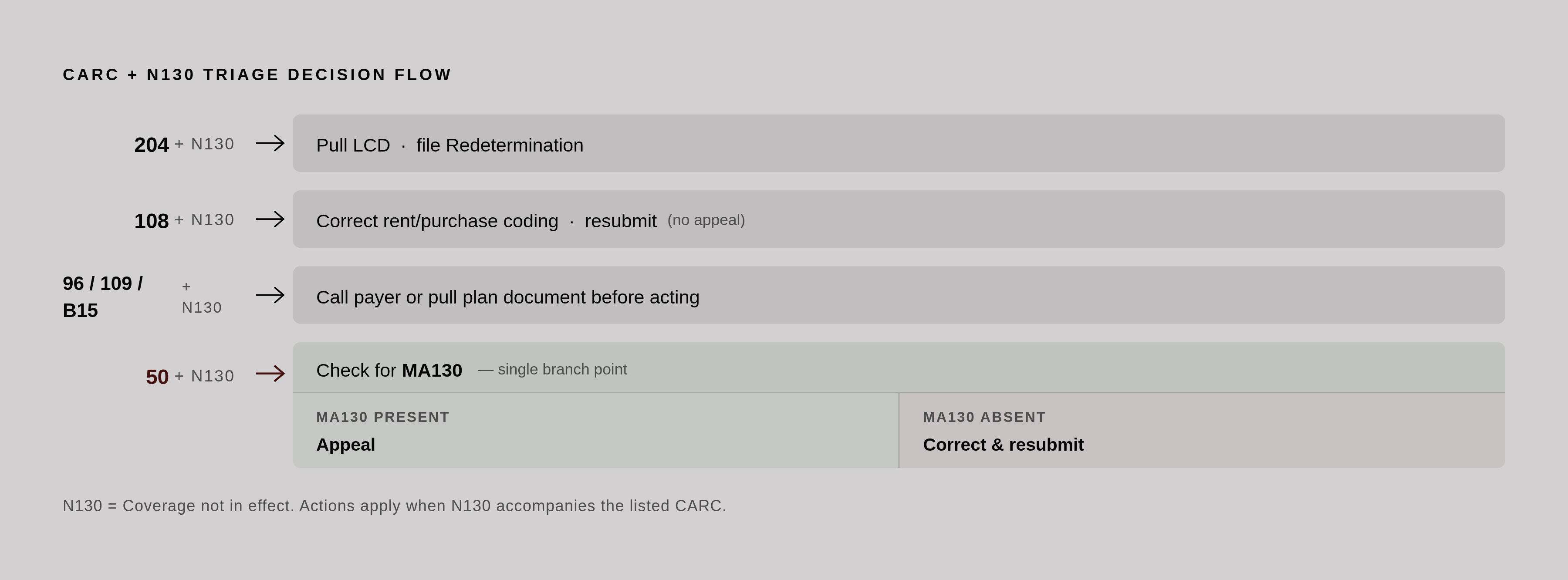
Routing has to happen the moment a claim posts, not weeks later when someone runs the aging report. Filing windows tighten with each week a claim goes unrouted after posting, and by the time a stack of N130 denials appears on a monthly review, some Medicare filing windows may have already closed.
The logic, once it's built, isn't complicated:
204 + N130: pull the LCD and documentation checklist, file a Redetermination with full support. 50 + N130: check for MA130 first. If it's there, correct and rebill. If it's not, build the appeal around the specific LCD cited. 108 + N130: skip the appeal entirely, correct the rent/purchase coding, and confirm the PDAC fee schedule category before resubmitting. 96, 109, or B15 + N130: hold the claim, call the payer or pull the plan document, and only route it toward appeal or correction once the specific restriction is known.
None of this works as a once-a-month batch process. High-dollar infusion claims carry too much drug cost per line, and the filing clocks on Redeterminations and payer appeals run on fixed windows. The CARC sitting next to N130 is the entire instruction set, and reading it at the point of posting is what keeps a denial from turning into a write-off nobody chose on purpose.
Sources
- Guidance on Required Remittance Advice Remark Codes Related to the No Surprises Act
- N130 Remark Code: CARC Pairings, Fixes, and When You Can Bill
- Reason Code 108 | Remark Code N130 - JD DME - Noridian
- Reason Code 204 | Remark Code N130 - JA DME - Noridian
- RARC N130: Consult plan benefit documents
- med.noridianmedicare.com