Health Insurance Appeal Letter Templates and Best Practices
Most infusion appeal letters target the wrong problem and lose.

Denial rates on infusion claims are climbing, and most appeal letters get sent back built for the wrong problem. Claim denials rose from 30% in 2022 to 38% in 2024, according to Experian Health's 2025 State of Claims report. Generic appeal templates, the kind sitting on payer portals and patient advocacy sites, are written for procedure-level denials. Infusion denials are drug-level, dose-level, and authorization-lifecycle problems instead, so a template that says "explain medical necessity" without touching step therapy, site-of-care rules, or J-code units isn't going to move a payer. With buy-and-bill acquisition costs for biologics running into the tens of thousands per encounter, a denied biologic represents a serious financial risk. It's a cash-flow event, and a large one.
The most common reasons infusion claims get denied in the first place
The same three culprits show up year after year: missing or wrong patient data, coding mistakes, and eligibility or authorization failures. Eligibility problems alone drive roughly 22% of preventable denials, things like a wrong policy number, an expired insurance card, or a skipped recheck that nobody caught before the infusion chair was booked.
Infusion adds its own layer on top of that. Any change in medication, dosage, frequency, or duration can trip a denial, because payers want proof that less invasive options were tried and failed first. Prior authorization is its own minefield, and turnaround for infusion PAs varies widely depending on the payer. Then there's the billing side, where wrong billing units on J-codes account for a meaningful chunk of outpatient denials that have nothing to do with clinical judgment at all.
Payer behavior is making this worse, not better. Site-of-care policies, like Aetna's for drug infusions and injections, steer treatment away from hospital outpatient departments toward physician offices, ambulatory infusion centers, or home infusion, wherever the payer's cost runs lowest. Medicare Advantage step therapy has expanded steadily since CMS rescinded its 2012 ban on mandatory step therapy for Part B drugs back in August 2018. Humana's step therapy list for injectable drugs and biologics took effect January 1, 2025, and gets revised again January 1, 2026. Audits targeting dosage accuracy, vial wastage records, and medical necessity for high-cost biologics have picked up right alongside all of it.
None of this gets fixed by writing a stronger paragraph about clinical need. The EOB reason code is where the real diagnosis starts, not where it ends, and treating every denial like a pure clinical-argument problem is the mistake that keeps practices rewriting the same losing letter, month after month.
What every infusion appeal letter must include before addressing the clinical argument
Before any clinical argument gets made, the letter has an administrative job to do. Payers route and log appeals off a fixed set of header details: patient name exactly as it appears on the policy, policyholder name if different, policy number, group number, member ID, the date of denial, what was denied and the stated reason from the EOB, the treating provider's name and contact information, and the claim or reference number. Skip one of these and the appeal sits in a queue instead of getting reviewed. It's a small, boring detail, and it's also the reason a lot of well-argued appeals never get read at all.
Timing matters just as much. Internal appeals need to go in within 180 days of the denial notice. Miss that window, and the internal appeal path closes, full stop, no exceptions worth counting on.
Attach the full document bundle, which should include the original prior authorization form and letter of medical necessity, a copy of the denial or EOB, and any supporting records, labs, treatment history, and relevant literature. If the appeal goes out by fax, keep the transmission confirmation. If it goes by mail, send it certified with return receipt, and confirm it lands in the payer's system within 7 to 10 days. A letter that vanishes into a mailroom helps nobody, no matter how strong the argument inside it is.
State the ask directly, both at the opening and the close: reversal of the denial, coverage of the specific treatment. Keep the tone factual and short. An infusion appeal is a clinical argument, not a complaint letter, and payers read it that way whether the writer means it that way or not.
How to construct the medical necessity argument for infusion claims specifically
The core move here is simple to describe and harder to pull off: pull the payer's own clinical criteria, and walk through, point by point, how the patient meets each one. Not a general statement that treatment is needed. A direct match against the payer's own language, line by line, criterion by criterion.
Insurers define medical necessity along three lines: the treatment fits generally accepted standards of medical practice, it's clinically appropriate in type, frequency, extent, site, and duration, and it isn't more costly than an alternative likely to work just as well. The clinical package needs to hit each of those directly. That means a diagnosis backed by labs or imaging, a treatment history showing what was tried and failed before infusion came up, a clear explanation of why oral or subcutaneous options won't work for this particular patient, and, where the payer's policy pushes toward home infusion, a site-of-care justification laying out why the patient needs an outpatient infusion center instead.
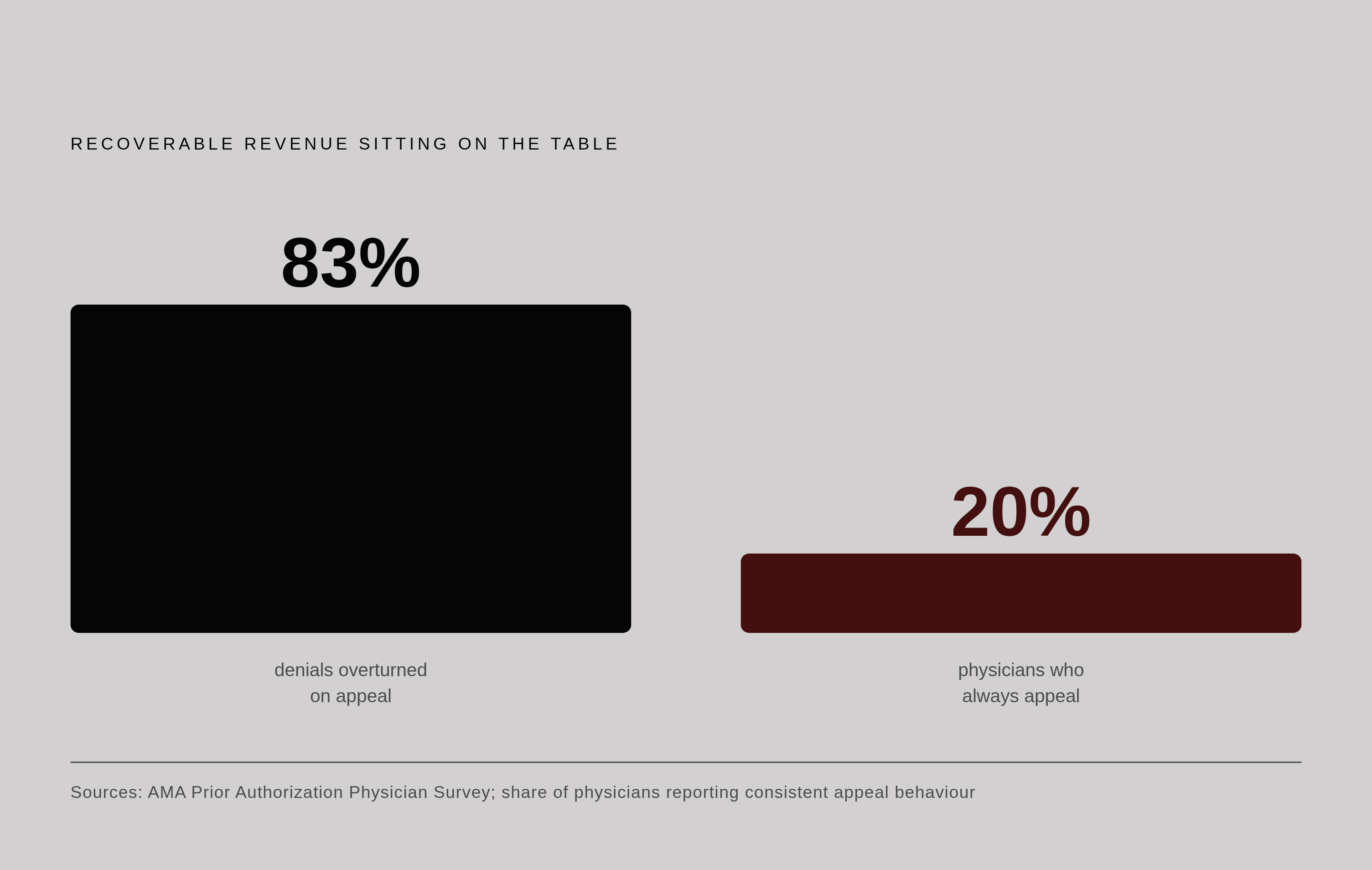
The physician letter of medical necessity carries more weight here than most practices give it credit for. It needs to name the specific drug ordered, explain why it was chosen over alternatives, spell out any comorbidities or genetic factors that make the case unusual, and cite clinical guidelines or peer-reviewed literature to back the choice. Structured clinical documentation tools designed for this process can meaningfully reduce appeal prep time and improve outcomes over unstructured manual approaches. That gap matters: the AMA puts the overturn rate on medical necessity denials at 83%, yet only 20% of physicians say they always appeal an adverse prior authorization outcome. An 83% win rate against a 20% appeal rate is recoverable revenue sitting on the table, plain and simple, and most practices are leaving most of it there.
One more thing worth doing every single time: pull the exact coverage provision from the plan's summary of benefits and coverage, and quote it directly in the letter. A payer can argue with a physician's opinion. It's a lot harder to argue with its own policy language quoted back at it.
J-code accuracy and drug-level documentation as appeal evidence
J-codes, the HCPCS Level II codes that identify the drug given, do more than name the medication. Paired with the unit count, they tell the payer exactly what dose was administered and whether the reimbursement claimed lines up with it. Get the code or the units wrong, and the payer has no way to verify what happened, so the claim bounces.
Unit math trips people up constantly, and it's almost always avoidable. Most J-codes are defined per a set measurement, per mg, per 10 mg, per 100 mg, or per vial, and if the code is billed per 10 mg but the patient got 100 mg, the claim needs to show 10 units. Report one unit instead, and the claim underpays or gets kicked back outright. This category is fixable on appeal, but only once the unit math gets rebuilt and documented properly, not just re-asserted with more confidence than the first time.
Some drugs draw more scrutiny than others. Infliximab (J1745) and other monoclonal antibodies carry high per-unit costs, so unit accuracy on these isn't just a payment issue, it's an audit trigger, and improper reporting can bring OIG attention along with the payment recovery. Intravitreal injections sit under similar pressure: audit findings on Medicare payments for these injections have kept the category under active review.
Code pairing needs checking too. A J-code names the drug, but it needs a CPT administration code alongside it. For chemotherapy infusions, the appropriate CPT administration codes should be confirmed against current coding guidelines. Any appeal on a drug-only denial should confirm both codes went in, and that they're paired correctly. Vial wastage is another audit flashpoint; the appeal package should include the administered dose, the vial size used, and the wastage amount with a clinical explanation attached.
Building the appeal argument on a J-code denial comes down to reconstruction: rebuild the unit calculation from the clinical record, show the dose given, show the correct unit count, attach the pharmacy or nursing administration record as backup. For legal-grade disputes involving major underpayments or post-payment recoupment demands, some practices bring in outside help. Aspirion, named Best in KLAS for Denials Management in both 2024 and 2025 and HITRUST certified, runs a platform called Compass that generates appeals backed by clinical evidence.
Appealing prior authorization denials and step therapy redirects for recurring infusion treatment
PA denials work differently from post-service denials because the appeal is prospective. The payer needs convincing before treatment happens, not after, which raises the bar on completeness considerably. A thin PA appeal doesn't just risk another denial. It risks delaying a patient's next infusion cycle entirely, and for a lot of these conditions, that delay is not a small thing to gamble with.
Whatever was missing or thin in the original submission needs rebuilding, not repeating, in the appeal. For step therapy exceptions specifically, the letter needs real evidence, not just a physician's say-so, that the required step therapy drugs were tried and failed, were contraindicated, or would cause clinically significant harm. Prior treatment records need to back this up directly, and the appeal has to be written against the specific plan's rules. Humana's step therapy list for injectable drugs and biologics, effective January 1, 2025 and revised again January 1, 2026, is not the same as another MA plan's list, and an appeal written to generic step therapy standards is aimed at the wrong target from the start.
Statutory timelines are worth citing directly in the letter. Standard step therapy exception requests get a 72-hour response requirement from the insurer; emergency or urgent cases get 24 hours. Connecticut has gone further: starting January 1, 2026, insurers there can't require step therapy longer than 30 days for drugs treating multiple sclerosis or rheumatoid arthritis. Appeals filed in Connecticut for those conditions should point straight at that statute, by name.
For patients on long-term biologic therapy, the appeal risk shifts over time, from getting the first approval to keeping the renewals current. Every authorization reference number, approval date, and approved unit count needs to stay on file, because a renewal that lapses mid-cycle creates a different kind of denial than an initial one, and it needs a different kind of appeal. Authorization-based denials, in a lot of cases, get won on the paper trail alone. No fresh clinical argument required, just the receipts.
How the denial reason code should dictate the appeal letter's structure
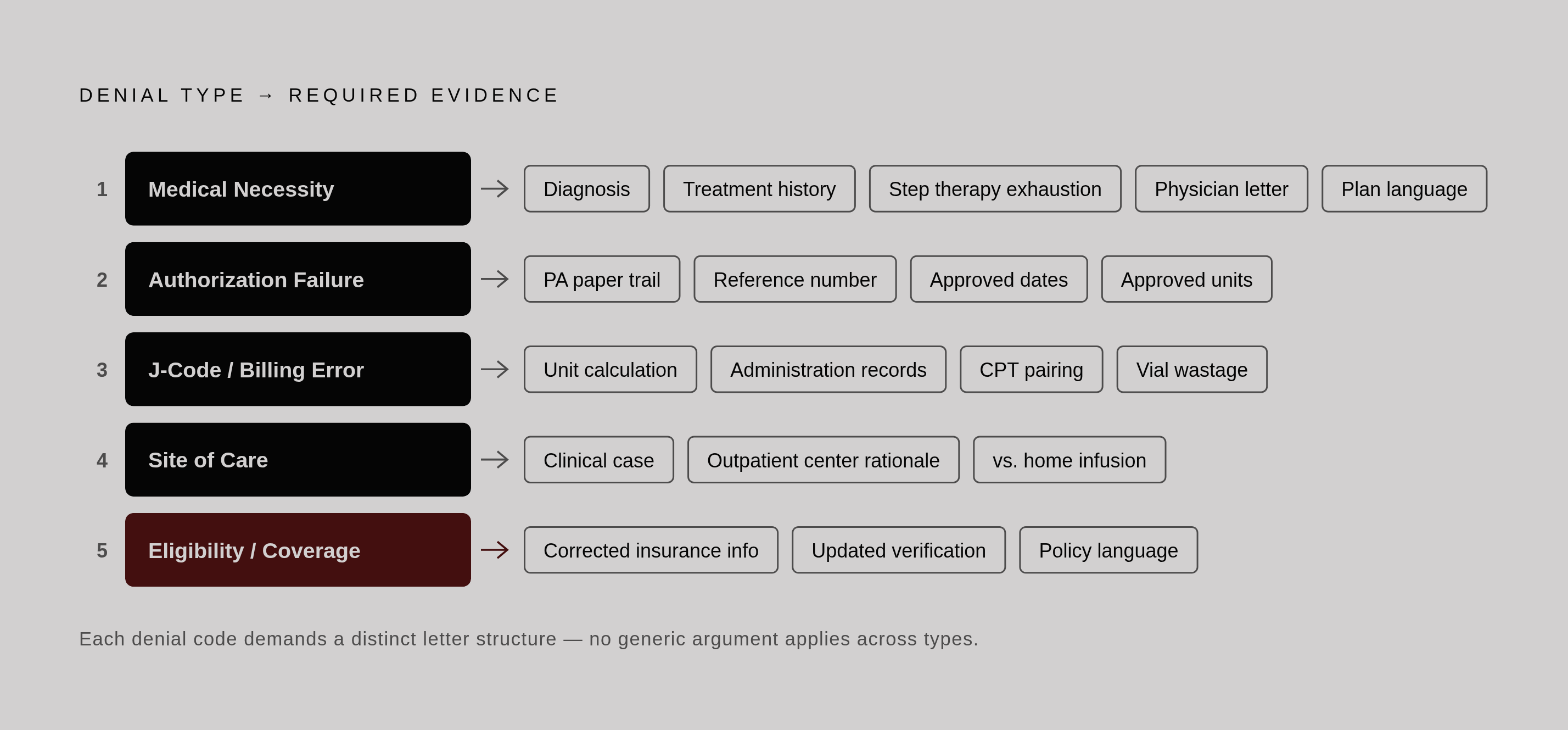
The EOB denial reason code should set the whole shape of the appeal, full stop. Writing a strong letter against the wrong reason code is the single most common structural mistake in this process, and it consumes the appeal opportunity on an argument the payer would disregard from the outset.
Each reason code calls for its own structure, and mixing them is how appeals lose. A medical necessity denial needs the full clinical package: diagnosis, treatment history, step therapy exhaustion, a physician letter citing guidelines, quoted plan language. An authorization failure needs the PA paper trail instead: original submission, reference number, approved dates and units, evidence of renewal if the denial hit mid-cycle. A J-code or billing error needs the unit calculation rebuilt, administration records attached, CPT pairing confirmed, vial wastage documented. A site-of-care denial needs a clinical case for the outpatient infusion center over home infusion, built around safety, monitoring needs, and drug stability. An eligibility or coverage denial needs corrected insurance information, updated eligibility verification, and the policy language that supports coverage.
Payer-specific detail matters at every step here. What Humana wants for a step therapy exception isn't what Aetna wants for a site-of-care override, and an appeal built on a generic framework instead of the specific payer's own criteria starts from a weaker position before a single word gets read. Practices that track denial codes by payer, not just in aggregate, catch systemic problems before they turn into a pile of individual appeals that all needed the same fix six months earlier.
If the internal appeal still gets denied, external review through an independent review organization is the next step, and its decision binds the insurer. That path belongs in the appeal workflow from day one. Treating it as a last resort, something to think about only after everything else fails, wastes time nobody in this process can afford to waste.
What an infusion RCM operation needs upstream to make appeals winnable
Most of what makes an appeal winnable, or not, happens long before the claim gets submitted. Eligibility failures, authorization gaps, documentation holes: these get seeded at scheduling and intake, weeks before anyone writes a word of appeal. By the time the claim goes out the door, the appeal letter is already remediation for a process failure that happened long before, and no amount of good writing fixes a bad intake process after the fact.
The scale of the drag is worth sitting with for a second. Providers spend substantial administrative time each week on authorization tasks, a burden that only gets heavier when PA workflows aren't standardized and every denial creates fresh rework. At the practice level, every hour spent writing and tracking an appeal is an hour not spent on the next patient encounter, and that trade only gets worse as denial volume climbs.
A few upstream habits separate practices that win appeals routinely from practices fighting the same battles over and over, month after month, with the same missing pieces. Eligibility needs verification before every infusion encounter, not just at intake, and it needs rechecking before each cycle for long-term patients. PA needs logging with a reference number, an approval date, and approved units before treatment starts, with renewal reminders set ahead of expiry, not after the fact. J-code unit calculations need documenting in a structured workflow as treatment happens, not reconstructed from memory after a denial lands. Vial wastage needs recording at the moment of administration, and denial reason codes need tracking by payer, because lumping denials together generically hides the exact signal a practice needs to fix the root cause instead of refighting it every month.
Infusion-specialized revenue cycle platforms exist to manage this whole documentation lifecycle as one continuous thread: benefits verification, prior authorization, J-code billing, and denial management handled as connected steps instead of separate fire drills. Some practices use tools like Ruby RCM, a revenue cycle management platform built specifically for infusion centers and buy-and-bill practices, that combines software with hands-on operators to handle benefits verification, prior authorizations, claims, and AR as one integrated workflow rather than a series of disconnected hand-offs. The appeal letter matters, no question. But it's the last line of defense, not the first, and treating it like the first is exactly how practices end up writing the same appeal twice.