Departmental Appeals Board Process for Medicare Infusion Claim Disputes
How infusion claims move through Medicare's four-level appeal process before federal court.

The Departmental Appeals Board sits as the fourth and final administrative stop before a Medicare dispute moves into federal court. For an infusion provider with a denied claim, that makes the DAB the last chance to recover payment without hiring litigation counsel. The Medicare appeals ladder has five levels: redetermination by the Medicare Administrative Contractor, reconsideration by an independent review contractor, an ALJ hearing before the Office of Medicare Hearings and Appeals, Medicare Appeals Council review within the DAB, and then federal district court. The DAB itself is an HHS body, and the Council that operates inside it is structurally independent of both CMS and OMHA. Its Administrative Appeals Judges review ALJ decisions, and whatever they decide is generally the final word of the Department, with federal court as the only remaining option.
Infusion claims land at the DAB more often than a typical Part B claim, and the reason is built into how infusion billing works. The triggers behind these denials are structural: a biologic authorized for a set number of sessions that lapses, step therapy that was never documented in the chart, J-code units that don't match the administered dose, a biosimilar billed against an originator code, or an E/M visit denied as bundled into the infusion encounter. Any one of these can deny a claim worth tens of thousands of dollars in drug cost alone. The 2026 amount-in-controversy threshold for judicial review is $1,960, and the threshold to even get an ALJ hearing at Level 3 is lower still. A single infusion encounter, particularly one involving a biologic, clears both thresholds without difficulty. Claims can also be aggregated, so a practice holding several smaller denials can bundle them into a single appeal track and reach those thresholds collectively.
The economics of buy-and-bill infusion practice make this more than a paperwork problem. By the time a claim is denied, the drug has already been purchased, administered, and billed. The practice has spent the cash. The payer, meanwhile, is holding the money and has no urgency to release it while an appeal works through four levels of review. That asymmetry means procedural precision at every level of the appeal, not just the brief filed at the DAB, functions as a cash-flow issue for the practice. Winning at the Council starts well before the Council ever sees the file. It starts with the documentation built at Levels 1 through 3, which is the subject the rest of this piece works through in order.
How the five-level appeals ladder works before a claim reaches the DAB
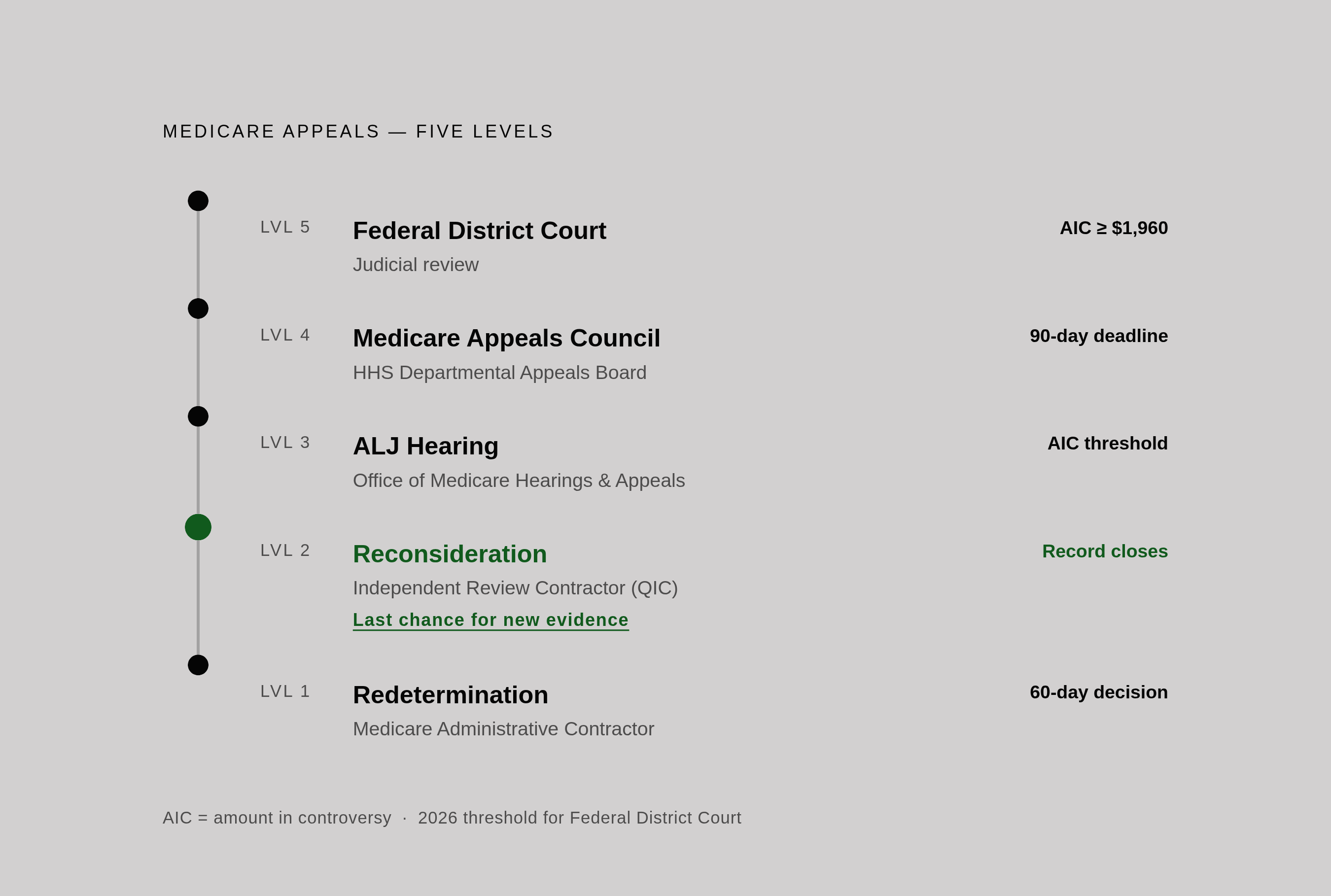
Each level of the Medicare appeals process does two things at once: it imposes a filing deadline, and it builds a record that travels upward. A thin file or a missed step early on cannot be patched later. By the time a claim reaches the DAB, whatever wasn't documented is simply gone.
Redetermination, the first level, is handled by the Medicare Administrative Contractor that processed the original claim. The provider files a written request, typically using the CMS Redetermination Request Form, and the request has to include the Medicare number, the specific items and dates of service in dispute, an explanation of the disagreement, and any supporting documentation. The MAC issues a decision within 60 days. Before filing, check whether the denial actually traces back to a clerical error: a transposed procedure code, a wrong provider number, a misapplied fee schedule. Errors like these can be fixed through a reopening instead of a formal appeal, and filing a full appeal on something that simple only slows down payment. Providers and participating physicians generally have the right to appeal; physicians and suppliers who don't take assignment have more limited rights. One other wrinkle at this stage: a claim marked unprocessable can't be appealed. Trying to appeal it risks a timely-filing denial instead. The fix is to correct the claim and resubmit it within the timely-filing window, not to file an appeal against it.
Reconsideration, Level 2, moves the claim to an independent review contractor named on the Medicare Redetermination Notice. The QIC had no role in the Level 1 decision, making this review genuinely independent. The request should include the MRN or remittance advice, a clear explanation of why the redetermination was wrong, and any new clinical or coding evidence the practice can produce. This matters because Level 2 is the last point in the process where new evidence can be introduced freely. Once the claim reaches an ALJ, the opportunity to add fresh documentation narrows considerably. For Medicare Advantage claims specifically, the contractor handling Level 2 changed in 2026: C2C Innovative Solutions, Inc. Practices need to route MA appeals to the correct contractor based on the date of service, not assume the prior vendor is still handling the file.
Level 3 is the ALJ hearing before OMHA. The request must be filed within the specified period after the QIC's decision, and the amount in controversy has to meet the applicable 2026 threshold. The hearing itself can happen in person, by video, or entirely on the written record. What matters most for the appeal's future is the document that comes out the other end: the ALJ's written decision. That decision is the record the Medicare Appeals Council will review at Level 4. Whatever the ALJ record contains, in terms of clinical detail, coding rationale, and authorization history, sets the ceiling on what the Council has to work with.
Missed deadlines at any of these levels generally end the appeal. Good cause exceptions exist, and they can be established by disability, illness, accident, or similar circumstances that genuinely prevented a timely filing. But good cause has to be argued explicitly. It isn't assumed just because a deadline was close. For infusion practices, the most common way a deadline gets blown is an administrative handoff failure, where the denial letter arrives at the practice but never reaches the person tracking appeal deadlines.
What the Medicare Appeals Council Reviews
The Council does not reopen the facts of the case. It reviews the ALJ's decision for legal and procedural error, and the ability to introduce new evidence at this stage is limited. That makes the record assembled at Levels 1 through 3 the primary material the Council has in front of it, not a starting point for further fact-finding.
The Council sits inside the HHS Departmental Appeals Board and operates independently of both CMS and OMHA. Its Administrative Appeals Judges aren't bound by the ALJ's conclusions, and their review happens on the existing record. From there, the Council has four options: affirm the ALJ's decision, modify it, reverse it, or remand it back to OMHA for further proceedings. A remand doesn't resolve the claim. It sends the matter back down for more work. That means more time before any payment determination is final. The Council can also take up review of an ALJ decision on its own motion, so this isn't exclusively a process that providers initiate. A case can land in front of the Council even without a request from the practice involved.
For an infusion provider, a remand is a mixed result. It extends the timeline without putting money in the bank, but it also gives the practice a chance to fix a procedural defect before an adverse decision becomes final and unappealable. Whether a remand helps or hurts depends entirely on what caused it and what the practice does with the additional time.
What separates a strong Council outcome from a weak one is the strength of the record built at the ALJ level: clinical documentation, coding rationale, and prior authorization evidence. A claim that arrived at the ALJ hearing with thin documentation and a weak argument carries those same structural weaknesses into the Council review, and no amount of skillful brief-writing at Level 4 fixes a gap that should have been closed at Level 2 or Level 3. The opposite is also true. A claim with a complete authorization trail, accurate J-code unit documentation, and a clearly stated medical necessity argument gives the Council what it needs to reverse or remand a denial that should never have occurred.
Filing requirements and procedural mechanics at the Council level
A request for Council review has to be filed in writing within 60 days of receiving the ALJ's decision. The request must identify the specific issues and findings being contested, and it's submitted using Form DAB-101. Getting this stage wrong can end the appeal before anyone looks at the merits of the case.
The 60-day clock starts on the date the ALJ decision is received rather than the date it was issued, so practices should document exactly when that decision arrived. The request itself needs to name which specific findings and conclusions in the ALJ decision are being challenged. A general statement that the practice disagrees with the outcome isn't enough to meet the filing standard. Form DAB-101 is the standard mechanism for initiating review, but a written request that covers the same required content elements is an accepted alternative if the form itself isn't used.
One more mechanical detail matters for practices juggling multiple denials: the amount-in-controversy threshold for judicial review, the level beyond the Council, sits above what many individual infusion claims reach on their own. Claims can be aggregated to meet that threshold. A practice holding several smaller denied encounters should look at whether combining them opens up a path to judicial review that no single claim would reach by itself.
The Council operates under a mandatory adjudication deadline of 90 calendar days, set by 42 C.F.R. § 405.1100. In practice, that deadline gets missed regularly. Many providers report Council matters sitting pending well past the 90-day mark, sometimes by months. For a practice with a high-dollar biologic claim tied up in that backlog, the delay is a continued gap in cash flow against a drug cost the practice already paid. That gap is also the reason the next procedural lever matters: the regulation that lets a provider move the case forward when the Council doesn't.
The escalation mechanism when the Council fails to act within the 90-day window
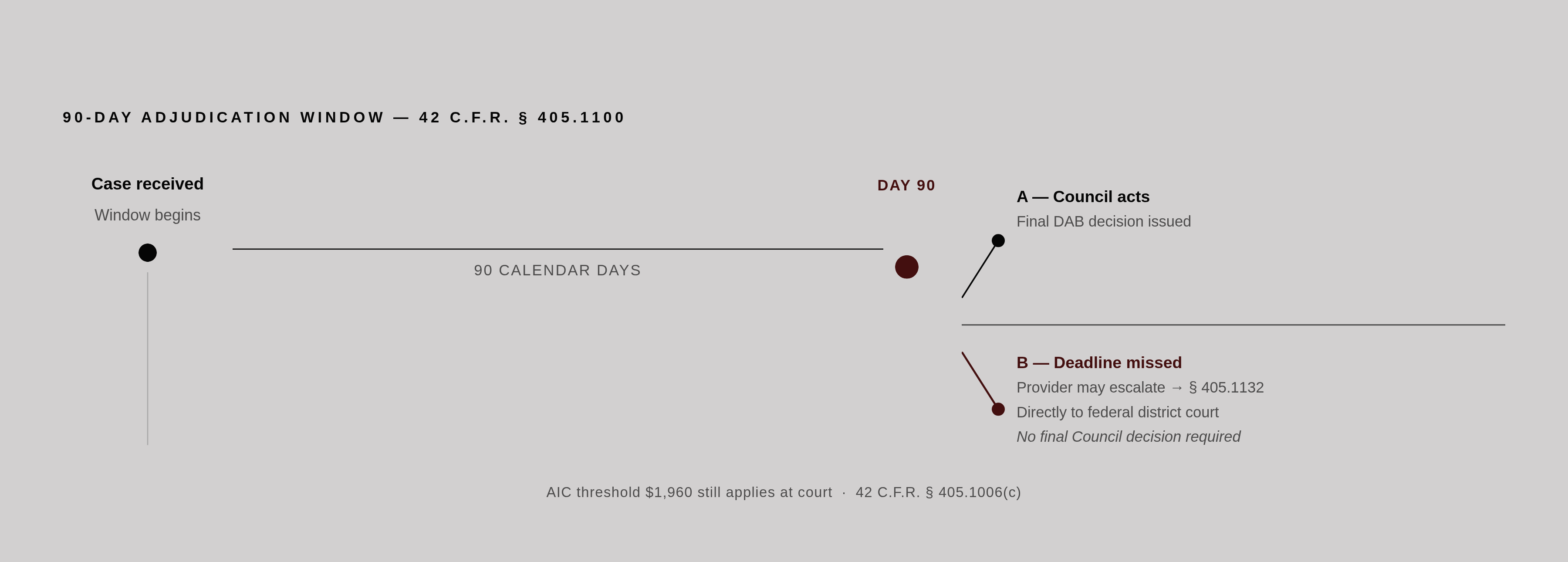
When the Council misses its 90-day deadline, 42 C.F.R. § 405.1132 gives providers a formal right to escalate the case to federal district court. For high-dollar infusion claims, this is a real strategic option to put in front of counsel, not a provision that sits unused on the books.
The regulation works like this: once the Council's adjudication period has lapsed, the appellant files a request for escalation. The Council then has a short window to either act on the case or send notice confirming that it can't. The provider isn't required to wait indefinitely for a final decision that may or may not arrive on any predictable schedule. Escalation removes the requirement of a final Council decision altogether and lets the provider take the dispute directly to federal district court. The $1,960 judicial review threshold for 2026, set under 42 C.F.R. § 405.1006(c), still has to be met, but for most infusion claims that threshold isn't a meaningful barrier.
What makes this mechanism matter structurally is what it does to the backlog itself. Without it, a stalled Council case is just a trap: the clock runs, the drug cost sits unrecovered, and the practice has no lever to pull. With it, the stalled case becomes a decision point. The provider can wait for the Council to rule, or file for escalation and move the dispute into federal court once the window has passed.
That decision isn't automatic. Federal litigation brings legal costs and timelines that may not make sense for a single mid-range claim. The calculus shifts for a high-dollar biologic denial, where the amount in dispute reflects a serious drug acquisition cost the practice needs back. It shifts further when a practice has aggregated several claims under the judicial review threshold, since escalation at that point covers multiple encounters at once and changes the cost-benefit math considerably. The decision to escalate belongs in front of counsel, weighed against the specific dollar amount at stake and how long the case has already been sitting. What matters operationally is knowing the option exists the moment the 90-day deadline passes, rather than discovering it months into an open-ended wait.
Building the clinical and coding record that wins at the Council level
A reversal at the Medicare Appeals Council has less to do with how the DAB brief is written and more to do with whether clinical necessity, the authorization chain, and J-code billing accuracy were documented completely before the claim was ever denied. The brief can argue only what the record already supports.
The authorization chain for recurring infusion therapy is usually the first place that record breaks down. If the original authorization covers a fixed number of sessions or a defined treatment window, any infusion delivered after that window closes, without a valid re-authorization in place, creates a coverage gap that no argument at the Council level can talk around. The fix has to happen at the point of care: re-authorization requests should go out well before the existing authorization expires, particularly for ongoing infusion cycles, so that no session is ever delivered into a gap that didn't need to exist.
J-code documentation is the second place precision matters. Units billed have to reflect the dose actually administered at that encounter. For weight-based biologics, that means tracking the patient's current weight at each visit, not the weight recorded back when the original authorization was approved. Overbilling units creates a compliance exposure. Underbilling units creates a straightforward revenue loss the practice never recovers. Neither error becomes a problem until a claim gets denied and the chart gets pulled apart level by level, where fixing it then costs far more than documenting it correctly would have at the outset. The practices that come out of the Council with a reversal in hand are, almost without exception, the ones whose authorization trail, weight-based dosing records, and medical necessity notes were airtight long before the denial letter ever arrived.