Modifier 25 Use in Infusion Encounters With Same-Day E&M
Modifier 25 unlocks separate payment when E&M work truly stands apart from the infusion.
Modifier 25 tells a payer that a same-day evaluation and management service is distinct work, not paperwork tacked onto a procedure. The AMA's own language defines it as a "Significant, Separately Identifiable Evaluation and Management (E/M) Service by the Same Physician or Other Qualified Health Care Professional on the Same Day of the Procedure or Other Service". That modifier goes on the E&M code, full stop, never on the procedure code. Putting it on the infusion administration code is a beginner mistake, and it's one of the fastest ways to get a claim kicked back before anyone even looks at the clinical merits.
Without modifier 25, payers bundle the E&M into the procedure payment automatically. So the modifier isn't a bonus, it's the thing that unlocks separate payment when the E&M actually stands on its own.
Three words that carry the legal and clinical weight of the modifier: significant, separately identifiable, same physician. "Significant" means the visit has to rise above a routine pre-infusion check, real medical decision-making or a substantial history and exam has to be there. Separately identifiable" means the documentation must show the E/M and the procedure address different clinical questions, or that the evaluation went substantially beyond what performing the procedure requires. "Same physician" sounds simple, but it covers the whole practice: physicians of the same specialty in the same group are treated as one physician under this rule, so switching which doctor signs the note doesn't create separation.
There's a practical decision test from AAFP and the CMS NCCI Policy Manual January 1, 2026: if the procedure had not been performed that day, would the E/M visit still be fully justifiable and billable on its own? If yes, modifier 25 has a case. If no, it doesn't. Modifier 25 can't go on CPT 99211 when it's billed with drug or infusion administration codes, because 99211 carries no medical decision-making requirement to begin with. Infusion visits raise this same question every time a procedure and a visit land on the same date, but the dollar amounts per encounter are bigger and payers are watching closer than they used to.
Infusion encounters as a natural, and legitimate, setting for same-day E&M services
Infusion visits are procedural by design. The drug administration is the billed service. But patients on biologic and specialty infusion therapies are often managing complicated, evolving conditions, and that complexity generates real E&M work on a regular basis, not as an exception.
Think about the situations that come up constantly in an infusion suite. A patient on a routine, recurring infusion shows up with a new symptom, maybe something that looks like an adverse reaction, maybe a new comorbidity or a sign the disease is progressing, and that needs its own evaluation and its own decision-making. Or the physician is assessing how the patient responded to treatment last time, or working through a toxicity issue that's about to change the plan, work that goes well past just supervising the drip. Sometimes a completely unrelated problem surfaces and gets worked up during the visit. And sometimes the whole reason for the visit is reconsidering the regimen itself, a dosing change or a drug switch that needs its own assessment separate from the infusion event.
Noridian, the CMS Medicare contractor for Jurisdiction E Part B, states that new patient CPT codes are required when a separately identifiable E&M service is performed on the same day as chemotherapy or non-chemotherapy infusion or injections, because these are not considered surgery. That's not a loophole. That's CMS building the framework around the assumption that E&M on infusion days happens and gets billed.
The E&M doesn't need a different diagnosis code to qualify. The CMS NCCI Policy Manual, effective January 1, 2026, states that different diagnoses are not required for modifier 25 to apply, since what matters is whether the documentation supports work above and beyond the procedure. So the clinical legitimacy of same-day E&M in infusion isn't really in question. Where practices fall down is the documentation discipline, which is the real driver behind these failures.
The documentation standard that makes modifier 25 defensible (and what falls short)
The AAFP and AMA both anchor this to one test: could the E&M note stand alone as a billable visit, completely apart from the procedure? If the answer requires squinting, the claim probably doesn't hold up under review.
Every modifier 25 encounter should be able to answer a short set of questions. Did the physician actually perform and document the key components of a problem-oriented E&M visit for a real complaint? Is there genuine medical decision-making in the note, something beyond confirming the patient is ready for the infusion? A different diagnosis helps make the case obvious, but as covered above, it isn't required, additional documented physician work is what counts.
Structurally, the NCCI Policy Manual effective January 1, 2026 states that the E&M service must be significant and separately identifiable from the procedure, with documentation supporting that standard. A single note that blends the E&M and the procedure together, with no visible line between them, fails that standard even if all the right clinical content is technically in there somewhere. The safest way to avoid that trap is splitting the note into two clear sections. Section one covers the E&M problem: chief complaint, history, exam, and plan for that specific issue. Section two covers the procedure: indication, technique, how the patient tolerated it, and post-procedure status. Separate headings, or even timestamps, make that separation visible to anyone reviewing the chart later, which is exactly the point.
What fails, consistently: templated or vague language that doesn't show independent clinical thinking, which CMS and OIG findings point to as the leading cause of audit denials and recoupment. Also failing: an "E&M" note that's really just vital signs, confirming the infusion site, walking through the procedure, or getting consent, because that work is already baked into the procedure's payment. And any note where the E&M and procedure content run together without a visible break fails the separately-identifiable test even when the underlying care was fine.
AAFP recommends physically separating the procedure documentation from the problem-oriented E&M documentation within the record, "if possible," which is about as close as official guidance gets to saying just do it. The E&M code itself, 99213-25 or 99214-25 for example, has to be supported by the documented medical decision-making or total time, not by how complicated the infusion happened to be. A hard infusion doesn't justify a high-level E&M code on its own. The 2026 NCCI guidance sets the safest structural approach as follows.
OIG audit findings and their translation into infusion billing risk
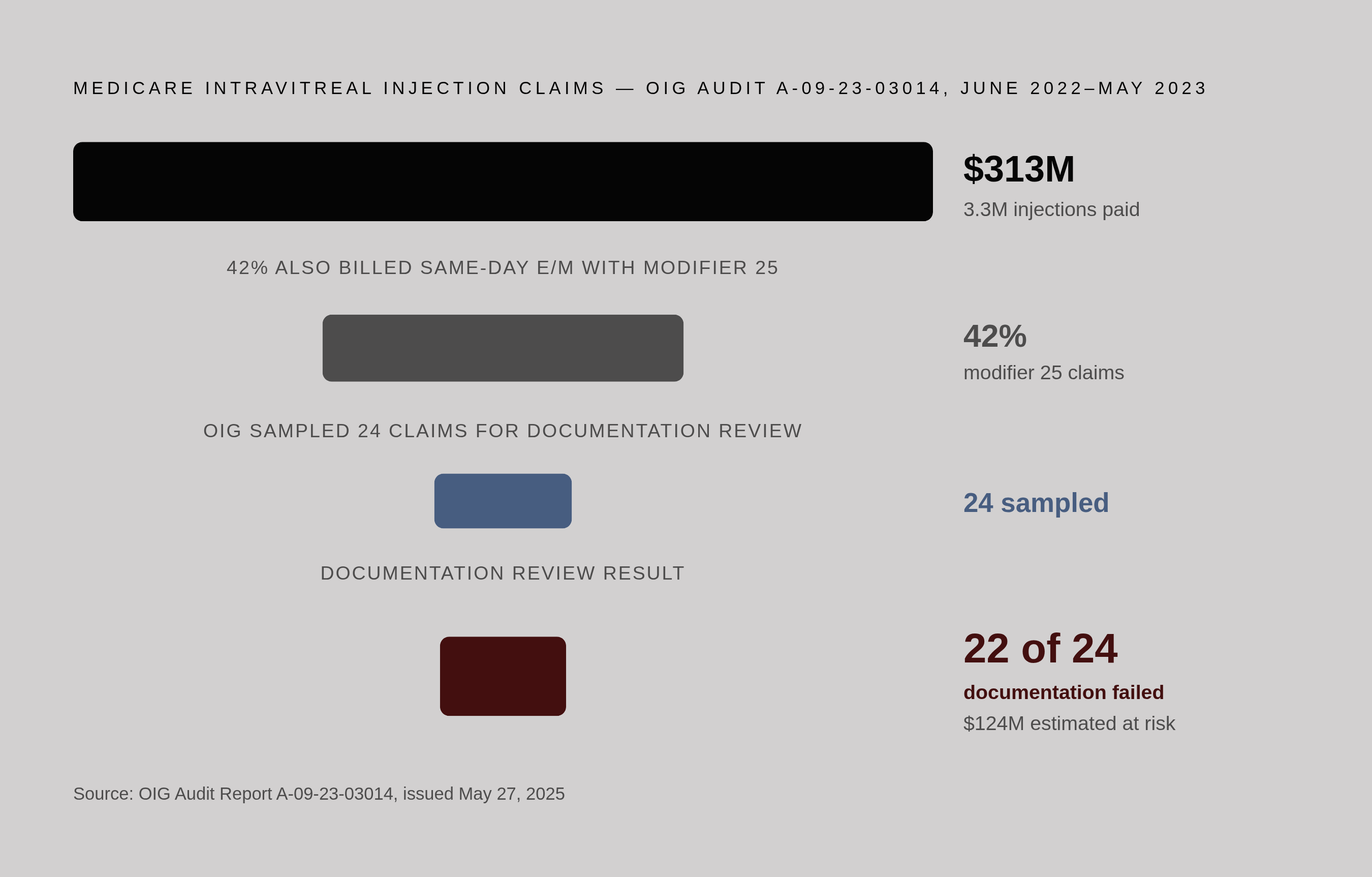
The clearest data point comes from OIG Audit Report A-09-23-03014, issued May 27, 2025, which looked at Medicare payments for intravitreal injections between June 2022 and May 2023. Medicare paid out $313 million for 3.3 million of those injections during that window OIG Audit Report A-09-23-03014. For 42% of them, the billing provider also billed a same-day E&M service using modifier 25 OIG Audit Report A-09-23-03014. When OIG pulled a sample and checked the supporting documentation, 22 out of 24 claims didn't meet Medicare's requirements, putting an estimated $124 million at risk for recoupment OIG Audit Report A-09-23-03014.
That audit was about eye injections, not infusions. But the documentation standard behind it is identical across service types, and that's the part infusion practices need to sit with. The finding wasn't that modifier 25 is improper. The finding was that the documentation, over and over, didn't back it up.
NAMAS calls modifier 25 likely the second most abused modifier in medical billing, and notes that insurers started announcing prepayment audits for any claim carrying it, years ago at this point, meaning review before payment, not after. NAMAS also flags an organizational pattern that quietly builds risk: a lot of large practices now let providers code their own visits instead of running a dedicated coding department, and coders working through system-generated edits sometimes append modifier 25 just to clear the edit without ever reading the note. That's exposure sitting there, waiting for an audit to find it, and internal QA often doesn't catch it in time.
The enforcement climate has also changed shape. Payers are using AI-powered claim validation and real-time prepayment review to flag modifier inconsistencies faster than manual audits. A claim that got paid in prior years is not evidence that it was compliant. High-dollar infusion and oncology claims face more manual review, and the combination of high per-claim value and modifier 25 usage creates a compound audit trigger. OIG has identified modifier 25 as one of the highest-risk billing patterns in Medicare; between May 2025 and March 2026, the OIG issued two completed audit reports and announced a new Work Plan project on this modifier.
The G2211 interaction that catches infusion billers off guard
G2211, the complexity add-on code, brought a wave of confusion with it when it launched, and AAFP notes that modifier 25 questions specifically increased once G2211 entered the picture.
The rule that matters for procedure days is this. Beginning January 1, 2025, CMS changed its policy on how modifier 25 and G2211 interact, creating a limited exception when a visit and a Part B preventive service, such as an AWV or vaccine administration, occur on the same day. Outside that narrow case, the two generally shouldn't be billed together on a day when a procedure is also happening. Current CMS guidance for 2025 through 2026 treats G2211 as off-limits when modifier 25 is required. The exception only kicks in when a Part B preventive service, an AWV, or a vaccine administration is also on the claim that same date.
For infusion practices, that distinction is easy to miss and expensive to get wrong. Plenty of commercial payer systems automatically deny the G2211 plus modifier 25 combination on procedure days, so billing both on an infusion visit without checking that specific payer's policy first sets up a denial before the claim even gets reviewed by a person. CMS reinforced the underlying principle in MLN Booklet MLN006764, issued September 2025: the E&M has to be medically necessary, significant, and separately documented, not a pre-procedure screening dressed up as a visit.
This is a coding-level trap, not a clinical failure. The encounter itself might be entirely legitimate, well-documented, defensible on every clinical point, and it still gets denied because the code combination was wrong. That denial will look, at first glance, like a modifier 25 problem. It isn't. The add-on code is the actual root cause.
Payer-specific denial patterns for modifier 25 in infusion settings
Not every payer plays by the same rulebook. Traditional Medicare runs on NCCI edits, updated quarterly, while commercial payers build their own claims editing systems that may or may not line up with Medicare's logic, which means checking individual payer policy, or just calling provider relations, isn't optional. Medicare Administrative Contractors, Novitas, CGS Medicare, First Coast Service Options, and Palmetto among them, run NCCI Lookup tools that serve as the reference point for their specific jurisdiction, not a universal answer.
The denials themselves tend to fall into recognizable buckets. CO-97 bundling denials occur when the payer decides the E&M was already folded into the procedure payment. Downcoding happens when the payer accepts the claim but knocks the E&M level down because the documentation doesn't support the complexity that was billed. Then there's the slower, uglier version: documentation-based recoupment after a post-payment audit, where the claim gets paid, then reversed months later once someone actually reads the chart. Payer-specific LCD and NCD policies add another layer, restricting same-day E&M for particular infusion CPT codes in ways that differ payer to payer and need individual review. And the G2211 stacking error covered above appears here too, triggering an automatic denial on procedure days.
Global period rules matter as well. Procedures with 000 or 010 global days already have an E&M component priced into their reimbursement, so the decision to perform a minor procedure can't be billed separately. Major surgery, the 090-day global procedures, works differently: the decision to operate gets reported with modifier 57, not folded into the procedure payment, and modifier 25 can still apply on top of that, but only for a significant E&M that's unrelated to the surgical decision itself. That distinction rarely comes up in infusion billing directly, but it's the same underlying logic that governs whether an E&M is truly separate or just baked in.
The type of denial a claim gets back is actually useful information: it points straight at the root cause, whether that's a documentation gap, a bundling issue, or a code-pairing mistake, which is why sorting denials by type and by payer matters for fixing the pattern instead of just resubmitting and hoping. Infusion billing already carries its own load of complexity: strict CPT code hierarchy, correct J-code unit counts, ICD-10 codes that have to align with payer medical policy. Modifier 25 failures don't happen in isolation, they appear stacked on top of drug billing errors on the same claim. And given that infusion visits often generate $5,000–$50,000 in charges per encounter, a bundled or denied E&M on top of a drug billing error on a high-value infusion claim is not a minor variance, it is a cash-flow problem. It's a cash-flow problem, and on a big enough claim, a real one. This article walks through exactly how those requirements work and what makes modifier 25 defensible in this setting. The common modifier 25 denial categories in infusion encounters are as follows.
Workflow-level needs for infusion practices to prevent modifier 25 denials before claims go out
The fix starts long before the claim gets submitted. By the time a claim is submitted, the documentation either supports modifier 25 or it does not (there is nothing billing staff can do to fix a combined note after the fact).
That puts a lot of weight on provider education, not just coder training. Clinicians need to actually understand what "significant and separately identifiable" means in practice, because they're the ones writing the note that either holds up or doesn't. NAMAS, as of May 2026, points out a common response when providers are told their modifier 25 use was wrong: "but we got paid for it." Getting paid isn't the same as being entitled to the money, and post-payment audits exist specifically to claw back the difference. Training should address the NCCI Manual, the AMA's "Reporting CPT Modifier 25" resource, and payer-specific LCD/NCD policies that restrict same-day E&M for specific infusion CPTs.
On the coding side, the fix is procedural. Coders shouldn't be appending modifier 25 just to clear a system-generated edit without opening the chart and reading it, a shortcut NAMAS identifies as a real contributing factor behind incorrect use. Internal QA should be sampling modifier 25 claims on a regular schedule, not waiting until a denial pattern already appears in the aging report. And the two-section note structure, E&M problem separate from procedure detail, should be a standing template requirement for any infusion encounter where a same-day E&M is even a possibility, not something providers reinvent case by case.
When denials do land, speed affects how much of the denial is recoverable. Denial management and appeals work should start within 48 to 72 hours of the denial hitting the system. About 65% of denials are recoverable, but that number only holds if the appeal gets worked inside the payer's actual timeline. On high-dollar infusion claims, sitting on a denial for a few extra weeks isn't a paperwork delay. It's money that gets harder to recover with every day that passes.
Sources
- Modifier 25: The Drama Never Ends - NAMAS
- 25 - JE Part B - Noridian
- Setting the record straight on proper use of modifier 25 | American Medical Association
- How To Use Modifier 25 | AAFP
- Page 1 of 29 Evaluation and Management Services MLN006764 May 2026
- medicare payments for evaluation and management services provided on the same day as eye injections were at risk for noncompliance with medicare requirements
- Bill G2211 With Confidence (and Modifier 25) - AAPC Knowledge Center
- How to Bill G2211 with Modifier 25 (or, Why You Probably Cannot) · RVUDoc