Recoupment Meaning in Infusion Therapy Medicare Audits
Medicare claws back infusion payments when audits find overpayments, threatening cash flow.

Recoupment is what happens after Medicare decides it paid a claim it shouldn't have, and it wants that money back now, out of the practice's future payments. For infusion providers, that mechanism is not a theoretical billing risk sitting in a compliance manual. It's a cash-flow event, because the drug cost embedded in a J-code claim has already been paid out to a distributor, and the recoupment doesn't care about that.
An overpayment, under Medicare's own definition, is money received in excess of what program rules allow. That covers a lot of ground: duplicate payments, services later found not payable, coding errors, coordination-of-benefits mistakes, and amounts an auditor flags through sampling or extrapolation. Once a Medicare Administrative Contractor identifies one, it sends a demand letter. If the debt doesn't get resolved, the MAC starts withholding future Medicare payments until the balance is paid off. That withholding is the recoupment.
Timing matters more than most practices assume. Federal law requires providers to report and return an identified overpayment within 60 days, or by the date the related cost report is due, whichever comes later. CMS updated this rule effective January 1, 2025 (published December 9, 2024), and the change is worth sitting with: providers now get an investigation grace period to look into a suspected overpayment before the 60-day repayment clock even starts running, extending the total window before the repayment obligation becomes legally enforceable. Operationally, this fixes something that used to be genuinely murky. A billing team that notices an odd pattern in remittances, but hasn't yet nailed down the scope, now has a defined runway to investigate rather than guessing at when the clock started.
Miss that deadline, though, and the exposure jumps categories entirely. Retaining an overpayment past the deadline can trigger False Claims Act liability: civil penalties per claim, adjusted every year for inflation, treble damages (three times the overpayment), and potential exclusion from federal healthcare programs. That's not a billing dispute anymore. That's a legal one.
The recoupment process itself has mechanical timing rules that determine whether money actually leaves the practice's account. A MAC can't start recoupment earlier than 41 days from the initial demand letter. File a timely, valid redetermination request, and the MAC has to stop recoupment under 42 CFR 405.379(d)(1), full stop. If the MAC then affirms the overpayment, recoupment picks back up after that redetermination notice, unless a reconsideration request already got filed in the meantime. And here's the detail that catches practices off guard: after the first two appeal levels, recoupment resumes at 100%, regardless of whatever appeals are still pending above that. An Extended Repayment Schedule exists as an alternative to full withholding, but it isn't automatic. It has to be set up before recoupment resumes at full strength, or it does nothing.
The audit entities that can initiate recoupment and why their differences matter for infusion providers
Recoupment doesn't come from one office. Several different types of contractors can trigger it, and each one plays by different rules, which means a practice has to know exactly who it's dealing with before it can respond correctly.
MACs, or Medicare Administrative Contractors, process claims and run medical review within their own jurisdictions. Their audits center on coverage rules, local coverage determinations, and whether the medical record actually backs up what got billed. Because MACs are so tied into day-to-day claims administration, their reviews live or die on documentation precision, coding support, and how local policy gets interpreted.
RACs, Recovery Audit Contractors, work post-payment and get paid on contingency, earning a cut of whatever they claw back. They can look back as far as three years from the date a claim paid, and because their fee depends on finding overpayments, they tend to push hard on repayment issues. The RAC landscape has shifted structurally: the old A/B/C/D regional setup is gone, replaced by numbered Regions 1 through 5. Cotiviti GOV Services LLC now holds the DMEPOS RAC contract nationally (Region 5), awarded in April 2025, taking over from Performant Recovery, which no longer holds that contract.
UPICs, Unified Program Integrity Contractors, investigate potential fraud, waste, and abuse. Their reviews can involve data mining, extrapolation, payment suspension, and referrals that go well past a routine claims adjustment. That's a materially higher level of exposure than a standard MAC or RAC look.
ZPICs, Zone Program Integrity Contractors, focus on program integrity across Medicare service lines. Their reviews can occur before or after payment, and a ZPIC finding can hand off directly into a MAC or RAC referral down the line.
SMRCs, Supplemental Medical Review Contractors, run issue-based medical review nationwide. They can zero in on a single specialty or service category across multiple MAC jurisdictions at once, which means infusion providers in totally different regions can get swept into the same review cycle.
CERT, the Comprehensive Error Rate Testing program, randomly samples claims and asks for documentation. Miss the request, and Medicare simply treats the claim as an overpayment and issues recoupment. No response means no defense. This is a quiet risk, the kind that catches practices that aren't tracking their audit correspondence closely.
The OIG completed an audit of Medicare Part B claim lines where federal payments exceeded billed charges, Project A-07-24-04138, as of July 2026. Earlier versions of this same audit found overpayments ranging from $2 million to $7 million per MAC jurisdiction. OIG audit findings of this kind typically inform subsequent Medicare recovery activity.
On the Medicare Advantage side, CMS announced on May 21, 2025 that it plans to audit every eligible MA contract for Payment Years 2018 through 2024, and to recover on all prior audits. That expands MA recoupment exposure well past anything seen historically.
The operational takeaway: each of these entities carries its own response deadline, its own format for what documentation to produce, its own appeal path, and its own legal stakes. Respond to an inquiry from a certain type of program integrity contractor like it's a routine MAC request, and the practice is playing by the wrong rulebook entirely.
Why infusion therapy claims land in audit crosshairs more often than general Part B services
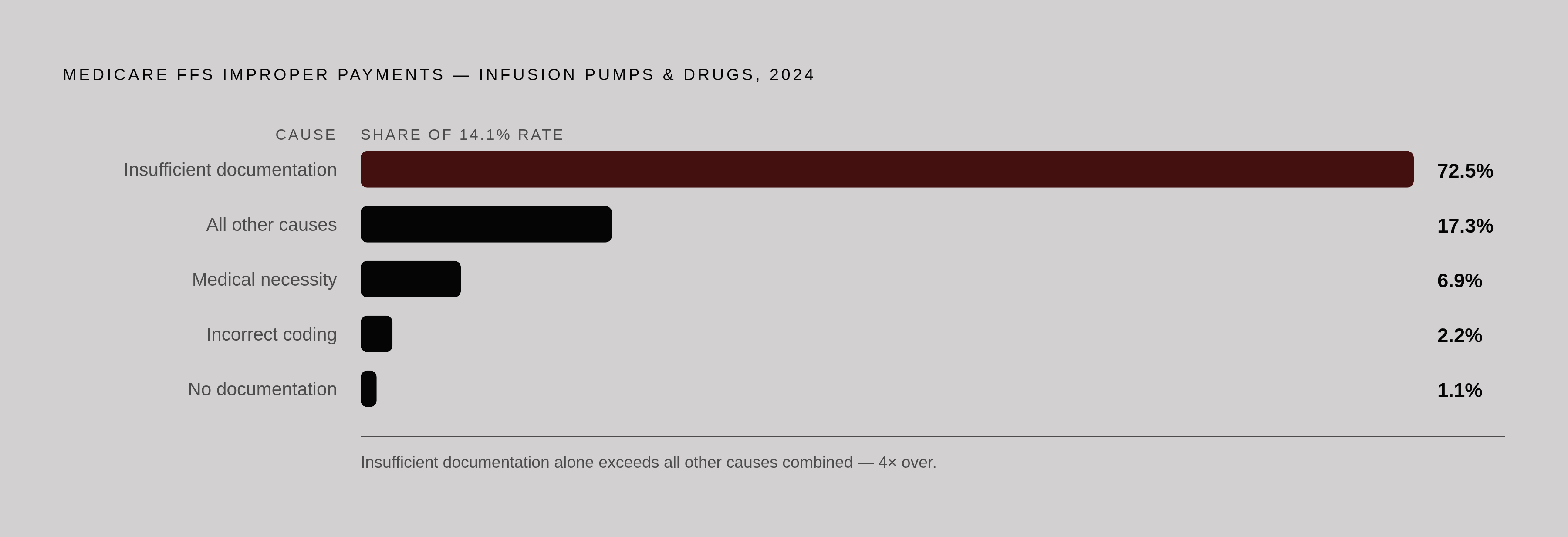
The 2024 Medicare Fee-for-Service Supplemental Improper Payment Data puts the improper payment rate for infusion pumps and related drugs at 14.1%, with a projected improper payment amount of $89.5 million. That's not a guess about where infusion sits relative to other service lines. It's a documented concentration of error.
Break down what's driving that 14.1%, and one cause dwarfs the rest: insufficient documentation accounts for 72.5% of the improper payments. Medical necessity errors are 6.9%, incorrect coding is 2.2%, no documentation at all is 1.1%, and everything else lumped together is 17.3%. So this isn't really a coding problem, at its core. It's a documentation problem, and a large one.
Audit volume across payers, broadly, is climbing too. MDaudit analysis found total at-risk audit amounts per customer rose 30% year-over-year through the first three quarters of 2025, and the average at-risk amount per claim rose 18% in that same stretch.
Infusion carries its own specific gravity toward audit attention, for a few reasons that layer on top of each other:
- High-cost biologics and J-code drugs draw scrutiny because a single claim line can carry tens of thousands of dollars in drug cost. That kind of dollar concentration makes the audit worth the auditor's time.
- Predictive analytics now let payers target providers and claims with the highest denial or takeback potential, and practices running high volumes of injectable drugs show up statistically more often in those models.
- Incorrect units of service are a recurring deficiency in Part B billing, and infusion billing is especially exposed here because drug units get calculated off weight, concentration, and vial size, in combinations that create systematic miscoding risk.
- Wound care, infusion, therapy, and incident-to billing all face recurring scrutiny because coverage criteria, product rules, or supervision requirements are easy to get wrong even when the clinical care itself is sound.
The OIG's July 2026 audit, Project A-07-24-04138, reviewed Medicare Part B claim lines broadly, which puts infusion providers billing Part B drugs within the population potentially affected.
There's also a structural habit that lets overpayments sit undetected until an auditor finds them: when a payment posts higher than expected, billing staff often move on to the next claim instead of stopping to investigate why. That overpayment doesn't disappear. It just sits there as a liability, quietly, until someone with an audit letter quantifies it.
The specific documentation failures that convert infusion claims into recoupment targets
Insufficient documentation drives 72.5% of infusion pump and drug improper payments. That single number should reframe how a practice thinks about audit risk as fundamentally a record-keeping problem rather than a coding-complexity problem or a clinical judgment dispute. It's a record-keeping problem.
CMS documentation standards for infusion spell out specifics that auditors check line by line. Infusion administration must meet defined duration and intensity thresholds to qualify for the applicable coding level. Hydration therapy always ranks secondary to infusion or injection therapy on the claim, and sequencing errors here show up again and again in audit findings. When a MAC requests records, providers have to produce documentation of volume, start and stop times, and infusion rate. If there's no recorded stop time, documentation of volume, start time, and infusion rate must be sufficient to substantiate the duration of the service, not just gesture at it.
Noridian's coding rules add another mechanical trap. CPT codes 96360, 96365, 96374, 96409, and 96413 all describe "initial" service codes, and only one initial code can go on a single patient encounter. Bill two initial codes on the same date, and Noridian denies the second one, unless the patient came back for a separately identifiable service later that day. It is a rule that automated systems and auditors apply retroactively just as mechanically.
CMS has also updated its guidance on complex drug administration services, and Medicare's current approach widens the documentation burden for complex infusion coding considerably.
Beyond the coding rules themselves, mid-market infusion organizations tend to run into the same handful of root causes: prior authorization that doesn't match what actually got administered, drug-to-diagnosis mismatches on the claim, eligibility that lapses between the authorization date and the treatment date, and timely filing breakdowns on secondary claims. None of these are exotic failures. They're process gaps.
The OIG's audit pattern from Project A-07-24-04138 names four recurring categories: incorrect units of service, HCPCS codes that don't match the procedure actually performed, packaged services billed separately when they shouldn't be, and documentation that's simply missing. All four show up in infusion billing more often than average, because drug unit calculation, bundling rules, and the hierarchy of infusion codes stack error opportunities on top of each other.
What sets infusion apart from general Part B billing is the sheer number of things the record has to prove at once. It's not enough to show a service happened. The chart has to support the specific drug, the dose, how long the administration ran, the sequence of what got given, and the route, and every one of those elements maps to a billing code or unit count an auditor can check independently against the order and the remittance.
How recoupment translates into cash-flow disruption when the claim involves a high-cost biologic
General Part B recoupment and infusion recoupment aren't the same animal, financially. Recoup a general Part B claim, and the practice loses a physician fee, usually modest. Recoup a buy-and-bill infusion claim, and the practice loses that same fee plus the drug cost baked into the J-code, a cost the practice already paid the distributor before the patient ever got the infusion.
A single recouped or denied biologic claim can tie up tens of thousands of dollars in drug cost with nothing to offset it. The practice bought the inventory, administered the treatment, and now Medicare is withholding money from future payments, the same payments that fund the practice's day-to-day operations.
Scale matters here. Hospitals faced an average at-risk amount of $17,000 per external payer audit, per 2025 analysis. In infusion, a single biologic infusion can exceed that figure in drug cost alone. That's not an abstract statistic. That's one claim.
Recoupment also doesn't stay contained to the service line under review. Medicare withholds from the practice's entire Medicare revenue stream, so a recoupment triggered by infusion claims specifically still drains cash available for every other part of the operation.
The timing trap is the part that catches practices most off guard. MACs resume recoupment at 100% after the second appeal level, regardless of whether an ALJ appeal or federal court appeal is still pending. So a practice with a genuinely strong third-level appeal can still be having money withheld the entire time that appeal sits unresolved, which means it needs either an Extended Repayment Schedule or real capital reserves just to keep operating through the wait.
Medicare Advantage adds a second, parallel layer of pressure. The average denied amount for an MA claim rose 22.4% to roughly $1,000, per 2025 reporting, and MA denial rates now sit above 17%, more than double the traditional Medicare rate. For infusion providers with a heavy MA payer mix, recoupment risk and denial risk stack on top of each other rather than trading off.
The DMEPOS precedent shows what happens when error patterns go unaddressed at the structural level. The OIG found $22.7 million in improper payments over seven years in a single audit of DMEPOS claims during inpatient stays, and $4.5 million of that came after CMS had already modified its system edits in January 2020. The corrective action didn't fix the underlying process, so the errors kept recurring anyway. Infusion billing runs the same risk: without a structural fix to the documentation and coding process, the same mistakes keep resurfacing no matter how many individual claims get corrected after the fact.
The five-level Medicare appeals process and where recoupment can be paused or reversed
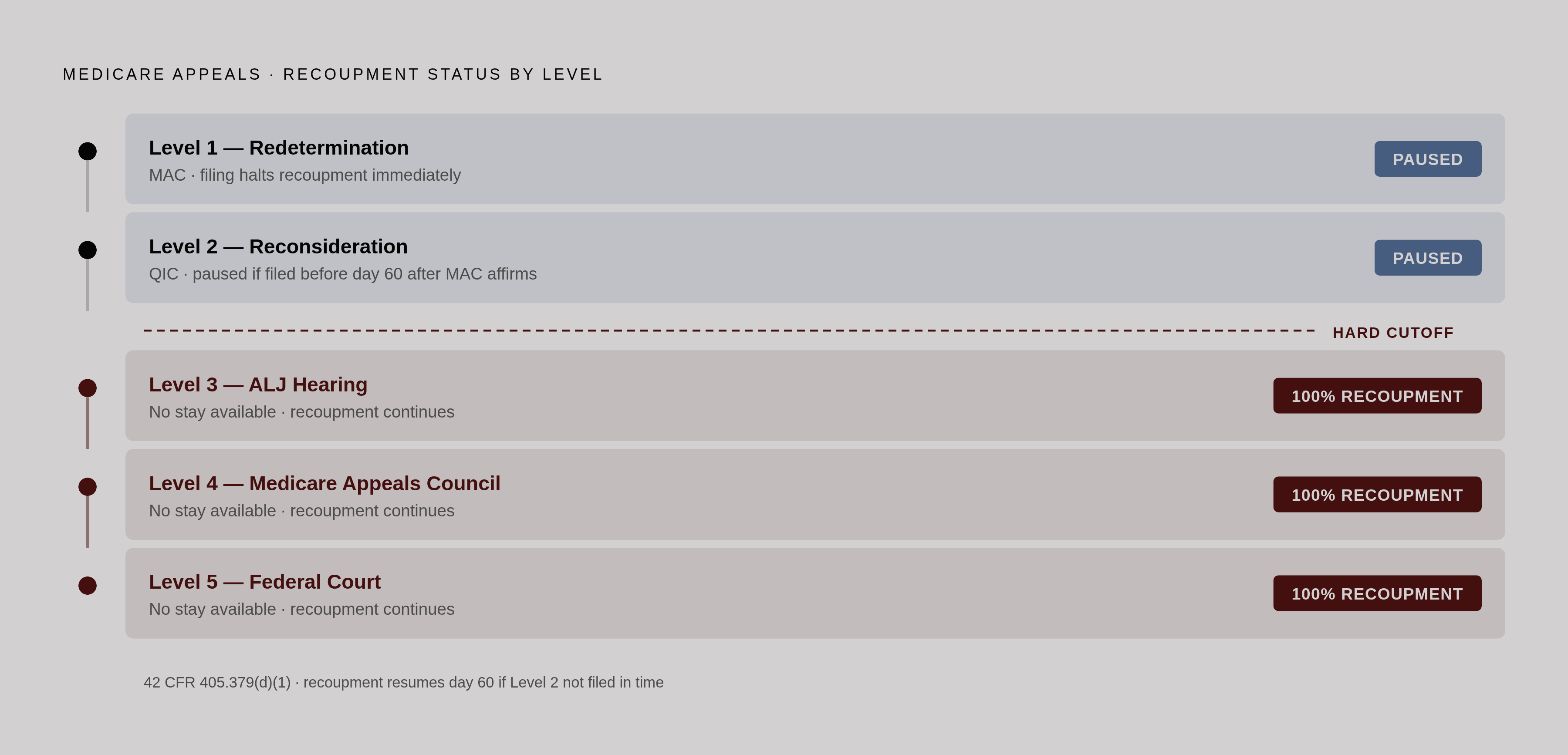
Every stage of the Medicare appeals process affects whether recoupment is actively happening, not just whether the underlying claim dispute eventually gets resolved. Knowing which lever to pull, and when, is the difference between managing cash flow and getting steamrolled by it.
Level 1, redetermination by the MAC, is the first stage. Filing a timely, valid redetermination request forces the MAC to stop recoupment under 42 CFR 405.379(d)(1). This is the fastest cash-flow protection available to a practice, full stop. It halts the withholding clock immediately.
Level 2, Reconsideration by a Qualified Independent Contractor. If the MAC affirms the overpayment at redetermination, recoupment resumes on the 60th calendar day after that notice, unless a reconsideration request has already been filed before then. Timing that reconsideration filing to close the gap between the redetermination decision and the resumption date isn't just a legal move. It's an operational one, and getting the timing wrong means watching recoupment restart while the appeal is still sitting in someone's inbox.
Level 3, ALJ hearing at the Office of Medicare Hearings and Appeals. The amount in controversy threshold is $190 for 2025 and rises to $200 for 2026. Infusion claims clear that bar routinely, often by a wide margin, given drug costs alone. Average wait time for ALJ hearings dropped to roughly 71 days as of fiscal year 2024, a real improvement over the backlogs of prior years. Still, that's 71 days of recoupment continuing at 100% while the practice waits for a hearing date. The threshold itself isn't a meaningful barrier for this service line. It's a formality that a single biologic claim clears without effort.
Level 4 is the Medicare Appeals Council.
Level 5, Federal district court. The amount in controversy threshold rises to $1,960 for 2026, and again, that's not a real obstacle for high-cost biologic claims.
The rule that shapes all of this financially: contractors resume recoupment at 100% after Level 2, regardless of whatever appeals get filed afterward. Filing at Level 3, 4, or 5 doesn't slow the withholding down. The financial pressure keeps running the entire time the higher-level appeal works its way through review, which is exactly why an Extended Repayment Schedule matters as much as the appeal itself. Winning the appeal eventually doesn't help a practice that ran out of cash waiting for the decision.
Sources
- OIG Just Finished a Medicare Billing Audit. What Practices Should Check.
- Medicare Improperly Paid Suppliers $22.7 Million Over 7 Years for Durable Medical Equipment, Prosthetics, Orthotics, and Supplies Provided to Enrollees During Inpatient Stays
- CMS Doubles Down on Medicare Advantage Recoupment: Announces Aggressive RADV Strategy to Reclaim Billions
- med.noridianmedicare.com
- cms.gov
- law.cornell.edu