Accounts Receivable in Healthcare Revenue Cycle
Infusion billing stacks complexity that demands specialty-specific revenue cycle discipline.

Accounts receivable in healthcare comes down to one number: money owed for work already done. It sounds simple, and for a lot of specialties, the mechanics are simple. Infusion billing breaks that simplicity. High drug costs, layered authorization rules, and payer-specific denial patterns turn ordinary AR discipline into something that has to be rebuilt for this specialty specifically, and I've watched practices lose real money because they never made that adjustment.
How infusion billing loads the AR cycle with structural pressure from the start
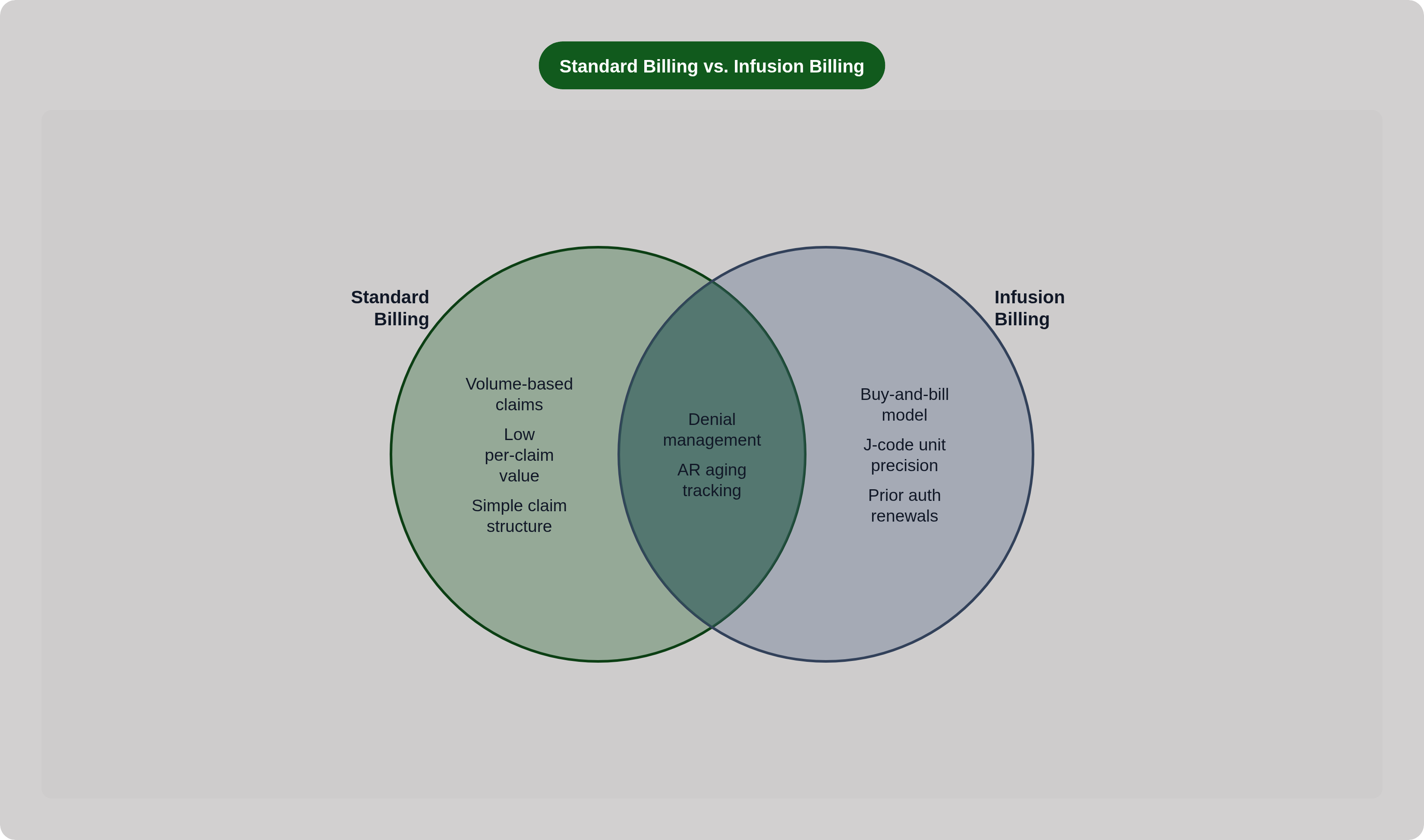
Most medical billing runs on volume. You see a lot of patients, each claim is worth a few hundred dollars, and if one gets denied, it stings but it doesn't threaten the practice. Infusion carries a different weight. A single encounter can generate charges well into the tens of thousands of dollars, so every claim that goes out the door carries weight most specialties never have to think about.
The dollar amount is only part of the picture. One infusion visit usually stacks several billable pieces on top of each other: the drug itself billed under a J-code, the administration codes for primary, concurrent, sequential, or push infusion (each governed by its own rules), modifiers that shift depending on the payer, and NDC numbers tied to the drug line. Getting any one of those wrong puts the whole claim at risk.
Then there's authorization. Most specialty infusion drugs need prior approval before the first treatment, and that approval has to be renewed on the payer's schedule, often every three to six months. That means AR exposure starts building before the patient even sits down in the chair. An off authorization compromises the claim regardless of how clean the billing team's work is downstream.
This all matters more by the year. The ambulatory infusion center market is projected to grow from $50.98 billion in 2025 to $93.41 billion by 2031, a compound annual growth rate above 10%. As more infusion care shifts from hospital outpatient departments into independent and ambulatory settings, practices are absorbing a billing burden that hospitals used to carry with dedicated revenue cycle teams. The money at stake is growing, and so is the cost of managing it badly.
Why the buy-and-bill model turns a denied claim into a cash-flow emergency
Buy-and-bill is exactly what it sounds like. The practice buys the drug up front at acquisition cost, gives it to the patient, then bills the payer and hopes the reimbursement covers the spread. That spread is the margin. It's a reasonable model when claims pay correctly and on time.
When a claim gets denied or underpaid, there's no undoing what already happened. The drug is administered, the money is spent, and now the practice is waiting on a payer to make it whole. At tens of thousands of dollars per encounter, one denied buy-and-bill claim can trigger a genuine cash-flow event.
J-code unit errors cause a lot of this damage. Every J-code is defined against a specific measurement unit, whether that's per milligram, per 10mg, per 100mg, or per vial. Take J9035, the code for bevacizumab, which bills per 10mg. A 400mg dose requires 40 units. Bill the wrong unit count, and you've just created a massive underpayment that might not surface until someone does post-payment reconciliation weeks later. Multiply that error across every patient on that drug, every cycle, every month, and the scale of the problem becomes clear.
White-bagging adds another wrinkle. When a payer routes the drug through its own specialty pharmacy, the practice only bills for administration, not the drug itself. Knowing which payers require this model, and billing correctly under it, takes real operational tracking. As of 2025, 12 states have passed legislation addressing white-bagging mandates, so the rules form a patchwork that varies depending on where you practice.
Medicare complicates things further. Part B drug reimbursement rates update every quarter, meaning the correct payment for the same J-code shifts regularly. Teams that aren't recalibrating margin calculations four times a year are quietly eroding their own numbers without realizing it. Payer scrutiny on drug billing has only intensified through 2024 into 2026, with audits increasingly targeting drug billing accuracy and documentation. Without structured workflows for unit calculation and waste documentation, a practice is carrying denial risk on the front end and recoupment risk on the back end simultaneously.
How prior authorization gaps seed AR problems weeks before a claim is submitted
Prior authorization failures rank among the top causes of infusion denials, and here's the frustrating part: almost all of them are preventable. This isn't a one-and-done step. For a recurring infusion patient, the authorization has to specify drug, dose, frequency, and duration. It has to be renewed on the payer's timeline, usually every three to six months. It has to be re-triggered any time the physician adjusts the regimen. And for new-to-market unclassified codes, 93% of payers require a prior auth, with 30% imposing a moratorium of one to six months before they'll even approve it.
Here's where it gets dangerous: when an authorization lapses in the middle of a treatment cycle, nobody usually notices until the denial letter shows up. By then, several infusions may have already been given without valid coverage behind them. Each of those infusions carried a drug acquisition cost that's now sitting unrecovered, and even a successful appeal adds two to six weeks to the payment timeline.
The overhead compounds too. Manual authorization processing runs about $10.97 per authorization, versus $5.79 when it's handled electronically. Across hundreds of monthly authorizations at a multi-drug infusion practice, that gap adds up to tens of thousands of dollars a year in pure administrative cost, before you even factor in how much slower manual processing is.
Calendar-based renewal tracking and real-time status monitoring, organized by patient and by drug, function as core infrastructure rather than optional add-ons. They're what keeps an authorization lapse from turning into an AR problem three weeks later. CMS is tightening the screws here too: starting in 2026, payers will be required to respond to standard PA requests within 7 days, down from 14. That's a win for practices, but the work of submitting and tracking those requests still lands squarely on the practice's shoulders.
What the denial rate surge means for infusion AR aging in practice
Denial rates have been climbing hard. Claim denials rose from 30% in 2022 to 38% in 2024, according to the 2025 State of Claims Report from Experian Health, and rose over 11% in 2025. Medicare Advantage denials, specifically, rose 55.7% between 2022 and 2023 per AHA data, which hits infusion practices especially hard since their patient populations skew older and sicker.
Payers are leaning on AI and predictive models now to flag claims before they ever pay out, and high-dollar infusion claims draw more manual review as a result, adding another two to six weeks to payment even on claims that will eventually be approved.
Watch what that does to an aging report. One disputed biologic claim can sit in the 90 to 120 day bucket for the entire length of an appeal, while the practice has already eaten the drug acquisition cost and is carrying that balance the whole time. If several recurring patients hit the same payer-driven denial pattern at once, that aging report can degrade fast, turning what looks like a scattering of small problems into one large one.
Site-of-care denials are picking up too. UnitedHealthcare expanded its Specialty Pharmacy Oncology program to cover 47 infused therapies in 2025, adding a coinsurance penalty for hospital-based administration. Anthem rolled out similar edits across 14 states, projecting $180 million in annual savings for itself. Practices need to track these edits closely and build medical necessity defense directly into their standard appeals process, because these changes reflect a broader trend rather than isolated policy shifts.
A lot of this traces back further than the claim itself. Front-end errors drive a significant share of denials, with eligibility issues alone responsible for about 22% of preventable denials. A meaningful chunk of aged AR reflects something that went wrong before the claim was ever submitted, rather than a billing failure on its own.
How to structure infusion AR prioritization so the highest-risk balances get worked first
Working AR strictly by age doesn't hold up in infusion. A small balance sitting in the 90-day bucket and a high-dollar biologic denial sitting in that same bucket are not the same problem, and treating them the same way in a work queue is a mistake that costs real money.
Good infusion AR prioritization layers a few things at once. Dollar value matters regardless of age, so high-dollar claims get pulled and worked first. Denial category matters too, since PA failures, J-code errors, NDC mismatches, and bundling disputes each need a different fix, not a generic one. Payer identity matters because the same denial type resolves differently depending on who you're dealing with; a team that's already cracked a particular payer's pattern can apply that playbook instead of starting from scratch. And appeal deadline proximity matters most of all, since infusion denials often carry hard windows that vary by payer and plan, and missing one turns a recoverable claim into a permanent write-off.
Organizing work queues by payer, rather than by denial type alone, lets a team apply what it already knows instead of researching every denial as if it's new. Authorization-related denials deserve their own separate queue entirely, since they resolve through a different set of steps than standard claims corrections.
Here's something worth saying plainly: the 120+ day bucket doesn't function as an automatic write-off queue in infusion. A high-dollar biologic claim sitting there might still be worth a peer-to-peer call or an escalated appeal. The dollar threshold for that kind of escalation needs to be written down and explicit, not left to whoever happens to be working the queue that day.
If operators are spending their time manually triaging a flat list of denials instead of reading status and outcomes across the system, that's a sign the AR operation itself isn't built for what infusion actually demands.
Underpayments hidden in infusion remittances and how they become permanent losses
A paid claim isn't the same thing as a correctly paid claim. Payers pay under the contracted rate more often than most practices realize, and without checking every line against the contract, that gap just disappears into the noise.
Infusion remittances are especially hard to untangle. J-code drug lines, administration CPT lines, and modifier-driven adjustments all show up together on the same remittance. A payer might pay the administration codes exactly right and underpay the drug units, or the reverse, and the EOB still reads as "paid" either way. Add in that ASP-plus-a-percentage rates update every quarter, meaning the correct payment for the same J-code shifts every 90 days, and a team that isn't tracking current ASP pricing has no way to catch a Medicare underpayment when it happens.
These losses compound quietly on recurring patients. If a payer is underpaying bevacizumab by a consistent amount per unit, and a practice is treating dozens of patients on that drug, the total loss can get large fast, and it's often completely invisible sitting inside aggregate AR numbers.
Without line-level comparison against the contract at the time of posting, underpayments usually get written off the moment the payment lands. They never even become a balance someone works. The window to catch and dispute an underpayment is limited by the payer's own contract terms, so anything missed in that window is gone for good.
Line-level remittance reconciliation functions as the core mechanism that makes underpayment recovery possible at all, not a supplementary step for a quality team to run when it has time.
The AR signals that indicate an infusion billing operation has a systemic problem
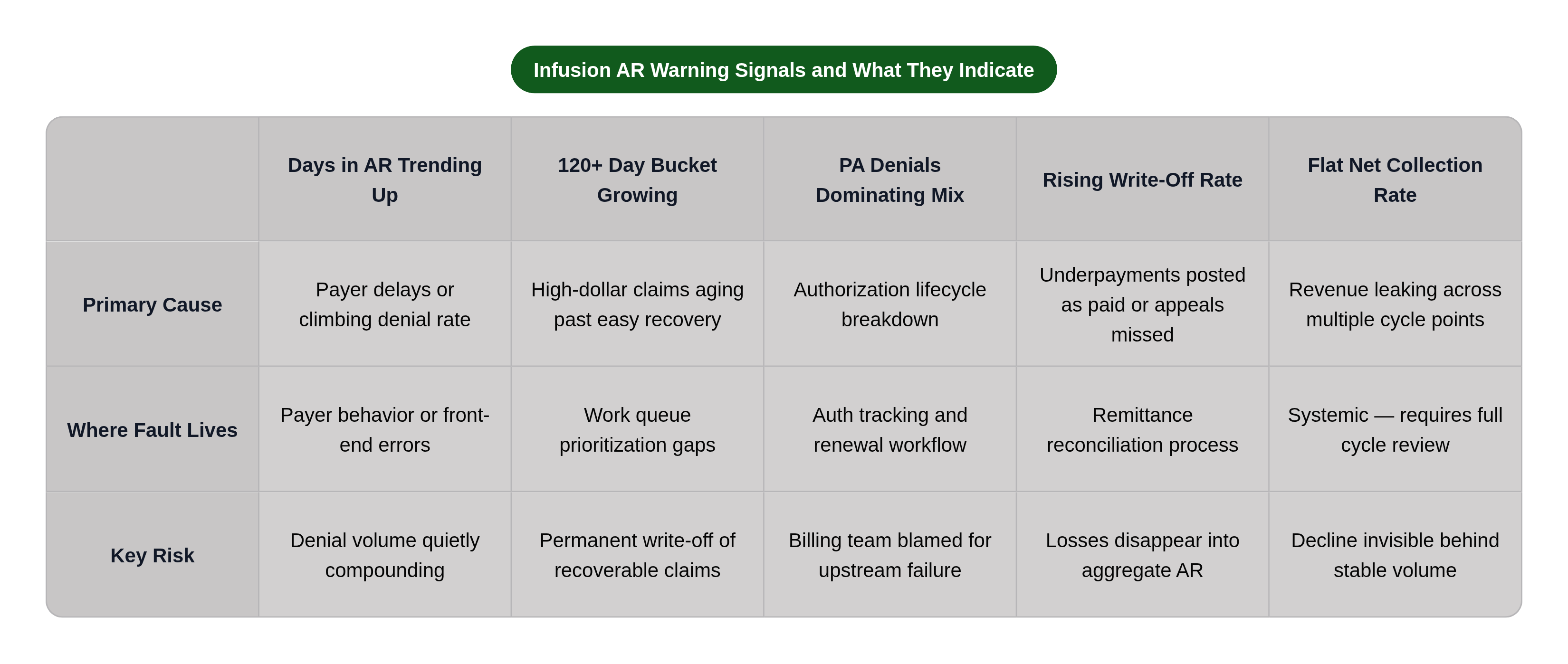
None of these signals are arbitrary. Each one maps directly back to the structural pressures already covered here.
Watch for days in AR trending upward without a matching rise in claim volume; that usually points to payer-driven delays or a climbing denial rate, not organic growth. Watch the 120+ day bucket as a share of total AR: if it's growing, high-dollar infusion claims are piling up past the point where recovery gets easy. Watch the denial rate against the 38% level reported for 2024, and even if the rate itself looks stable, check whether the dollar value of denied claims is climbing, since that's what happens when high-cost biologics start becoming the ones getting denied.
If PA-related denials make up a large share of the denial mix, the authorization lifecycle carries the underlying fault, not the billing team. A rising write-off rate can point to underpayments getting posted as paid without reconciliation, or denials aging past their appeal window unworked. A flat or declining net collection rate, even with stable patient volume, is the single clearest sign that revenue is leaking somewhere in the cycle.
Commercial denials rose 20.2% and Medicare Advantage denials rose 55.7% between 2022 and 2023, per AHA data. A practice whose own denial rate is tracking those trends without a matching improvement in recovery is losing ground in real dollars, even if the top-line revenue looks steady.
The real diagnostic question isn't how much money is sitting in AR. It's why it's there, and what the composition of that balance says about where the cycle is breaking down. A practice that can answer that by payer, by denial category, and by dollar bucket is managing its revenue cycle with intent. One that can't is simply reacting to whatever the mail brings that week.
What an infusion-aware AR operation looks like in practice
Infusion-aware AR starts with acknowledging that this specialty doesn't run on the same rules as the rest of the practice, and building the workflow around that instead of pretending otherwise.
That means authorization tracking that runs on a calendar, not a hope. It means unit-level J-code review built into the billing process itself, not caught later during an audit. It means payer-specific work queues instead of one generic denial pile, and a dedicated lane for authorization-driven denials since those don't resolve like a normal claims correction. It means line-level reconciliation against the actual contract every time a remittance posts, not a spot check every few months. And it means dollar-based escalation thresholds that are written down, so a high-dollar claim in the 120+ day bucket gets a peer-to-peer call instead of getting quietly written off because nobody flagged it.
None of this is complicated in concept. It's disciplined execution against a set of rules that infusion billing simply demands, given what's riding on every single claim. The practices getting this right tend to share a common trait: they treat authorization, J-codes, and payer patterns as the backbone of their AR strategy rather than an afterthought bolted onto standard billing practice. Ruby RCM, a revenue cycle management platform built specifically for infusion centers and buy-and-bill practices that pairs billing software with hands-on operators to manage prior authorizations, claims, denials, and AR, is one option built around exactly that kind of specialty-specific structure.
The margin for error here is thin, and the dollar amounts are large enough that sloppy AR management doesn't just cost a little. It costs a lot, consistently, quarter after quarter, until someone finally builds the operation this specialty actually requires.