Total Cost of In-House RCM for Infusion Centers
Infusion billing's true cost goes far beyond staff salaries, denials, and forgotten authorizations.

Most infusion practices measure RCM cost with a simple formula: salaries, plus benefits, plus whatever the billing software runs each month. That number is real, but it misses most of what infusion billing actually costs in-house. The real price shows up in denials nobody worked, prior auths that lapsed mid-cycle, underpayments that quietly turned into write-offs, and a knowledge gap that widens every time a payer rewrites its rules. I want to walk through each piece, then show how to put them on the same ledger, so a practice can compare in-house and outsourced RCM without kidding itself.
Infusion billing carries more risk than general medical billing, even when the paperwork looks similar at a glance. J-code unit conversion, NDC matching, quarterly ASP updates, 340B modifier discipline, administration sequencing: get any one of these wrong and you've lost cash, not just created a paperwork headache. A single encounter can generate charges running into the tens of thousands of dollars, so one billing mistake becomes a cash-flow event, not friction you shrug off. The infusion market sat around $8 billion in 2024 and is headed toward $11.3 billion by 2028. The dollars riding on getting this right keep climbing, and I don't see that slowing down.
What practices actually pay for in-house RCM staff — and what that number leaves out
Start with what shows up on the budget: salaries, benefits, payroll taxes, the cost of replacing someone who quits, ongoing training. That part's visible, and it's not small. But infusion billing needs a narrower skill set than general medical billing does. Staff have to know J-code billing cold, understand prior auth workflows for recurring biologics, and read how a given payer behaves the second it denies a claim. You can't rotate people in and out like temp workers and expect the same result.
Turnover in billing roles runs high. Every departure drains months of institutional memory: which payer flags which drug, which auth requirements change at every renewal, which claim edits keep tripping up submissions. Getting a new hire to infusion-level competency takes real time, and during that stretch, errors and missed deadlines pile up quietly. Nobody notices until the numbers force the issue.
Staffing costs keep climbing too. MGMA data shows practice spending on prior-auth staffing jumped 43% between 2019 and 2024, while reimbursement didn't keep pace. And the visible budget line almost always skips management overhead. Someone senior enough to audit the work, catch a systematic error before it repeats fifty times, and track payer policy changes has to exist somewhere. Skip that role, and quality slips without anyone noticing, until it gets expensive.
So even when a practice counts every staff cost correctly, that number still says nothing about what happens when the work is wrong, or just doesn't get done at all.
How denial rates translate into hard revenue loss for infusion practices
This has gotten worse over the past few years. Claim denials rose from 30% in 2022 to 38% in 2024, per Experian Health's 2025 State of Claims Report, and 41% of providers now report denial rates above 10%. That's the backdrop every infusion practice runs against, whether or not anyone's actually looked at the numbers.
Infusion denials cluster in predictable spots: PA failure, J-code unit errors, NDC mismatches, disputes over administration hierarchy, 340B modifier mistakes, gaps in documentation. Medical necessity denials rose 70% from 2024 to 2025, and outpatient coding denials rose 26% over the same window. Both sit squarely in infusion's wheelhouse.
A single denial costs more than the claim's face value. There's the drug already bought under buy-and-bill, the labor spent reworking the claim, and the time-value cost of money that should've landed weeks earlier. Hospitals lose roughly 5% of net revenue to denials on average; for an infusion center where the average charge per encounter runs into the thousands, that percentage turns into real money fast.
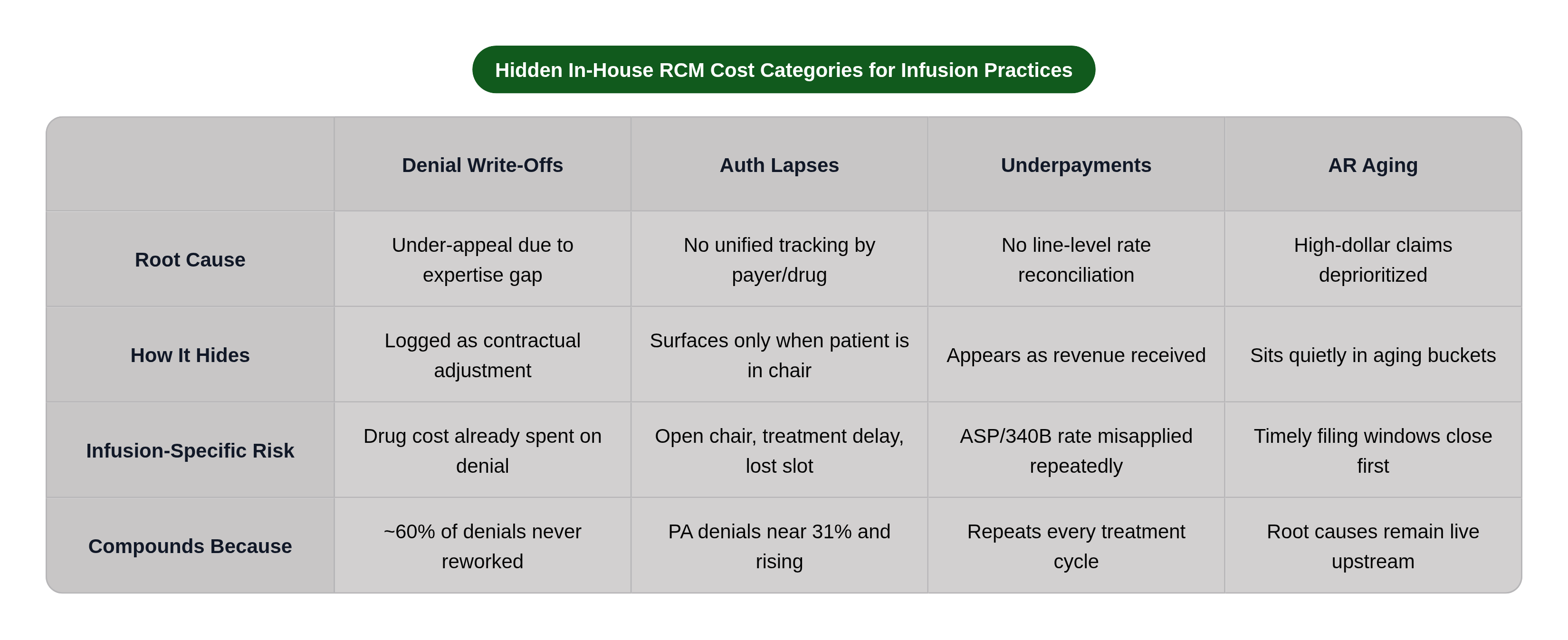
What actually decides the outcome is how much of what gets denied ever gets worked at all. Fifty-nine percent of in-house billers don't review Explanation of Benefits statements, and fifty-five percent have never appealed a denied claim. Roughly 60% of denied claims industry-wide never get reworked, period. They just become permanent write-offs.
Everyone fixates on the denial rate, but the recovery rate is what actually moves revenue. In-house teams without deep infusion expertise under-appeal, not because they're careless, but because they lack the payer-specific, coding-specific knowledge to build an appeal a payer will actually reverse. Denial patterns aren't random noise either; they're tied to a specific payer and a specific root cause. Lump them into one undifferentiated pile, and the signal you need to fix anything disappears. Without some kind of analytics layer to sort it, most in-house teams never even see the pattern forming.
The prior authorization burden specific to recurring infusion treatments
Prior auth for infusion isn't a hurdle you clear once and forget. It's ongoing: initial approval, renewal tracking, reauthorization every time a regimen shifts, and constant watching for a policy update that can void an approval mid-cycle without warning.
PA denials climbed to around 31% heading into 2026, driven largely by high-complexity specialty infusion and biologics, exactly where payers have the biggest financial incentive to scrutinize a claim. Physicians now handle an average of 43 authorization requests a week, according to AMA survey data, eating up roughly 12 staff hours a week that could go toward patients instead.
The fallout reaches well past administrative pain. In a 2022 SamaCare survey, 91% of providers said consistent PA delays or denials would change whether they prescribe a drug at all, given an equally effective alternative without the hassle. When a request gets denied, patients face a median treatment delay of 50 days. For an infusion practice, that's an open chair nobody can fill on short notice. AMA data also found 82% of physicians see patients abandon treatment outright because of authorization struggles with insurers. Lost revenue and a worse patient outcome end up tangled together in that one statistic, and it's worth sitting with for a second.
The gap in most in-house operations comes down to tracking. Managing PA for recurring infusion means keeping unified records by payer, by drug, by patient: approval timelines, renewal windows, appeal rates, peer-to-peer scheduling. Most in-house teams never build that infrastructure. Without it, a lapse doesn't surface until the patient's already in the chair, and a routine renewal turns into an emergency, a possible denial, and a delayed treatment, all at once.
Reform is coming. CMS's interoperability and prior authorization final rule will require most payers to decide within 72 hours for urgent requests and 7 days for standard ones, starting in 2027. Real, but still years off, so practices have to run on today's rules for now.
Buy-and-bill financial exposure when billing execution fails
Under buy-and-bill, the practice buys the drug, gives it to the patient, and only then bills the payer. The money's already gone before a single claim goes out the door. Drug and supply acquisition front-loads financial risk in a way most medical billing never has to deal with, since the money goes out before a single claim is submitted.
The math turns uncomfortable fast. When treatment margins are thin, a single unpaid claim can wipe out the margin from many successful ones before the practice breaks even on that denial. That's the leverage problem buy-and-bill creates: a handful of billing failures can erase a large pile of successful ones.
Cash flow makes it worse. Reimbursement can take weeks or months to land, and practices running tight cash cycles sometimes use one patient's delayed reimbursement to fund the next patient's drug purchase. When that cycle breaks, whether from a denial, a stuck appeal, or a lapsed auth, some practices end up reaching for short-term financing at a steep rate just to keep drug supply moving.
J-code accuracy sits at the center of all this. Medicare updates Part B drug reimbursement rates every quarter based on ASP, and CMS revises that schedule regularly. Miss an update, and every claim submitted against the old rate gets underpaid systematically, not randomly. The usual failure points: unit conversion mistakes, missing or wrong 11-digit NDC codes, and 340B modifier errors that cut both ways. Leave the JG modifier off a 340B drug, and you risk an audit; slap JG on a drug that isn't 340B, and you take a reimbursement cut for nothing.
Without a process built specifically to catch quarterly fee schedule changes and J-code discrepancies, in-house teams generate errors that repeat across billing cycles, quietly, until the pattern gets big enough for someone to finally notice.
Underpayments that in-house teams don't catch become permanent write-offs
An underpayment is sneakier than a denial. It shows up as a payment, so it looks like revenue that arrived rather than revenue left on the table. That's exactly why it gets undercounted cycle after cycle.
Underpayments in infusion come from a handful of recurring sources: the payer applies the wrong contractual rate, the ASP rate doesn't match the current schedule, fewer units get paid than were billed, or a 340B rate gets misapplied. Sometimes the drug cost gets paid at a pharmacy benefit rate instead of the medical benefit rate it should've fallen under.
Catching this takes line-level reconciliation against the contracted rate and the current ASP schedule, not just confirming a check showed up. Skip that step, and underpayments age quietly into "accepted payment," written off as a contractual adjustment, and the practice never even learns the gap existed.
One trend is making it worse: insurers and PBMs increasingly shift drug claims from the medical benefit to the pharmacy benefit, which changes the reimbursement rate and the billing pathway at the same time. That's a site-of-care and benefit-routing problem, and it's exactly the kind of shift that catches teams without deep infusion knowledge flat-footed.
Multiply a missed underpayment across a full panel of recurring biologic patients, and the exposure compounds fast. Every treatment cycle is another chance to either catch the gap or lose it again. The same expertise gap that produces J-code errors and missed appeals is what lets underpayments slide through unnoticed. Same root cause, just a different corner of the workflow.
The AR aging problem that compounds when high-dollar infusion claims go unworked
Infusion AR aging behaves differently from general medical AR aging. Claim values run far higher, the drug cost is already spent, and plenty of claims need complex, payer-specific appeal work just to move at all.
The longer a high-dollar infusion claim sits unworked, the worse the odds of ever recovering it. Timely filing windows close, the payer contact who knew the account gets reassigned, and documentation requirements tighten the longer a claim sits untouched. In-house teams with limited bandwidth tend to chase the highest-volume claims first, not the highest-dollar ones, so the claims worth the most money often sit the longest. It is a pattern that compounds quietly until the numbers become impossible to ignore.
Given that roughly 60% of denied claims never get reworked at all, in infusion that permanent write-off drags along the drug cost, the administration cost, and the staff hours already spent submitting the claim the first time.
Bulk AR aging is also a warning sign pointing upstream. If claims are piling up in aging buckets, the root causes, whether auth lapses, coding errors, or documentation gaps, are still live, not resolved. Most in-house RCM operations don't have reporting that breaks AR aging out by payer, denial reason, and claim age all at once. Without that view, prioritization defaults to whatever's loudest that week, not whatever's actually worth the most.
What the expertise gap actually costs — and why it widens as payer complexity grows
Every cost I've covered so far, missed appeals, auth lapses, J-code errors, underpayments, aging AR, traces back to one root: infusion billing expertise is specialized, it's scarce, and most in-house teams aren't built to the depth this work demands.
Payer complexity isn't sitting still either. Prior auth requirements keep expanding, coverage policies shift, site-of-care restrictions grow, and documentation expectations for high-cost therapies keep climbing. Whatever level of know-how was enough two years ago probably isn't enough now. A March 2024 MGMA poll of 235 medical-group leaders found 60% reporting higher denial rates than the same period in 2023, with only 11% seeing any improvement. The trend runs against any practice not actively investing in this knowledge.
Real depth here means three things at once. Drug-level knowledge: which biologics need which auth pathway, and how NDC-to-J-code mapping shifts across payers. Payer-specific knowledge: denial patterns, and which appeal approaches actually land. Regulatory fluency: quarterly ASP updates, 340B program rules, CMS coding edit logic. Automation only covers part of this. Rules engines handle the structured, repeatable stuff fine, but the judgment calls in a complex denial, a peer-to-peer call, or a payer escalation still need a person who actually gets infusion's specific context.
That gap creates a visibility problem on top of everything else. A practice running in-house RCM without this depth doesn't know what it's missing, and the errors and missed recoveries stay invisible right up until an audit or a cash-flow crisis forces someone to finally look.
How to build an honest total-cost comparison between in-house and specialized RCM
A fair comparison puts the same categories on both sides of the ledger. Comparing in-house payroll against an outsourced fee, without accounting for everything that fee actually buys, gives you a number rigged to flatter whichever side you already picked.
The true in-house cost stacks up like this: staff salary and benefits, plus turnover and retraining, plus management overhead, plus the revenue lost to denials nobody worked, underpayments nobody caught, auth lapses nobody prevented, and AR that aged past the point of recovery.
Here's the part you don't have to guess at: a practice can estimate the revenue-impact side from data it already has. Take the current denial rate, multiply by average claim value, multiply by the share of denials that actually get reworked versus written off. Layer in the underpayment rate found through line-level reconciliation, the dollar impact of auth lapses over the past year, and the AR sitting past 90 or 120 days. Put a real number next to each of those, and the in-house total almost always lands higher than the budget line ever suggested.
That gap has less to do with the people doing the work than with what happens when a highly specialized billing discipline gets run by a team that was never sized, staffed, or trained for its full weight. Platforms built specifically for this work, such as Ruby RCM, a revenue cycle management tool purpose-built for infusion centers that pairs software with hands-on operators to handle benefits verification, prior auth, claims, denials, and AR, exist precisely because general billing infrastructure cannot close that gap on its own.