Infusion RCM Vendor Transition Playbook for Mid-Size Practices
How to navigate vendor switches without disrupting high-stakes infusion billing cycles.

Many mid-size infusion practices are mid-integration following a record wave of platform deals, including 11 announced in 2024 alone, more than 2022 and 2023 combined. That gap is where the money disappears. Infusion therapy M&A hit an all-time high in 2025 after a slow 2023, and platform creation alone saw 11 announced deals in 2024, more than 2022 and 2023 combined https://www.healthfmv.com/post/infusion-therapy-valuation-guide. A lot of these practices didn't choose their timing at all; they inherited it from a merger calendar. An authorization expiring inside the transition window doesn't pause itself out of courtesy. If the outgoing vendor doesn't renew it before handoff, and the incoming vendor doesn't flag it for same-day renewal, it just lapses.
Infusion billing has no pause button. Monthly and quarterly treatment cycles keep running on their own clock no matter who's submitting the claims that week, and high-cost drug claims are always somewhere mid-flight when a vendor switch gets announced. That's the part practices underestimate: there's no clean week to make the swap. The claims keep coming regardless of what's happening on the vendor side.
The exposure is worse here than in most other parts of healthcare because the dollars are so concentrated. Drug costs make up 60 to 80% of revenue in buy-and-bill infusion settings https://qualigenix.com/oncology-revenue-cycle-management-2026/. A vendor transition that disrupts even a few weeks of clean claim submission is a cash-flow event at that margin. It's a cash-flow event, and practices that treat it like paperwork find that out the hard way.
Evaluation criteria for the incoming vendor before signing any transition agreement
Demos are where vendors look best and reveal the least. Any platform can walk through a clean claim submission with zero hitches and still have no real answer for step therapy navigation, J-code unit reconciliation, payer-specific auth quirks, or quarterly ASP rate management. Those are the exact spots where infusion billing actually breaks, and a sales pitch is built to steer around them, not surface them. Evaluating a vendor on the demo alone is a mistake almost every practice makes once.
Start the real evaluation at J-code billing. The vendor needs to show, concretely, that it can reconcile NDC to J-code, catch biosimilar substitution conflicts before they become denials, and track ASP rate updates that land every January, April, July, and October.
Medicare Advantage needs its own line of questioning, since denial rates there run roughly double traditional Medicare, with oncology/infusion MA denial rates reaching 12.7% in 2026. Denial rates in MA run roughly double what traditional Medicare sees, and oncology and infusion specifically hit a 12.7% MA denial rate in 2026 https://www.revenuesynergy.com/resources/medicare-advantage-denial-report-2026.html. Any vendor that treats MA the same as traditional Medicare in its workflow simply hasn't built for this specialty, and that should disqualify them on the spot.
Step therapy is where vendors fumble most often, so press hard there too. Aetna splits its process between CVS Caremark and Aetna's own direct channel, and a vendor needs documented workflows for both, plus fluency in the five recognized step therapy exception grounds. The clock runs differently depending on payer type: 60 days for Medicare Advantage, 180 days for commercial plans https://muni.health/blog/aetna-step-therapy-denial-appeal-2026. A vendor that treats those two deadlines as interchangeable will eventually miss one, and when that happens it's rarely a small claim.
Ask direct questions. Expect direct answers back. What's the clean claim rate on first submission for infusion clients specifically, not blended across every specialty the vendor serves? How far ahead does auth renewal tracking flag an authorization about to expire? What's the actual step-by-step process when an NDC doesn't match the authorized biosimilar? A vendor that answers in generic, blended denial rates hasn't done this work at the level infusion billing demands. Same goes for a vendor with no infusion-specific references, or an onboarding timeline that never explains how active authorizations get transferred.
Conducting the pre-transition revenue cycle audit before anything moves
Nothing moves, not one claim, not one authorization, until three separate audits are done. Skipping this step costs the practice money, and the loss stays unnoticed until months later, when the numbers don't add up and nobody can trace why.
Start with AR aging. Every open claim gets logged by payer, aging bucket, and dollar value, because the incoming vendor can't chase what it can't see, and the outgoing vendor has zero incentive to keep working claims once its contract is ending anyway. Next comes the prior authorization inventory: every active auth pulled and documented by drug name, authorized NDC, remaining visit count, expiration date, and payer. Anything expiring within 60 to 90 days of go-live gets flagged immediately, since that window roughly matches the length of a typical transition, and anything inside it is at real risk of falling through the gap between vendors.
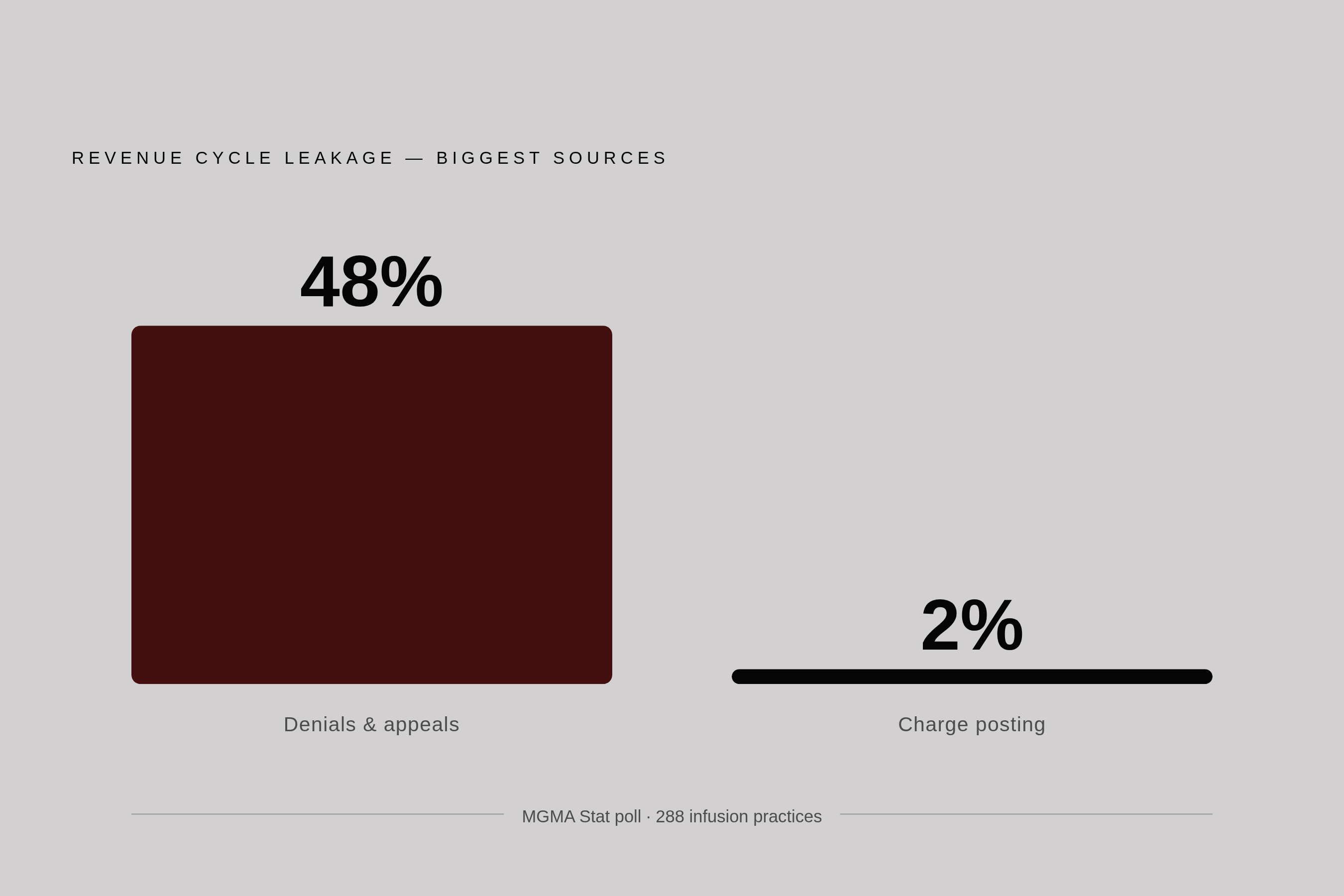
Then there's the denial backlog, and it deserves more attention than most practices give it. Categorize unworked denials by CARC code and dollar value, because in most practices the bulk of denied AR concentrates in a small handful of those codes. Find out which codes the outgoing vendor let pile up, and make sure the incoming vendor walks in with an actual plan for each one." A MGMA Stat poll of 288 practices found denials and appeals account for 48% of the biggest revenue cycle leaks, compared to just 2% citing charge posting https://www.billingparadise.com/blog/rcm-vendor-evaluation-guide/. That gap alone settles where the audit's attention belongs: the denial backlog left behind by an outgoing vendor is, almost without exception, the single largest financial exposure in the whole transition.
For every high-value open claim, check that the chart documentation actually connects the diagnosis, the patient's response to prior treatment, and the relevant clinical guideline to the drug administered. If a denial lands after the transition, and some will, the new vendor needs that paper trail ready to go, not something it has to build from scratch under deadline. Set a financial baseline covering current-period denial impact, an annual projection, and recoverable AR by aging bucket. That baseline becomes the benchmark the new vendor gets measured against in months one through six.
Protecting active prior authorizations across the handoff window
Prior authorizations are the most fragile piece of this whole process, and they fail in a specific, predictable way. The moment a transition gets announced, the outgoing vendor's attention to renewal timelines starts to slip, because there's no longer a long-term incentive to stay sharp on it. The incoming vendor, meanwhile, can't renew an authorization it hasn't even been credentialed to see yet. The gap in the middle is where auths quietly die, and it happens more often than practices expect.
The scale of exposure is hard to overstate. Prior auth denial rates overall climbed to around 31% in 2026, concentrated heavily in high-complexity specialty infusion and biologics, which is exactly the category most exposed during a transition window https://rcmworkshop.com/insights/blogs/from-chair-time-to-denial-prior-authorization-errors-collapse-infusion-billing/.
On the day the transition gets announced, generate a full snapshot of every active authorization: remaining visits, expiration dates, dollar value at risk. That document belongs to the practice, not to either vendor, and it stays that way through the entire handoff. Triage by how close each one is to expiring. Anything inside the 60-to-90-day window has to get renewed by the outgoing vendor before handoff, or flagged for same-day renewal by the incoming vendor.
Keep at least one experienced person, internal staff or someone from the incoming vendor, actively watching the auth queue for the entire overlap period. Most authorization expiration denials trace back to one specific failure: somebody stopped watching the queue. Confirm the incoming vendor has real portal access and full credentialing with every relevant payer before the overlap period closes. Credentialing delays sound like paperwork friction, but they're a common, consistently underestimated cause of auth gaps during transition.
Match recurring treatment schedules against remaining auth windows too, and don't skip this one. For a patient on a monthly or quarterly infusion cycle, confirm the visits left on the authorization cover the next scheduled appointment. If they don't, reschedule the encounter rather than run the auth out and hope it clears in time. Given that 99% of Medicare Advantage plans require prior authorization for physician-administered drugs under the medical benefit, there's essentially no MA drug claim that survives an auth gap.
Sequencing the claim submission handoff to avoid mid-cycle revenue gaps
The incoming vendor doesn't touch live claims until it has proven, with real claims from this specific practice, that it can submit clean ones for this payer mix and this drug portfolio. A parallel-run period, where a defined slice of claims runs through the new vendor while the rest stays with the old one, beats a hard cutover by a wide margin. Any vendor pushing for a full flip on day one should get questioned hard on why, because that's the vendor optimizing for its own onboarding timeline, not the practice's cash flow.
Sequence the cutover by claim type, not by a date on the calendar. Low-complexity claims go first: straightforward administration codes, no prior auth required, payer relationships already well established. High-value buy-and-bill claims for biologics like Remicade, Stelara, Ocrevus, Humira biosimilars, and oncology drugs move last, only after the incoming vendor has already proven it handles the lower-risk claims cleanly. Anything sitting on an active denial or a pending appeal doesn't transfer until that appeal resolves, unless it moves with full documentation attached to it.
Timing has to account for ASP updates too, since those land every January, April, July, and October. A cutover that straddles one of those dates, with the incoming vendor still running old fee schedules, creates underpayment that's systematic and quiet enough to go unnoticed for a full billing cycle.
On clean claim rates, the incoming vendor should target 90% as a floor during ramp-up, climbing to 95% or higher once fully operational. Those numbers don't belong in a sales deck to nod along to in a meeting. They belong in the contract, with a defined timeline for hitting them and real consequences spelled out if the vendor doesn't.
Managing the AR backlog the outgoing vendor leaves behind
Once notice is given, the outgoing vendor's attention shifts fast, and it shifts away from exactly the claims a practice most needs followed up on. Claims in late-stage follow-up, appeals still in progress, small-dollar denials that take real effort to chase: these get deprioritized first, and they're precisely the ones that quietly pile into write-offs nobody planned for.
What gets left behind has also gotten bigger. Denied inpatient claim amounts rose 12% and outpatient denials rose 14% from 2024 to 2025, and denials tied to medical necessity jumped 70% in dollar value, now averaging $450 per denial https://www.billingparadise.com/blog/rcm-vendor-evaluation-guide/. Whatever backlog a practice inherits is probably bigger in real dollars than historical patterns would suggest, so budget the cleanup with that in mind, not with last year's numbers.
Segment inherited AR into three buckets and work them in order. Recent denials with clean documentation and clear appeal grounds are high-dollar and highly recoverable, so they go first. Claims denied for medical necessity or step therapy need a clinically literate billing specialist who can pull the chart and build the appeal correctly. Aging small-dollar claims get checked against the filing deadline before anyone spends labor on them, and write-offs happen only after that check, never by default just because a claim looks old.
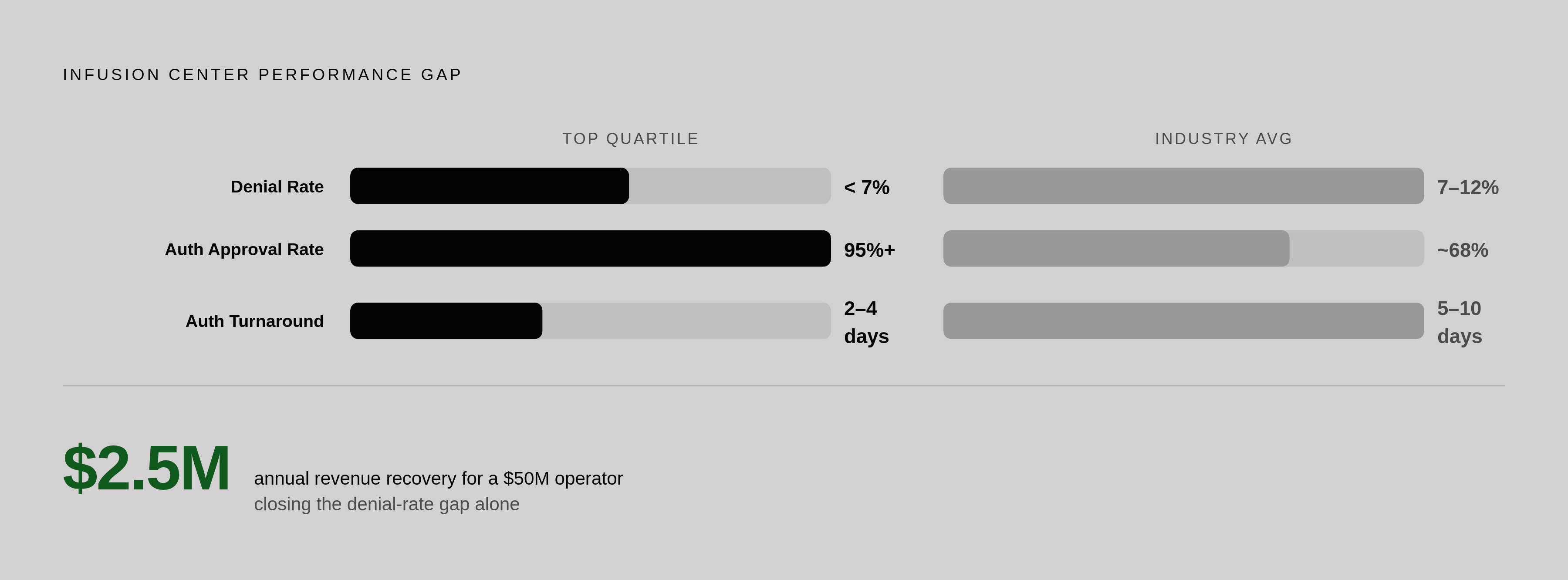
The payoff for doing this well is concrete. Top-quartile infusion providers keep denial rates under 7%, while the mid-market average runs between 7 and 12% https://solisrx.com/services/revenue-cycle-analytics. For a $50 million operator, closing that gap is worth up to $2.5 million a year https://solisrx.com/services/revenue-cycle-analytics. AR backlog recovery isn't cleanup work, it's a revenue project with a return that appears in the books at the end of the quarter.
Establishing the operating model and reporting structure with the incoming vendor in the first 90 days
Whatever pattern gets set in the first 90 days tends to stick. Denial rate trends, AR aging curves, clean claim rates: these establish a baseline early, and if something's broken in that window and nobody catches it, the problem compounds quietly for months before it becomes visible as a real number.
Reporting needs a fixed cadence, not an ad hoc check-in whenever someone remembers to ask. Weekly, expect clean claim rate by payer, new denials broken out by CARC code, and any prior auth expirations coming due within 30 days. Monthly, look for AR aging by bucket and payer, denial rate trend against the prior period, underpayment variance between expected and actual reimbursement, and appeal win rate. Quarterly, the vendor should bring payer performance benchmarks, the margin impact of ASP rate updates on buy-and-bill drugs, and prior auth denial rates broken out by payer.
There's a simple gut check for whether the operating model actually works: practice leadership should be reviewing outcomes, not managing workflows by hand. If anyone on staff is still spending real time chasing claim status or sorting denial queues manually three months in, the model is broken, full stop. The vendor's system should surface exceptions on its own instead of handing the practice busywork dressed up as a report.
At the 60-day mark, the vendor owes the practice a denial root-cause analysis broken out by payer, not lumped into a single blended number. Denial patterns are payer-specific and root-cause-specific by nature, and mixing them together buries the exact signal that would prevent the denial from recurring. That defeats the entire point of tracking denials in the first place, and it's the fastest way to land back in the same billing mess six months after the transition was supposed to fix it. High-performing infusion centers run authorization approval rates of 95% or higher, with turnaround times of 2 to 4 business days against an industry standard of 5 to 10 https://infusionbillingservices.com/blogs/infusion-revenue-cycle-management-strategy/. That gap, between what a well-run operation hits and what the industry treats as normal, is the entire argument for holding a new vendor to the tighter number from day one, which is the standard Ruby RCM, a revenue cycle management platform built exclusively for infusion centers and buy-and-bill practices that pairs billing software with hands-on operators, is designed to meet from the start. According to KFF, 99% of Medicare Advantage Plans require prior authorization for physician-administered drugs under medical benefits. In 2024, UnitedHealth Group denied 12.8% of prior authorization requests among Medicare Advantage insurers https://www.careroute.ai/blog/prior-authorization-denied. Among Medicare Advantage insurers in 2024, Aetna denied 11.9% of prior authorization requests https://www.careroute.ai/blog/prior-authorization-denied. Among Medicare Advantage insurers in 2024, Centene denied 12.3% of prior authorization requests https://www.careroute.ai/blog/prior-authorization-denied. Market-size estimates for the global RCM industry range from roughly 60–85 billion dollars for standalone RCM software https://en.wikipedia.org/wiki/Revenue_cycle_management. Most forecasts project continued 11–13% compound annual growth rate for the RCM industry through the early 2030s https://en.wikipedia.org/wiki/Revenue_cycle_management. U.S. healthcare organizations investing in multiple automation tools such as AI for administrative tasks jumped from 30% in 2025 to 50% in 2026 https://acuservecorp.com/rcm-partnership-infusion-centers/. An oncology infusion center had a denial rate of 30% before implementing billing improvements for CPT code 96402 https://infusionbillingservices.com/blogs/infusion-revenue-cycle-management-strategy/.