Buy-and-Bill Model Explained for Infusion Providers
Practices buy drugs upfront and collect reimbursement later, creating cash flow and margin risk.

Buy-and-bill is the model where an infusion practice buys a drug, gives it to the patient, then bills the payer and hopes to get back what it already spent. The whole thing hinges on a gap: the practice pays acquisition cost the day it buys the drug, and it only gets that money back if the claim gets approved and paid at the rate it expected. Everything below is about what happens inside that gap, and why so many practices get it wrong.
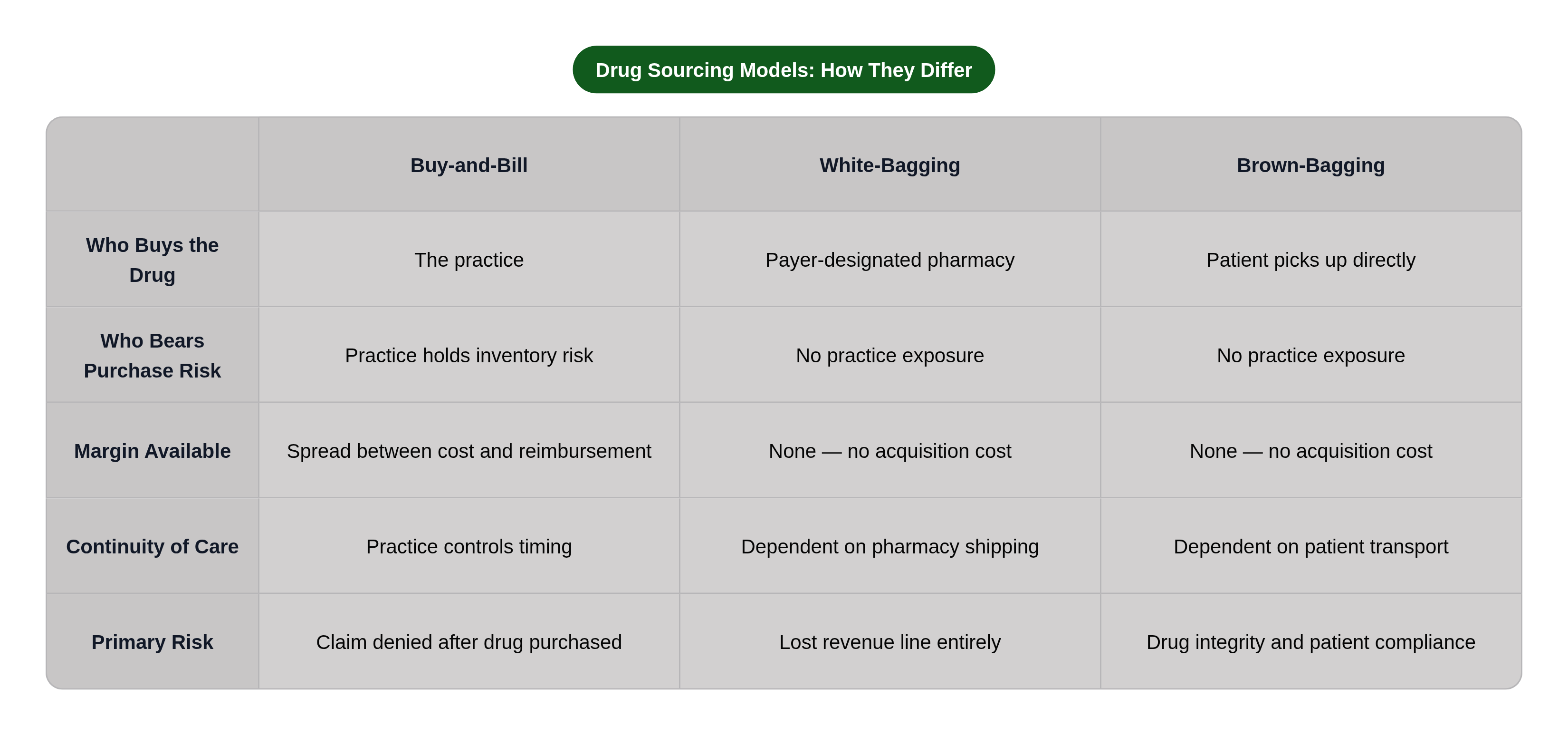
The margin in buy-and-bill, the spread between what a practice pays a distributor and what a payer reimburses, is the entire reason the model exists. It lets an infusion center control its own drug sourcing, keep continuity of care going, and skip waiting on an outside pharmacy to ship the right vial at the right time. Compare that to white-bagging, where a payer-designated pharmacy ships straight to the provider, or brown-bagging, where the patient picks up the drug and brings it in themselves. Under either of those, the practice never buys the drug. Buy-and-bill is the model where the practice takes on the purchase, and with it, the risk.
I've watched this play out in independent infusion centers, hospital outpatient departments, and specialty practices across rheumatology, oncology, neurology, and GI. And the market underneath all of it is expanding fast: U.S. home and outpatient infusion therapy was valued at $21.52 billion in 2025, with projections putting it at $49.83 billion by 2034. That growth is exactly why payers and regulators keep tightening the screws on how this model gets reimbursed.
How Medicare prices buy-and-bill drugs and why the formula creates a margin floor, not a guarantee
Medicare Part B pays 106% of a drug's Average Sales Price, or ASP. That 6% cushion above cost is supposed to cover acquisition, storage, handling, and the waste that comes from drawing doses out of vials. Sounds simple on paper. In practice, it's a moving target.
ASP rates update every quarter. So the margin a practice modeled when it signed a distributor contract can shrink or grow before the claim for that exact drug even lands on a payer's desk. A practice planning cash flow around last quarter's rate is planning around a number that might not exist anymore.
There's a bigger shift coming, too. Starting in 2028, drugs selected under Medicare's Drug Price Negotiation program move off ASP-based pricing entirely and onto Maximum Fair Price, reimbursed at 106% of MFP instead. That's a structural change, and it's going to compress margins on whichever biologics get selected. Practices that build financial models assuming ASP-based reimbursement forever are the ones that get caught flat when 2028 arrives.
Commercial payers don't follow any of this, of course. Their contracted rates vary by plan, by payer, by therapy, so the exact same drug can carry a completely different margin depending on which insurer is footing the bill. A practice with a diverse payer mix is really running several different margin structures on the same shelf of inventory, whether it realizes that or not.
One of the clearest ways practices protect themselves here is group purchasing organization membership. GPOs let infusion centers buy specialty drugs below open-market price, often with rebates layered on for high-cost or newly launched biologics. That's one of the few real levers a practice has to widen its margin floor before a single claim goes out the door.
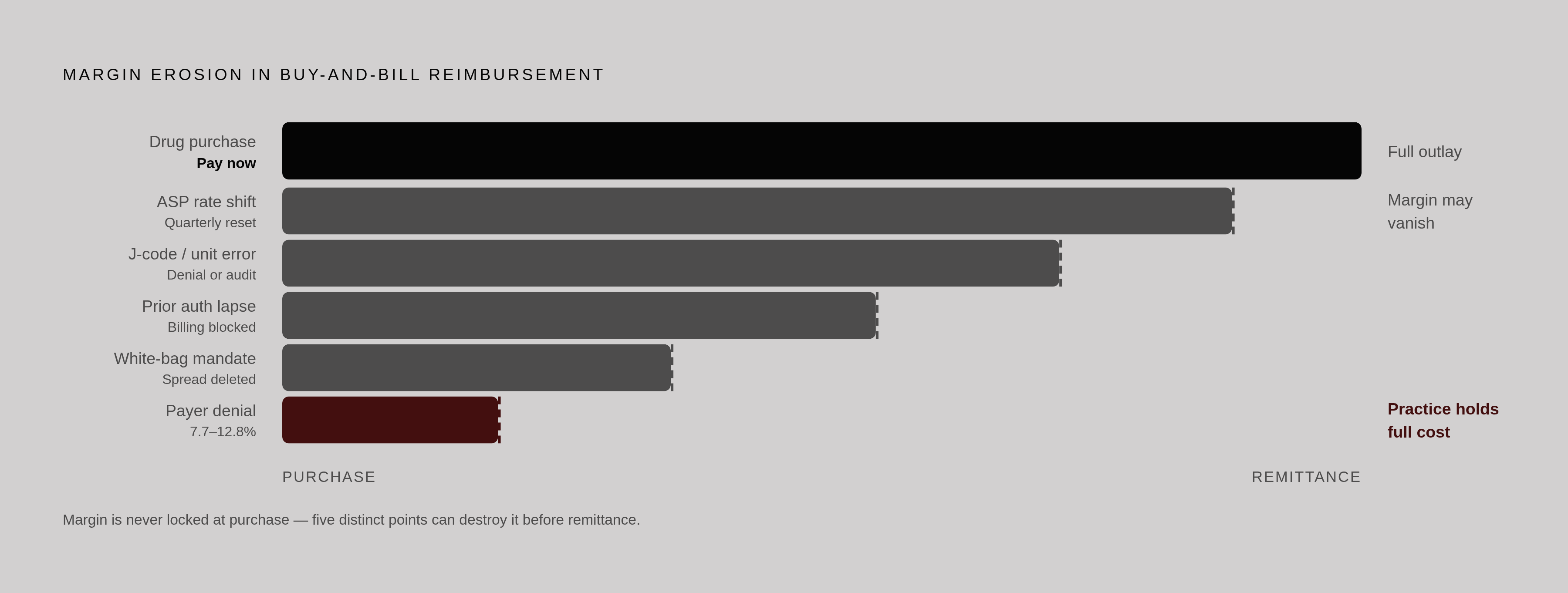
Here's the point worth sitting with: margin isn't locked in when the drug gets purchased. It's only confirmed once the payer actually pays at the expected rate, and that depends on coverage rules, prior authorization, and whether someone coded the claim right in the first place.
Why biologics dominate the financial stakes in buy-and-bill
Biologics are where nearly all the financial exposure in this model concentrates. Biologics made up 78.9% of total Medicare Part B drug spending, growing at 11.5% a year between 2008 and 2021. Specialty drugs overall accounted for more than 49% of total prescription drug spending as of 2020. The infusion channel is carrying a disproportionate share of the most expensive medicine in the entire healthcare system, full stop.
What does that mean on a Tuesday morning at an infusion center? A single encounter for a high-cost biologic can involve acquisition costs in the tens of thousands of dollars, and the practice has already paid that before the payer says a word. The drug cost is known and immediate. The reimbursement is uncertain and slow. That asymmetry is the whole ballgame; it means every step between the purchase order and the remittance advice is a risk decision, whether anyone treats it that way or not.
Oncology, rheumatology, neurology, and rare disease therapies carry the heaviest exposure, and each behaves differently. Payers scrutinize oncology claims one way and rheumatology infusions another. A practice running multiple therapeutic lines is juggling several distinct risk profiles under one roof, even if the front desk treats them all the same.
J-code billing as the mechanism that converts drug administration into revenue — and where it breaks
J-codes turn a drug administered in a clinical setting into a billable claim. The HCPCS Level II codes running from J0120 through J9999 cover chemotherapy drugs, immunoglobulins, and biologics. Get them right, you get paid. Get them wrong, you get flagged.
Most errors start at unit calculation. Each J-code is defined against a specific unit of measure, like per 10mg or per 100mg, and the math is easier to botch than people expect. Take J9035, the code for bevacizumab, sold under the brand name Avastin. It's billed per 10mg. A 400mg dose means 40 billed units. Get that number wrong and the claim gets denied outright, or worse, flagged for audit.
J-codes never stand alone, either. Every infusion claim needs a paired CPT administration code, like 96413 for the first hour of infusion or 96415 for each additional hour. Submit a J-code without the right CPT pairing and you'll get a partial payout at best, a flat denial at worst.
Then there's vial wastage. If a practice uses part of a vial and tosses the rest, that unused portion needs documentation to justify the units billed. Skip the paperwork and payers will deny or claw back the waste portion. No exceptions, no appeals that go anywhere.
CMS revises these codes every quarter, and an outdated code delays a claim or trips an audit flag. A practice without a structured process for catching those updates is carrying that risk without knowing it's there. Payer scrutiny on all of this intensified through 2024 into 2026, with audits specifically targeting dosage accuracy, wastage documentation, and medical necessity on high-cost biologics.
Here's what makes J-code errors genuinely dangerous: they don't happen once. They repeat, encounter after encounter, for every patient on that same drug. A single gap in the coding workflow doesn't cost one claim, it costs a pattern that quietly compounds across months before anyone notices the practice has been underpaid the whole time.
Prior authorization for recurring infusion treatments and the cost of a lapse
Most commercial payers and Medicare Advantage plans require prior authorization before a high-cost biologic gets administered, not after. That timing matters more in infusion than almost anywhere else in medicine, because these treatments repeat on a schedule, and the schedule doesn't pause for a renewal to catch up.
Authorizations expire. If a patient's next infusion date lands after the current authorization runs out and before the renewal comes through, the practice is stuck choosing between delaying treatment or administering a drug it might not get to bill for. Neither option is good, and I've seen both play out badly.
The administrative load behind this is heavy, too. Providers spend nearly two business days a week on authorization tasks alone. For an infusion practice managing a roster of recurring patients across multiple payers, that authorization calendar is a live operational risk, not a paperwork chore. KFF's 2024 analysis of Medicare Advantage found plans denied 7.7% of 53 million prior authorization requests, with some major insurers denying as much as 12.8%. Apply even a slice of that rate to biologic infusions and you've got a real cash-flow problem, given that a denied claim leaves the practice holding a drug cost with zero reimbursement.
These errors don't scatter randomly, either. They cluster by payer, by therapy type, and wherever the pre-treatment workflow has a gap. Practices that treat authorization as something the billing team handles after the fact, rather than something scheduling nails down before the appointment, are the ones eating preventable denials month after month.
Good authorization management looks like proactive renewal tracking tied directly to the infusion calendar, payer-specific documentation gathered before the patient walks in, and an escalation path for when an approval is running late.
White-bagging mandates and what they do to the buy-and-bill margin
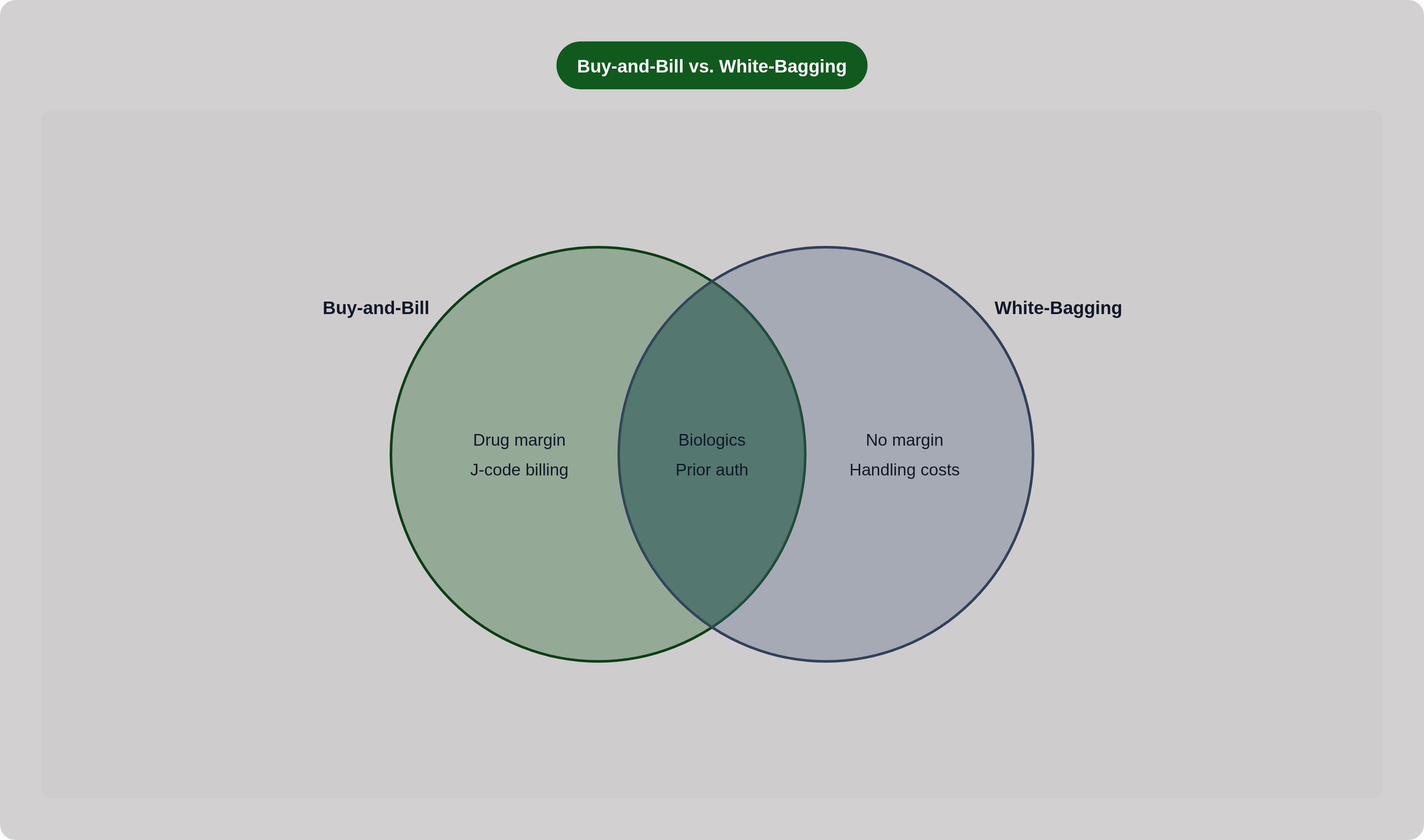
White-bagging is when a payer or PBM requires a payer-designated specialty pharmacy to dispense the drug and ship it to the provider, who administers it but never buys it. That last part is everything. It deletes the margin entirely, since no acquisition cost means no spread to capture.
For a lot of specialty practices, drug administration revenue under buy-and-bill can be half or more of total practice income. A white-bagging mandate removes that entire revenue line, in one move.
And this isn't something practices are choosing for themselves. 81% of practices acquiring drugs through white-bagging did so because a payer contract forced it, not because it made operational sense on their end. On top of losing the margin, practices absorb real handling costs, ranging from $13,000 to $67,500, tied to managing and disposing of unusable product shipped in from an outside pharmacy.
Payers keep pushing these mandates further into oncology, rheumatology, and rare disease, which happen to be the exact therapeutic areas most infusion centers depend on for revenue. States are pushing back: 12 had passed legislation restricting mandatory white-bagging as of 2025, backed by advocacy from groups like the AMA, ASCO, and ASHP. Even so, the legal landscape varies enormously depending on where a practice operates, so a mandate that's illegal in one state runs fine two states over.
The practical takeaway: payer mix analysis has to include white-bagging exposure, broken down by plan and by drug. A practice that hasn't mapped this out is making purchasing decisions blind, without knowing which slice of its expected revenue will actually show up.
How denial patterns in infusion billing differ from general medical billing
Denials are climbing across healthcare broadly. In 2022, 30% of providers reported elevated denial rates. By 2024 that had grown to 38%, and by 2025, 41% of providers reported denial rates above 10%. Medicare Advantage denials specifically rose 55.7% between 2022 and 2023. The plan type covering a growing share of infusion patients is also the plan type denying claims the most aggressively, which is its own kind of bad luck.
Infusion denials don't scale like general billing denials do. When a denied claim includes a high-cost biologic, the dollar value at stake is orders of magnitude larger than a denied claim for a routine office visit, and treating them the same in a report is a category error.
Most elevated denial rates in infusion trace back to a handful of causes: mismatches between the prior authorization on file and the actual treatment given, drug-to-diagnosis inconsistencies, eligibility that lapsed between visits, timely filing breakdowns on secondary claims. Payer behavior varies, too. Aetna, for instance, restricts coverage to a defined drug list for non-hospital and home care settings. A practice that hasn't checked that list before scheduling a patient is administering a drug that was never going to be covered in that setting, and nobody finds out until the denial lands.
By the time a denial shows up in accounts receivable, the decision that caused it happened days or weeks earlier, back at scheduling or authorization. Denial management in infusion is really a front-end process problem that only becomes visible on the back end. Lumping all these denials into one generic bucket hides exactly the signal a practice needs, the one that tells you whether the fix belongs in scheduling, authorization, coding, or claims submission.
Accounts receivable aging in buy-and-bill practices and why high-dollar claims need active prioritization
AR in an infusion practice doesn't age evenly. A small number of high-dollar biologic claims make up a disproportionate share of everything sitting outstanding, so treating every claim the same in a collections queue misses where the real money actually is.
There's a real capital cost buried in this, too. If a practice bought a biologic weeks ago and hasn't gotten paid yet, it's carrying that cost as working capital, cash tied up that it could be using somewhere else. The longer that claim sits in AR, the more the cash-flow strain compounds, and it doesn't compound gently.
Underpayments make it worse. Sometimes a payer pays a claim, just not at the contracted rate, and without line-level remittance reconciliation, that shortfall gets quietly accepted as final. It becomes a permanent write-off that nobody ever flagged.
Claims that age past 90 days without resolution see their recovery rates drop off hard. In a model where individual claims can run into the tens of thousands of dollars, crossing that 90-day line isn't a routine collections milestone. It's a material financial event. Prioritization has to run on dollar value, days outstanding, payer identity, and whether the denial is administrative and fixable or clinical and requires an appeal. A first-in-first-out queue misses all of that nuance completely.
Secondary claims are a common leak point, too. Timely filing windows for secondary payers run shorter and leave less room for error, so coordination-of-benefits mistakes on a high-dollar infusion claim are only recoverable if someone catches them inside that narrow window.
What buy-and-bill financial risk management requires from an RCM operation
Risk in buy-and-bill doesn't live at the billing desk. It's spread across scheduling, authorization, drug purchasing, coding, claims submission, and remittance review, and it only shows up at billing as the final symptom of something that went wrong much earlier in the chain.
General-purpose revenue cycle platforms weren't built for this. They don't have authorization tracking logic tuned to recurring infusion schedules. They don't enforce J-code unit discipline. They don't do line-level remittance reconciliation on drug underpayments, and they don't surface payer-specific denial patterns the way infusion billing actually demands.
The real operating question is whether authorization gets treated as a pre-treatment function or a billing function. In infusion, the revenue cycle has to start at scheduling, because by the time a claim goes out the door, most of the risk has already been decided one way or the other.
Automation catches pattern errors well. It can't replace human judgment on payer-specific coverage shifts, formulary changes, and the authorization edge cases that never fit a clean rule. What infusion-specialized revenue cycle management actually looks like, in practice: benefits verification before every treatment cycle, prior auth tracking tied directly to the infusion calendar, J-code and unit accuracy built into the coding workflow itself, line-level remittance reconciliation on every payment, and denial root-cause reporting broken out by payer and therapy type.
For a practice sizing up its own RCM setup, the more useful question is where in the workflow the revenue is actually slipping away, and how far upstream that leak can be caught, rather than simply asking what the denial rate is. Ruby RCM, a revenue cycle management platform built exclusively for infusion centers and buy-and-bill practices that pairs billing software with hands-on operators to handle benefits verification, prior auth, claims, denials, and AR, is one example of what that infusion-specific focus looks like in practice. That answer tells you whether you're looking at a problem you can recover from, or one you could have prevented in the first place.