IV Push CPT Codes and Billing Rules
Timing and documentation rules separate billable IV push codes from claim denials.
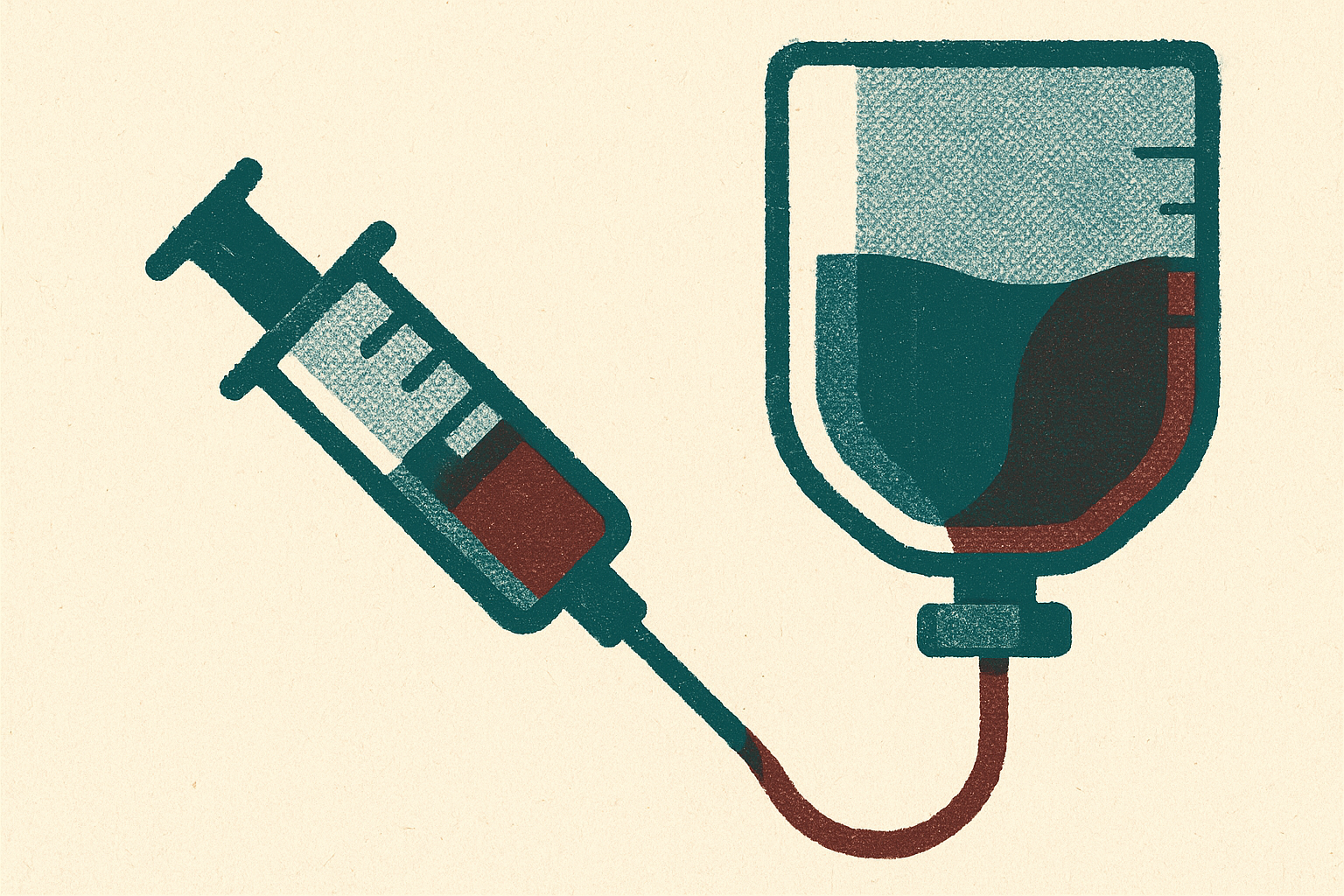
An IV push is a clinician driving a drug through a syringe directly into an existing IV line or saline lock, delivering a controlled bolus. CMS defines the service as administration completed in 15 minutes or less, or any administration without documented start and stop times consistent with infusion.
Sixteen minutes changes everything. With documented infusion timing, the claim moves into an entirely different CPT family: 96365 and 96366 for non-chemo infusions, 96413 and 96415 for chemo. That threshold is a hard line in CMS guidance, not something a clinician or coder gets to interpret case by case.
The audit finding I see most often is a mismatch between actual administration time and the code on the claim. Billing 96365 when the service finished in under 15 minutes is a misclassification, and so is billing a push code when the drug ran 20 minutes with documented infusion timing. Both create exposure in opposite directions, and both trace back to the same root: the medication administration record is missing a clear stop time.
When the MAR lacks a stop time, the claim defaults to push billing even if clinical intent was infusion. Four elements are non-negotiable for defensible code selection: start time, stop time, route specified as intravenous push, and a signed provider order. All four, every time.
How 96374, 96375, and 96376 divide the work among them
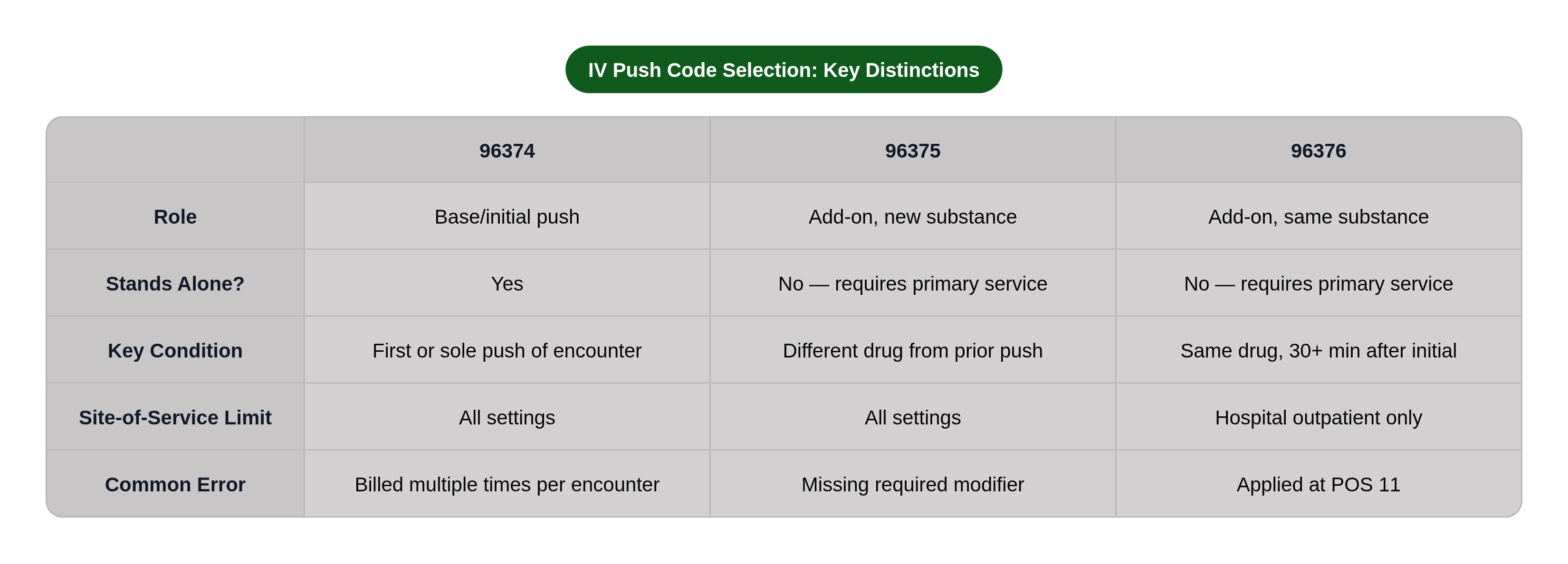
Three codes, three scenarios, none interchangeable.
96374 is the base code, covering the initial or sole IV push of a single substance. It is reported once per encounter as the primary push service. Billing it multiple times for multiple drugs is the most common unit error I see; payers deny the second and third instances as duplicate initial services, and rightfully so.
96375 is an add-on code for each additional push of a new substance through the same venous access. It never stands alone. The primary service it attaches to does not have to be 96374, either. If a higher-ranked service like a therapeutic infusion is the initial service for the encounter, 96375 still functions as the add-on for additional drug pushes.
96376 is an add-on for a subsequent push of the same substance, administered at least 30 minutes after the initial dose. Its site-of-service restriction generates a disproportionate share of preventable denials. More on that shortly.
Three variables drive every code selection decision: Is this the first push of the encounter or an additional one? Is the drug the same as or different from the prior push? If it is the same drug, has at least 30 minutes elapsed?
Say a patient receives a Zofran push, a Decadron push, and a Pepcid push in the same encounter. The correct claim is 96374 for the initial push and 96375 twice for the two additional new substances, plus J-codes for all three drugs. Billing two 96374s is wrong. Billing three 96374s is worse, and I've watched it happen.
The parenthetical notes following 96374 and 96375 in the AMA CPT codebook govern exactly when add-on codes get reported, and AMA updates them annually. Relying on prior-year rules is a documented, completely avoidable source of denials.
Service hierarchy: why the first push chronologically is not always the initial code
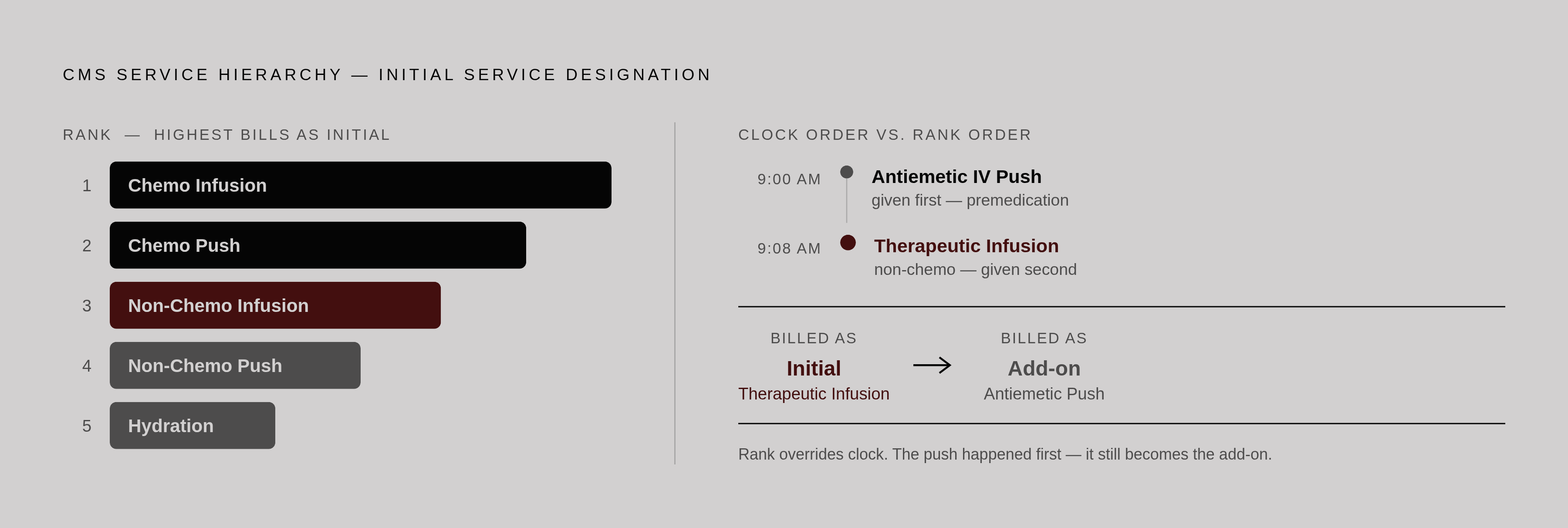
CMS established a service hierarchy that determines which service in a multi-service encounter is designated "initial," ranking from highest to lowest: chemo infusion, then chemo push, then non-chemo infusion, then non-chemo push, then hydration.
The service that ranks highest is the initial service, regardless of clock order. If a patient receives a therapeutic infusion and an IV push in the same encounter, the infusion is the initial service even if the antiemetic push was given first as a premedication. That push becomes the add-on.
Sequencing codes by clock time rather than hierarchy rank misidentifies the initial service, and that misidentification triggers denials and NCCI edit conflicts that feel arbitrary until you trace what actually caused them.
If the IV push is the only service or the highest-ranked service in the encounter, bill 96374 as initial. If a higher-ranked service exists, the push is an add-on, coded accordingly. Individual payer LCDs add restrictions on top of the AMA/CMS hierarchy, but they do not override the base hierarchy itself.
The 96376 site-of-service restriction that causes the most preventable denials
CMS Publication 100-04, Chapter 12, Section 30.5 is explicit: 96376 is restricted to hospital outpatient department settings. The code description states "requires the presence of a physician," and that language is part of the code's operative definition.
HCPCS site-of-service edits and MAC LCDs reinforce this. Billing 96376 with place-of-service 11 generates a denial every time because it is baked directly into the adjudication logic.
The practical consequence for physician offices and freestanding infusion centers operating under POS 11: if the same drug is pushed again 30 or more minutes later, that additional push is not separately billable. There is no office-equivalent code for 96376. The service was rendered; the coding system simply has no mechanism to capture it in that setting.
I'll be honest, that part genuinely bothers me. You're trying to reflect real clinical work accurately, and the system just doesn't have a slot for it in the office setting. The correct response is to accept that limitation and document it cleanly, not to apply 96376 anyway and wait for the denial.
On the remittance, this error looks like a documentation problem. It is a code selection problem upstream. Practices applying 96376 across all settings without checking site of service are generating a denial category they should never see.
A separate billing logic applies in hospital outpatient and ED settings. Under OPPS, the facility bills drug administration codes, and the treating physician generally does not report 96360 through 96379 for facility-side services. Add-on drug administration codes including 96375 function as packaged services under OPPS, reported for data and rate-setting purposes even when they do not generate a separate APC payment line.
Modifier logic that protects push claims from editing and bundling
Modifiers do not fix code selection errors. If the wrong base code is chosen, no modifier rescues the claim. What modifiers do is supply the clinical context that justifies reporting two codes that would otherwise edit together.
Modifier 59 is required when 96374 is billed for a second, separate, and distinct encounter on the same date of service. It signals to the payer that these are not duplicate services, and the record must show two distinct clinical events, separate orders, and separate administration times. Modifier 59 appended without that documentation is a compliance risk, not a billing strategy.
Modifier XS applies when a second push uses a different anatomical IV site, distinguishing that service from an add-on at the same access point. These are genuinely different clinical scenarios, and the modifier exists precisely to communicate that distinction.
Modifier 25 attaches to the same-day E/M code when a significant, separately identifiable evaluation occurred. It does not attach to 96374. Coders misplace it on the wrong code regularly, and that creates its own edit conflict.
NCCI edits govern which code pairs bundle by default. Modifiers override those edits only when the clinical scenario genuinely meets the override criteria. Using 59 or XS to bypass an edit without meeting those criteria is a documented compliance vulnerability, and RAC auditors know the pattern well.
J-code billing alongside push codes and where unit errors produce silent revenue loss
Every IV push encounter with a drug generates two claim components: the administration code and the J-code for the drug. Getting the admin code right while getting J-code units wrong still produces revenue loss, and that loss is often silent because the claim adjudicates partially rather than denying outright.
J-code unit complexity is the most underestimated technical challenge in push billing. Each HCPCS J-code has a defined billing unit in its descriptor, per milligram, per milliliter, or per vial, and that unit almost never matches the clinical dose one-to-one. J1745 (infliximab) bills per 10 mg, so a 400 mg dose requires 40 units on the claim. A unit conversion error there is a math error, not a judgment call, and it shows up constantly across practices that otherwise bill cleanly.
The most frequent J-code denial causes are unit conversion mismatches, missing or incorrect 11-digit NDC codes, and failure to track current quarterly payer fee schedule updates. Medicare Part B reimburses most J-code drugs at ASP+6%, recalculated quarterly, so a drug that was profitable in Q1 reimburses below acquisition cost in Q2 if ASP drops. Without a quarterly reconciliation process, a practice has no visibility into that shift until the damage compounds across hundreds of claims.
JW and JZ modifier compliance became mandatory January 1, 2024, and enforcement has continued through 2026. Apply JW or JZ on every single-dose vial J-code claim for covered drugs. Claims missing these modifiers face rejection or recoupment audit, and recoupment audits reach back across a volume of claims that a practice may have considered closed.
For buy-and-bill practices, a denied or underpaid J-code is not a back-office variance. The drug was already purchased. A denied biologic claim immediately creates a cash-flow gap tied to acquisition cost, and that gap compounds when the denial pattern goes undetected across volume.
Documentation requirements that determine whether a push claim survives audit
The medication administration record is the primary audit document for every push claim, and it must be completed at the point of care. Retrospective reconstruction is a compliance problem, and payers have developed real capability to identify it.
CMS and AMA guidance require these fields on every MAR:
- Exact drug name and dose
- Administration start time
- Administration stop time confirming 15 minutes or less
- Route specified as intravenous push
- Signed provider order
- Clinical indication linked to the diagnosis code on the claim
Missing start and stop times mean the administration cannot be confirmed as a push. The clinical indication field matters separately: payers audit medical necessity independently from coding accuracy, so a correctly coded claim still denies if the record does not connect the drug to a supported diagnosis.
For 96376 specifically, the record must document the timestamp of the repeat administration to confirm the 30-minute interval was met. Without that timestamp, the additional push has no defensible billing basis.
Payer AI systems now scan records for documentation gaps at scale. The AMA's 2025 survey found that a majority of physicians reported payer AI systematically driving up denial rates. Documentation deficiencies that previously survived manual review now trigger automated denials. The standards did not change; the enforcement capacity did.
Denial patterns specific to push billing and what they signal about upstream process gaps
Initial claim denial rates reached 11.8% in 2024, up from 10.2% in 2020. Infusion and specialty drug claims sit among the highest-scrutiny categories. Medicare Advantage denials spiked 59% in 2024, making MA the highest-risk payer segment for infusion practices right now. Push claims with J-codes attached are exactly what MA plans are auditing.
Each predictable push-code denial pattern signals a specific upstream failure:
- Duplicate initial service denial (multiple 96374s): a coder applying the code by drug count rather than by hierarchy and sequence rules
- 96376 denial at POS 11: systematic application of the code without checking site-of-service restrictions, not a one-time mistake
- Bundling denial on 96375: the code was correct, but the claim was missing a required modifier or hitting an NCCI edit conflict
- J-code unit denial alongside a correct push code: the drug billing workflow and the administration coding workflow are running independently, with no reconciliation step between them
Denial patterns are payer-specific. What one MA plan auto-denies on first pass, another adjudicates manually. Grouping denials as "push code errors" without root-cause analysis by payer hides the signal you need to prevent recurrence.
I've watched practices chase the same denial category for six months straight because they were reviewing aggregate numbers instead of filtering by payer and code pair. Slice the data that way and the pattern becomes obvious fast. The frustrating part is that most operations never slice it at all, so they fix nothing and just absorb the loss quarter after quarter.
Revenue leakage increased roughly 25% in 2025, with analyzed providers collectively missing an estimated $48.4 billion. Push-code errors contribute through both outright denials and underpayments that never get appealed, often because no one is tracking them as a discrete category.
What a billing operation needs to catch push-code errors before they reach the payer
The errors described throughout this piece are rule-governed, repeatable, and largely preventable. They persist because the rules are specific and the workflows enforcing them are either absent or inconsistently applied.
Pre-submission audit checkpoints need to cover four things:
- Confirm that 96374 appears only once per encounter and that additional pushes are coded as 96375 or 96376 as appropriate
- Verify that 96376 is restricted to eligible site-of-service settings before the claim leaves the practice
- Reconcile J-code units against the drug's descriptor definition and the current quarterly fee schedule before submission
- Confirm that start time, stop time, and route are documented in the MAR for every push coded on the claim
Coders need annual training timed to AMA CPT updates, because the parenthetical instructions following 96374 and 96375 change. A coder working from last year's rules is working from the wrong rules.
Denial analysis needs to run by payer, by code, and by denial reason code, at minimum monthly. A denial pattern that looks like random noise in aggregate often resolves into a clear systematic error when filtered by payer and code pair. The practices billing push codes accurately are not doing anything exotic: they have documented workflows, they update those workflows when rules change, and they treat denial patterns as diagnostic information rather than administrative friction. Ruby RCM, a revenue cycle management platform built specifically for infusion centers that handles prior authorizations, claims, denials, and AR, is one option practices use to keep that denial analysis running by payer and code pair consistently.