RCM Outsourcing Contract Red Flags for Provider Groups
Infusion billing contracts often hide gaps in drug-cost coverage until denials pile up.

RCM outsourcing contracts read like insurance paperwork: dense, standard, easy to sign without reading closely. For infusion provider groups, that habit gets expensive fast. Infusion billing carries drug-cost risk and payer complexity that generic RCM vendors weren't built to handle, and the contracts they write show that mismatch in ways you only notice once something breaks.
Here's why the stakes run higher than they look. Infusion practices buy high-cost drugs on credit, give them to patients, then wait on reimbursement that may or may not cover what they spent. A denied claim isn't a paperwork problem you clean up next week; it's the practice sitting on drug cost with nothing to offset it. Multiply that across a market where deal activity keeps pulling infusion groups into vendor contracts they inherited through an acquisition or signed under deadline pressure, and the exposure stacks up quickly. The vendor's legal team wrote these contracts, and they wrote them to protect the vendor first. Reading closely isn't about avoiding outsourcing altogether. It's about not signing with a vendor whose own contract quietly admits it can't do the job.
How scope-of-service definitions quietly exclude the workflows infusion billing actually requires
Most RCM contracts define "billing services" as claim submission and follow-up. That's the whole definition. Authorization management, drug-level reconciliation, denial root-cause tracking: often unaddressed, sometimes carved out on purpose.
The trouble is infusion's revenue cycle doesn't start at claim submission. It starts before anyone even orders the drug: eligibility checks, benefits investigation, prior authorization, step therapy documentation. Get any of that wrong and the claim was dead before the patient sat down for treatment. If a vendor's contract only picks up the story at claim submission, that vendor has no contractual stake in the upstream steps causing most infusion denials in the first place.
I look for scope language that treats prior authorization as a one-time submission, no renewal tracking attached. I look for benefits verification pushed off as a separate add-on, billed extra on top. J-code unit validation and the NDC-to-ASP crosswalk get left off the covered list more often than you'd think, with drug dispensing reconciliation quietly handed back to practice staff. And denial management sometimes gets defined as "one appeal per claim" rather than a real escalation path through peer-to-peer review and plan-level appeal.
None of this is small print. These clauses mark the exact spots where drug-cost exposure lives, and a vendor with no contractual duty there has no reason to staff for it. My gut check: lay the contract's scope clause next to an actual infusion encounter, step by step, from benefits investigation through secondary billing, and mark every stage the contract skips over.
Performance guarantees that look strong but measure the wrong things for infusion
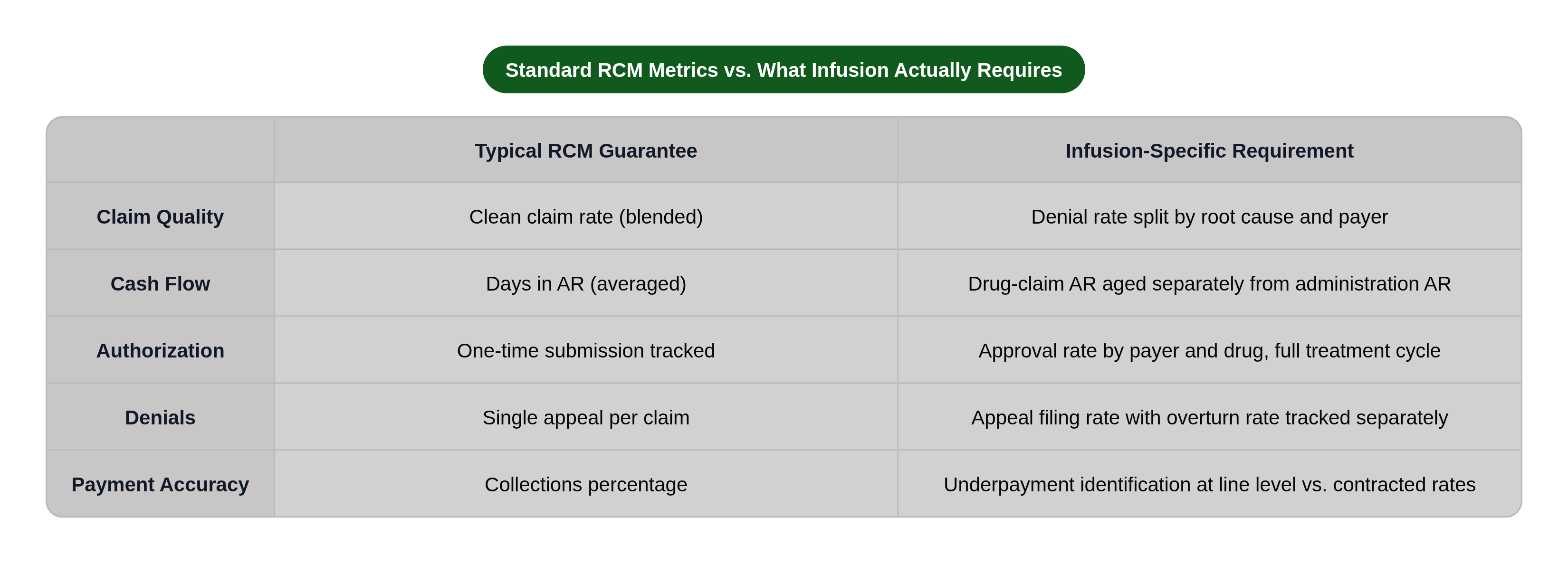
Clean claim rate. Days in AR. Collection percentage. These show up in almost every RCM performance guarantee because they were built for high-volume, low-dollar fee-for-service work. Not infusion.
A vendor can post a great clean claim rate while underbilling drug units, botching the administration coding hierarchy, or letting authorizations lapse. None of that shows up as a "dirty" claim until a payer audit or an internal reconciliation catches it, often months later. Days in AR is an average, and averages hide things well. A handful of six-figure biologic claims sitting untouched in aging, because the vendor's team can't run payer-specific escalation, won't move that number much. It'll still hurt the practice, though.
What actually matters for infusion, and what belongs in the guarantee itself: authorization approval rate by payer and by drug, tracked through the whole treatment cycle rather than just the first submission. Denial rate split by root cause and payer, not blended into one book-wide number that hides the ugly parts. Appeal filing rate on clinical denials, with overturn rate tracked separately. Underpayment identification at the line level against contracted rates. Drug-claim AR aging kept apart from administration-claim aging.
Blended metrics let a vendor coast on the easy claims while the complex, high-dollar infusion claims underperform without ever tripping a breach. A guarantee without teeth isn't a guarantee, either. No fee reduction, no cure period with real milestones, no right to walk away: that's just reading reports every month. It's not accountability.
How fee structures create hidden incentives against pursuing high-complexity infusion claims
Percentage-of-collections is the standard fee model, and on paper it sounds fair: the vendor makes more when the practice collects more. In infusion, that alignment falls apart fast.
A biologic denial needing a peer-to-peer call, a written clinical appeal, and a plan-level escalation can eat weeks of staff time, and it might recover the same dollar amount a routine claim pays out in three days flat. Under percentage-of-collections, the vendor earns the same cut either way but absorbs wildly different costs getting there. That's not a moral failing on the vendor's part, it's just math, and the math points toward working the easy claims first and letting hard infusion denials sit in aging until they near the timely-filing deadline and get written off.
I watch for a percentage fee on gross collections with no floor requiring specific claim types to actually get worked. I watch for a separate "complex" or "specialty" claim fee that's never defined anywhere, which leaves the vendor free to call any denial complex and charge more. Flat-fee deals that cap what the vendor earns even as claim volume climbs kill any incentive to chase underpayments that take real effort to recover. And fee structures that carve appeals, authorization management, or peer-to-peer coordination out as separate line-item charges are unbundling the exact work infusion billing depends on most.
Ask this before signing anything: what does it actually cost the vendor to do infusion billing well, and does the fee structure reward that effort, or quietly punish it?
Data ownership and access clauses that hold practices hostage at transition
Every month a vendor runs the books, it builds up a pile of operational knowledge: authorization histories by payer and drug, denial patterns, payer contract terms checked against remittances, years of claim-level detail.
That's not paperwork sitting in a drawer. For an infusion practice, it's the record you need to manage recurring authorizations, dispute underpayments against contracted rates, and get a new vendor up to speed on how each payer actually behaves. A contract letting the vendor own that data, or tying data extraction to extra fees or vendor goodwill, builds an exit tax that gets bigger the longer the relationship runs.
I check whether the practice is named as owner of claim-level data, authorization records, and remittance data from day one, not just after termination kicks in. I check what format exports come in, and whether that format loads into a new system without the old vendor lifting a finger to help. I check whether the vendor keeps any right to use the practice's data, even anonymized, for its own benchmarking or product work, and whether that right survives after the contract ends. And I check how fast the vendor has to hand data over on request, and what happens if it doesn't.
A practice that can't pull clean data at the end can't rebuild its own payer performance history. Which means it can't hold the next vendor to a real baseline, and it can't chase underpayments from before the switch. The clause saying nothing at all about data ownership is the most dangerous one on the page: silence just means the vendor holds the leverage exactly when the practice needs it least.
Termination provisions that make it expensive to fix a bad vendor relationship
Termination clauses protect the vendor's revenue first. That's their job, from the vendor's side of the table. For the practice, a relationship that stops working doesn't just sit there quietly; it keeps generating drug-cost losses, missed authorizations, and underpayments for every week it drags on.
The traps show up in familiar shapes. Ninety- to 180-day notice periods keep the practice tied to a vendor it's already decided to leave, with that vendor doing the bare minimum on the way out the door. Cure periods reset every time there's a new alleged failure, letting a vendor stick around indefinitely through marginal fixes that never touch the real problem underneath. Termination-for-convenience fees apply even when the practice is leaving because the vendor failed, structured so "convenience" becomes the easier legal path even with clear cause on the table. And auto-renewal windows shorter than most practices' internal review cycles lock in another year before anyone's even finished evaluating the current one.
Termination-for-cause language should spell out, by name, what counts as cause in infusion: denial rates parked above a set threshold, failure to keep authorizations current for active patients, repeated failure to catch underpayments. A contract that makes leaving expensive no matter how the vendor performs isn't protecting a partnership. It's building an incentive to slack off once the ink dries.
Audit rights and reporting transparency as the practice's only real-time signal
Reporting obligations show up in nearly every RCM contract, but the reports get built around what's easy for the vendor to generate, not what an infusion practice actually needs to see.
Gross charges, collections, days in AR, blended denial rate: that's the standard package, and it's a rearview mirror. It won't catch a systemic J-code unit error. It won't show a vendor quietly letting biologic authorization renewals slide past their date. It won't surface underpayments piling up on one payer's remittances until the damage is already sitting there, done.
I push for denial reports split by root cause and by payer, so a practice can tell if PA failures are clustering around one plan or one drug. I push for authorization status reports, weekly at minimum for active infusion patients, showing what's pending, approved, denied, or about to expire. AR aging needs to keep drug claims separate from administration claims and flag high-dollar accounts for individual review past a set threshold. And appeal activity reports should show how many denials got appealed, where each one sits in the process, and how it landed, so the practice can tell whether the vendor is actually fighting for recoverable money or just writing it off quietly.
Audit rights need to go further than scheduled summaries. The contract should let the practice pull claim-level detail, authorization records, and denial disposition data on demand, not on the vendor's calendar. A vendor that pushes back on granular reporting, or tries to narrow audit scope down, is telling the practice something important. That resistance is worth pricing into the negotiation, not waving off as ordinary caution.
What to look for in a vendor's actual infusion capability before the contract is signed
None of this matters if the vendor can't actually do the work. A vendor that doesn't understand J-code hierarchy isn't going to catch administration coding errors no matter what the scope clause promises on paper.
I ask what share of the vendor's book is infusion or buy-and-bill specialty, and I ask for performance data on that slice specifically, not blended across every client type they touch. I ask how they track prior authorization renewals across recurring infusion schedules, who owns that workflow day to day, and what happens the moment an authorization lapses. I ask whether they reconcile underpayments at the line level against contracted rates, or whether they just post what the payer sends and move on to the next claim. I ask how they handle J-code unit math for dose-adjusted biologics and what changes when a drug's ASP crosswalk updates each quarter. And I ask which payers make up most of their denial volume and how their appeal process shifts payer to payer; a vendor that can't answer that by name isn't tracking denial patterns at the depth infusion demands.
The vendors actually built for this work tend to pair infusion-specific billing software with staff who make real payer-specific judgment calls, rather than leaning on a generic rules engine and hoping it generalizes across specialties, such as Ruby RCM, a revenue cycle management platform built specifically for infusion centers that combines software with hands-on operators to handle prior authorizations, claims, denials, and AR end to end. Generic RCM platforms usually lack exactly that combination.
Contract review and vendor due diligence aren't two separate steps. They're the same step, seen from two angles: the contract shows what the vendor is willing to be held to, and the due diligence shows whether it can actually deliver. Skip either one, and a practice risks finding out the vendor's limits only after signing, right when the exit clauses make leaving costly and the data clauses make transition slow.