Infusion Pharmacy RCM Mergers and Acquisitions Considerations
High denial rates and systemic RCM failures can erase the earnings buyers are actually paying for.

Infusion pharmacy is one of the hottest corners of healthcare M&A right now, and the reason has nothing to do with sentiment. Biologics volume is growing, care is shifting out of hospitals, and private equity platforms are hunting for add-ons. But the multiples buyers are paying only mean something if the revenue cycle behind the numbers actually holds up. Get the RCM diligence wrong, and a buyer is acquiring someone else's unresolved billing problem at a 10x markup. They're acquiring someone else's unresolved billing problem at a 10x markup.
How RCM determines infusion provider valuation
Pricing in this space runs on EBITDA multiples, and the range is wide depending on scale and specialty. Home infusion platforms with a substantial level of EBITDA trade between 9x and 13x. Smaller home infusion operations, in the lower EBITDA range, land closer to 7x to 10x. Single-pharmacy operations clear a broader spread, roughly 5x to 8x. Specialty infusion providers focused on rare disease, biologics, or chronic conditions command a premium on top of that, because the clinical complexity and the durability of their payer contracts make the revenue harder to replicate.
VMG Health projects EBITDA across the pharmaceutical value chain could reach a substantial multiple of current levels by 2029, and expects deal activity to keep strengthening through 2026. The most active names doing the buying include Option Care Health, which has closed 8 announced deals since 2019 and leads the field by count, along with CVS Coram, BioPlus, Soleo Health, Amerita/PharMerica, BrightSpring, Cardinal Health, and McKesson-affiliated buyers, plus a steady stream of PE-backed platforms.
healthfmv.com identifies what earns a premium: a broad mix of therapies, clinical operations that run efficiently, in-network payer contracts, a steady referral pipeline, and room to expand regionally. All reasonable. But every one of those factors gets measured through EBITDA, and EBITDA is calculated off net revenue. If a target's denial rate is elevated, if underpayments are sitting undetected in the remittance data, or if AR is quietly aging past the point of collectibility, reported EBITDA is overstating what the business actually earns.
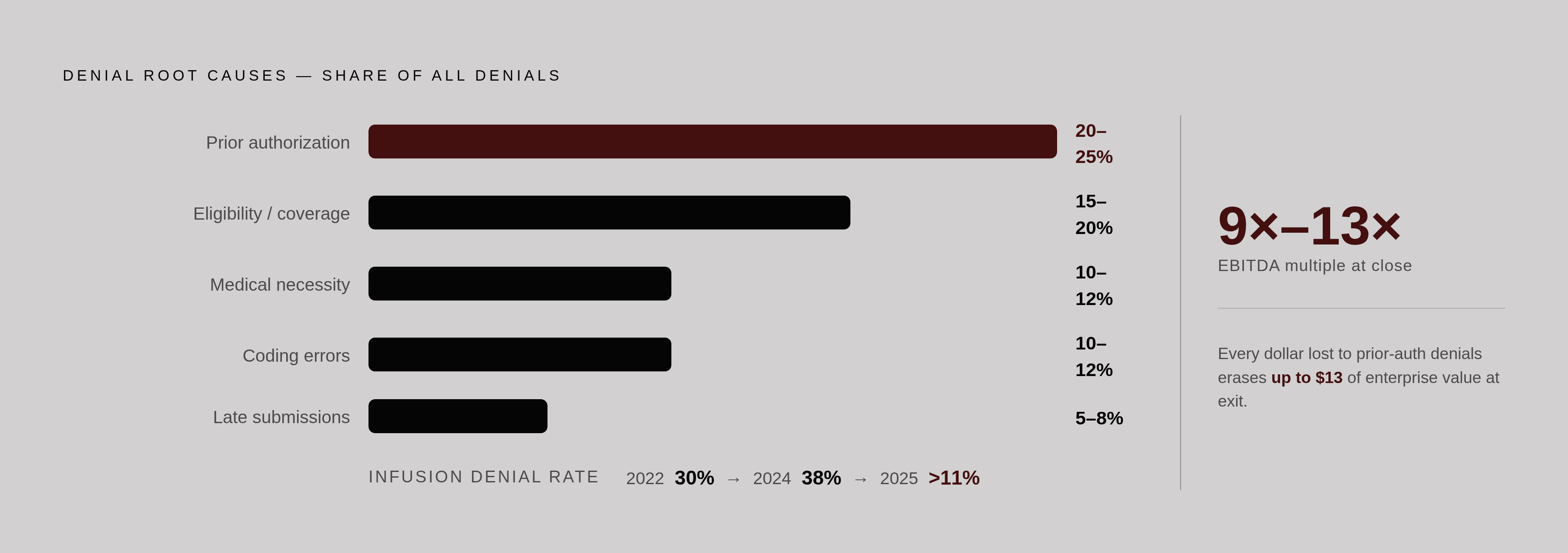
That's the trap: a buyer paying 9x to 13x on inflated EBITDA isn't just overpaying, they're paying a multiple on a problem. A buyer paying 9x to 13x on inflated EBITDA isn't just overpaying, they're paying a multiple on a problem. Whatever revenue shortfall exists in the target's books gets magnified by the deal math itself. This is why RCM can't sit in the back-office bucket during diligence. It has to be treated as a primary driver of whether the valuation is even real. Understanding that starts with understanding the environment infusion claims are actually getting denied in.
The denial environment infusion practices operate in
Denials have gotten worse, not better, and the trend line is not subtle. Experian Health's 2025 State of Claims Report put overall claim denials at 30% in 2022, climbing to 38% by 2024, and rising past 11% again into 2025. rcmworkshop.com reports that prior authorization denials specifically climbed to around 31% in 2026, and that growth is concentrated hardest in high-complexity specialty infusion and biologics, where payers have the strongest financial incentive to scrutinize a claim before paying it.
A real due diligence review has to inventory denial categories specific to infusion, not just look at a top-line denial percentage. That means checking for prior authorization failures (missing, expired, or scoped incorrectly), administration hierarchy disputes where CPT codes were sequenced wrong, NDC errors and J-code unit miscalculations, 340B modifier disputes, documentation gaps like missing clinical notes or absent step-therapy evidence, and site-of-care redirects where payers are pushing patients out of hospital outpatient departments.
The Medicare Advantage data makes the pattern concrete. Oncology carried a 12.7% MA denial rate in data from revenuesynergy.com, concentrated in J-code drug claims and step-therapy edits. CARC 197, the code for missing authorization, accounted for roughly 38% of all MA denials across advanced imaging, surgical scheduling, infusion therapy, and physical therapy combined. Industry-wide, prior authorization issues make up 20% to 25% of all denials, eligibility and coverage problems another 15% to 20%, medical necessity disputes 10% to 12%, coding errors another 10% to 12%, and late submissions 5% to 8%.
None of this is abstract money. Infusion visits routinely generate $5,000 to $50,000 in charges, and a single denied biologic claim can represent tens of thousands of dollars in drug cost the practice already spent to acquire. In buy-and-bill infusion, a denial is a cash-flow emergency. It's a cash-flow emergency.
So the real diligence question isn't "what's the denial rate." It's whether the target tracks denials by root cause and by payer, or just logs them as one-off events to clean up individually. Grouped, undifferentiated denial data hides the signal. Root-cause tracking is what tells a buyer whether the problem is systemic or occasional.
Prior authorization management as the single most foreseeable failure point in infusion RCM
A perfectly documented, perfectly administered infusion generates exactly zero revenue if the prior authorization was wrong, expired, or never obtained. Rcmworkshop.com reports that the gap between "the patient got treated" and "the payer will actually pay for it" has widened considerably in recent years, and it keeps widening.
Recurring treatment makes this structurally harder than episodic care. Every new authorization cycle has to be tracked by therapeutic, by payer, and by patient, all at once, continuously. Expiration denials are almost always a monitoring failure rather than a clinical one. If a target has no standing report showing active authorizations sorted by remaining visits and days until expiration, that's not a minor gap, that's structural exposure baked into daily operations. Incomplete documentation, whether it's a missing clinical note, an unclear diagnosis code, or absent step-therapy evidence, triggers back-and-forth with the payer that delays approval or kills it.
CMS has taken some steps on prior authorization burden in general, but regulatory changes alone have not resolved the authorization challenges most consequential to infusion therapy. So regulatory improvement alone won't protect the revenue a buyer thinks they're acquiring.
During diligence, a handful of questions separate a real authorization operation from one running on hope. Does the target track average payer turnaround time broken out by therapeutic? Does it capture first-time denial rates and approval rates on appeal at a unified practice level, not scattered across individual billers? Is authorization handled proactively, before treatment gets scheduled, or reactively, after a lapse already happened? Are renewals triggered by a system, or by whichever staff member remembers to check?
A target that can't answer those with actual data is running on tribal knowledge. It's running on tribal knowledge, and tribal knowledge doesn't survive an acquisition, an EHR migration, or a key employee's resignation. That's a direct integration risk, not just a revenue one.
Authorization failure is one way revenue disappears before a claim is even submitted. J-code billing is the other, and it fails differently: it compounds.
Financial risk from J-code billing errors and buy-and-bill mechanics that standard due diligence misses
Buy-and-bill is inherently front-loaded risk. The practice purchases the biologic first, the drug cost hits the books immediately, and reimbursement only appears after the claim clears adjudication, sometimes weeks later. The margin between what the practice paid and what it collects isn't guaranteed. It depends entirely on claims accuracy and how fast the payer moves.
J-code billing is where small errors turn into real dollar losses, fast. Wrong units, a missing administration code, undocumented drug waste, or a mismatched drug code, each one creates a denial or an underpayment, and at scale, across every infusion encounter, those errors compound. Take a multi-drug chemotherapy regimen: CPT code 96413 should be billed once, and 96417 for each additional drug given after that. Bill 96413 multiple times instead, and NCCI bundling edits will kick the claim back as a denial.
CMS tightened enforcement around product-specific J-codes and quarterly pricing validation in 2026. The rule that deleted codes get no grace period has been in effect since 2010, but the scale of the 2026 HCPCS overhaul makes staying current far more consequential than it used to be. Charge masters, HCPCS tables, and EHR systems all have to reflect every quarterly CMS update in real time. A target running on a stale code library is generating denials it doesn't even know it's causing.
White bagging adds another layer of structural risk. When a payer mandates that specialty pharmacy handle dispensing instead of the practice, the entire buy-and-bill margin on that drug disappears. As of 2025, 12 states have passed legislation addressing mandatory white bagging, and the practice faces ongoing opposition from major medical and pharmacy professional organizations. Still, a target's exposure depends entirely on its specific payer contract mix, state by state, contract by contract.
In oncology, rheumatology, and gastroenterology specifically, J-code accuracy is the line between recovering drug acquisition cost and quietly absorbing a loss on every dose administered. So diligence needs answers to a few specific things: is there a structured unit-calculation and waste-documentation workflow, how often does the charge master get updated against CMS's quarterly J-code releases, what percentage of drug encounters clear on first submission with correct CPT hierarchy, and what the white bagging exposure looks like across the current payer contract portfolio.
Underpayments: the revenue loss that settled claims hide and standard AR reviews don't find
Underpayments show up disguised as paid claims, which is what makes them dangerous. That's what makes them dangerous. The claim gets paid, the remittance posts, the balance closes out as resolved, and the shortfall between the contracted rate and what actually landed in the bank just disappears into the gap. Nothing flags it. Nothing forces anyone to look twice.
The scale of this problem across the industry is not small. Claims-processing errors among commercial insurers are a documented industry-wide problem, with costs to providers running into the billions annually. In August 2025, a federal judge granted final approval on Blue Cross Blue Shield's $2.8 billion settlement with hospitals and healthcare organizations over antitrust claims tied to suppressed reimbursement rates. As part of that settlement, BCBS also has to overhaul its BlueCard claims system, improve transparency, and standardize prior authorization. That case alone shows how systemic underpayment can run for years before it becomes visible in the numbers.
For infusion specifically, the combination of RCM complexity and buy-and-bill dynamics means many providers collect meaningfully less than their contracted rates would entitle them to. At acquisition multiples of 9x to 13x, that's not rounding error, that's the difference between a good deal and a bad one. Wherever a target's denial rate sits relative to industry peers is a direct read on how much revenue is being left on the table.
A real remittance-level review has to compare line-item payments against contracted rates by payer, not just check whether the total looks roughly right. It has to hunt for systematic underpayment patterns tied to specific payers, specific drug categories, or specific sites of service. It has to check the recovery window too: underpayments discovered after the timely-filing appeal deadline has passed are gone permanently, no matter how clearly the contract was violated. And it's worth simply asking whether the target has ever run a payer contract audit at all, or whether it's just been trusting whatever showed up in the remittance file.
The implication for deal structure is blunt. Underpayment patterns discovered after close can't be clawed back once appeal windows have closed. That revenue is gone, and it was priced into the purchase price at a multiple.
What AR aging and billing operations reveal about a target's revenue repeatability
AR aging is a good leading indicator, but the buckets mean something different in infusion than in general medical billing. A high-dollar biologic claim in the 90 to 120 day bucket might still be fully recoverable, if someone is actively working an authorization appeal on it. Or it might already be dead money, if no one's touched it in weeks. Aging past 120 days on J-code claims usually points to a process failure somewhere upstream, not a one-off collection miss. A clean average days-in-AR number can hide a tail of high-value stale claims that are functionally uncollectible, just sitting there dragging down the average without showing up as an obvious red flag.
A few billing operation patterns tend to surface fast in diligence, once someone knows to look for them. Denials handled one at a time instead of by root-cause pattern means staff is putting out fires without ever preventing the next one. No payer-specific denial tracking means the practice is treating every payer the same, even though authorization rules, bundling edits, and appeal timelines differ payer to payer, which leaves recoverable money sitting unclaimed. Authorization work that only starts after a denial hits, instead of before treatment gets scheduled, means most of the damage is already done by the time a claim gets submitted. And RCM staff spending their time on data entry and status checks instead of actual judgment calls is a sign the operation is running reactively, not strategically.
Scale matters here too. A billing team that keeps up with 500 infusion visits a month through sheer effort and overtime will not keep up with 2,000 visits post-acquisition, not without real process infrastructure behind it. Buyers need to stress-test the operating model itself, not just the metrics it's currently producing at current volume. Some practices address this by moving to a platform purpose-built for infusion billing rather than a general RCM tool, such as Ruby RCM, a revenue cycle management platform built exclusively for infusion centers that handles prior authorizations, claims, denials, and AR as a single integrated workflow.
The sources checked for this guide are listed below.