When Your Denial Fix Addresses the Symptom but Leaves the Root Cause Billing the Payer Again
Root-cause denial fixes require fixing the upstream process, not just resubmitting the claim.
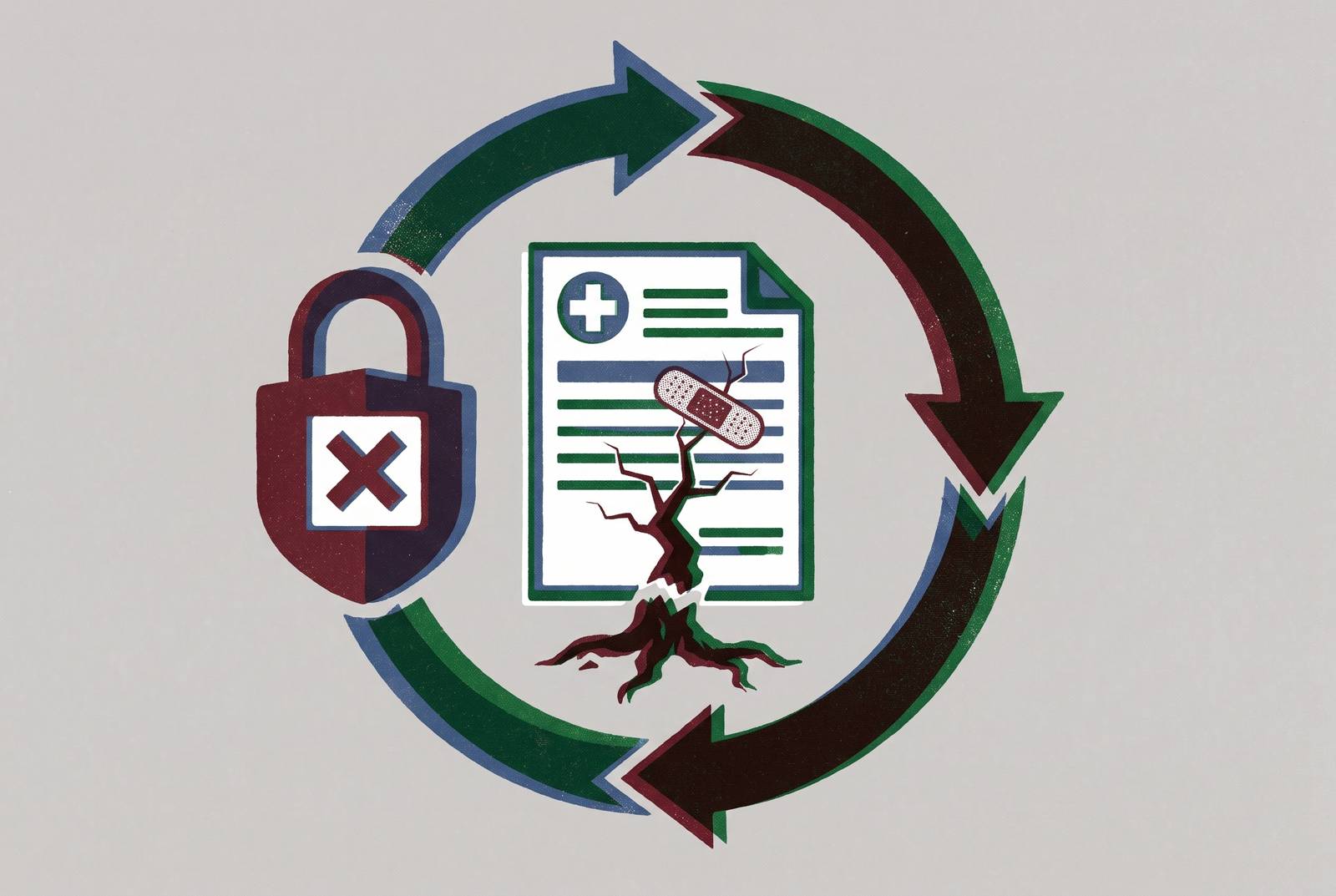
Payer-specific root-cause denial management for infusion claims means tracing recurring denials to the intake, authorization, documentation, or coding process that generated them, then correcting that process before the next claim. Faster appeals recover money, but they do not stop recurrence. The durable fix is to group denial patterns by payer, therapy, and site, assign each cause an upstream owner, and monitor whether the correction prevents new losses.
Why infusion denials keep recurring even after the appeals work
A billing director recognizes the same denial code from last month, and the month before. The team appealed those claims, corrected them, and resubmitted them. But the next batch comes in with the same defect. The work repaired individual claims without changing the process that produced them.
That is the structural trap in reactive denial management. More appeals staff, faster resubmission, and larger accounts receivable teams all address the point where the problem becomes visible. None necessarily reaches the decision that caused it. While billing works on yesterday’s denial, the same process can produce tomorrow’s.
In infusion, that loop has unusually sharp financial consequences because the practice has already purchased the drug. A single denied biologic can represent tens of thousands of dollars in drug cost, before the labor spent pursuing payment. Repeated failures then add aging receivables, cash flow disruption, and write-offs to the original exposure. Recovery and prevention are different jobs here. The question after a successful appeal is which upstream decision must change so that the next infusion does not produce the same denial.
How denials concentrate around a small number of upstream causes, not random claim errors
In most mid-market infusion organizations, much of denied AR traces to a handful of denial codes. Those codes concentrate around particular payers, therapies, and often sites. The pattern is narrower than the queue suggests.
That concentration changes the unit of investigation from an individual claim to a recurring process failure. Claim adjustment reason code, or CARC, concentration analysis brings the pattern into view by grouping denied claims across a trailing period and comparing payer, therapy type, site, and submission date. A single-site queue can show a local problem within the limits of that site.
The kind of denial also helps distinguish the likely correction path. Soft denials can be fixed without a formal appeal, but hard denials need formal appeals and often a clinical review. They should not feed the same resubmission routine. A code cluster is a starting point for investigating whether its claims failed for the same reason.
Why denial rates keep climbing even when billing teams are doing their jobs
Payer behavior makes that investigation more urgent. Payers have become faster, more automated, and more willing to deny first and require providers to appeal. Documentation gaps that previously passed manual review now get flagged within the payer’s system. Better back-end execution cannot neutralize that shift alone.
The Kodiak Solutions benchmark shows that initial denial rates have risen for five consecutive years. Clinical denials tied to prior authorization and medical necessity accounted for nearly all of the jump in losses to final denials and uncollected patient balances in 2025 over 2024. The direction is not simply toward more claim corrections. It makes the clinical and coverage decisions made before submission more important.
The National Infusion Center Association has documented increased denials and underpayments as payers intensify drug spending management. Infusion centers face that pressure because of the drugs they give, on top of the billing problems they share with other practices. Appeals remain necessary for claims already denied. But adding people to the appeal queue cannot offset payer automation at scale, so the durable response must reduce the correctable flaws that reach the payer in the first place.
Prior authorization as the root cause that keeps regenerating denials across treatment cycles
Authorization is especially dangerous when a recurring treatment is managed as a one-time approval. A missed or expired authorization can affect an entire course already in progress. Remaining visits, expiration dates, approved dose ranges, and treatment changes all need attention throughout the cycle.
A dose adjustment outside the approved range, an agent swap after non-response, or added cycles requires the authorization to be reopened before the next infusion is covered. Without a monitoring workflow, the practice may discover the lapse only through a denied claim. Billing then gets a problem that started before treatment. Correcting that claim does not automatically protect the remaining infusions.
The operational fix is a standing exception report for active authorizations, showing remaining visits, days until expiration, and dollar value at risk, sorted by proximity to expiration. Intake is in charge of the report, and intake and clinical teams act before a lapse. This moves authorization management out of the resubmission queue.
CMS-0062-P, proposed in April 2026, addresses electronic prior authorization for drugs under medical and pharmacy benefits. Even with that policy, authorization management must start before the treatment cycle and carry on through it.
Where J-code and unit-level billing errors become silent, recurring underpayments
A denial queue has another blind spot. J-code and unit-level errors can produce a payment that looks complete but is short, leaving no denial flag for the team to work. In buy-and-bill infusion, that distinction is costly because the drug purchase has already created a financial obligation. A paid claim is not necessarily a correctly paid claim.
Outdated NDC-to-J-code crosswalk tables, wrong unit conversion factors, and mapping to a cheaper equivalent NDC can distort the drug line. Incorrect infusion time documentation and missed billable add-on codes can reduce reimbursement for administration. If the underlying mapping or documentation workflow stays unchanged, the loss repeats on affected claims.
The fix therefore needs both a pre-submission control and a post-payment check. A structured unit-calculation workflow takes the administered dose from the clinical record and turns it into the correct J-code unit count before the claim is generated. After payment, line-level remittance reconciliation compares reimbursement with contracted rates and administered units. These controls do different jobs. The first prevents incorrect coding and counts, while the second detects short payments that denial-focused workflows would otherwise overlook.
Eligibility and benefits verification gaps that seed denials before authorization is even requested
When coverage information is wrong at registration, the authorization request and later billing work both rest on that error. A clean submission cannot repair the original gap. By then, the practice may already have delivered treatment on an invalid coverage assumption.
A plan change at open enrollment, Medicaid eligibility redetermination, or employer benefit change can interrupt coverage during a course. A verification that was accurate at treatment one may be invalid by treatment four.
The correction is a pre-encounter eligibility check tied to scheduling and triggered before each infusion. An incomplete benefit verification or an unidentified payer-specific billing rule can place thousands of dollars at risk before a claim exists. Connecting verification to scheduling allows a coverage lapse to trigger work before the drug is ordered and administered.
Timing defines the available correction window here. When an eligibility-sourced denial reaches AR, the treatment has already occurred and the drug cost has already been incurred.
Why adding analytics without fixing processes accelerates errors rather than resolving them
A dashboard can show that denials rose last month without showing why they rose. The origin may be intake, documentation, authorization, coding, or billing, and each calls for a different intervention. Visibility does not change the process by itself. Using automation on the same flawed workflow can make it produce denied claims faster.
Correcting that sequencing problem requires process remediation before or alongside automation, with analytics used to monitor whether the correction holds.
SolisRx’s methodology distinguishes the billing function that works the queue from the analytics layer that identifies at-risk claims and emerging patterns upstream. The functions complement each other. Clinical documentation, authorization data, and claims history become more useful when they can be considered together before submission. Acting on that information also requires revenue cycle, clinical, and IT leadership to agree on the process change. The investment case for better tooling depends on whether the organization can correct the workflow it exposes.
How do you stop recurring infusion denials from the same payers by tracing them upstream?
For a denial manager or RCM director, the practical starting point is to pull denied claims across a meaningful trailing period and cluster them by CARC. Cross-reference each cluster against payer, therapy type, site, and submission date to locate where and when the cause is active. Then quantify the exposure. The methodology described earlier moves from diagnosis to current-period impact, annual projection, and recoverable AR by aging bucket, so collection targets can be set by payer.
For authorization expiration denials, put the standing exception report with intake rather than billing, ranked by proximity to expiration and showing dollar value at risk. For drug-to-diagnosis mismatches, place a clinical documentation review before the authorization request.
Eligibility lapses require verification at scheduling before every infusion in the ongoing course. To fix J-code and unit errors, teams need the structured calculation from the clinical record before the claim is generated, along with line-level reconciliation after payment. Neither belongs solely in an appeals workflow. Their correction points differ because their causes differ.
Secondary timely filing failures need a different trigger again. Primary adjudication should start an automated secondary filing workflow that tracks how much time is left to file. After each intervention, monitor the same payer-specific cluster to see whether new claims continue to fail. The test is not whether the old queue shrank, but whether the changed process stopped generating its replacement.
What a revenue cycle built around prevention looks like in practice, and where Ruby fits
A prevention-oriented revenue cycle organizes daily work around exceptions before submission as well as claims after denial. It surfaces authorizations nearing expiration, coverage gaps, and coding risks while there is still time to act. It also tracks payer performance against contracted rates and monitors AR aging by bucket. Paid claims stay in view because denial reports can miss underpayments.
That model requires more than a general denial dashboard. The relevant capability criteria are authorization lifecycle management, pre-encounter benefits verification, structured J-code unit workflows, payer-specific denial pattern monitoring, and reconciliation of payments against expected reimbursement. Each capability has a distinct purpose. Together, they connect a visible financial loss to the process capable of preventing its recurrence.
Ruby is an infusion-specialized RCM platform built around software and hands-on operators working in combination. It manages the end-to-end billing workflow, including benefits verification, prior authorization, claims submission, denial management, cash posting, and AR, giving practices visibility into status and outcomes while handling the workflows for them. For infusion and buy-and-bill, it has authorization lifecycle management, J-code unit workflows, and denial pattern monitoring built to handle these failures.
The operating principle remains larger than the platform. Each loss that keeps happening needs someone upstream to own it, a point where it can be fixed before the next affected claim, and checks that show whether the fix worked. Appeals recover what can still be collected. Prevention changes what the payer receives next.