What the revenue cycle actually is in infusion therapy (and what it is not)
Revenue cycle in infusion therapy extends far beyond billing and collections.

What the revenue cycle actually is (and what it is not)
Ask a physician who just bought a practice what RCM means and most will say billing and collections. Ask a hospital CFO the same question and you will often get the same answer, just delivered with more confident terminology. The shorthand is understandable. Billing and collections are the parts that visibly hurt when they go wrong: claims bounce back, cash slows, staff spend their days chasing payments. But the shorthand is wrong, and the cost of that misidentification shows up on the balance sheet.
The actual definition, as understood by the operational and financial professionals who run these systems, covers all administrative and clinical functions that contribute to the capture, management, and collection of patient service revenue. That scope begins the moment a patient schedules an appointment and does not end until the provider has accepted all payments and reconciled every outstanding balance. Registration, insurance verification, authorization, documentation, coding, claim submission, payment posting, denial management, patient collections. All of it.
When you only actively manage the back end, the upstream errors that created your back-end problems are never seen, never named, and never corrected. They compound quietly, visit after visit, until you are staring at a denial rate that appeared from nowhere. It did not come from nowhere. It came from registration, six weeks ago, in a field someone filled out incorrectly.
That is the universal truth of revenue cycle management. But infusion therapy adds layers of complexity that make the universal truth feel almost quaint. Infusion providers, whether ambulatory infusion centers, home infusion agencies, hospital outpatient departments, or specialty pharmacy-adjacent models, operate inside a billing and reimbursement environment that is genuinely unlike any other care setting. The drug itself is a billable unit. The administration of the drug is a separate billable unit. The site of care changes what both of those units reimburse. And the supply chain decisions made before the patient ever sits in the chair determine which of those units the provider is even permitted to bill.
This article is specifically about RCM in the infusion context. The foundational framework applies everywhere. The operational reality is infusion-specific, and that specificity deserves direct treatment.
Why infusion therapy billing is structurally unlike other specialties
Most specialty practices bill for professional services: the clinician's time, judgment, and skill applied to a patient encounter. The product, if any, is incidental. Infusion is different at its core. The drug being administered is often the single largest cost component of the encounter, frequently worth thousands or tens of thousands of dollars per infusion, and how that drug enters the billing equation depends on decisions made at the payer, pharmacy, and supply chain level, not just at the clinical level.
This creates a revenue cycle where the front end must do substantially more work than it does in almost any other care setting. Before a patient receives their first infusion of a specialty biologic, the infusion provider must have confirmed insurance eligibility, obtained prior authorization for both the drug and the administration service, verified the site-of-care benefit and whether it is covered at the specific facility type, investigated whether the payer mandates a specific drug acquisition model, and confirmed the patient's financial responsibility down to the copay and deductible structure. Miss any one of those steps and the encounter may be unbillable, or the drug costs may be unrecoverable.
High-deductible health plans have added a consumer-collections dimension that simply did not exist at scale a decade ago. Patients are now responsible for a meaningfully larger share of their own care costs. In infusion, where a single administration visit can carry a patient cost-sharing obligation of several thousand dollars, this is not an abstract concern. It is an accounts-receivable problem that starts at scheduling and does not resolve itself.
Value-based payment models press further. Organizations operating under outcomes-based contracts must demonstrate that care met quality thresholds. The financial logic of the encounter now extends well beyond the encounter itself, into documentation trails and outcome reporting that did not exist in the fee-for-service world. For infusion providers, this adds another documentation layer on top of an already documentation-intensive billing environment.
Brown bagging, white bagging, and clear bagging: what they are and why they define infusion revenue
No concept shapes ambulatory infusion revenue more directly than the drug acquisition and dispensing model the payer mandates or the provider negotiates. Three terms, brown bagging, white bagging, and clear bagging, describe the three primary models, and the financial and operational consequences of each are dramatically different.
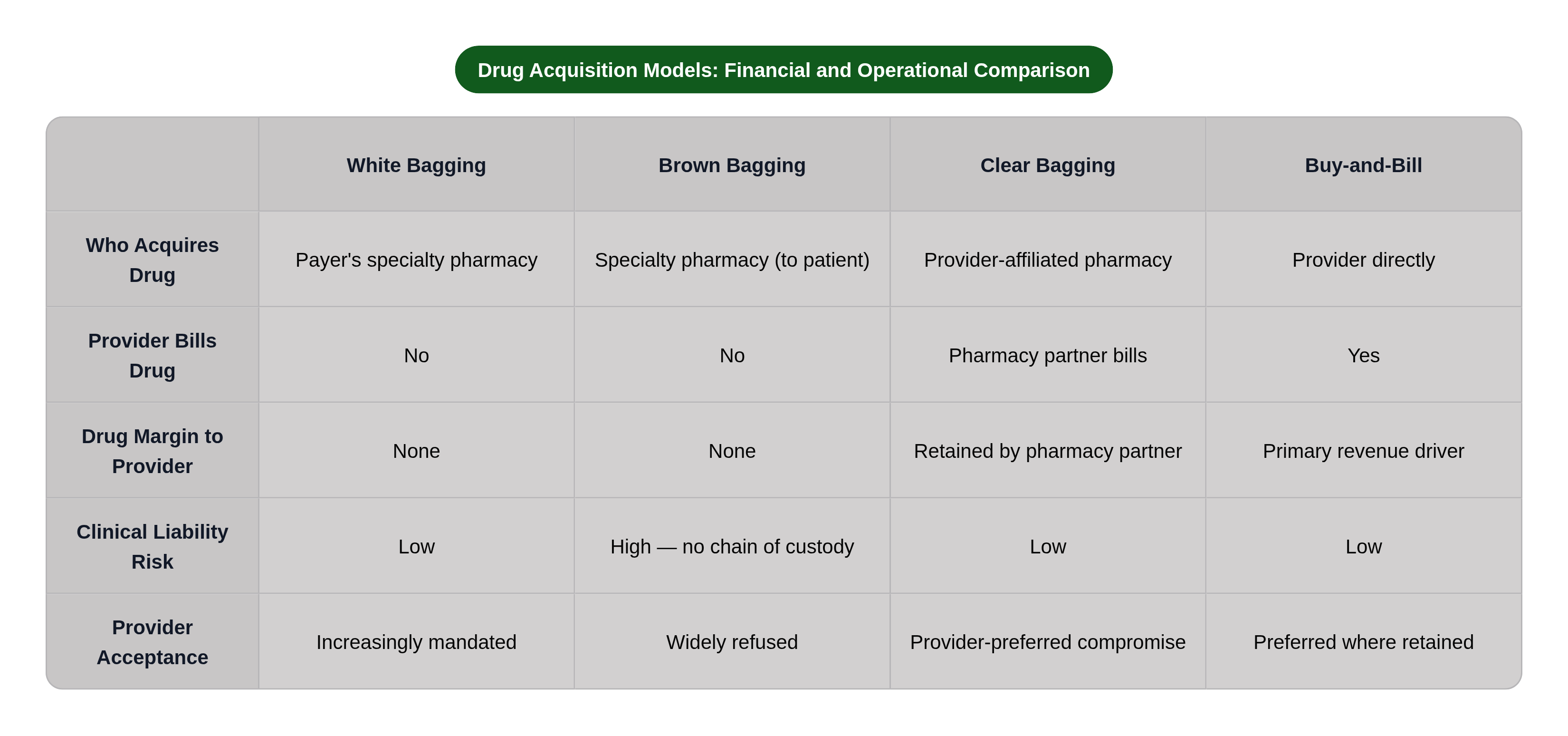
White bagging is the model that has become dominant among commercial payers and pharmacy benefit managers. Under white bagging, the payer's designated specialty pharmacy dispenses the drug and ships it directly to the infusion center or provider site, where it is administered to the patient. The provider does not purchase the drug, does not bill for the drug, and does not earn a margin on the drug. The payer controls the drug acquisition. The infusion center bills only for the administration service. For ambulatory infusion centers operating under a buy-and-bill model that depended on drug margin to remain financially viable, white bagging is not a minor process change. It is a fundamental restructuring of the revenue model.
Brown bagging takes that logic one step further in a direction most providers find untenable. Under brown bagging, the specialty pharmacy dispenses the drug directly to the patient, who then brings it to the infusion center for administration. The provider handles a drug it did not acquire, has no chain of custody over, and cannot verify the integrity of. The clinical liability exposure is significant. Drug stability, storage compliance, and proper handling cannot be confirmed once a drug has left the pharmacy and passed through a patient's hands. Most infusion providers refuse brown bagging arrangements for exactly this reason, and many state pharmacy boards have added regulations limiting or prohibiting the practice. It remains more common in certain payer markets and should be explicitly addressed in every payer contract negotiation.
Clear bagging is the provider-preferred alternative that has gained traction as a compromise model. Under clear bagging, a specialty pharmacy affiliated with or contracted by the provider dispenses the drug, maintaining chain of custody and proper handling while allowing the provider's pharmacy partner to capture the drug dispensing revenue rather than ceding it entirely to the payer's PBM-selected pharmacy. The infusion center may still bill separately for administration. Clear bagging preserves more of the revenue that white bagging removes while addressing the clinical liability concerns that make brown bagging unacceptable to most providers.
Understanding which model a payer mandates, and whether that mandate is contractually enforceable, legally permissible in the relevant state, or negotiable, is front-end work that must happen before the first authorization is submitted. Providers who discover the applicable drug acquisition model at the billing stage, after the drug has already been administered, have no recovery path. The revenue is gone.
Buy-and-bill: the traditional model and its continuing relevance
Buy-and-bill is the traditional infusion revenue model and, despite pressure from white bagging mandates, remains financially significant for providers who can maintain it. Under buy-and-bill, the infusion provider purchases the drug directly from the manufacturer or distributor, administers it to the patient, and bills the payer for both the drug and the administration service. The spread between the acquisition cost and the reimbursed amount, the drug margin, has historically been the economic engine that made ambulatory infusion centers and hospital outpatient infusion departments financially viable.
The margin available under buy-and-bill varies significantly by drug, payer, and contract terms. Medicare reimburses most Part B drugs at ASP plus 6%, a formula that is straightforward to model but that compresses as ASP calculations shift. Commercial contracts may reimburse at higher percentages above ASP or at AWP-based rates, and the spread between acquisition and reimbursement can be substantial for certain biologics and specialty drugs. Managing that spread, tracking ASP updates, negotiating contract rates, optimizing the drug formulary mix, is a revenue cycle function in infusion that has no analog in most other specialties.
The pressure on buy-and-bill from payer-driven white bagging mandates has been consistent and accelerating. Providers defending their buy-and-bill arrangements need to do so at the contract negotiation stage, with clear language about drug acquisition rights, and need to monitor payer policy changes proactively rather than reactively. A contract that permits buy-and-bill today may include a mid-term policy change clause that effectively eliminates it tomorrow without triggering a formal renegotiation.
Site of care: how setting determines reimbursement before a single service is delivered
Where an infusion is administered is not just a clinical and logistical decision. It is a reimbursement decision, and the financial consequences of getting it wrong can be severe in either direction.
Hospital outpatient departments (HOPDs) bill under the Outpatient Prospective Payment System (OPPS) and typically reimburse at higher rates than freestanding ambulatory infusion centers for the same drug and administration service. That differential has made HOPD infusion financially attractive for health systems, and payers have responded with site-of-care management programs specifically designed to redirect infusion patients from HOPDs to lower-cost ambulatory settings. Step therapy requirements, prior authorization conditions, and network-tier structures are all used to influence where patients receive their infusions.
Ambulatory infusion centers, including physician office-based infusion suites and freestanding infusion centers, typically bill under the physician fee schedule for administration and under Part B for drugs. The reimbursement rates are lower than HOPD rates but the cost structure can be managed to viability, particularly for providers with strong payer contracts and efficient operations. The revenue cycle challenge at this site type is that every authorization must account for site-of-care benefit coverage. Some plans will not authorize ambulatory infusion at all for certain diagnoses and require HOPD or home infusion instead.
Home infusion is a distinct care setting with its own billing framework, primarily governed by the United States Pharmacopeia and CMS standards and billed through a combination of Part B drug billing and per-diem nursing and supply reimbursement. The revenue cycle for home infusion is operationally complex because the clinical encounter is distributed. Nursing visits are documented remotely, supply utilization must be tracked across home environments, and the patient's home is effectively the clinical site, making real-time charge capture impossible without purpose-built workflows.
Specialty pharmacy models sit alongside all of these settings. A specialty pharmacy may be a direct provider of infusion services, a supply-chain partner to an infusion center, or an operator of its own infusion suite. In each configuration, the revenue cycle involves both pharmacy billing (typically under the pharmacy benefit) and medical benefit billing (for administration), and the interaction between those two billing streams is a persistent source of coordination errors and revenue leakage.
Prior authorization in infusion: the most labor-intensive front-end function
Prior authorization is burdensome in every specialty. In infusion, it is the defining front-end challenge. Specialty biologics, rheumatologic agents, oncology infusions, neurologic therapies, immunology treatments, almost universally require prior authorization, and the authorization requirements are layered in ways that do not exist for most other services.
The infusion provider may need to obtain authorization for the drug itself, authorization for the specific site of care, and authorization for the administration service as a distinct billable event. Step therapy requirements may require documented failure of one or more alternative therapies before the requested drug is authorized. Clinical criteria requirements may demand lab values, imaging results, specialist notes, or prior treatment histories that must be assembled from multiple sources and submitted in payer-specific formats.
Authorization failures account for a disproportionate share of infusion denials. When an authorization is not obtained, or obtained for the wrong site of care, or obtained for a drug that is then substituted during the encounter without a new authorization, the resulting denial is often not recoverable. Retro-authorization, while sometimes available, is not a reliable backstop and most payers have tightened retro-authorization policies significantly in recent years.
The operational response is to build authorization workflows that are integrated into scheduling from the first contact. The moment a patient is referred for infusion therapy, the authorization process should begin. Drug, diagnosis, site of care, clinical criteria, all of it documented and submitted before the patient is ever scheduled for an actual infusion appointment. Practices that treat authorization as a step that happens after scheduling are setting themselves up for last-minute cancellations, unbillable encounters, and high denial rates.
Coding complexity: J-codes, administration codes, and the documentation they require
Medical coding in infusion is among the most technically demanding coding work in outpatient medicine. The drug itself is typically billed using a HCPCS J-code that specifies the drug, the formulation, and the unit of measure. Administration services are billed using CPT codes that vary by infusion type (initial, sequential, concurrent, push), by duration, and by drug category. Getting the combination right requires coders who understand both the clinical workflow and the payer-specific rules that govern how those codes interact.
J-code billing requires accurate unit reporting. If a drug is dosed by weight and the patient's weight changes between authorizations, the billed units must reflect the actual administered dose, not the originally authorized dose. Over-billing units is a compliance risk. Under-billing units is a revenue loss. Both happen with regularity in practices that do not have robust weight-based dosing reconciliation built into their charge capture process.
Administration coding follows the CPT hierarchy for infusion services, and the hierarchy matters. An initial infusion, a sequential infusion of a different drug, and a concurrent infusion of a third drug each bill at different code levels with different reimbursement rates. Coders working from nursing notes that do not clearly document start times, stop times, drug identity, and infusion sequence cannot correctly assign these codes. The documentation gap that creates coding failure in infusion is almost always in the nursing infusion record, not the physician note, and that distinction matters because it means the intervention point is the nursing workflow, not physician documentation habits.
Modifier usage adds another layer. The 59 modifier and its X{EPSU} modifier family are used to distinguish separate procedures and services in infusion billing, and incorrect modifier application is a consistent audit trigger. Infusion centers with high claim volumes and repetitive coding patterns are specifically targeted by both payer pre-payment review programs and post-payment audits. The compliance exposure from coding error in infusion is not theoretical.
The three-stage structure applied to infusion
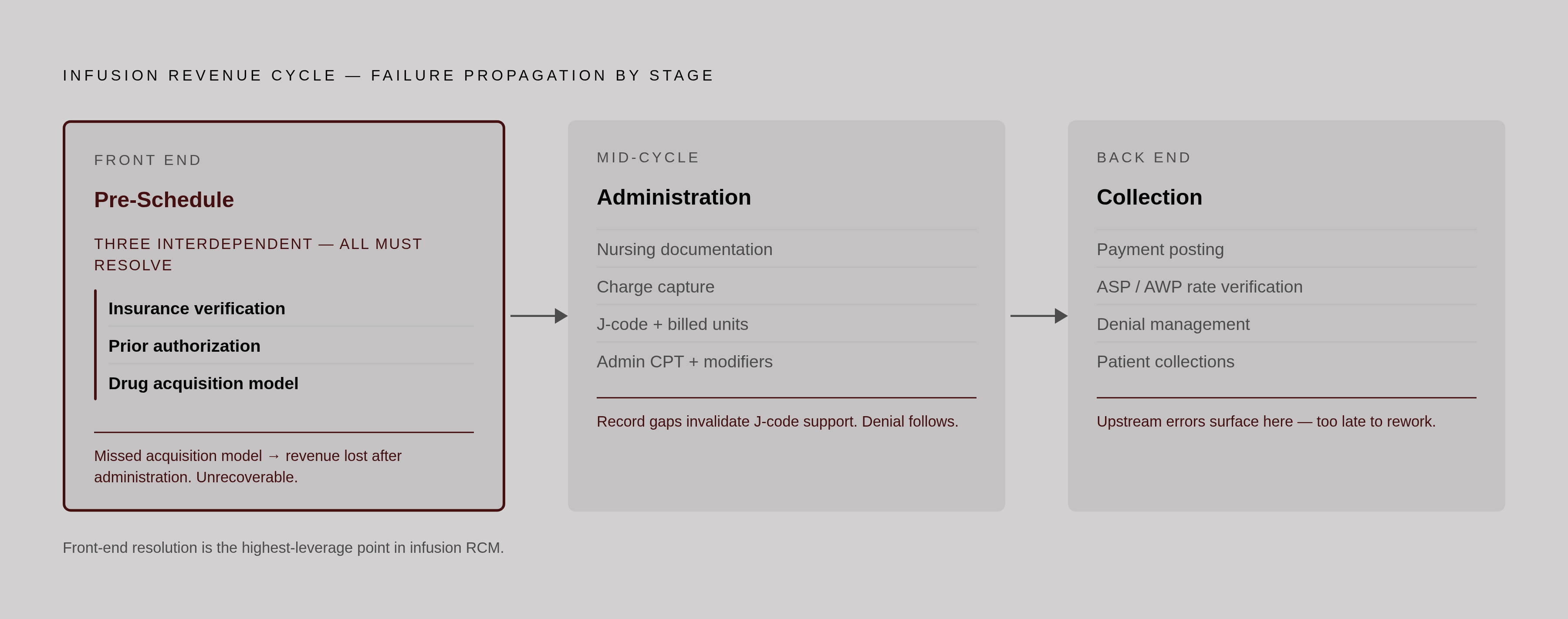
The field has settled on a three-stage model, front end, mid-cycle, back end, and it remains the right frame. In infusion, each stage carries specific content that differs meaningfully from the general RCM framework.
The front end in infusion is dominated by the intersection of insurance verification, prior authorization, and drug acquisition model determination. None of these can be treated as sequential steps completed one at a time. They are interdependent. The drug acquisition model affects what the authorization must cover. The site-of-care benefit affects which administration codes are billable. The patient's benefit structure determines whether copay assistance programs are available and necessary. Front-end infusion RCM requires a workflow that addresses all of these simultaneously, not a checklist that handles them in order.
The mid-cycle in infusion centers on nursing documentation and charge capture. The clinical record for an infusion encounter must support the J-code billed, the units billed, the administration codes billed, and the modifier structure used. That is a documentation standard that most nursing infusion record templates do not meet out of the box, and EHR systems that were not specifically configured for infusion billing often produce records that are inadequate for coding purposes. Mid-cycle investment in infusion means investing in nursing documentation training and EHR configuration, not just coder training.
The back end in infusion includes all of the standard functions, payment posting, denial management, patient collections, plus the infusion-specific requirement of contract rate management. Because drug reimbursement under buy-and-bill fluctuates with ASP updates and payer contract terms, payment posting must include a verification step that confirms the remitted amount matches the expected rate under the applicable contract. Practices that post remittances without that verification step are systematically underpaid in ways they never detect, and platforms like Ruby RCM, a revenue cycle management tool built specifically for infusion centers that combines software with hands-on operators to handle claims, denials, and AR, are designed precisely around that contract-rate reconciliation requirement.
Denial patterns specific to infusion and how to address them
Infusion denials cluster in patterns that are distinct from general medical claim denials. Understanding those patterns is the starting point for any serious denial reduction effort.
Authorization-related denials in infusion are often not simple missing-authorization situations. They are mismatched-authorization situations: the authorization was obtained for the wrong site of care, for the wrong drug formulation, for a dose that does not match what was administered, or for a number of units that was exhausted before the authorization was renewed. Each of these has a different root cause and a different preventive fix. Lumping them together as authorization denials without subcategory analysis makes the data useless for operational improvement.
Drug acquisition denials occur when the provider bills for a drug under buy-and-bill but the payer's policy requires white bagging through a designated specialty pharmacy. These denials are often categorized as coverage denials, but they are actually payer-policy compliance denials, and they are entirely preventable if the drug acquisition model is confirmed during front-end intake. When these denials occur repeatedly, it is a signal that the front-end workflow is not capturing payer policy information at the point where it can affect the drug ordering decision.
Medical necessity denials in infusion frequently involve step therapy noncompliance. The authorization may have been obtained, but if the clinical documentation does not clearly establish that the required prior therapy was tried and failed, the payer may deny on medical necessity grounds even with a valid authorization on file. This denial type requires a documentation intervention upstream: the referring physician's notes, the infusion center's intake documentation, and the prior authorization submission must all tell a consistent clinical story about prior therapy history.
Coding-level denials for incorrect units, incorrect J-codes, or incorrect administration code sequences are addressable through coder training and documentation improvement, but only if the practice has granular enough denial data to identify which specific codes and code combinations are generating the denials. Denial management in infusion requires code-level reporting, not just category-level reporting.
Specialty pharmacy integration and the revenue cycle implications
Many infusion providers operate in close relationship with specialty pharmacies, whether through ownership, affiliation, or contractual partnership. That relationship has direct revenue cycle consequences that are often managed less deliberately than they should be.
When a specialty pharmacy and an infusion center are under common ownership or affiliation, the opportunity exists to coordinate the benefit investigation, prior authorization, and drug dispensing workflow in ways that eliminate the handoff failures that plague arm's-length pharmacy-provider relationships. The patient's benefit investigation, completed at the pharmacy level, can feed directly into the infusion center's authorization and billing setup. Drug dispensing records from the pharmacy can feed directly into the infusion center's charge capture. That integration, when it works, reduces front-end errors and speeds the billing cycle.
When the relationship is not integrated, when the specialty pharmacy and the infusion center are separate entities with separate systems and separate workflows, the coordination failures are predictable. Authorization information does not transfer cleanly. Dispensed drug quantities do not match billed units. Drug shipment timing does not align with scheduled infusion appointments. Each of these misalignments creates either a billing error or an operational disruption, and the revenue cycle absorbs both.
The specific challenge of copay assistance programs also intersects with specialty pharmacy operations. Manufacturer copay assistance cards and patient assistance programs can substantially reduce patient out-of-pocket costs for high-cost specialty biologics, but accessing these programs requires knowing they exist, confirming patient eligibility, and correctly applying them to the billing workflow. Specialty pharmacies are often the entity closest to this information. Infusion centers that do not have a reliable communication channel from their pharmacy partners about available copay assistance programs are leaving patient financial experience and collection rate on the table simultaneously.
Home infusion: a distinct revenue cycle within the infusion category
Home infusion carries a revenue cycle model that differs enough from ambulatory infusion to warrant separate treatment. The patient population receiving home infusion is often clinically complex, the therapy duration is typically longer, and the billing structure combines elements of pharmacy billing, nursing service billing, and durable medical equipment supply billing in ways that require specialized operational competency.
The benefit investigation for home infusion must determine not only whether the drug is covered and authorized, but whether home infusion nursing services are covered under the medical benefit, whether infusion supplies are covered, and whether the patient's home environment meets the clinical requirements for safe infusion administration. These are not questions with simple yes-or-no answers, and the coverage determinations vary substantially by payer and plan.
Per-diem reimbursement models, used by some payers for home infusion, aggregate drug, supplies, and nursing into a single daily rate. Under this model, the revenue cycle challenge is accurate day-counting and visit reconciliation: each day a patient receives home infusion must be documented and billed, and missed billing days represent direct revenue loss with no recovery mechanism once the claim period closes. Per-diem models also create financial risk when drug costs increase but the per-diem rate does not adjust, a dynamic that must be managed at the contract level rather than the billing level.
Nursing visit documentation for home infusion is the mid-cycle equivalent of ambulatory infusion nursing records, with the added complexity that documentation is completed outside of the infusion center's direct oversight. Home nurses documenting on paper or on mobile applications in a patient's home are the source records for billing. Documentation training, real-time clinical record review, and exception-based auditing of home nursing notes are not optional activities in a well-run home infusion revenue cycle. They are the primary quality control mechanisms available.
What well-managed infusion RCM produces across the organization
The financial outcomes of high-functioning RCM in infusion are substantial and specific. Reduced authorization-related denials translate directly to fewer unbillable encounters and faster cash conversion. Accurate J-code and unit billing under buy-and-bill captures drug revenue that is otherwise permanently lost. Contract rate management for drug reimbursement recovers systematic underpayments that most practices never identify. These are not marginal improvements. In a setting where a single patient encounter may involve a drug cost of $10,000 or more, billing accuracy is not a process quality metric. It is an organizational survival question.
The operational outcomes are equally real. Efficient prior authorization workflows reduce the last-minute cancellations that create both direct revenue loss and scheduling inefficiency. Clear drug acquisition model policies, enforced at the front end, eliminate the retroactive denial discoveries that destabilize cash flow. Integrated specialty pharmacy communication reduces the coordination failures that generate billing errors. Lower administrative cost per claim and fewer staff hours spent correcting upstream errors represent genuine savings that show up in margin, not just in process quality reports.
What gets underappreciated is how much infusion RCM quality surfaces in the patient experience. A patient beginning a course of biologic infusion therapy is often managing a serious chronic condition, navigating insurance complexity they did not anticipate, and confronting out-of-pocket costs that may be genuinely alarming. Accurate pre-visit cost estimates, clear communication about copay assistance options, and the absence of a surprise bill for a drug the patient believed was authorized, these moments are not peripheral to clinical care. They are part of whether the patient continues therapy or abandons it. Adherence is a clinical outcome. The revenue cycle contributes to it or undermines it, depending on how well it runs.
How AI and automation are reshaping infusion-specific revenue cycle functions
Automation investment in infusion RCM is accelerating, and the infusion-specific use cases are maturing faster than general RCM automation in some dimensions. Prior authorization automation, submitting authorization requests, tracking status, managing renewal timelines, is one of the highest-value automation targets in infusion given the authorization volume and complexity. Organizations that have deployed authorization management automation report meaningful reductions in authorization-related denials and in the staff time consumed by authorization phone calls and portal navigation. Platforms purpose-built for infusion, such as RubyRCM, are designed around exactly these workflows, addressing the authorization, drug acquisition, and billing coordination challenges that general-purpose RCM tools were not built to handle.
Autonomous coding solutions configured for infusion billing, specifically trained on J-code selection, unit calculation, and administration code sequencing, can reduce coding time and improve first-pass accuracy. But these systems are only as reliable as the documentation they process. An autonomous coding system presented with a nursing infusion record that does not clearly document infusion start and stop times, drug identity, and sequence will produce the same coding errors a human coder would produce from the same documentation. The technology investment must be paired with documentation improvement investment to produce the results it is capable of producing.
Drug acquisition model tracking and contract rate verification are areas where automation adds particular value in infusion. Maintaining current payer-by-payer drug acquisition policy information across a payer mix of any size is a manually intensive research function. Systems that aggregate and update this information automatically, flagging when a payer's white bagging policy changes, for example, provide a front-end risk management function that is difficult to replicate with manual processes alone.
Agentic AI systems, capable of autonomous decision-making across multi-step workflows, have clear theoretical application in infusion RCM: managing the sequential steps of benefit investigation, authorization submission, drug acquisition model confirmation, and scheduling coordination without requiring a human hand-off at each stage. The technology is real and developing, but its deployment in infusion-specific workflows remains earlier-stage than in general RCM functions. The organizations building toward it now are the ones likely to operate at genuine competitive advantage in three to five years.
One thing AI does not change: the fundamental structure of infusion revenue cycle risk. The drug acquisition model must be confirmed before the drug is ordered. The authorization must be obtained before the infusion is administered. The documentation must support the codes before the claim is submitted. Technology can accelerate and improve every one of those functions. It cannot reorder the sequence, and it cannot recover revenue from an encounter that was misconfigured before the patient ever arrived.
The persistent challenges that are specific to infusion and that technology alone does not resolve
Payer policy volatility around site of care and drug acquisition is the defining strategic pressure on infusion revenue cycles right now. White bagging mandates continue to expand. Site-of-care management programs continue to redirect patients away from higher-cost settings. These are deliberate payer strategies, not administrative errors, and they require provider responses at the contract and policy level, not just at the billing level. Infusion providers who are not actively engaged in payer contract negotiation with specific attention to drug acquisition rights and site-of-care authorization policy are ceding financial ground they may not recover.
Staffing volatility in infusion billing is compounded by the specialty knowledge required. A biller or coder who can handle general outpatient claims is not interchangeably competent in infusion billing. J-code expertise, administration code sequencing, authorization workflow management for specialty biologics, these are learned competencies that take time to develop and that walk out the door with every departure. The turnover problem is not unique to infusion, but the knowledge loss per departure is higher.
Clinical documentation in infusion nursing remains the most structurally underdeveloped component of the infusion revenue cycle. Nursing infusion records are the source documents for billing, and they are routinely configured in ways that do not support optimal coding. This is a system design and training problem, not a compliance problem, but it has compliance consequences. Infusion centers that have not audited their nursing documentation against their billing codes are almost certainly billing at a level that does not match what their nursing records will support, either over or under, and both carry risk.
The pattern across all of these challenges is the same one that governs RCM everywhere, intensified by infusion's structural complexity. A failure at drug acquisition model identification propagates forward. A documentation gap in the nursing record propagates forward. A missed authorization renewal propagates forward. Managing infusion RCM effectively means accepting that every stage depends on the integrity of what came before it, and that the infusion-specific stakes at each stage are higher than in most other care settings. The cycle's architecture is fixed. The operational discipline required to run it well is not optional. It is the difference between a financially viable infusion program and one that is eroding from the inside, visit by visit, without anyone quite knowing why.